Ida May Park began and ended her life and career in Los Angeles, California, credited as a writer of approximately five hundred scenarios and fifty features, having had a successful career as a director with fourteen films under her belt. Unfortunately, as a woman of early Hollywood, she falls into a category of women who were notable enough to have some of their work survive and be remembered, but not notable enough for many history books or archives to chronicle her career.
* A portion of each sale from Amazon.com directly supports our blogs
** Many of these books may be available from your local library. Check it out!
† Available from the LA Public Library
This one allowed me to riff on some of my favorite female science fiction writers across time, whether they be novelists or television writers. It also opened up a good conversation on what art we support and include in our lives – and what that art says to us and about us. — Rosanne
Transcript:
…On a book that for years and years Hollywood wasn’t making into a movie because it starred a little girl and they really didn’t think enough people would pay money to see the story of a little girl having this wild crazy adventure. Even though Alice in Wonderland has been around a long time okay. So it’s interesting. We really we sort of censor before we even put things out into the audience for them to really tell us what they’re gonna watch right? So we have to think about that.
* A portion of each sale from Amazon.com directly supports our blogs ** Many of these books may be available from your local library. Check it out!
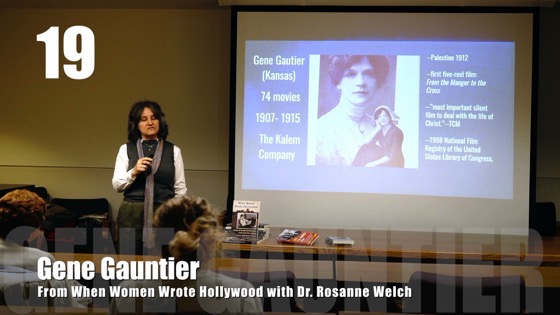
Gene Gauntier is from Ireland. She was born in Kansas. She ended up being the first person to film a movie on location and it was “From The Manger to the Cross” which was the story of The Christ. It was the first time that the story of Jesus was told on film and she went to Jerusalem and then she filmed some in other places in Europe. So she was pretty famous for a good long time. A company called the Kalum company. Again when that company went out of business and all their paperwork disappeared, a lot of her history disappeared with it but you can find “From The Manger to the Cross” on YouTube
Dr. Rosanne Welch discusses the women in her new book “When Women Wrote Hollywood” which covers female screenwriters from the Silents through the early 1940s when women wrote over 50% of films and Frances Marion was the highest paid screenwriter (male or female) and the first to win 2 Oscars. Yet, she fails to appear in film history books, which continue to regurgitate the myth that male directors did it all – even though it’s been proven that the only profitable movies Cecil B. de Mille ever directed were all written by Jeannie Macpherson film ever won for Best Picture was written by Robert E. Sherwood (who people have heard of, mostly due to his connection to Dorothy Parker) and Joan Harrison.
* A portion of each sale from Amazon.com directly supports our blogs ** Many of these books may be available from your local library. Check it out! † Available from the LA Public Library
Don’t forget: The Journal of Screenwriting is calling for articles for a special issue with a focus on female screenwriters, to be published in November 2020. I will be co-editing this Special Issue! — Rosanne
The Journal of Screenwriting is calling for articles for a special issue with a focus on female screenwriters, to be published in November 2020.
JOSC wants to emphasize the importance of female screenwriters across eras, genres, mediums. This importance may arise from an analysis of bodies of work, from individual scripts written by women or from case studies where female screenwriters have worked collaboratively to express screen stories. Articles may also include women’s work behind the scenes in advocating for/promoting greater gender equality within screenwriting milieux. Articles on female screenwriters from diverse cultural backgrounds are encouraged.
Articles may include (but are not limited to) the following topics:
Female screenwriters in silent cinema
The influence of female writer(-directors) in contemporary culture
Case studies on an individual screenwriter’s work, collaborations between women or on how women-centred stories have been brought to the screen
Historiography of manuals and screenwriting pedagogy where this reflects the work of female screenwriters
National and global tendencies with regard to women within screenwriting – relations, influences, cultural transfers
Censorship and women’s stories and women’s writings
Biographies of female screenwriters of any era
Female screenwriters within writing partnerships
The work of female screenwriters within script production (e.g. as showrunners, script editors or consultants)
• The question of a female voice within screenwriting
In the first instance, please email abstracts of up to 400 words and a short biography, no later than Friday, 4 October 2019 to both of the editors of this special issue: Rosanne Welch: rosanne@welchwrite.comRose Ferrell: rosieglow@westnet.com.au Completed articles of between 4000 and 8000 words should be sent by the end of January 2020.
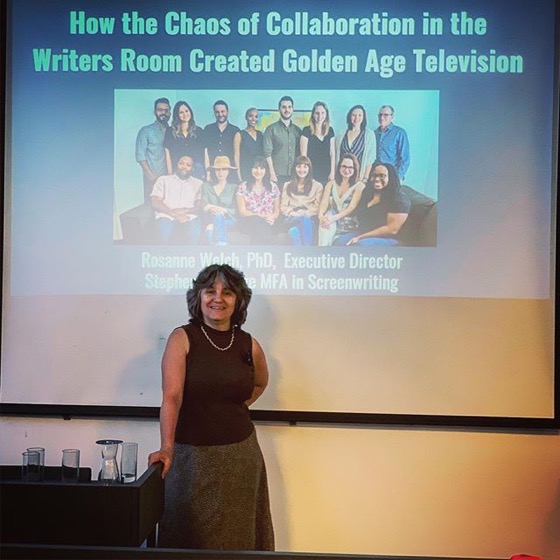
I deeply enjoyed making my presentation on Writers Rooms in the U.S. but even more I enjoyed the presentations I attended.
This program is chock a block full of new international films to learn about (did you know there’s a Portuguese film with the name “Django” in it that has nothing to do with the one by Tarantino?) and new ways to teach writing students how to take in all the (often negative) notes they receive and decide which constructive ones to use to make their scripts stronger?
Just skimming the schedule shows the breadth of new ideas that are running around in my head right now. — Rosanne
12th SCREENWRITING RESEARCH NETWORK CONFERENCE Porto, September 11-14, 2019 · School of Arts, Universidade Católica Portuguesa
Theme: Foundation and Crisis of Europe in Screenwriting
Chair: Paolo Russo
Pablo Echart Savage continent, united continent: the writing of a feature film screenplay about the “founding fathers” of the European Union
María Noguera / Miguel Muñoz-Garnica Narrative detours in the cinematic representation of Europe in crisis: Ulysses’ Gaze, A Talking Picture and Our Music
Daniel Sierra / Marta Frago Young Winston and Darkest Hour’s films: Winston Churchill as British Hero in a Changing Europe
Theme: Modes I
Chair: Nelson Zagalo
Ruth Gutiérrez Delgado Causality is not casual in a film despite it seems to be: A Perfect Day
Paolo Braga The line between fate and chaos in Collateral
Armando Fumagalli Order and chaos in the ending of a film
I was honored to read this review of my novelization of the life of Filippo Mazzei, which posted on the same day that I am preparing to guest lecture about the book to Dennis Bullock’s AP Government class at Providence High School.
I’m particularly happy that the reviewer, from the Historical Novel Society recognized all the research work I did on not just Mazzei’s place in American History and the founding of the government – but that I strove to give a full picture of his life from childhood through his later years. I want readers to find him to be an interesting man who worked hard for the privileges we enjoy today – even though his name rarely appears in any celebrations of our 4th of July. Maybe now that can change. — Rosanne
“But the book has a larger focus than Mazzei’s place in the American Revolution. It covers his early years, travels in Turkey, and relationships with family as well as discussions of religion, the prerogatives of landed gentry versus the rights of ordinary people, even the proper pronunciation of Italian words.
This is an interesting and informative biographical sketch aimed at young readers.”
Surgeon, merchant, vintner, and writer Filippo Mazzei influenced American business, politics, and philosophy. Befriending Benjamin Franklin and Thomas Jefferson, Mazzei was a strong liaison for others in Europe. Mazzei was Jefferson’s inspiration for the most famous line in the Declaration of Independence: “All men are created equal.”
Wherever you go, you find Monkees fans and the Denver Popular Culture Con was no different. Amid rooms full of caped crusaders and cosplay creations, I was initially not sure how many folks would attend a talk on a TV show from the 1960s – but happily I was met by a nice, engaged audience for my talk on Why the Monkees Matter – and afterward they bought books! What more could an author ask for?
Transcript
Down in the right corner is Peter Meyerson. Clearly from his photograph truly on the hippie train back in the day — had a very interesting life and ended up married to one of Michael Nesmith’s early girlfriends later in life — like his third wife was Nesmith’s first girlfriend or some silly thing like that. Gentlemen the middle is Bernie Ornstein. He was a writer of more mainstream work and had a lot to say about what The Monkees were about, Dave Evans, the gentleman who’s smiling. He’s so adorable He’s the nicest man you would ever want to meet and he had written for Bullwinkle before he came to The Monkees and then Treva Silverman is the woman I was speaking of. The first woman to write on television write comedy without a male partner and so she went on to earn two Emmys in her career writing on The Mary Tyler Moore Show. So all these writers had very good histories coming into and then moving out of The Monkees and again people dismissed the show but it really deserves much more attention. She wrote the particular episode of Mary Tyler Moore where Lou Grant’s wife asked for a divorce which was huge in the early 70s and that’s what she got the Emmy for.
A hit television show about a fictitious rock band, The Monkees (1966-1968) earned two Emmys–Outstanding Comedy Series and Outstanding Directorial Acheivement in Comedy.
Capitalizing on the show’s success, the actual band formed by the actors, at their peak, sold more albums than The Beatles and The Rolling Stones combined, and set the stage for other musical TV characters from The Partridge Family to Hannah Montana. In the late 1980s, the Monkees began a series of reunion tours that continued into their 50th anniversary.
This book tells the story of The Monkees and how the show changed television, introducing a new generation to the fourth-wall-breaking slapstick created by Laurel and Hardy and the Marx Brothers.
Its creators contributed to the innovative film and television of 1970s with projects like Bob & Carol & Ted & Alice, The Mary Tyler Moore Show, Laugh-In and Welcome Back, Kotter. Immense profits from the show, its music and its merchandising funded the producers’ move into films such as Head, Easy Riderand Five Easy Pieces.
This one allowed me to riff on some of my favorite female science fiction writers across time, whether they be novelists or television writers. It also opened up a good conversation on what art we support and include in our lives – and what that art says to us and about us. — Rosanne
Transcript:
Now, most people know Madeleine L’Engle. So guess what? She gets the put her name on the book is definitely a chick name right? Madeleine L’Engle. Definitely a chick name. And “A Wrinkle In Time.” How many people saw the movie? Two people. Really good movie. Ava Duvernay directed it. Really interesting to think about the fact that the controversy here was switching out the race right and then it was a big deal. You’re gonna change who the child is in the book and thereby change some of who the other characters are that she’s connected with but one of the first movies starring an African-American who that scored over 100 million dollars in the box office right of way kind of thing, right? Then Black Panther is going to come in and score a bajillion, million dollars, but so it’s a trend that Ava Duvernay wanted to get started.
* A portion of each sale from Amazon.com directly supports our blogs ** Many of these books may be available from your local library. Check it out!
“Clara Beranger is one among many prominent female screenwriters during the Silent Era of film. Like the other amazing women who wrote at least half of the films produced during that time, very little is known about her, and what information there is, is hard to find. “It is lamentable that so little is known about Clara Beranger. From the piles of film books, even those devoted to the screenwriter, her name is conspicuously absent.”
Clara Beranger: The Unseen Laborer
by Amanda Stockwell
* A portion of each sale from Amazon.com directly supports our blogs
** Many of these books may be available from your local library. Check it out!
† Available from the LA Public Library