Born in Italy at the tumultuous end of France’s influence in Europe, Giuseppe Verdi went on to become the world’s most recognizable name in opera.
Set against the rise of the Italian states in the middle of the nineteenth century, The Faithful depicts an artist bedeviled by his role not just as a composer, but as an unassuming icon of the Italian Unification and the birth of modern Italy.
Through chance encounters in gilded Milanese salons and the hushed politics of the Italian opera, we experience the struggles of a man conflicted by his role as an artist and by his commitment to a country yearning for independence.
About the Author
Collin Mitchell is a graduate of UC Santa Barbara, with a degree in Comparative Literature and Film Studies. Originally from the Bay Area, he now resides in Los Angeles.
Subscribe to Rosanne’s Channel and receive notice of each new video!
This one allowed me to riff on some of my favorite female science fiction writers across time, whether they be novelists or television writers. It also opened up a good conversation on what art we support and include in our lives – and what that art says to us and about us. — Rosanne
Transcript:
What’s really cool about her is that the series survives into a couple of generations later and now, of course, she gets to be a general. That’s huge. That is a huge step that people didn’t necessarily foresee and, of course, in the new versions we’re surrounded by women in power. However, you have probably seen online much controversy over the fact that when she, who’s a general, didn’t tell dude who has got no rank what she was up to — oh no, it’s all her fault. Trouble happened. She should have told the boy. He’s way lower than her rank. She had no business telling him anything that was being planned at the higher levels, but there was so much discussion about how it was all her fault that things went bad because she should have told the boy and he would have saved the day. He’s not in charge. They are. Right? But our biases — our ideas are that they have to let the boy take over. So I think it’s really, really fascinated where we’re going with this series.
* A portion of each sale from Amazon.com directly supports our blogs ** Many of these books may be available from your local library. Check it out!
Subscribe to Rosanne’s Channel and receive notice of each new video!
Transcript:
Then, of course, we were talking about Nora Ephron but before we get Nora Ephron — that’s her mother Phoebe Efron — was a film writer in Hollywood in the 50s with her husband right but she’s the one who gave her daughter the phrase “Everything is copy.” Whatever’s happening in your life write it down that’s gonna be good in a movie someday, right? So Phoebe did all these films we’re looking at here. They did largely adaptations of musicals but they were very — Phoebe and Henry Efrain. This is Nora when she was in college. She got herself a sweatshirt that said Girl Writer because she worked at a newspaper and that’s what they were. They weren’t junior writers. They weren’t journalists. They were the girl writers who wrote the girl stuff for the newspaper, right. Do she just blazoned that on her chest and said fine Then I’ll be a girl writer right? I think it’s cute because you notice when we move into the television world that’s Madeline Pugh who wrote almost all of the I Love Lucy’s together with her male partner Bob Carol who she wasn’t married to and she called herself a girl writer. That’s all you were back in the day even though you invented Lucy for heaven’s sakes.
Dr. Rosanne Welch discusses the women in her new book “When Women Wrote Hollywood” which covers female screenwriters from the Silents through the early 1940s when women wrote over 50% of films and Frances Marion was the highest paid screenwriter (male or female) and the first to win 2 Oscars. Yet, she fails to appear in film history books, which continue to regurgitate the myth that male directors did it all – even though it’s been proven that the only profitable movies Cecil B. de Mille ever directed were all written by Jeannie Macpherson film ever won for Best Picture was written by Robert E. Sherwood (who people have heard of, mostly due to his connection to Dorothy Parker) and Joan Harrison.
* A portion of each sale from Amazon.com directly supports our blogs ** Many of these books may be available from your local library. Check it out! † Available from the LA Public Library
Wherever you go, you find Monkees fans and the Denver Popular Culture Con was no different. Amid rooms full of caped crusaders and cosplay creations, I was initially not sure how many folks would attend a talk on a TV show from the 1960s – but happily I was met by a nice, engaged audience for my talk on Why the Monkees Matter – and afterward they bought books! What more could an author ask for?
Subscribe to Rosanne’s Channel and receive notice of each new video!
Transcript
In our current era The Monkees have suddenly come around in all our popular culture. So many TV shows have referenced them because the people making television now are the people who were little when they were watching the show. Whether it be the sixties and seventies. So they’ve been riffed on — they had music played on Breaking Bad. They’ve been riffed on in Mad Men. There was a marvelous moment in Grace and Frankie where they were discussing dumb things they did when they were younger and Frankie says that she had sex with one of The Monkees. She just can’t remember which one. Turns out to be Micky. So that just came out of nowhere, right?So I think that’s pretty cool.
A hit television show about a fictitious rock band, The Monkees (1966-1968) earned two Emmys–Outstanding Comedy Series and Outstanding Directorial Acheivement in Comedy.
Capitalizing on the show’s success, the actual band formed by the actors, at their peak, sold more albums than The Beatles and The Rolling Stones combined, and set the stage for other musical TV characters from The Partridge Family to Hannah Montana. In the late 1980s, the Monkees began a series of reunion tours that continued into their 50th anniversary.
This book tells the story of The Monkees and how the show changed television, introducing a new generation to the fourth-wall-breaking slapstick created by Laurel and Hardy and the Marx Brothers.
Its creators contributed to the innovative film and television of 1970s with projects like Bob & Carol & Ted & Alice, The Mary Tyler Moore Show, Laugh-In and Welcome Back, Kotter. Immense profits from the show, its music and its merchandising funded the producers’ move into films such as Head, Easy Riderand Five Easy Pieces.
Subscribe to Rosanne’s Channel and receive notice of each new video!
This one allowed me to riff on some of my favorite female science fiction writers across time, whether they be novelists or television writers. It also opened up a good conversation on what art we support and include in our lives – and what that art says to us and about us. — Rosanne
Transcript:
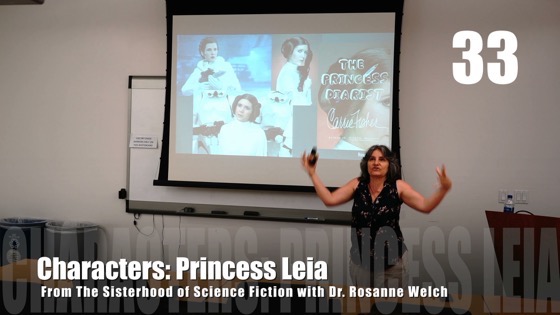
My favorite picture of her is always this moment, where she breaks him down with no weapon just her mind and her courage. She’s like screw you dude. I could smell you when I walked in the room. Too bad right? That diplomat. That person who could do it with their voice and their inner strength. That’s the character that I like to remember better but you’re mostly gonna see these pictures and you know I didn’t put up the picture of her in the bikini and Jabba the Hutt because that’s just overdone — overdone and sad to say — much as I like George Lucas — pretty cool in many things he’s done, she does throw out reference in the book when she showed up as a 19-year-old all alone in England to film this movie with a bunch of dudes who are older than her. She’s not wearing a bra under that thing and when she asked George Lucas why he said there are no bras in the 25th century and it wasn’t till later in life she was like these guys just wanted to see me bouncing around without a bra. All the men on the crew just wanted to watch me without a bra. What do you mean there are no bras in the 25th century?! Who are you? You’re not the guy who invented that! So you know that’s kind of sad and kind of bums me out, but this is the Princess Leia that I like to remember. I think she’s powerful.
* A portion of each sale from Amazon.com directly supports our blogs ** Many of these books may be available from your local library. Check it out!
Subscribe to Rosanne’s Channel and receive notice of each new video!
Transcript:
Then we have this lady who I think is fascinating if you’re a Star Wars fan. Leigh Brackett. She’s mostly did all these kinds of space operas they called them right but she got hired to write the first draft of The Empire Strikes Back because George Lucas wanted her sci-fi brain on his property. The problem is she wrote the script — which there you are — and she died of cancer. So Lawrence Kasdan who I adore was hired to do the next draft in the next draft and Lawrence Kasdan becomes the writer we know from Star Wars but when you think about the Han Solo character, Leigh Brackett made him the cowboy that he is because she did cowboy movies and space operas. That’s the perfect blending of Han Solo. So she gave us that character in the incarnation that we know him in — which i think is cool.
Dr. Rosanne Welch discusses the women in her new book “When Women Wrote Hollywood” which covers female screenwriters from the Silents through the early 1940s when women wrote over 50% of films and Frances Marion was the highest paid screenwriter (male or female) and the first to win 2 Oscars. Yet, she fails to appear in film history books, which continue to regurgitate the myth that male directors did it all – even though it’s been proven that the only profitable movies Cecil B. de Mille ever directed were all written by Jeannie Macpherson film ever won for Best Picture was written by Robert E. Sherwood (who people have heard of, mostly due to his connection to Dorothy Parker) and Joan Harrison.
* A portion of each sale from Amazon.com directly supports our blogs ** Many of these books may be available from your local library. Check it out! † Available from the LA Public Library
Wherever you go, you find Monkees fans and the Denver Popular Culture Con was no different. Amid rooms full of caped crusaders and cosplay creations, I was initially not sure how many folks would attend a talk on a TV show from the 1960s – but happily I was met by a nice, engaged audience for my talk on Why the Monkees Matter – and afterward they bought books! What more could an author ask for?
Subscribe to Rosanne’s Channel and receive notice of each new video!
Transcript
In the 80s, they get a star on the Walk of Fame in Hollywood for the television show. Not for the music — which is interesting. You can have a star for or five different things — radio, TV, film, vaudeville — whatnot. So this is pretty cool. So that’s all of them showing up. That’s when they decide to do the re-touring. They’re still obviously famous and this year they just came out with an Archie comic that blended The Monkees into it and, of course, The Archies are big again now because of what TV show? Riverdale! So all of a sudden everything is going in circles and the sixties karma get popular again and I often say to younger audiences when I talk to them. They may never have heard of The Monkees but they know one of The Monkees’ songs by heart because they saw this movie and you start singing it and they all I know it. I didn’t know that it was a Monkees song. Again, who wrote that song? Close. They’re major songwriters for them. Yeah, Neil Diamond. That’s a Neil Diamond song and in concert recently people have asked him to sing it and he says No, that’s Mickey Dolenz’ song. I wrote it but it doesn’t belong to me anymore. Again a musician complimenting another musician. They do take each other seriously.
A hit television show about a fictitious rock band, The Monkees (1966-1968) earned two Emmys–Outstanding Comedy Series and Outstanding Directorial Acheivement in Comedy.
Capitalizing on the show’s success, the actual band formed by the actors, at their peak, sold more albums than The Beatles and The Rolling Stones combined, and set the stage for other musical TV characters from The Partridge Family to Hannah Montana. In the late 1980s, the Monkees began a series of reunion tours that continued into their 50th anniversary.
This book tells the story of The Monkees and how the show changed television, introducing a new generation to the fourth-wall-breaking slapstick created by Laurel and Hardy and the Marx Brothers.
Its creators contributed to the innovative film and television of 1970s with projects like Bob & Carol & Ted & Alice, The Mary Tyler Moore Show, Laugh-In and Welcome Back, Kotter. Immense profits from the show, its music and its merchandising funded the producers’ move into films such as Head, Easy Riderand Five Easy Pieces.
Subscribe to Rosanne’s Channel and receive notice of each new video!
This one allowed me to riff on some of my favorite female science fiction writers across time, whether they be novelists or television writers. It also opened up a good conversation on what art we support and include in our lives – and what that art says to us and about us. — Rosanne
Transcript:
Now of course, post Star Trek, the next big star science fiction thing that’s going to happen is Star Wars. We all know that and so it’s interesting because now sometimes people go oh Princess Leia sort of sat there and waited to be rescued. Ehhh… it was a big deal back in the day that she fought her way out right? She grabbed the blaster and they jumped in the garbage chute and all those things. She was considered a much more active princess. She’s not as active as we want people to be today but she’s like a bridge between where they didn’t do anything and where they do everything but I think it’s an important thing to pay attention to. She writes a lot about that in her last book before Carrie Fisher died, The Princess Diarist. She writes about the experience of filming that. What I don’t like is that we sort of when you look up pictures of Princess Leia and you think power it’s because she’s always got that blaster in her hand. So we’re still equating power with the male concept of a weapon as opposed to the interior power that you bring.
* A portion of each sale from Amazon.com directly supports our blogs ** Many of these books may be available from your local library. Check it out!
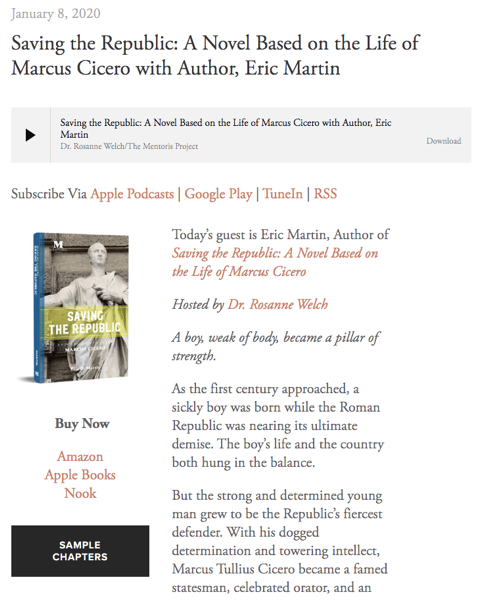
As the first century approached, a sickly boy was born while the Roman Republic was nearing its ultimate demise. The boy’s life and the country both hung in the balance.
But the strong and determined young man grew to be the Republic’s fiercest defender. With his dogged determination and towering intellect, Marcus Tullius Cicero became a famed statesman, celebrated orator, and an esteemed philosopher.
Surviving civil wars, political intrigues, and assassination attempts, Cicero pushed against the grain, standing steadfastly in support of the Republic, even when it threatened his career—or his life.
About the Author
Eric D. Martin is a novelist and screenwriter. He has a BA in film studies from the University of California, Santa Barbara, and an MFA in screen and television writing from Pepperdine University. While studying at Pepperdine, Martin served as president of the student film society, Courier 12, and was a semifinalist for the Academy of Arts and Sciences Nicholl Fellowship. Recently, Martin adapted the novel The Liar’s Chair for the screen and wrote the popular Lifetime thriller, The Other Mother. Currently, he is writing for the premium cable television drama Heels and for Starz, and developing the TV comedy King Elizabeth.
Subscribe to Rosanne’s Channel and receive notice of each new video!
Transcript:
Moving through into the 50s, we come up with Harriet Frank Jr. — a woman going by Jr. because her mother was Harriet Frank and her mother was a reader at one of the studios which is how she got into the business of writing. She married Irving Ravetch and together they made several important films. To me, most important is Norma Rae. Again a very female based film which really falls into Harriet’s world and also Stanley and Iris and Murphy’s Romance are very female-focused stories. Harriet was a really strong woman — very involved in the Union which makes sense when you think about Norma Rae right? So again names people don’t really know because these are considered Martin Ritt films because he directed all four of them, because he was best friends with Frank and Ravetch. So they liked to hire directors they knew who wouldn’t muck up their work and I believe in those collaborations. I don’t — like I’m dissing directors. I don’t mean to. I like directors but there it’s an even collaboration and I think that’s what academia has to start referencing more than we do because that’s how writers get lost and if male writers are getting lost you know female writers getting even more lost right? So we need to keep thinking about it’s a — it’s a collaboration.
Dr. Rosanne Welch discusses the women in her new book “When Women Wrote Hollywood” which covers female screenwriters from the Silents through the early 1940s when women wrote over 50% of films and Frances Marion was the highest paid screenwriter (male or female) and the first to win 2 Oscars. Yet, she fails to appear in film history books, which continue to regurgitate the myth that male directors did it all – even though it’s been proven that the only profitable movies Cecil B. de Mille ever directed were all written by Jeannie Macpherson film ever won for Best Picture was written by Robert E. Sherwood (who people have heard of, mostly due to his connection to Dorothy Parker) and Joan Harrison.
* A portion of each sale from Amazon.com directly supports our blogs ** Many of these books may be available from your local library. Check it out! † Available from the LA Public Library