Rosanne Welch, PhD, Author of Why The Monkees Matter, presents “How The Monkees Changed Television” at a Cal State Fullerton Lunch Lecture on May 8, 2018.
In this talk, she shows how The Monkees, and specifically their presence on television, set the stage for large changes to come in the late 1960s.
Transcript
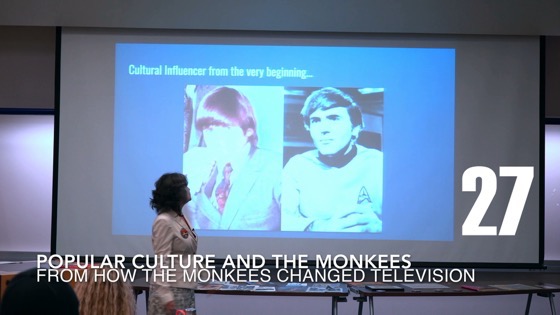
Identity construction was a mess for these guys and it really I think was sad cuz now we’re a little better. We understand Jim Parsons is not just Sheldon. He’s now on Broadway in the Boys in the Band. He did act of God which toured here in California. We understand he’s an actor he can play other parts right? Now because there was this idea that they weren’t very important and they disappeared I like to show how culturally connected they were. It is proven in a memo from Gene Roddenberry that when Star Trek went for the second season and they’re gonna have Walter Koenig play Chekov he wrote I need him to have a haircut that matches that guy on the Monkees because that’s what girls want right now and they literally planned that his character should be connecting with the girls who like the Monkees and Star Trek obviously culturally kind of important a little bit. Of course back in the day they were part of commercials because everybody is part of commercials. you go to YouTube you’ll see their their Nerf ball commercial and then they have a Schick razor commercial. They did everything but this was at the end of the show often.
A hit television show about a fictitious rock band, The Monkees (1966-1968) earned two Emmys–Outstanding Comedy Series and Outstanding Directorial Acheivement in Comedy.
Capitalizing on the show’s success, the actual band formed by the actors, at their peak, sold more albums than The Beatles and The Rolling Stones combined, and set the stage for other musical TV characters from The Partridge Family to Hannah Montana. In the late 1980s, the Monkees began a series of reunion tours that continued into their 50th anniversary.
This book tells the story of The Monkees and how the show changed television, introducing a new generation to the fourth-wall-breaking slapstick created by Laurel and Hardy and the Marx Brothers.
Its creators contributed to the innovative film and television of 1970s with projects like Bob & Carol & Ted & Alice, The Mary Tyler Moore Show, Laugh-In and Welcome Back, Kotter. Immense profits from the show, its music and its merchandising funded the producers’ move into films such as Head, Easy Riderand Five Easy Pieces.
…And I speak fast so I apologize but I want to get through it and I’m sort of Italian not really in this country but in America I qualify as Italian. We should teach during writing because writer precedes director when describing a filmmaker skills and we allow people to forget that in class and I don’t like that. When you remember a film to your friends you do not speak of camera angles. You speak of dialogue you speak of the lines that you repeat with your friends so the writer is the person that we should credit I believe with most of the work and if you’re studying to be a screenwriter how can you forget the names of the people who write your films? I want to say or even don’t you to the auteur theory because I think it’s nonsense because it is not the director it is the writer who comes up with it and I want to get rid of disrespect to writers which has existed forever
* A portion of each sale from Amazon.com directly supports our blogs ** Many of these books may be available from your local library. Check it out! † Available from the LA Public Library
Dr. Sarah Clark and I are having more fun than should be allowed by recording our Monkees 101 segments once a month for Zilch: A Monkees Podcast. Here’s our coverage of the classic episode guest starring Stan Freberg. — Rosanne
Drs. Rosanne Welch and Sarah Clark are back for Zilch Monkees 101. Join them for a fun, thoughtful romp through S1 E2 “Monkee VS Machine” the 3rd episode of The Monkees to air. We also have a live version of “Saturday’s Child” from 2016 and Monkees News!. Originally aired 11/29/18.
A hit television show about a fictitious rock band, The Monkees (1966-1968) earned two Emmys–Outstanding Comedy Series and Outstanding Directorial Acheivement in Comedy.
Capitalizing on the show’s success, the actual band formed by the actors, at their peak, sold more albums than The Beatles and The Rolling Stones combined, and set the stage for other musical TV characters from The Partridge Family to Hannah Montana. In the late 1980s, the Monkees began a series of reunion tours that continued into their 50th anniversary.
This book tells the story of The Monkees and how the show changed television, introducing a new generation to the fourth-wall-breaking slapstick created by Laurel and Hardy and the Marx Brothers.
Its creators contributed to the innovative film and television of 1970s with projects like Bob & Carol & Ted & Alice, The Mary Tyler Moore Show, Laugh-In and Welcome Back, Kotter. Immense profits from the show, its music and its merchandising funded the producers’ move into films such as Head, Easy Riderand Five Easy Pieces.
Rosanne Welch, PhD, Author of Why The Monkees Matter, presents “How The Monkees Changed Television” at a Cal State Fullerton Lunch Lecture on May 8, 2018.
In this talk, she shows how The Monkees, and specifically their presence on television, set the stage for large changes to come in the late 1960s.
Transcript
My non-Monkee example of that is Cher because when Cher was doing rock music she wanted to act everybody said well you can’t do that you’re a singer. Then she got an Oscar for Moonstruck and she got Best Supporting for Silkwood and then she wanted to go on tour again. Like well you can’t be a singer in a concert you’re an actress. How about both? Maybe we can actually do more than one thing. So America is not good at that and it really harmed them when the show was over. For a little moment Micky Dolenz was considered to play the Fonz on Happy Days but they were afraid his fame coming into the show would be too hard to make you understand and believe the rest of the characters. So as we know Henry Winkler got that job right but that might have been his next TV show?
A hit television show about a fictitious rock band, The Monkees (1966-1968) earned two Emmys–Outstanding Comedy Series and Outstanding Directorial Acheivement in Comedy.
Capitalizing on the show’s success, the actual band formed by the actors, at their peak, sold more albums than The Beatles and The Rolling Stones combined, and set the stage for other musical TV characters from The Partridge Family to Hannah Montana. In the late 1980s, the Monkees began a series of reunion tours that continued into their 50th anniversary.
This book tells the story of The Monkees and how the show changed television, introducing a new generation to the fourth-wall-breaking slapstick created by Laurel and Hardy and the Marx Brothers.
Its creators contributed to the innovative film and television of 1970s with projects like Bob & Carol & Ted & Alice, The Mary Tyler Moore Show, Laugh-In and Welcome Back, Kotter. Immense profits from the show, its music and its merchandising funded the producers’ move into films such as Head, Easy Riderand Five Easy Pieces.
So we’re here today to talk about why I created a history of screenwriting class not a history of film class and that’s my problem. This is quickly Who I am. I’ve been a screenwriter in Los Angeles. I’ve written on Touched By An Angel Beverly Hills 90210, Picket Fences and for ABC news…oh… too fast. I’ve also just come up with a book and I’ll tell you about that came out of my class so that’s part of why I love this class. It’s another set of books that I’ve done. I’m also the book review editor for Journal of Screenwriting which I mentioned the other day. So please offer to review books and I’m on the editorial board for Written By which I always recommend as part of a screenwriting class because it’s free online digitally. You can look it up as Written By magazine and you’ll have the digital copy every month we interview either a movie writer or a television writer and it’s quite good, Of course, it’s in English. My apologies and I work for Stephens College which is located in Columbia Missouri but we do a low residency program where the students come to Los Angeles and work at the Jim Henson studios…hence Kermit … and this is Charlie Chaplin’s original studio so it’s still designed the way it was when he set it up in 1917.
* A portion of each sale from Amazon.com directly supports our blogs ** Many of these books may be available from your local library. Check it out! † Available from the LA Public Library
Rosanne Welch, PhD, Author of Why The Monkees Matter, presents “How The Monkees Changed Television” at a Cal State Fullerton Lunch Lecture on May 8, 2018.
In this talk, she shows how The Monkees, and specifically their presence on television, set the stage for large changes to come in the late 1960s.
Transcript
Micky Dolenz is gonna leave the country and go to England and become a director for 15 years and he directs children’s television programs that are classics in England right? So he was going the Ron Howard I’m not gonna be Opie anymore thing and then he got drawn back to the states for their 20th anniversary tour and has been touring ever since but had he not given up being a director who knows where he might have gone with his directing right but he couldn’t get taken seriously as an actor here in the States even though he’d had his own TV show when he was 10 and he had his own TV show when he’s 18 and they were both hits. So but his acting career nobody believed right because he was just the goofy guy. Mike Nesmith wanted to be more of a songwriter and a country songwriter. Nobody took him seriously. He started the First National Band. It didn’t work. He ended up going off and you know running his own video company and he’s now a millionaire so he’s happy and Davy Jones probably had it the worst because being a boy teen idol — look look how hard it was for Justin Timberlake to grow up right — I mean that is the hard position for a man to grow out of. So we’re not good with Renaissance people. The fact that you can have more than one talent.
A hit television show about a fictitious rock band, The Monkees (1966-1968) earned two Emmys–Outstanding Comedy Series and Outstanding Directorial Acheivement in Comedy.
Capitalizing on the show’s success, the actual band formed by the actors, at their peak, sold more albums than The Beatles and The Rolling Stones combined, and set the stage for other musical TV characters from The Partridge Family to Hannah Montana. In the late 1980s, the Monkees began a series of reunion tours that continued into their 50th anniversary.
This book tells the story of The Monkees and how the show changed television, introducing a new generation to the fourth-wall-breaking slapstick created by Laurel and Hardy and the Marx Brothers.
Its creators contributed to the innovative film and television of 1970s with projects like Bob & Carol & Ted & Alice, The Mary Tyler Moore Show, Laugh-In and Welcome Back, Kotter. Immense profits from the show, its music and its merchandising funded the producers’ move into films such as Head, Easy Riderand Five Easy Pieces.
The goal of our program and the goal of the book in general is to remind people that there was a time in Hollywood when 50% of the writers and producers were women and that was in the silent and the early Hollywood era and then they were all sort of wiped away and what happened was now we think oh can women do that? women did it in droves just a hundred years ago .It was a lot of research for all the different contributors many of who came from Columbia Missouri and it was because a lot of these women don’t have books written about them. They had to look through newspaper archives.They had to look through the Library of Congress. They — you know we could check the internet but the Internet’s not your perfect source for anything. It took a lot of time about six months for everyone to get enough research to be able to write and then the book itself took two years to go through the editing production and then produced available today. I have been a fan of very famous women from the past and Anita Loos, Adela Rodgers St. John. I’ve read their books. I’d seen them on television when I was a child doing talk shows and I thought how fascinating their lives had been and yet I never saw them in the history books that I was given about Hollywood. They always talked about the men. They never talked about the women who done that work and I wanted to create a program and a course that would allow other women to learn how many women had come before them.
On Saturday, November 3rd, 2018 several of the contributors to When Women Wrote Hollywood gathered at the Skylark Bookshop in Columbia, Missouri for a signing and launch party that functioned like a mini-reunion of the Stephens College MFA in TV and Screenwriting Class of 2017.
Many thanks to all who came to hear them each speak with passion about the research subjects who became whole chapters in this book of essays on female screenwriters from the Silent Era into the 1940s.
* A portion of each sale from Amazon.com directly supports our blogs ** Many of these books may be available from your local library. Check it out! † Available from the LA Public Library
For her 5th Doctor Who lecture to the CPP community, Dr. Rosanne Welch discusses how society – and the show’s writing staff – prepared the audience for a major change in this 50-year franchise – the creation of the first Lady Doctor!
Transcript:
I love this quote because this is pretty much my summation of what we learned from Doctor Who is that men and women should be free to be both sensitive and strong. That’s what makes us human. To deny those things or to try to claim those things only belong to one sex. It’s a waste of everybody’s time because that’s not the kind of human being you want to have in your life is it? You want someone who blends it all so yay for back to Hermione it’s all about Harry Potter and Doctor Who. Again, we come back to Jodie Whittaker. This was the quote I mentioned before and this has been chosen as the costume for this character and there’s already some controversy about that because people don’t think it’s quite right. Well that’s what the people have come up with so we’re gonna have to see how they create this character and how this is carried off. My only complaint is where little girl’s gonna find teal culottes for Halloween next year. You know the colors are fun but yeah it’s not I mean hello I could find a tweed jacket anywhere and instantly you’re Matt Smith right? So a little more difficult I think but in the long run I think we’ll be fine. But this was a posted the other day and people had some issues with it. People had issues with everything. Everyone wants to critique the writers but look what a good job they did paving the way for this new character and I think that that proves writers are sensitive and strong and cool. So basically that’s what I have to say about gender diversity. It’s always been there in Doctor Who if we’re able to interpret it and when we’re watching it when we’re seeing it and have those conversations. Art opens conversations for people to think about their world and how they like it and what they want to change about it and I think a show obviously that’s been this influential and lasted this long has had so much more power than even we can imagine. Thank you for coming. If anybody questions? chatting?
Rosanne Welch PhD teaches the History of Screenwriting and One-Hour Drama for the Stephens College MFA in Screenwriting.
Writing/producing credits include Beverly Hills 90210, Picket Fences, ABCNEWS: Nightline and Touched by an Angel. In 2016 she published the book Why The Monkees Matter: Teenagers, Television and American Pop; co-edited Women in American History: A Social, Political, and Cultural Encyclopedia; and placed “Transmitting Culture Transnationally Via the Characterization of Parents in Police Procedurals” in the New Review of Film and Television Studies. Essays appear in Torchwood Declassified: Investigating Mainstream Cult Television and Doctor Who and Race: An Anthology. Welch serves as Book Reviews editor for Journal of Screenwriting and on the Editorial Advisory Board for Written By magazine, the magazine of the Writers Guild.
![The Mentoris Project Presentation and Book Reading at Leatherby Library, Chapman University [Video] (1:14:00).](https://rosannewelch.com/wp-content/uploads/2018/12/mentoris-chapman-2018-1080.jpeg)




![02 Say “Arrivaderci” to the Auteur Theory from Why I Created a History of Screenwriting Course [Video] (0:47)](https://rosannewelch.com/wp-content/uploads/2018/12/srn-rmw-2018-02.jpeg)
![Rosanne co-hosts Zilch #127 Monkees 101 on the episode, “Monkee VS Machine” [Audio]](https://rosannewelch.com/wp-content/uploads/2018/11/zilch-127-sq.jpg)
![Frank and Funny: Female Screenwriters Who Should Be More Famous from Citizen Jane Film Festival 2018 [Video] (1:15:00)](https://rosannewelch.com/wp-content/uploads/2018/11/cjff-2018-mfa-presentations.png)
![26 More On After The Monkees from How The Monkees Changed Television [Video] (0:45)](https://rosannewelch.com/wp-content/uploads/2018/11/monkees-tv-26-after-2.jpeg)
![01 Introduction from Why (and How) I Created a History of Screenwriting Course [Video] (1:11)](https://rosannewelch.com/wp-content/uploads/2018/11/srn-rmw-2018-01-intro.png)
![25 After The Monkees from How The Monkees Changed Television [Video] (0:58)](https://rosannewelch.com/wp-content/uploads/2018/11/monkees-tv-25-after.jpeg)
![Dr. Rosanne Welch is interviewed by MUTV23, on “When Women Wrote Hollywood” [Video] (1:21)](https://rosannewelch.com/wp-content/uploads/2018/11/rmw-skylark-interview.jpeg)
![37 In Conclusion from Gender Diversity in the Who-niverse [Video] (2:02)](https://rosannewelch.com/wp-content/uploads/2018/11/gender-dw-37-conclusion.jpeg)