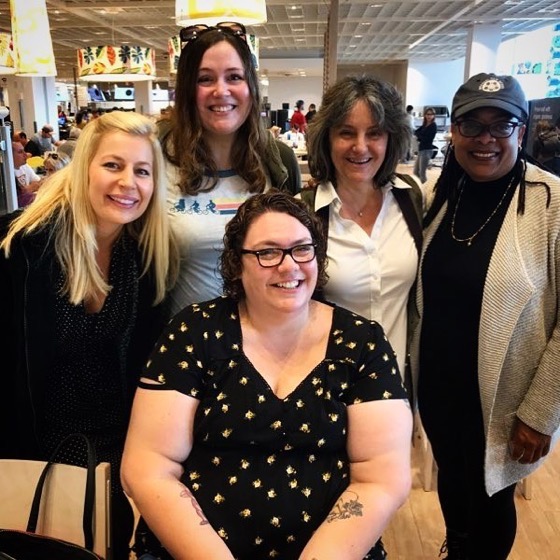
I had such a fun catch up lunch with 2017 Stephens MFA alums and Val yesterday at, of all places, IKEA because alum Amy Banks was in town to attend an all day workshop at the Disney Studios for writers with First Nation backgrounds (in their continued work to provide diversity on their channel).
Amy set it up with me and fellow mentor, Val Woods. Then alums Julie Berkobien and Lauren Smith were also free to drop by. I loved hearing about the various work they were all doing and how their MFAs both helped them get hired and, more importantly, helped them excel in their new positions! It also served as an accidental reunion of several writers of our When Women Wrote Hollywood book of essays, which we will be launching to the Columbia, Missouri community in just a few weeks, during the Citizen Jane Film Festival!
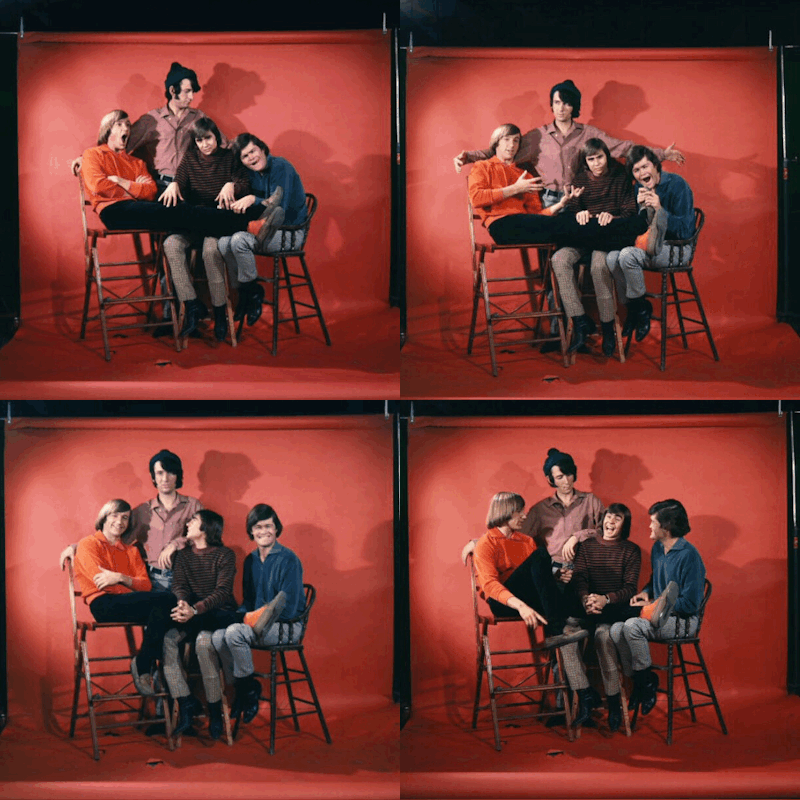
Rosanne Welch, PhD, Author of Why The Monkees Matter, presents “How The Monkees Changed Television” at a Cal State Fullerton Lunch Lecture on May 8, 2018.
In this talk, she shows how The Monkees, and specifically their presence on television, set the stage for large changes to come in the late 1960s.
Transcript
In this metatextuality world, they weren’t — The Monkees weren’t the first ones to do it. We can go back to George Burns and Jack Benny and they talked directly to the screen. George would be having a problem with Gracie then he would walk into his study and look right at you and say “Well, what’s Gracie gotten us into now?” So talking to the audience — breaking the fourth wall — it’s been done before, but no one was doing it right there in the 60’s so I think it’s interesting that our guys jumped in and did that. And you see that in a lot of ways. They would write on the screen, so in the Pilot, you have dancing and then ‘Typical Teenager? No, friends of the producer.” So there were often those kinds of inside jokes so they’re talking to the audience. They’re letting you in on the joke which made a younger audience, a hipper audience think “Wow. We’re part of this things. That’s really exciting.” Now we also have the fact that they were on NBC and in one of the episodes they were running through town and they were at NBC. It’s a little knock knock cute.
A hit television show about a fictitious rock band, The Monkees (1966-1968) earned two Emmys–Outstanding Comedy Series and Outstanding Directorial Acheivement in Comedy.
Capitalizing on the show’s success, the actual band formed by the actors, at their peak, sold more albums than The Beatles and The Rolling Stones combined, and set the stage for other musical TV characters from The Partridge Family to Hannah Montana. In the late 1980s, the Monkees began a series of reunion tours that continued into their 50th anniversary.
This book tells the story of The Monkees and how the show changed television, introducing a new generation to the fourth-wall-breaking slapstick created by Laurel and Hardy and the Marx Brothers.
Its creators contributed to the innovative film and television of 1970s with projects like Bob & Carol & Ted & Alice, The Mary Tyler Moore Show, Laugh-In and Welcome Back, Kotter. Immense profits from the show, its music and its merchandising funded the producers’ move into films such as Head, Easy Riderand Five Easy Pieces.
For her 5th Doctor Who lecture to the CPP community, Dr. Rosanne Welch discusses how society – and the show’s writing staff – prepared the audience for a major change in this 50-year franchise – the creation of the first Lady Doctor!
Transcript:
We also had this young gentleman who was in both the Baker and the Davison Era who was Adric, who was a math genius and he was a young kid so he had more access to his emotions. We don’t let young boys have their emotions. We tell them not to cry. That’s stupid. Humans cry. There’s no such thing as not cryng, right, but we do that. So, it was nice to have Adric as an example back in the day. And until I was putting this together I never had read that fun fact. That’s where they got his name from — an actual Nobel-winning guy. I thought it was pretty cool. I love that — again — writers playing and giving us more information. I just learned something a guy I had never heard of, right? A little research.
Rosanne Welch PhD teaches the History of Screenwriting and One-Hour Drama for the Stephens College MFA in Screenwriting.
Writing/producing credits include Beverly Hills 90210, Picket Fences, ABCNEWS: Nightline and Touched by an Angel. In 2016 she published the book Why The Monkees Matter: Teenagers, Television and American Pop; co-edited Women in American History: A Social, Political, and Cultural Encyclopedia; and placed “Transmitting Culture Transnationally Via the Characterization of Parents in Police Procedurals” in the New Review of Film and Television Studies. Essays appear in Torchwood Declassified: Investigating Mainstream Cult Television and Doctor Who and Race: An Anthology. Welch serves as Book Reviews editor for Journal of Screenwriting and on the Editorial Advisory Board for Written By magazine, the magazine of the Writers Guild.
You have stories to tell. We’re here to make it happen. Come to Hollywood to learn from some of the best working writers in the industry. Stephens is an institution on a mission: To increase the voices and impact of women in television and film.
WHY STEPHENS?
Our program — with its bold, daring mission — has drawn the attention and the support of some of the most successful and well-known writers in Hollywood. Our faculty includes some of the best working writers in the profession, and our curriculum includes an in-depth look at the business side of TV and screenwriting. Explore more: program highlights, student achievements and stories.
HOW DOES IT WORK?
Stephens is proud to be the first college in the nation to offer a low-residency MFA program specifically for TV and screenwriting. Our students come to Los Angeles twice a year for 10-day workshops at the beautiful Jim Henson Studio. Between workshops, students work one-on-one online with at least four different mentors over two years. Two years + four workshops in Hollywood = your M.F.A.
Rosanne Welch, PhD, Author of Why The Monkees Matter, presents “How The Monkees Changed Television” at a Cal State Fullerton Lunch Lecture on May 8, 2018.
In this talk, she shows how The Monkees, and specifically their presence on television, set the stage for large changes to come in the late 1960s.
Transcript
This is my final happy episode. It’s called “Some Like It Lukewarm.” If you’re an old movie fan, of course, that’s “Some Like It Hot.” So the writers are making fun of some of their favorite movies. There’s a band contest and everyone shows up and discovers you have to be in a mixed gender band. So they force Davy to dress as a girl and they meet a girl’s group where they force — that’s Deanna Martin — Dean Martin’s daughter — she and Davy were hooked together in the tabloids as being a relationship. but they really weren’t, but it’s kind of fun to put them together. So this group, so she’s doing that. The answer — for the most pretty feminist in that there’s this girl rock band before The Bangles and The Gogos there’s a girl rock band. The flaw in this one — I feel bad — is when you first meet the women, see how they can all play their own instruments. They’re all playing guitars and drums. When the answer of course is we are individually lying about having a mixed gender group so let’s mix our groups together and we will be telling the truth, but when we do it look what the girls become. They’re the gogo dancers behind the boys playing their instruments. They totally lose their own ability to be rock stars.
A hit television show about a fictitious rock band, The Monkees (1966-1968) earned two Emmys–Outstanding Comedy Series and Outstanding Directorial Acheivement in Comedy.
Capitalizing on the show’s success, the actual band formed by the actors, at their peak, sold more albums than The Beatles and The Rolling Stones combined, and set the stage for other musical TV characters from The Partridge Family to Hannah Montana. In the late 1980s, the Monkees began a series of reunion tours that continued into their 50th anniversary.
This book tells the story of The Monkees and how the show changed television, introducing a new generation to the fourth-wall-breaking slapstick created by Laurel and Hardy and the Marx Brothers.
Its creators contributed to the innovative film and television of 1970s with projects like Bob & Carol & Ted & Alice, The Mary Tyler Moore Show, Laugh-In and Welcome Back, Kotter. Immense profits from the show, its music and its merchandising funded the producers’ move into films such as Head, Easy Riderand Five Easy Pieces.
For her 5th Doctor Who lecture to the CPP community, Dr. Rosanne Welch discusses how society – and the show’s writing staff – prepared the audience for a major change in this 50-year franchise – the creation of the first Lady Doctor!
Transcript:
In the old era, but also largely in the new era, all the men have been given the chance to be depicted as sensitive human beings, which gives them a 3-dimensional complete humanity. Which I think is very important. Now in the very early days, as I said, Lethbridge-Stewart is the father of Kate, so that is how we invented her character in the future. So he started out in the early days with Jon, came through guest starred as an older actor of course on The Sarah Jane Adventures and he came into modern Who in one episode where everybody was turned into a Cyberman who had died. All the people buried in cemeteries had their bodies converted into Cybermen and yet he’s in a cemetery when his daughter gets kicked out of an airplane and she’s going to die except he catches her and saves her life which is a super-cool thing and because he loves his daughter. He’s a super-Dad which is a super-sensitive cool thing to be and so that’s why when the actor actually died they had The Doctor honor him with that portrait which I thought was pretty cool. So even back in the day, we had a relatively sensitive man.
Rosanne Welch PhD teaches the History of Screenwriting and One-Hour Drama for the Stephens College MFA in Screenwriting.
Writing/producing credits include Beverly Hills 90210, Picket Fences, ABCNEWS: Nightline and Touched by an Angel. In 2016 she published the book Why The Monkees Matter: Teenagers, Television and American Pop; co-edited Women in American History: A Social, Political, and Cultural Encyclopedia; and placed “Transmitting Culture Transnationally Via the Characterization of Parents in Police Procedurals” in the New Review of Film and Television Studies. Essays appear in Torchwood Declassified: Investigating Mainstream Cult Television and Doctor Who and Race: An Anthology. Welch serves as Book Reviews editor for Journal of Screenwriting and on the Editorial Advisory Board for Written By magazine, the magazine of the Writers Guild.
Rosanne Welch, PhD, Author of Why The Monkees Matter, presents “How The Monkees Changed Television” at a Cal State Fullerton Lunch Lecture on May 8, 2018.
In this talk, she shows how The Monkees, and specifically their presence on television, set the stage for large changes to come in the late 1960s.
Transcript
…And then there’s an episode called “99 Pound Weakling” where Micky falls in love with a girl and look how he defines her. It’s about her intelligence. Two words about how smart she is. Only one word about how pretty she is. So it’s her smarts that makes him want her and go through all this trouble to try and get muscles and whatnot and it’s cute, but never did they want a girl just because she was pretty and I thought that was particularly unexpected in an era when — in The Big Bang Theory which is having its 250th episode this week, which is lovely. It really is all about who’s going to have sex with who next week. Right? I mean that’ what the show devolved to in terms of their personal relationships and this did not. Now, I have to grant you that, back in the day, they couldn’t discuss that on television, but they didn’t even go to a point where it was about getting a beautiful girl. it was about getting a smart girl. So that strikes me as very cool.
Rosanne Welch, PhD is a writer, producer and university professor with credits that include Beverly Hills 90210, Picket Fences, Touched by an Angel and ABC NEWS/Nightline. Other books include Why The Monkees Matter: Teenagers, Television and American Pop Culture (McFarland, 2017) and Women in American History: A Social, Political, and Cultural Encyclopedia and Document Collection (ABC-CLIO, 2017), named to the 2018 Outstanding References Sources List, by the Reference and User Services Association (RUSA), a division of the American Library Association. Welch has also published chapters in Torchwood Declassified: Investigating Mainstream Cult Television (I.B.Tauris) and The American Civil War on Film and TV: Blue and Gray in Black and White and Color (Lexington Books, 2018) and essays in Doctor Who and Race: An Anthology and Outside In Makes it So, and Outside in Boldly Goes (both edited by Robert Smith). By day she teaches courses on the history of screenwriting and on television writing for the Stephens College MFA in Screenwriting programs. Her talk “The Importance of Having a Female Voice in the Room” at the 2016 TEDxCPP is available on YouTube.
All the video and audio you see here on the blog and Facebook is also available directly to your computer, tablet or phone automatically when you subscribe for free!
Never miss another talk or clip as I teach and speak around the neighborhood and around the world!


 and Follow
 ![20 Metatextuality and The Monkees from How The Monkees Changed Television [Video] (0:58)](https://rosannewelch.com/wp-content/uploads/2018/10/monkees-tv-20-metatextuality.jpeg)
![31 Adric from Gender Diversity in the Who-niverse [Video] (0:38)](https://rosannewelch.com/wp-content/uploads/2018/10/gender-dw-31-adric.jpeg)
![Want to go backstage at the Stephens MFA? Apply Now! [Video]](https://rosannewelch.com/wp-content/uploads/2018/10/stephens-behind-scenes.jpeg)
![19 Some Like It Lukewarm from How The Monkees Changed Television [Video] (1:10)](https://rosannewelch.com/wp-content/uploads/2018/10/monkees-tv-19-lukewarm.jpeg)
![30 Sensitive Men on Doctor Who from Gender Diversity in the Who-niverse [Video] (1:08)](https://rosannewelch.com/wp-content/uploads/2018/10/gender-dw-30-sensitive-men.jpeg)
![18 All About Intelligence from How The Monkees Changed Television [Video] (0:48)](https://rosannewelch.com/wp-content/uploads/2018/09/monkees-tv-18-intelligence.jpeg)