Thanks to the gracious invitation from my Screenwriting Research Network colleague Paolo Russo – and a grant he was able to procure (and in the before-Covid time) I was able to spend a week at Oxford Brookes University working with the screenwriting masters students in Paolo’s course. At the culmination of the week, I gave this lecture on how writers rooms worked in the States.
Transcript:
Everything that’s written that’s remembered is because you learned something while you were watching it. It might be that friends matter which is really the theme of all of the Harry Potter movies let’s admit it. That’s all you learned from those movies. They were quite fun but that’s a pretty good theme. In life, friends matter. Themes are universal. So this is my opinion but I think, generally speaking, people find this the opinion.
Watch this entire presentation
Subscribe to Rosanne’s Channel and receive notice of each new video!
* A portion of each sale from Amazon.com directly supports our blogs ** Many of these books may be available from your local library. Check it out! † Available from the LA Public Library
Many thanks to Fred Velez for telling me about Daniel Sam and his fun internet Monkees talk show — followed by thanks to Dan for inviting me onto this discussion of all the great Monkees books out there. I enter the chat at the 15 minute mark in the video. — Rosanne
On Tuesday February 16th, 2021, the Plastic EP TV Facebook Live Monkees Discussion Panel held a literary discussion on Monkees Books.
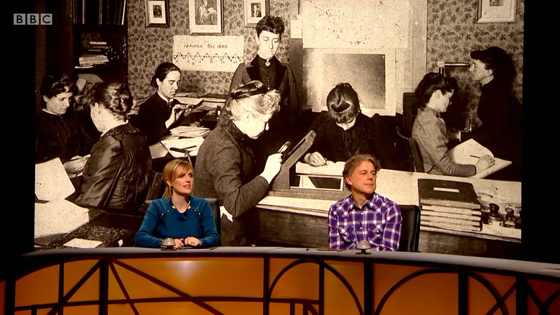
Research on Edwin Hubble lead me to learn more about this set of female mathematicians – and in that wonderful way the synergy of the world seems to work they were then discussed on a UK comedy game show starring Sandy Toksvig – and I learned even more!
Henrietta Swan Levitt figured out how to measure the distance from the earth of pulsating stars. Edwin Hubble then used her calculations to discover the Milky Way. One of the game show guests asks when she gets credit and the answer is – only anecdotally from Hubble reminding people of her work. Why you might ask? For two reasons…
First, Levitt was part of what was nicknamed Pickering’s Harem. Edward Pickering ran the Harvard Observatory and found his male employees who analyzed data from the skies incompetent and slow so one day he said, “My maid could do it better.” The male staff said “Go ahead” so Pickering did hire a slew of women and as they worked so well he hired more women. Annie Jump Cannon manually classified 350,000 stars in her career. Yet, in that way misogyny takes over, rather than call them fellow mathematicians or astronomers, the women became… Pickering’s Harem. I also learned that this lead to the Harem effect — a phenomenon where male executives hire female assistants as they are cheaper and work harder. The jokes of these game show celebrities reminded me of the misogyny of naming the women Pickering’s Harem. We didn’t call the men of the Mercury project “Jackie Kennedy’s consorts”. I mean what a way to demean a set of highly educated women.
The Second reason Henrietta Swan Levitt did not receive full credit for her discovery is that Swedish mathematician Gösta Mittag-Leffler DID want to nominate Levitt for the 1926 Nobel Prize for Physics – but she had died 4 years earlier and the Prize can’t be awarded posthumously (I wonder what male thought up that dumb rule – and why?). Thankfully, Hubble always mentioned Levitt – but textbooks do not necessarily. At the end of the segment the host then covers the many lies Hubble told in his lifetime as a means of polishing his less than elegant background.
Subscribe to Rosanne’s Channel and receive notice of each new video!
Transcript:
So now, in reading screenplays, people can appreciate the voice of the writer in a way they were never able to before. So we see this movement going on which is very important to me. Again, why does this matter? Because we stand on the shoulders of all the people who came before us in this business. We owe them understanding who they are and what they had to offer. In my mind, we have to honor them the same way he honors his ancestors in this movie. That’s what we’re all about if you ask me. So when i teach in this program, this is why these words mean something to me. WRITE, so you can REACH other people and REPRESENT the cultures and the stories that have not been told before. That, to me, is something that we should be very excited about. That’s why researching screenwriters has always mattered. I’m Rosanne Welch I approve this message. Thank you very much.
Watch this entire presentation
A Note About This Presentation
A clip from my keynote speech at the 10th Screenwriters´(hi)Stories Seminar for the interdisciplinary Graduation Program in “Education, Art, and History of Culture”, in Mackenzie Presbyterian University, at São Paulo, SP, Brazil, focused on the topic “Why Researching Screenwriters (has Always) Mattered.” I was especially pleased with the passion these young scholars have toward screenwriting and it’s importance in transmitting culture across the man-made borders of our world.
To understand the world we have to understand its stories and to understand the world’s stories we must understand the world’s storytellers. A century ago and longer those people would have been the novelists of any particular country but since the invention of film, the storytellers who reach the most people with their ideas and their lessons have been the screenwriters. My teaching philosophy is that: Words matter, Writers matter, and Women writers matte, r so women writers are my focus because they have been the far less researched and yet they are over half the population. We cannot tell the stories of the people until we know what stories the mothers have passed down to their children. Those are the stories that last. Now is the time to research screenwriters of all cultures and the stories they tell because people are finally recognizing the work of writers and appreciating how their favorite stories took shape on the page long before they were cast, or filmed, or edited. But also because streaming services make the stories of many cultures now available to a much wider world than ever before.
Many thanks to Glaucia Davino for the invitation.
* A portion of each sale from Amazon.com directly supports our blogs ** Many of these books may be available from your local library. Check it out! † Available from the LA Public Library
Subscribe to Rosanne’s Channel and receive notice of each new video!
Transcript:
…And that’s very important why, when we’re teaching screenwriting — It’s funny. People who come from a directing background like to teach that writers shouldn’t “direct on the page.” Don’t say things about where the camera should go. Don’t say how the actor is feeling. Don’t talk casually. But in fact, most of the screenwriters who sell and win Oscars are people whose voice is so recognizable. Aaron Sorkin sounds like Aaron Sorkin in everything he does. Every single piece of action is as if you are sitting there talking to him. Right? William Goldman did that. most of the big names — Nora Ephron — who was a major American female screenwriter. Their personality comes through in the lines and they do tell the director “I need this. I need this closeup. I want this moment. This is exactly what needs to happen here. Those are the screenplays that do sell because a person at a studio has to read the thing and envision the movie. If they don’t see it. They don’t buy it and they don’t make it. So that piece of advice has never worked for me.
Watch this entire presentation
A Note About This Presentation
A clip from my keynote speech at the 10th Screenwriters´(hi)Stories Seminar for the interdisciplinary Graduation Program in “Education, Art, and History of Culture”, in Mackenzie Presbyterian University, at São Paulo, SP, Brazil, focused on the topic “Why Researching Screenwriters (has Always) Mattered.” I was especially pleased with the passion these young scholars have toward screenwriting and it’s importance in transmitting culture across the man-made borders of our world.
To understand the world we have to understand its stories and to understand the world’s stories we must understand the world’s storytellers. A century ago and longer those people would have been the novelists of any particular country but since the invention of film, the storytellers who reach the most people with their ideas and their lessons have been the screenwriters. My teaching philosophy is that: Words matter, Writers matter, and Women writers matte, r so women writers are my focus because they have been the far less researched and yet they are over half the population. We cannot tell the stories of the people until we know what stories the mothers have passed down to their children. Those are the stories that last. Now is the time to research screenwriters of all cultures and the stories they tell because people are finally recognizing the work of writers and appreciating how their favorite stories took shape on the page long before they were cast, or filmed, or edited. But also because streaming services make the stories of many cultures now available to a much wider world than ever before.
Many thanks to Glaucia Davino for the invitation.
* A portion of each sale from Amazon.com directly supports our blogs ** Many of these books may be available from your local library. Check it out! † Available from the LA Public Library
Explore the low-residency MFA in TV + Screenwriting with Executive Director Dr. Rosanne Welch. Our mission is to increase the impact of women and other under-represented voices in television and film. Our faculty and mentors include some of the best working writers in Hollywood, and our curriculum includes an in-depth look at the business side of TV and screenwriting.
Subscribe to Rosanne’s Channel and receive notice of each new video!
Transcript:
In my family, we like A Christmas Carol — Dickens’ A Christmas Carol — and it’s been made into movies several times and for us, the best version is the one made by The Muppets because in that version Gonzo the muppet gives the action dialogue — the narration — that you would not see in any other version of the film but he narrates — he walks around town — as Dickens narrating. So you hear language that you miss in the other movies. So, to me, that’s what’s happening when people start reading actual screenplays. They’re seeing the craft as it exists on the page. Yes, of course, we’d like it made into a film and we want to see the beautiful vistas and we want to see actors who are wonderful but I just really need the story. That’s enough for me. That’s gonna make me feel something.
Watch this entire presentation
A Note About This Presentation
A clip from my keynote speech at the 10th Screenwriters´(hi)Stories Seminar for the interdisciplinary Graduation Program in “Education, Art, and History of Culture”, in Mackenzie Presbyterian University, at São Paulo, SP, Brazil, focused on the topic “Why Researching Screenwriters (has Always) Mattered.” I was especially pleased with the passion these young scholars have toward screenwriting and it’s importance in transmitting culture across the man-made borders of our world.
To understand the world we have to understand its stories and to understand the world’s stories we must understand the world’s storytellers. A century ago and longer those people would have been the novelists of any particular country but since the invention of film, the storytellers who reach the most people with their ideas and their lessons have been the screenwriters. My teaching philosophy is that: Words matter, Writers matter, and Women writers matte, r so women writers are my focus because they have been the far less researched and yet they are over half the population. We cannot tell the stories of the people until we know what stories the mothers have passed down to their children. Those are the stories that last. Now is the time to research screenwriters of all cultures and the stories they tell because people are finally recognizing the work of writers and appreciating how their favorite stories took shape on the page long before they were cast, or filmed, or edited. But also because streaming services make the stories of many cultures now available to a much wider world than ever before.
Many thanks to Glaucia Davino for the invitation.
* A portion of each sale from Amazon.com directly supports our blogs ** Many of these books may be available from your local library. Check it out! † Available from the LA Public Library
Subscribe to Rosanne’s Channel and receive notice of each new video!
Transcript:
So to me the question of why has researching screen readers — screenwriters always mattered is because of all these reasons I’ve noted. Also one of the biggest things that makes me so excited is people are beginning to read screenplays as literature. I think maybe 20 years ago I saw a book publish the top five screenplays of the year and I was amazed that I could read the scripts in their format on a page right and so the more we see that happen — somebody like William Goldman who’s very famous in the states, he published several of his screenplays. I remember when Rocky came out they published a screenplay because it’s Rocky, so everyone loves Rocky, but the idea that now we really know this isn’t a blueprint. We’re going to look at this script. We’re going to read the action lines and we’re going to hear the voice of the writer in a way that we can’t on screen because those things aren’t what the audience is given right.
Watch this entire presentation
A Note About This Presentation
A clip from my keynote speech at the 10th Screenwriters´(hi)Stories Seminar for the interdisciplinary Graduation Program in “Education, Art, and History of Culture”, in Mackenzie Presbyterian University, at São Paulo, SP, Brazil, focused on the topic “Why Researching Screenwriters (has Always) Mattered.” I was especially pleased with the passion these young scholars have toward screenwriting and it’s importance in transmitting culture across the man-made borders of our world.
To understand the world we have to understand its stories and to understand the world’s stories we must understand the world’s storytellers. A century ago and longer those people would have been the novelists of any particular country but since the invention of film, the storytellers who reach the most people with their ideas and their lessons have been the screenwriters. My teaching philosophy is that: Words matter, Writers matter, and Women writers matte, r so women writers are my focus because they have been the far less researched and yet they are over half the population. We cannot tell the stories of the people until we know what stories the mothers have passed down to their children. Those are the stories that last. Now is the time to research screenwriters of all cultures and the stories they tell because people are finally recognizing the work of writers and appreciating how their favorite stories took shape on the page long before they were cast, or filmed, or edited. But also because streaming services make the stories of many cultures now available to a much wider world than ever before.
Many thanks to Glaucia Davino for the invitation.
* A portion of each sale from Amazon.com directly supports our blogs ** Many of these books may be available from your local library. Check it out! † Available from the LA Public Library
The Stephens College MFA in TV and Screenwriting is building a relationship with the Autry Museum of the American West since both organizations are devoted to bringing out more diverse and untold stories. Last year we were able to take our cohort of graduating MFA candidates to the museum’s theatre for a showing of Michael Wilson’s Salt of the Earth and we had plans to present a film of our choice this year – but of course the pandemic changed all that. Instead, Autry Curator Josh Garrett-Davis asked me if I would sit for an interview about female screenwriters in the western genre and so “When Women Wrote Westerns” came to be a part of their “What Is a Western? Interview Series”.
I had a great time discussing so many wonderful women writers – from Jeanne MacPherson to D.C. Fontana to Edna Ferber to Emily Andras. If you love westerns I suggest you watch Josh’s other interviews covering everything from the work of Native Americans in Western movies to films in the western-horror hybrid. —
As part of a series exploring the significance of the Western genre and the ways in which the movies shape our understanding of the American West, Autry Curator Josh Garrett-Davis interviews Professor Rosanne Welch about the women screenwriters of Hollywood and their contributions to the Western genre.
Thanks to the gracious invitation from my Screenwriting Research Network colleague Paolo Russo – and a grant he was able to procure (and in the before-Covid time) I was able to spend a week at Oxford Brookes University working with the screenwriting masters students in Paolo’s course. At the culmination of the week, I gave this lecture on how writers rooms worked in the States.
Transcript:
Neil Simon actually wrote about writing for Sid Caesar in a play and that was all about glorifying what happened in the writer’s room. So it’s really a fun kind of play if you see it. I did some work on this tv show which is from the 60s. It’s also all on YouTube if you care to see it. It was a comedy about four guys who ran a rock and roll band. They’re literally still around and still touring. They’re in New Zealand right now. That’s how long-lasting the effect of the show was but these folks were all the writers of it including Treva Silverman — the woman up in the corner. She was the first woman to write alone on a series without a male partner — a husband or a guy who happened to work with her. That’s a big move. It seems ridiculous but that was a big moment in TV history.
Watch this entire presentation
Subscribe to Rosanne’s Channel and receive notice of each new video!
* A portion of each sale from Amazon.com directly supports our blogs ** Many of these books may be available from your local library. Check it out! † Available from the LA Public Library

![Dr. Rosanne Welch Joins Panel on Monkees Books with Plastic EP Live [Video] (54 minutes)](https://rosannewelch.com/wp-content/uploads/2021/02/plastic-ep-monkees-20210216.png)

![49 Appreciating The Voice Of The Writer from Why Researching Screenwriters Has Always Mattered [Video] (1 minute 2 seconds)](https://rosannewelch.com/wp-content/uploads/2021/02/rmw-sao-paolo-49.png)
![48 Directing On The Page from Why Researching Screenwriters Has Always Mattered [Video] (1 minute 3 seconds)](https://rosannewelch.com/wp-content/uploads/2021/02/rmw-sao-paolo-48.png)
![47 More On Screenplays As Literature from Why Researching Screenwriters Has Always Mattered [Video] (51 seconds)](https://rosannewelch.com/wp-content/uploads/2021/02/rmw-sao-paolo-47.png)
![46 Screenplays As Literature from Why Researching Screenwriters Has Always Mattered [Video] (1 minute)](https://rosannewelch.com/wp-content/uploads/2021/01/rmw-sao-paolo-46.png)
![Watch Dr. Rosanne Welch on What Is a Western? Interview Series: When Women Wrote Westerns from the Autry Museum of the American West [Video] (27 minutes)](https://rosannewelch.com/wp-content/uploads/2021/01/RMW-Rosanne-Signature-for-Web.png)
![Watch Dr. Rosanne Welch on What Is a Western? Interview Series: When Women Wrote Westerns from the Autry Museum of the American West [Video] (27 minutes)](https://rosannewelch.com/wp-content/uploads/2021/01/rmw-autry-interview-w3h-20210122.jpg)
![07 The Monkees Writers Room from There And Back Again: Writing and Developing for American TV [Video] (44 seconds)](https://rosannewelch.com/wp-content/uploads/2021/01/rmw-oxford-brookes-07.png)