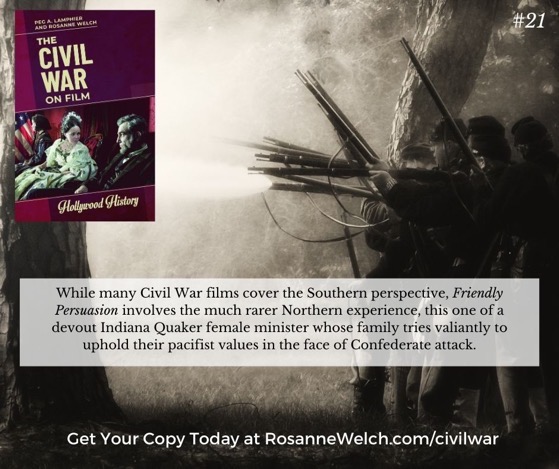
While many Civil War films cover the Southern perspective, Friendly Persuasion involves the much rarer Northern experience, this one of a devout Indiana Quaker female minister whose family tries valiantly to uphold their pacifist values in the face of Confederate attack.
Subscribe to Rosanne’s Channel and receive notice of each new video!
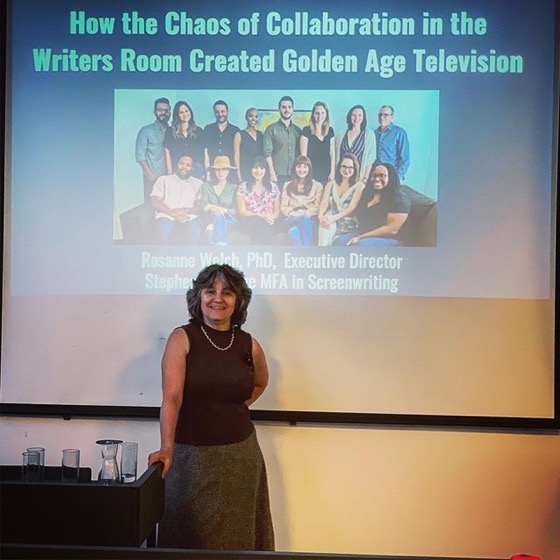
When the folks hosting the conference announced their theme as “Screen Narratives: Chaos and Order” the word ‘chaos’ immediately brought to mind writers rooms. I offered a quick history of writers rooms (the presentations are only 20 minutes long) and then quoted several current showrunners on how they compose their rooms and how they run them.
Transcript
This is my teaching philosophy. Words Matter. Writers Matter. Women Writers Matter, and that’s something I try to focus on as much as possible. There’s a lot of women who never get mentioned and that bothers me but that’s a different lecture so — I did that last year this year. We’re talking about why writers are important and how the writers room works. As far as I’m concerned we have to remember that writer precedes director so I want more of our students to know the names of the writers of their favorite films not always just the directors because when you talk about a film you don’t say “Do you remember that beautiful camera angle in scene seven?” You say “My name is Inigo Montoya. You killed my father. Prepare to die” and that is something the writer did so I think we have to remember that the dialogue is what makes movies special and the characters.
This new “A Woman Wrote That” post is an echo of the Writers Guild campaign of a few years ago (“A Writer Wrote That”) where they noted famous movie quotes and credited the screenwriter rather than the director. The difference here being that we will be posting lines from films written by female screenwriters. Feel free to share! — Rosanne
GEORGE
“The good news, however, is that this overreacting… tends to get proportionately less by generation. So, your kids could be normal.”
MFA Executive Director Dr. Rosanne Welch will give a Zoom presentation on “When Women Wrote Hollywood” for the Empire State Center for the Book, the New York State affiliate of the Library of Congress Center for the Book. This event begins at 7 p.m. Eastern/6 p.m. Central on Tuesday, March 9, and is free and open to the public.
Dr. Welch will discuss many highly successful female screenwriters of early Hollywood and explain why they don’t appear in most mainstream histories of the era.
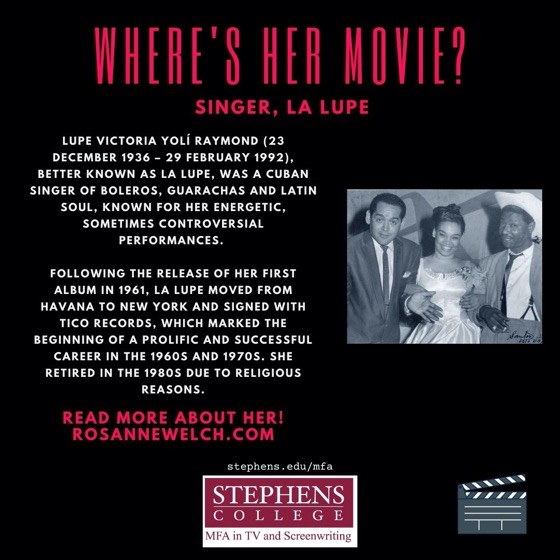
“Where’s HER Movie” posts will highlight interesting and accomplished women from a variety of professional backgrounds who deserve to have movies written about them as much as all the male scientists, authors, performers, and geniuses have had written about them across the over 100 years of film. This is our attempt to help write these women back into mainstream history. — Rosanne
Lupe Victoria Yolí Raymond (23 December 1936 – 29 February 1992),[1][2] better known as La Lupe, was a Cuban singer of boleros, guarachas and Latin soul, known for her energetic, sometimes controversial performances. Following the release of her first album in 1961, La Lupe moved from Havana to New York and signed with Tico Records, which marked the beginning of a prolific and successful career in the 1960s and 1970s. She retired in the 1980s due to religious reason — Wikipedia
Rosanne is speaking at the 2021 SCMS Conference on Thursday, March 18, 2021. If you are attending the conference virtually, please tune into this collection of excellent presentations on the “unreliable narrator” and more.
THURSDAY, MARCH 18 SESSION E – 12:00 PM Central Time
Chair: Christina Lane, University of Miami
Co-Chair: Vicki Callahan, University of Southern California
Vicki Callahan, University of Southern California, “Still Looking for Mabel Normand”
Philana Payton, University of Southern California, “Eartha Kitt vs. Eartha Mae: Black Women, Self-Fragmentation, and the Politics of Hollywood Stardom”
Rosanne Welch, Stephens College, “When Men Forget Women: The Many Ways Male Screenwriters Fail to Mention their Female Colleagues in Oral Histories”
Christina Lane, University of Miami, “Alternative Writing Strategies: Notes on Discovering the ‘Women Who Knew’ Joan Harrison”
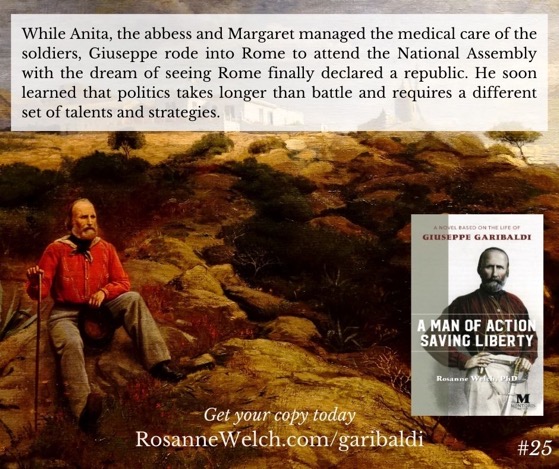
While Anita, the abbess and Margaret managed the medical care of the soldiers, Giuseppe rode into Rome to attend the National Assembly with the dream of seeing Rome finally declared a republic. He soon learned that politics takes longer than battle and requires a different set of talents and strategies.
As the twenty-first century began to mature, so too did Americans’ ideas about who qualified as heroes of the Civil War. While conflicts over taking down statues of old Confederate generals roiled southern cities, artists around the country started making art that glorified the anti-Confederates, and films were no different. This climate bred Free State of Jones, the story of a Confederate army deserter who organizes his own interracial militia of formerly enslaved people and lower-income farmers, all dedicated to ending the war, though for differing reasons.
Subscribe to Rosanne’s Channel and receive notice of each new video!
When the folks hosting the conference announced their theme as “Screen Narratives: Chaos and Order” the word ‘chaos’ immediately brought to mind writers rooms. I offered a quick history of writers rooms (the presentations are only 20 minutes long) and then quoted several current showrunners on how they compose their rooms and how they run them.
Transcript
Always good to see everybody here. We’re all like on different time schedules so I’m still — I think it’s three in the morning in Los Angeles but that’s okay. Yes, we’re going to talk about this concept of chaos in writers’ rooms, which are really run in chaos, at least the ones in the United States. Just a quick background on who I am. I was in the business for several years. I wrote Picket Fences, Beverly Hills 90210 — which is a show that won’t die because they just did a live show or is just a little crazy and Touched By An Angel for a long time. So this is where I came from in television. This is what I’ve done in academia and writing. My favorite new book is a collection of essays written by many of my students about female screenwriters from the early days and giving us their backgrounds so I’m all about finding more women that we can write about and talk about in our classes. I think that’s important. I’m also the book review editor of the Journal of Screenwriting so if you have any books you’d like to review please let me know. I’d love to get you a free copy and get your review in the journal and also I’m on the editorial board for the Written By Magazine, which is the magazine of the Writers Guild of America. You can access that for free digitally online if you go to writtenby.com or go to wga.org and they’ll have a link to it, but every month we do interviews with either a film person or a television person or whole writer’s room from a show and I think it’s a great way to bring guest stars into a classroom from all over the world. Again, they’re obviously Americans although I interviewed Russell Davies several years ago so we do have some other folks come on into the magazine but it’s pretty cool.
![02 Words Matter. Writers Matter. Women Writers Matter from How The Chaos Of Collaboration in the Writers Room Created Golden Age Television [Video]](https://rosannewelch.com/wp-content/uploads/2021/03/srn-porto-02.jpg)



![Dr. Rosanne Welch Joins Panel on the Monkees TV Show with Plastic EP Live [Video] (49 Minutes)](https://rosannewelch.com/wp-content/uploads/2021/02/maxresdefault-2.jpg)
![Dr. Rosanne Welch Speaks at the 2021 Society for Cinema and Media Studies Conference – Thursday, March 18, 2021 [Event]](https://rosannewelch.com/wp-content/uploads/2021/02/conference_pathform-website-.jpg)

![01 Introduction from How The Chaos Of Collaboration in the Writers Room Created Golden Age Television [Video]](https://rosannewelch.com/wp-content/uploads/2021/02/SRN-2019-Portugal-.jpg)