“Where’s HER Movie” posts will highlight interesting and accomplished women from a variety of professional backgrounds who deserve to have movies written about them as much as all the male scientists, authors, performers, and geniuses have had written about them across the over 100 years of film. This is our attempt to help write these women back into mainstream history. — Rosanne
Ochi broke barriers as the first Asian American woman to serve as a Los Angeles Police Commission member and as an assistant U.S. attorney general
she particularly cherished her contributions to the successful campaigns to win recognition and redress for the mass incarceration of 120,000 people of Japanese descent during World War II — including her and her family.
“Where’s HER Movie” posts will highlight interesting and accomplished women from a variety of professional backgrounds who deserve to have movies written about them as much as all the male scientists, authors, performers, and geniuses have had written about them across the over 100 years of film. This is our attempt to help write these women back into mainstream history. — Rosanne
Elizabeth Peratrovich (néeElizabeth Jean Wanamaker, Tlingit name: Kaaxgal.aat; July 4, 1911 – December 1, 1958)[1] was an American civil rights activist, Grand President of the Alaska Native Sisterhood,[2] and member of the Tlingit nation who worked for equality on behalf of Alaska Natives.[3] In the 1940s, her advocacy was credited as being instrumental in the passing of Alaska’s Anti-Discrimination Act of 1945, the first state or territorial anti-discrimination law enacted in the United States.
In 1988, the Alaska Legislature established February 16 as Elizabeth Peratrovich Day “for her courageous, unceasing efforts to eliminate discrimination and bring about equal rights in Alaska”.[2][4] In March 2019, her obituary was added to The New York Times as part of their “Overlooked No More” series,[5] and in 2020, the United States Mint released a $1 gold coin inscribed with Elizabeth’s likeness in honor of her historic achievements.[6] The Peratrovich family papers, including correspondence, personal papers, and news clippings related to the civil-rights work done by Elizabeth and her husband, are currently held at the Smithsonian National Museum of the American Indian.[7]
Thanks to the gracious invitation from my Screenwriting Research Network colleague Paolo Russo – and a grant he was able to procure (and in the before-Covid time) I was able to spend a week at Oxford Brookes University working with the screenwriting masters students in Paolo’s course. At the culmination of the week, I gave this lecture on how writers rooms worked in the States.
Transcript:
Writers. Really. Matter. I think it’s really true The Auteur Theory — and I don’t want to pick on the French — hopefully, there’s no one french in here — I’m picking on you — not my probably looking at your French friend, right — many people are now tearing down the Auteur Theory because it’s ridiculous. The director is not the only person responsible for why a film works. It has always begun with a writer. Yes, it moves to a director but that’s a collaboration and we made a mistake. Some people have written about the fact that in the early days of film critique critics couldn’t go through two or three names of writers so they went to the director’s name because it was the only one person named and slowly that became the idea of who the auteur was right? It’s not true. Vince Gilligan, very famous in America for Breaking Dad. Really considered one of our best showrunners — one of our best television writers — pretty much says it and I agree with him.
Watch this entire presentation
Subscribe to Rosanne’s Channel and receive notice of each new video!
* A portion of each sale from Amazon.com directly supports our blogs ** Many of these books may be available from your local library. Check it out! † Available from the LA Public Library
Highlighting the articles in the past editions of the Journal of Screenwriting, of which I am the Book Reviews Editor. Hopefully these abstracts will entice you to did a little deeper into the history and future of screenwriting. — Rosanne
This article addresses the long-lived literary and popular culture assumption that the beloved characters of Nick and Nora Charles in the MGM film The Thin Man (1934) were representations of the relationship between novelist Dashiell Hammett and his lover, playwright Lillian Hellman. However, in a comparison of the screenplay to the novel, the screenplay’s specific dialogue and plot changes incorporated by married screenwriters Frances Goodrich Hackett and Albert Hackett can lead to a different conclusion. I will explore the Nick and Nora marriage that has served for so many years as a benchmark in romantic comedy relationships and propose that, in fact, this relationship was based largely on the marriage shared by the Hackett’s. The results of my exploration suggests credit to the screenwriting couple and serves as evidence that some screenplay adaptations often prove more enduring than their original source material.
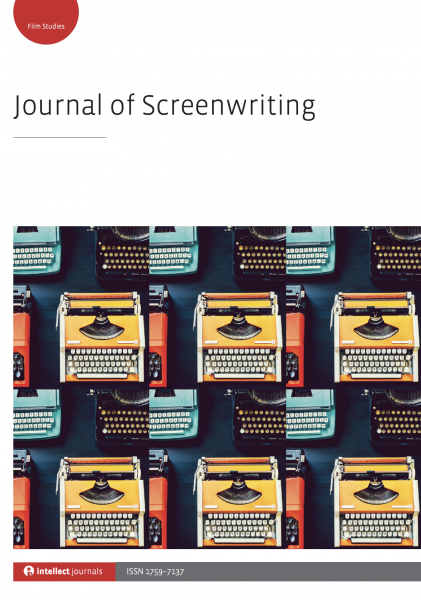
The Journal of Screenwriting is an international double-blind peer-reviewed journal that is published three times a year. The journal highlights current academic and professional thinking about the screenplay and intends to promote, stimulate and bring together current research and contemporary debates around the screenplay whilst encouraging groundbreaking research in an international arena. The journal is discursive, critical, rigorous and engages with issues in a dynamic and developing field, linking academic theory to screenwriting practice.
Lost Cause ideology, in its many iterations, maintained its grip on American movies for nearly eighty years, from Birth of a Nation (1915) to Gettysburg (1993). This national enthusiasm for the Lost Cause suggests white Americans, regardless of their regional roots, enjoy and believe the narrative.
I’m happy to announce the publication of a special issue of the Journal of Screenwriting focused on “Women in Screenwriting” that I co-edited with my SRN colleague Rose Ferrell, lecturer at the Western Australian Academy of Performing Arts, at Edith Cowan University.
While focusing on females was our first mandate, our second mandate was to be as international as possible. This issue, then, includes articles about women in screenwriting covering five continents including countries such as Japan, China, Syria, Argentina, Brazil, Peru, Zimbabwe and Canada. — Rosanne
Contents Volume (11): Issue (3) Cover date: 2020
Editorial introduction by Rose Ferrell, Rosanne Welch
Tang Cheng: The first female animation screenwriter and director in the People’s Republic of China by Shaopeng Chen
Scouting for scripts: Mizuki Yōko and social issue film in post-war Japan by Lauri Kitsnik
Who is the author of Neria (1992) – and is it a Zimbabwean masterpiece or a neo-colonial enterprise? by Agnieszka Piotrowska
The Hakawati’s Daughter: How the Syrian revolution inspired a rewrite by Rana Kazkaz
The silent women: The representation of Israeli female soldiers in Israeli women’s films by Mira Moshe, Matan Aharoni
How the scripts of Latin American screenwriters Lucrecia Martel (Argentina), Anna Muylaert (Brazil) and Claudia Llosa (Peru) have made a mark on the world stage by Margaret McVeigh, Clarissa Mazon Miranda
‘Polite, no chill’ for the win: How Emily Andras engaged fans and overcame problematic tropes in Wynonna Earp by Tanya N. Cook
Battle of the sketches: Short form and feminism in the comedy mode by Stayci Taylor
Anita Loos Rediscovered: Film Treatments and Fiction, Cari Beauchamp and Mary Anita Loos (eds) (2003) by Cierra Winkler
Modern Film Dramaturgy: An Introduction, Kristen Stutterheim (2019) by Andrew Wickwire
Nobody’s Girl Friday: The Women Who Ran Hollywood, J. E. Smyth (2018) by Toni Anita Hull
How to Write for Moving Pictures: A Manual of Instruction and Information, Marguerite Bertsch (1917) by Diane Barley
The Journal of Screenwriting is an international double-blind peer-reviewed journal that is published three times a year. The journal highlights current academic and professional thinking about the screenplay and intends to promote, stimulate and bring together current research and contemporary debates around the screenplay whilst encouraging groundbreaking research in an international arena. The journal is discursive, critical, rigorous and engages with issues in a dynamic and developing field, linking academic theory to screenwriting practice.
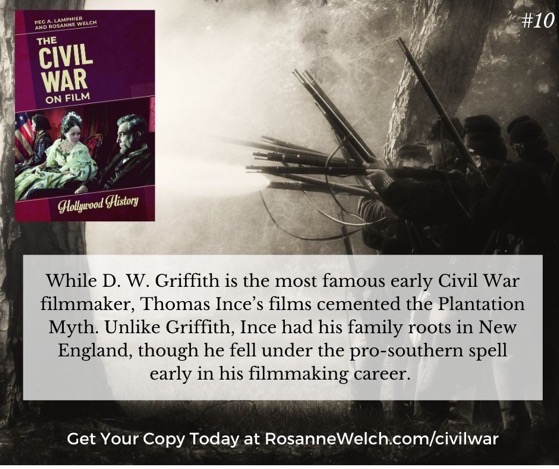
While D. W. Griffith is the most famous early Civil War filmmaker, Thomas Ince’s films cemented the Plantation Myth. Unlike Griffith, Ince had his family roots in New England, though he fell under the pro-southern spell early in his filmmaking career.
“Where’s HER Movie” posts will highlight interesting and accomplished women from a variety of professional backgrounds who deserve to have movies written about them as much as all the male scientists, authors, performers, and geniuses have had written about them across the over 100 years of film. This is our attempt to help write these women back into mainstream history. — Rosanne
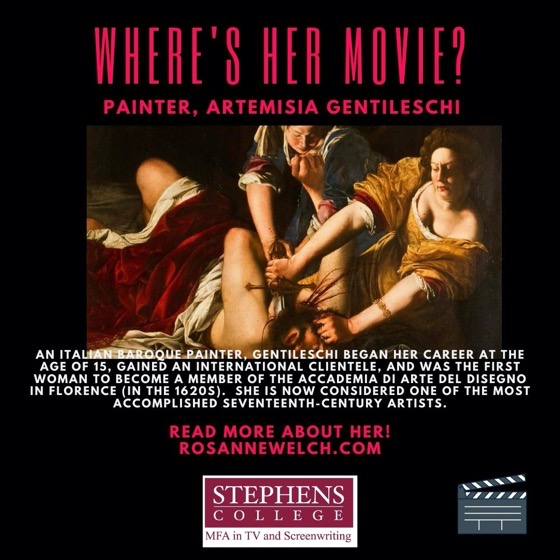
An Italian Baroque painter, Gentileschi began her careet at the age of 15, gained an international clientele, and was the first woman to become a member of the Accademia di Arte del Disegno in Florence (in the 1620s).
She is now considered one of the most accomplished seventeenth-century artists.
Artemisia Lomi or Artemisia Gentileschi (US: /ˌdʒɛntiˈlɛski/,[1][2] Italian: [arteˈmiːzja dʒentiˈleski]; July 8, 1593 – c. 1656) was an Italian Baroque painter, now considered one of the most accomplished seventeenth-century artists, initially working in the style of Caravaggio. She was producing professional work by the age of fifteen.[3] In an era when women had few opportunities to pursue artistic training or work as professional artists, Artemisia was the first woman to become a member of the Accademia di Arte del Disegno in Florence and she had an international clientele.[4][5]
Many of Artemisia’s paintings feature women from myths, allegories, and the Bible, including victims, suicides, and warriors.[6] Some of her best known subjects are Susanna and the Elders (particularly the 1610 version in Pommersfelden), Judith Slaying Holofernes (her 1614–1620 version is in the Uffizi gallery), and Judith and Her Maidservant (her version of 1625 is in the Detroit Institute of Arts).
Artemisia was known for being able to depict the female figure with great naturalism,[7][8] and for her skill in handling color to express dimension and drama.[9][10]
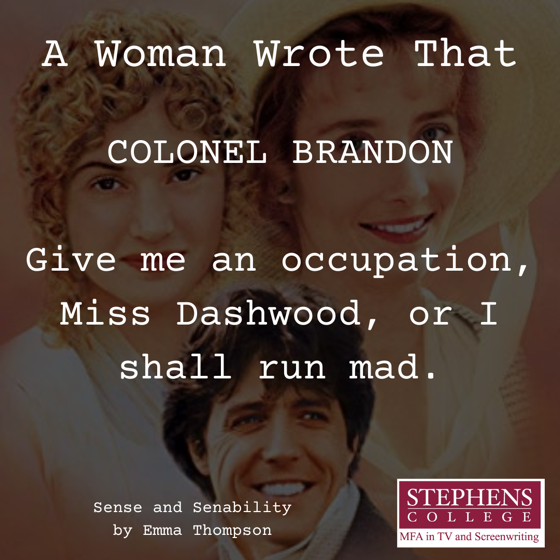
This new “A Woman Wrote That” post is an echo of the Writers Guild campaign of a few years ago (“A Writer Wrote That”) where they noted famous movie quotes and credited the screenwriter rather than the director. The difference here being that we will be posting lines from films written by female screenwriters. Feel free to share! — Rosanne
COLONEL BRANDON: “Give me an occupation, Miss Dashwood, or I shall run mad.”
Thanks to the gracious invitation from my Screenwriting Research Network colleague Paolo Russo – and a grant he was able to procure (and in the before-Covid time) I was able to spend a week at Oxford Brookes University working with the screenwriting masters students in Paolo’s course. At the culmination of the week, I gave this lecture on how writers rooms worked in the States.
Subscribe to Rosanne’s Channel and receive notice of each new video!
* A portion of each sale from Amazon.com directly supports our blogs ** Many of these books may be available from your local library. Check it out! † Available from the LA Public Library


![04 Down With The Auteur Theory from There And Back Again: Writing and Developing for American TV [Video] (54 seconds)](https://rosannewelch.com/wp-content/uploads/2020/12/rmw-oxford-brookes-04.png)


![There And Back Again: Writing and Developing for American Television]: from Freelancing to Writers Rooms [Video] (52 minutes)](https://rosannewelch.com/wp-content/uploads/2020/12/oxford-brookes.png)