Toypurina, a Kumi-Vit (or Tongva) woman from the village of Javachit in today’s San Gabriel Valley, California, was born nine years before the Spanish began colonizing southern California. The Spanish would have identified her as a Gabrielino, a term that identified all native people who were relocated to San Gabriel Mission (est. 1771) and baptized. A leader of an insurrection against the San Gabriel Mission in 1785, she continues to be a symbol of resistance to Spanish colonization.
Learn about more Women In History with these encyclopedia from Dr. Rosanne Welch and Dr. Peg Lamphier
† †
* A portion of each sale from Amazon.com directly supports our blogs ** Many of these books may be available from your local library. Check it out! † Available from the LA Public Library
An activist, scholar, professor, philosopher and author who came to prominence in the Civil Rights and Black Power movements of the 1960s and 1970s, Angela Davis had close ties with the Black Panther Party for Self-Defense. In 1970, Davis was arrested and charged with conspiracy in an armed confrontation that resulted in four deaths. She was later acquitted of all charges. The author of eight books, Davis is Distinguished Professor Emerita with the History of Consciousness Department at the University of California, Santa Cruz, and a former director of the university’s Feminist Studies department. Davis remains a powerful advocate of gender equity, the abolition of the prison-industrial complex, and LGBTQ rights.
Learn about more Women In History with these encyclopedia from Dr. Rosanne Welch and Dr. Peg Lamphier
† †
* A portion of each sale from Amazon.com directly supports our blogs ** Many of these books may be available from your local library. Check it out! † Available from the LA Public Library
Subscribe to Rosanne’s Channel and receive notice of each new video!
In honor of Halloween – and in service to my teaching philosophy —
“Words Matter. Writers Matter. Women Writers Matter.”
I presented this holiday lecture “When Women Write Horror” on Tuesday, October 29th, 2019. Researching the many, many women who have written horror stories – in novels, films and television – brought new names to my attention who I am excited to start reading. I hope you will be, too!
Transcript:
In also just a little bit post her period when I was researching this I found it so interesting. There were not many women who we teach in our schools, but here they were living full, professional careers as writers in eras when we don’t even think about women having jobs at all, right? So Elizabeth Gaskell really interested me. I love the fact that you can see full shelves of books written by women and books based on horror stories which again, we don’t really relate to women. So what was that about and why were they getting away with that? I think she’s really cool because we mostly know these women for the drama novels they wrote. The things that were proper books. If you wrote a book at all it was about a proper society. So Cranford is what she’s mostly known for which was turned into a miniseries with some famous ladies who’ve you seen in other sorts of Harry Potter-like stories, but she really wrote all kinds of ghost stories and she began her career by being published by Charles Dickens. So Dickens was doing magazine publishing and he’s publishing a lot of women which I thought was very interesting. I had not equated that with him. So Elizabeth Gaskell is one of the names we should know more.
* A portion of each sale from Amazon.com directly supports our blogs ** Many of these books may be available from your local library. Check it out! † Available from the LA Public Library
Actress and singer Audra Ann McDonald became the first performer to win six competitive Tony Awards in 2014 and the only performer to have won a Tony in all four acting categories. A graduate of the Julliard School, a performing conservatory in New York City, McDonald began acting as a child when her parents enrolled her in a theater group to manage a diagnosis of attention deficit hyperactive disorder (ADHD).
Learn about more Women In History with these encyclopedia from Dr. Rosanne Welch and Dr. Peg Lamphier
† †
* A portion of each sale from Amazon.com directly supports our blogs ** Many of these books may be available from your local library. Check it out! † Available from the LA Public Library
Every Monday we will be profiling a member of the Stephens College MFA in TV and Screenwriting 2020 graduating class. This exciting, fresh crop of writers are the future of the industry and are going on to do BIG things, so get to know them now!
This week, Stephens College is proud to present: CJ Ehrlich #MeetTheGraduates
A Bostonian who resides in the wilds of NY, C.J. Ehrlich is an award-winning playwright, whose works have enjoyed over 200 productions around the world, and are published in numerous “Best of” anthologies (including The Best American Short Plays of 2015-16). Full-lengths include The Cupcake Conspiracy: Terrorism is Easy, Marriage is Complicated (with Philip J. Kaplan), the anti-romcom This Time We’ll Make It Work, and scifi comedy Zane to Gate 69. While in the MFA program, C.J. has written a full-length horror screenplay, Graduation, and is developing the comedy Stupid Voices from the Future, as well as pilots for a supernatural, teen-oriented thriller, and a comedy about a team of reality TV losers. She also spent a wonderful semester living amongst the female screenwriters of the silent era, and has mixed feelings about Al Jolson.
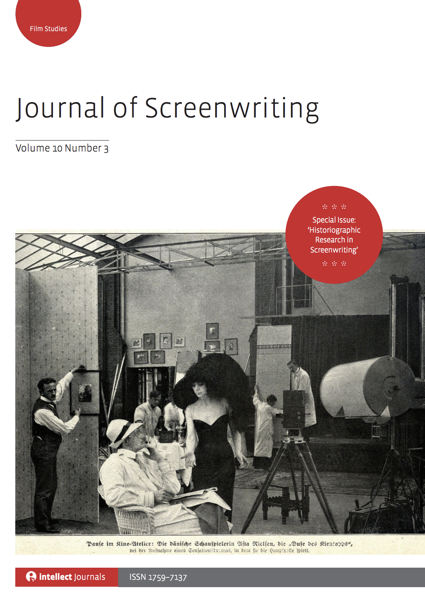
Highlighting the articles in the past editions of the Journal of Screenwriting, of which I am the Book Reviews Editor. Hopefully these abstracts will entice you to did a little deeper into the history and future of screenwriting. — Rosanne
The Screen Idea Work Group (SIWG) is a flexibly constructed group organized around the development and production of a screen idea; a hypothetical grouping of those professional workers involved in conceptualizing and developing fictional narrative work for any particular moving image screen idea. In this article, I use the notion of the SIWG to draw together the views of key workers about how the process of screen idea development works or doesn’t. My findings are based on a small ethnographic study I undertook in 2004, in which, through in-depth semi-structured interviews with seven SIWG workers, I attempted to understand how they came to occupy their role, how they felt their judgements were made and received, and how far the SIWG’s view of the screen idea accorded with the screenwriting doxa (characterized as how to do a good piece of work). As detailed below, their answers were concerned with status, a sense of self-worth and respect, points of tension, power, control, collaboration and trust, and the nature of the doxa itself.
The Journal of Screenwriting is an international double-blind peer-reviewed journal that is published three times a year. The journal highlights current academic and professional thinking about the screenplay and intends to promote, stimulate and bring together current research and contemporary debates around the screenplay whilst encouraging groundbreaking research in an international arena. The journal is discursive, critical, rigorous and engages with issues in a dynamic and developing field, linking academic theory to screenwriting practice.
Highly decorated member of the Navy Nurse Corps Laura Mae Cobb served as a military nurse for almost thirty years. She is best known for her leadership of the nurses, immortalized as the “Angels of Bataan,” who were held captive in the Philippines by the Japanese from just after Pearl Harbor until their liberation in February 1945. Throughout her time as a prisoner of war, Cobb and other Navy and Army nurses tended to those needing care while subtly resisting their captors, even mislabeling bottles to prevent looting. Under Cobb’s leadership, the nurses performed heroically and exemplarily, for which they were eventually recognized. Finally, on February 23, 1945, after four years in captivity and with almost all the nurses bordering on starvation, an American rescue team liberated them.
Learn about more Women In History with these encyclopedia from Dr. Rosanne Welch and Dr. Peg Lamphier
† †
* A portion of each sale from Amazon.com directly supports our blogs ** Many of these books may be available from your local library. Check it out! † Available from the LA Public Library
Subscribe to Rosanne’s Channel and receive notice of each new video!
Transcript:
Thank you all very much. I apologize that I will speak in English because we do very bad in teaching languages in the United States. So this is the best that I can do, but I appreciate very much the translator who will help us all this evening. So thank you all for coming. We are here to talk about why researching screenwriters is important and I think it’s a very important thing. I’ve been teaching it for a while and I was, in fact, a screenwriter myself for a while. As a writer in Hollywood, I wrote for these television shows. You can see me in the little corner picture there quite a few years ago on “Touched by an Angel”, “Beverly Hills 90210”. These are the kind of programs from the United States that get traveled around the world and I teach my students now how important it is that they are finally being able to take in the stories from other countries and we’ll talk about the importance of streaming media and how that has allowed for that to happen as we move on.
A Note About This Presentation
A clip from my keynote speech at the 10th Screenwriters´(hi)Stories Seminar for the interdisciplinary Graduation Program in “Education, Art, and History of Culture”, in Mackenzie Presbyterian University, at São Paulo, SP, Brazil, focused on the topic “Why Researching Screenwriters (has Always) Mattered.” I was especially pleased with the passion these young scholars have toward screenwriting and it’s importance in transmitting culture across the man-made borders of our world.
To understand the world we have to understand its stories and to understand the world’s stories we must understand the world’s storytellers. A century ago and longer those people would have been the novelists of any particular country but since the invention of film, the storytellers who reach the most people with their ideas and their lessons have been the screenwriters. My teaching philosophy is that: Words matter, Writers matter, and Women writers matte, r so women writers are my focus because they have been the far less researched and yet they are over half the population. We cannot tell the stories of the people until we know what stories the mothers have passed down to their children. Those are the stories that last. Now is the time to research screenwriters of all cultures and the stories they tell because people are finally recognizing the work of writers and appreciating how their favorite stories took shape on the page long before they were cast, or filmed, or edited. But also because streaming services make the stories of many cultures now available to a much wider world than ever before.
Many thanks to Glaucia Davino for the invitation.
* A portion of each sale from Amazon.com directly supports our blogs ** Many of these books may be available from your local library. Check it out! † Available from the LA Public Library
Distinguished Chinese American experimental physi- cist and the “First Lady of Physics,” Chien-Shiung Wu is best known for the Wu experiment, which proved that the law of conservation of parity does not hold for weak subatomic interactions. Dr. Wu was an expert in the subject of beta decay and played an important role in the Manhattan Project.
Learn about more Women In History with these encyclopedia from Dr. Rosanne Welch and Dr. Peg Lamphier
† †
* A portion of each sale from Amazon.com directly supports our blogs ** Many of these books may be available from your local library. Check it out! † Available from the LA Public Library
The tiny, brown-eyed redhead known to her many fans simply as “Lotta” was one of the most successful entertainers of the 19th century. Her family moved to California after the 1849 gold rush, when Crabtree was six, settling in Grass Valley. There, Crabtree reportedly befriended a neighbor, the notorious actress, dancer and courtesan, Lola Montez, who gave Lotta dancing lessons. Lotta appeared in light melodramas that showcased her talents as a banjo player, clog dancer and mimic. Crabtree began performing in the mining camps and small town variety theatres, singing ballads and clog dancing. The miners were said to have showered her with coins and gold nuggets, which her mother collected. When she retired at 45 she was one of the richest women in America.
Learn about more Women In History with these encyclopedia from Dr. Rosanne Welch and Dr. Peg Lamphier
† †
* A portion of each sale from Amazon.com directly supports our blogs ** Many of these books may be available from your local library. Check it out! † Available from the LA Public Library


![03 Elizabeth Gaskell from When Women Write Horror with Dr. Rosanne Welch [Video] (1 minute 3 seconds)](https://rosannewelch.com/wp-content/uploads/2020/03/rmw-cpp-horror-03.jpeg)


![01 Introduction from Why Researching Screenwriters (has Always) Mattered – Dr. Rosanne Welch [Video] (1 minute)](https://rosannewelch.com/wp-content/uploads/2020/03/rmw-sao-paolo-01.png)

