Alice Guy-Blaché (July 1, 1873 – March 24, 1968) was a pioneer filmmaker, active from the late 19th century, and one of the first to make a narrative fiction film.[2] From 1896 to 1906 she was probably the only female filmmaker in the world. [3] She experimented with Gaumont’s Chronophone sound syncing system, color tinting, interracial casting, and special effects. She was a founder and artistic director of the Solax Studios in Flushing, New York, in 1908. In 1912 Solax invested $100,000 for a new studio in Fort Lee, New Jersey, the center of American filmmaking prior to the establishment of Hollywood. That same year she made the film A Fool and his Money, with a cast comprised only African-American actors. The film is now at the National Center for Film and Video Preservation at the American Film Institute.[4] — Wikipedia
* A portion of each sale from Amazon.com directly supports our blogs ** Many of these books may be available from your local library. Check it out! † Available from the LA Public Library
Next, I don’t know most important , I don’t how I ordered these except they came to this order but Callie Khouri — anyone that can name the movie that she’s famous for? (Audience: Thelma & Louise) Thelma & Louise! Thank you. Thank Goodness. Thelma & Louise! An amazing film, right, that is still being talked about and debated in women’s studies, in Cinema Studies. Do we like the ending Don’t we like the ending? Is it how it could have ended? I think that’s pretty brilliant. Susannah Grant is probably not a name you recognize off the top of your head but you’ve seen these movies. Erin Brockovich is a huge film, right? Charlette’s Web – she has a lot of early kids work which is adorable. And Pocahontas, which is a very very famous Disney film so Suzanne has been one of our newer people and then as you recognized, Diablo Cody, right? Diablo Cody showed up doing Juno and then she did the United States of Tara with Spielberg on television. She’s moving and grooving through town so we’ll see what her next project is but she won an Oscar for Juno. That was her first outing as a screenwriter.
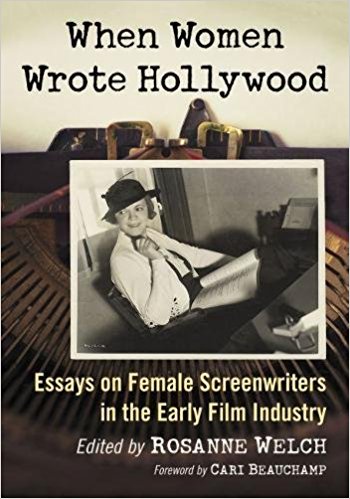
Dr. Rosanne Welch discusses the women in her new book “When Women Wrote Hollywood” which covers female screenwriters from the Silents through the early 1940s when women wrote over 50% of films and Frances Marion was the highest paid screenwriter (male or female) and the first to win 2 Oscars. Yet, she fails to appear in film history books, which continue to regurgitate the myth that male directors did it all – even though it’s been proven that the only profitable movies Cecil B. de Mille ever directed were all written by Jeannie Macpherson film ever won for Best Picture was written by Robert E. Sherwood (who people have heard of, mostly due to his connection to Dorothy Parker) and Joan Harrison.
* A portion of each sale from Amazon.com directly supports our blogs ** Many of these books may be available from your local library. Check it out! † Available from the LA Public Library
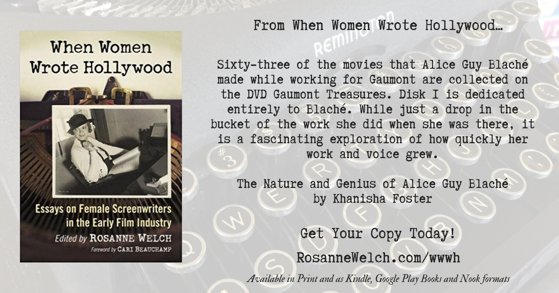
Sixty-three of the movies that Alice Guy Blaché made while working for Gaumont are collected on the DVD Gaumont Treasures. Disk 1 is dedicated entirely to Blaché. While just a drop in the bucket of the work she did when she was there, it is a fascinating exploration of how quickly her work and voice grew.
The Nature and Genius of Alice Guy Blaché by Khanisha Foster
* A portion of each sale from Amazon.com directly supports our blogs ** Many of these books may be available from your local library. Check it out! † Available from the LA Public Library
I was pleased to be asked to attend the first Italian Stories Day hosted by the Italian Society of Authors and Publishers and the Istituto Luce Cinecittà and Italian Audiovisual Producers Association at Mr. C in Beverly Hills. The three groups share the mission of helping more Italian authors see their work produced for the international film and television markets.
I had the pleasure of hearing about new books that we Americans will be able to read once their English translations are complete (within the next year) from authors like Tiziana Triana, author of Luna Nera – Le Città Perdute (Vol I) (Black Moon – The Lost Cities, Vol 1) which deals with witch hunters of 17th century Italy and how that affected women who yearned to gather knowledge; Stefania Auci, a Sicilian teacher and author of the historical novel Florence, published in 2015 by Baldini e Castoldi; and Edoardo Albinati, author of La Scuola Cattolica (The Catholic School).
I also had the chance to reconnect with Leonilde Callocchia, the Attaché at the Istituto Italiano di Cultura who hosted our Mentoris Book Launch last year, and a few producers I was able to invite to come to our Stephens College MFA workshops this August while we all munched on some marvelous brunch.
My Second-year MFA candidate Randi Barros and I spent the morning on set at the Manhattan Beach Studios watching a filmed table read of Barros’ script “Springtime in September.” A winner of this year’s ‘She Called Action’ 35 Pilot Table Read Contest, the script concerns a suddenly single mother dealing with dating in the new era.
This “She Called Action” event was created by Cheryl Rodes of the women-owned production company Rodes Unpaved, dedicated to putting women as the heroes of the story.
But for her, it started with Heartburn which is the novel she wrote about her own divorce from Carl Bernstein — the Carl Bernstein of All The President’s Men because he had an affair behind her back when she was pregnant. So she dumped him and then she wrote a book about it which became a movie starring Meryl Street and Jack Nicholson. From that, she went on to write Silkwood which is a brilliant film you should check out. Meryl Streep. It’s based on the real-life woman named Karen Silkwood who is about to give secrets to the government about how her nuclear facility was being mismanaged and she ended up crashed on the side of the road dead and nobody knew exactly how that happened. So that’s a brilliant — so she went from drama, drama, to comedy and then, of course, we know the other movies. My Blue Heaven is one of my favorites that got dismissed because didn’t make a lot at the box office but it is quite charming. It’s the witness protection program and it’s Steve Martin as a mafiosi in the program right and Rick Moranis is his his watcher and he doesn’t play by the rules he’s supposed to play and t’s funny as heck. So she’s Nora Ephron. She’s really she’s so brilliant that’s a Nora Ephron Prize you can win if you’re a screenwriter at the Tribeca Film Festival. That’s how important she is to the business right?
Dr. Rosanne Welch discusses the women in her new book “When Women Wrote Hollywood” which covers female screenwriters from the Silents through the early 1940s when women wrote over 50% of films and Frances Marion was the highest paid screenwriter (male or female) and the first to win 2 Oscars. Yet, she fails to appear in film history books, which continue to regurgitate the myth that male directors did it all – even though it’s been proven that the only profitable movies Cecil B. de Mille ever directed were all written by Jeannie Macpherson film ever won for Best Picture was written by Robert E. Sherwood (who people have heard of, mostly due to his connection to Dorothy Parker) and Joan Harrison.
* A portion of each sale from Amazon.com directly supports our blogs ** Many of these books may be available from your local library. Check it out! † Available from the LA Public Library
If you have friends who were interested in reading but low on cash, tell them to check it out.
And this is a reminder that if you want your local library to carry a copy, you need to ask a librarian. They have a form you can fill out that requests what books you’d like in their stacks. You can also send or give them this flyer with all the pertinent information!
* A portion of each sale from Amazon.com directly supports our blogs ** Many of these books may be available from your local library. Check it out! † Available from the LA Public Library
* A portion of each sale from Amazon.com directly supports our blogs ** Many of these books may be available from your local library. Check it out! † Available from the LA Public Library
KPFK’s Andrew Tonkovitch interviewed Paperback L.A. Editor Susan La Tempa for Bibliocracy Radio last weekend and they had nice things to say about how fun my piece on the writers of The Monkees and how much he had misunderstood the band until he read my article.
They discuss the whole anthology in this interview, and touch on The Monkees around the 20:20 mark.
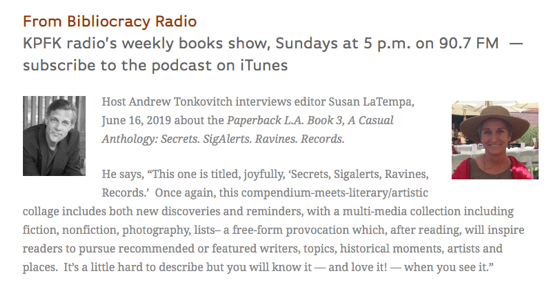
Host Andrew Tonkovitch interviews editor Susan LaTempa, June 16, 2019 about the Paperback L.A. Book 3, A Casual Anthology: Secrets. SigAlerts. Ravines. Records.
He says, “This one is titled, joyfully, ‘Secrets, Sigalerts, Ravines, Records.’ Once again, this compendium-meets-literary/artistic collage includes both new discoveries and reminders, with a multi-media collection including fiction, nonfiction, photography, lists– a free-form provocation which, after reading, will inspire readers to pursue recommended or featured writers, topics, historical moments, artists and places. It’s a little hard to describe but you will know it — and love it! — when you see it.”
Editor Susan La Tempa hosted all the local contributors at the event space in the Helms Bakery district, which gave us a chance to check out that lovely landmark. Then I had the chance to meet Lisa See – author of On Gold Mountain, which tells the story of 4 generations of her Chinese-American family living in Los Angeles and running a factory, an antique shop and a restaurant popular with the Hollywood crowd of the 1930s and 40s. We had first heard of her book when Doug and I were docents at the Autry Western Heritage Museum in Griffith Park and they had a whole exhibit dedicated to telling the story of the book (which it turns out Lisa curated!) It was so popular an exhibit that it hung around long enough for Joseph to be born and to become old enough to play in the little mini restaurant they set up with pots and plates and menus. So it was wonderful to hear Lisa read an excerpt from the book and then to talk to her during the book signing segment of the afternoon.
I was also deeply impressed by the way Susan opened the event with a native Tongva greeting – something I had only seen done at the public events we attended in New Zealand where everyone began events with the traditional Maori greeting where you introduce yourself in terms of what is your mountain, your river, and your ancestry. Beautiful! So hearing it in Los Angeles was a lovely idea we all ought to emulate.
Then the super cool thing was that several friends made the trip down to Culver City – thanks Duke and Dena Jackels and Dan and Liz Forer – and Euphemia – for coming to the reading, and for buying books!


![09 Important Women Screenwriters Today from “When Women Wrote Hollywood” with Dr. Rosanne Welch [Video] (58 seconds)](https://rosannewelch.com/wp-content/uploads/2019/07/csuf-rmw-w3h-09.jpeg)


![08 Nora Ephron from “When Women Wrote Hollywood” with Dr. Rosanne Welch [Video] (1 minute 9 seconds)](https://rosannewelch.com/wp-content/uploads/2019/06/csuf-rmw-w3h-08.jpeg)

![Rosanne Reads at Paperback LA 3 Launch Party [Photos]](https://rosannewelch.com/wp-content/uploads/2019/05/DSC09388.jpg)
![Rosanne Reads at Paperback LA 3 Launch Party [Photos]](https://rosannewelch.com/wp-content/uploads/2019/05/IMG_4246.jpg)
![Rosanne Reads at Paperback LA 3 Launch Party [Photos]](https://rosannewelch.com/wp-content/uploads/2019/05/IMG_4385.jpg)
![Rosanne Reads at Paperback LA 3 Launch Party [Photos]](https://rosannewelch.com/wp-content/uploads/2019/05/IMG_4388.jpg)
