13 The Amityville Horror from When Women Write Horror with Dr. Rosanne Welch [Video] (32 seconds)

Watch this entire presentation

13 The Amityville Horror from When Women Write Horror with Dr. Rosanne Welch

Subscribe to Rosanne’s Channel and receive notice of each new video!


In honor of Halloween – and in service to my teaching philosophy —

“Words Matter. Writers Matter. Women Writers Matter.”

I presented this holiday lecture “When Women Write Horror” on Tuesday, October 29th, 2019. Researching the many, many women who have written horror stories – in novels, films and television – brought new names to my attention who I am excited to start reading. I hope you will be, too!

Transcript:

The idea of a haunted house and what we do with haunted houses led us to probably the most famous horror house – changed house — book then film series – The Amityville Horror. Written by a guy so right I’m not doing guys today too much however it’s kind of interesting to say that the dude’s book was proven to be an entire fake. He gave a story about a family that had actually lived in this house and what had happened and then eventually the family came forward and said “Yeah, we just did that for the money. None of that really happened. We made it all up.” So it kind of undermined the whole concept.

From The Journal Of Screenwriting V1 Issue 2: The early screenwriting practice of Ernest Lehman by Ted Nannicelli

Highlighting the articles in the past editions of the Journal of Screenwriting, of which I am the Book Reviews Editor. Hopefully these abstracts will entice you to did a little deeper into the history and future of screenwriting. — Rosanne


The early screenwriting practice of Ernest Lehman by Ted Nannicelli

This article analyses Ernest Lehman’s early screenwriting practice and argues that there are essential commonalities between it and his prose fiction writing practice. In the first section, I highlight the similarities between Lehman’s working notes for his abandoned novel, You Scratch My Back , and his unfinished screenplay for the MGM project, Labor Story. In the second section, I look at the ways in which Lehman’s prose fiction writing practice influences the composition of his first screenplay, for Executive Suite, as well as the composition of his screenplay for Sweet Smell of Success, and argue that in his prose fiction writing and screenwriting, Lehman uses language in the same aesthetically relevant ways.


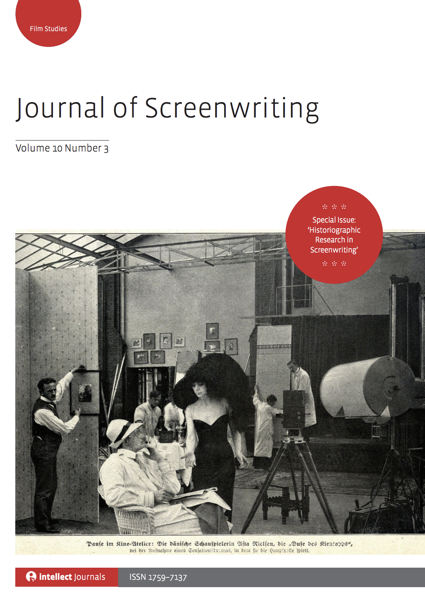
The Journal of Screenwriting is an international double-blind peer-reviewed journal that is published three times a year. The journal highlights current academic and professional thinking about the screenplay and intends to promote, stimulate and bring together current research and contemporary debates around the screenplay whilst encouraging groundbreaking research in an international arena. The journal is discursive, critical, rigorous and engages with issues in a dynamic and developing field, linking academic theory to screenwriting practice. 

Get your copy and subscription to the Journal of Screenwriting Today!


* A portion of each sale from Amazon.com directly supports our blogs
** Many of these books may be available from your local library. Check it out!

Watch Now: Creative Career Kickstart: Catching and Pitching Panel – ASU Film Spark Program [Video] (1 hour 15 minutes)

Asu film spark logoFor a few years running my colleague Warren Lewis has asked me to be a panelist for the semi-annual Film Spark event for ASU  (Arizona State University) discussing pitching on a panel and then listening and giving notes to students during an afternoon pitchathon. 

This year, due to our sheltering at home during the virus the event used Zoom so for the first time they recorded the hour long panel – and here it is. 

We were each asked to give advice based on the stories of our best and worst pitches, which provided a few good laughs and hopefully a lot of good advice.

Creative Career Kickstart: Catching and Pitching Panel - ASU Film Spark Program [Video] (1 hour 15 minutes)

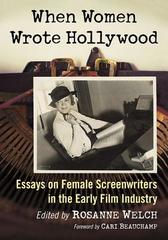
From The “When Women Wrote Hollywood” Archives 27: Feminism and the Female Author: The Not So Silent Career of the Woman Scenarist in Hollywood—1896–1930 by Donna R. Casella

Months of research went into the creation of the essays in “When Women Wrote Hollywood.” Here are some of the resources used to enlighten today’s film lovers to the female pioneers who helped create it.

From The “When Women Wrote Hollywood” Archives 27: Feminism and the Female Author: The Not So Silent Career of the Woman Scenarist in Hollywood—1896–1930 by Donna R. Casella

From The

In Of With Their Heads! A Serio-Comic Tale of Hollywood, scenarist Frances Marion speaks of her attempts to secures writing job in Hollywood ma reputable salary, particularly of her encounter with Fox who couldn’t understand why she would want to write. “Listen, cuteness, don’t try to be a foolish somebody. Nobody cares nothing about female writer,” She kept pestering him until he offered her a job as a staff writer for $80 a week. She then went across town to William A. Brady’s office at World Film Company and pushed her way in at $200 a week stating in her autobiography, “it’s about time the writers got on the gravy train.. It was the teens, the early days of scenario writing in Hollywood. Anita Loos was a staff writer at Biograph where she was paid by the story, eventually earning $200 a piece. Gene Gunder was acting and writing scenarios for Kalem, then her own company, Gene Gauntier Feature Film Company, and eventually Universal. Jeanie Macpherson was beginning along and prolific partnership with director Cecil B. DeMille. Grace Cunard was taming out and acting in action-packed serials at Universal. Arid by the end of the decade, June Mathis, a regular scenarist at Metro, was chief of their script department. Women did not struggle to be a part of the growing industry of scenario writing in its early days, for women dominated the industry, and women like Marion, Loos, Mathis and Macpherson were among the most successful scenarists finale on female) in film history.’


Buy “When Women Wrote Hollywood” Today!


When Women Wrote Hollywood: Essays on Female Screenwriters in the Early Film Industry

Paperback Edition | Kindle Edition | Google Play Edition

Help Support Local Bookstores — Buy at Bookshop.org

* A portion of each sale from Amazon.com directly supports our blogs
** Many of these books may be available from your local library. Check it out!
† Available from the LA Public Library

12 The Haunting of Hill House from When Women Write Horror with Dr. Rosanne Welch [Video] (50 seconds)

Watch this entire presentation

12 The Haunting of Hill House from When Women Write Horror with Dr. Rosanne Welch

Subscribe to Rosanne’s Channel and receive notice of each new video!


In honor of Halloween – and in service to my teaching philosophy —

“Words Matter. Writers Matter. Women Writers Matter.”

I presented this holiday lecture “When Women Write Horror” on Tuesday, October 29th, 2019. Researching the many, many women who have written horror stories – in novels, films and television – brought new names to my attention who I am excited to start reading. I hope you will be, too!

Transcript:

You probably know her more from the show that is currently on Netflix. However this show is not the book at all. It is based upon ideas in the book right? So Netflix is pretty smart. It’s based on the idea that a family grew up in this house and now as adults what’s wrong with their lives that they trace back to these moments in their childhood. So it’s a little bit like a haunted This Is Us, basically, but again with Stephen King, he really believes that the show is quite good and that she would like it and that’s a high praise from him because he thinks she is the greatest science fiction excuse-me horror writer in the United States. So I think it’s pretty cool that you can sample that and then go back and read the book and see where they got the ideas from. Imagine just taking that book and going “How do I do this differently right?” for TV. So Shirley Jackson, a very very big name.

From The Journal Of Screenwriting V1 Issue 2: Time, space and movement: screenplay as oral narrative by Adam Ganz

Highlighting the articles in the past editions of the Journal of Screenwriting, of which I am the Book Reviews Editor. Hopefully these abstracts will entice you to did a little deeper into the history and future of screenwriting. — Rosanne


Time, space and movement: screenplay as oral narrative by Adam Ganz

Paul Schrader contends that the screenplay is an oral medium. This article explores the validity of this contention by analysing the ballad Janet or Lady Maisry (Child 65) and its use of what are generally thought of as screenwriting techniques to tell its story, in particular looking at the way it makes use of montage, multiple narratives and different timescales to create suspense and involve the audience. It looks at the role of visualization in oral narrative and suggests that screenwriters and analyses have much to gain by looking at films as oral narratives, which like ballads are told rhythmically in real time in front of an audience. It suggests that screenwriters and academics studying the screenplay could benefit from looking at song and music as a helpful paradigm for understanding screenplay techniques and developing screenplay notation.


The Journal of Screenwriting is an international double-blind peer-reviewed journal that is published three times a year. The journal highlights current academic and professional thinking about the screenplay and intends to promote, stimulate and bring together current research and contemporary debates around the screenplay whilst encouraging groundbreaking research in an international arena. The journal is discursive, critical, rigorous and engages with issues in a dynamic and developing field, linking academic theory to screenwriting practice. 

Get your copy and subscription to the Journal of Screenwriting Today!


* A portion of each sale from Amazon.com directly supports our blogs
** Many of these books may be available from your local library. Check it out!

Learn More About the Stephens College MFA in TV and Screenwriting with this Open House Session [Video]

Thanks to the wonderful women of the Stephens College advancement office who arranged a Virtual Open House for our MFA.

This gave us the chance to meet potential students (and a few who had already been accepted) and answer questions about how the program operates.

It’s always fun to engage with people and share our enthusiasm about the Stephens College MFA in TV and Screenwriting – and nowadays part of the fun of Zooming is checking out other folks’ backgrounds whether they are virtual (are they using the TARDIS of the Golden Gate Bridge) or their real office bookshelves. (Hey – I have that same book on my bookshelf!).

If you have any questions that weren’t answered during this Open House, send them directly to me at rwelch@stephens.edu and I’ll be glad to answer them.

Learn More About the Stephens College MFA in TV and Screenwriting with this Open House Session [Video]

Subscribe to the Stephens College YouTube Channel


From The “When Women Wrote Hollywood” Archives 26: Adela St. Johns, . The Honeycomb. Garden City, N.Y.: Doubleday, 1969.

Months of research went into the creation of the essays in “When Women Wrote Hollywood.” Here are some of the resources used to enlighten today’s film lovers to the female pioneers who helped create it.

From The “When Women Wrote Hollywood” Archives 26: Adela St. Johns, . The Honeycomb. Garden City, N.Y.: Doubleday, 1969.

“At eighteen I must have been regarded as a woman, writes the author in this colorful memoir, for I was one of the first women reporters, maybe as an all-around police beat, sports, sin and society reporter the first in the world.” “Although she chose what was considered a man’s career, she never forgot that she was a woman, and in her recollections, she also finds time to discuss her youghful flirtations, her bittersweet marriage to Ike St. Johns, a profound love affair, her difficulties with being simultaneously a wife, mother and coreer woman, as well as more serious personal problems. The result is a blockbuster of a story which catches the reader up in its drama and excitement and involves him in a personal confrontation with the events.” — Amazon


Buy “When Women Wrote Hollywood” Today!


When Women Wrote Hollywood: Essays on Female Screenwriters in the Early Film Industry

Paperback Edition | Kindle Edition | Google Play Edition

Help Support Local Bookstores — Buy at Bookshop.org

* A portion of each sale from Amazon.com directly supports our blogs
** Many of these books may be available from your local library. Check it out!
† Available from the LA Public Library

11 More On Shirley Jackson from When Women Write Horror with Dr. Rosanne Welch [Video] (1 minute 3 seconds)

Watch this entire presentation

11 More On Shirley Jackson from When Women Write Horror with Dr. Rosanne Welch

Subscribe to Rosanne’s Channel and receive notice of each new video!


In honor of Halloween – and in service to my teaching philosophy —

“Words Matter. Writers Matter. Women Writers Matter.”

I presented this holiday lecture “When Women Write Horror” on Tuesday, October 29th, 2019. Researching the many, many women who have written horror stories – in novels, films and television – brought new names to my attention who I am excited to start reading. I hope you will be, too!

Transcript:

Some of you probably know her more from this short story that is also often read in high schools, The Lottery, which has to do with a town where once a year we choose one person who everybody else in town can stone to death and then we get all our aggressions out and we’re -peaceful the rest of the year and if you think about that coming from the brain of a housewife who’s been hanging around little kids all day and what was she saying about “I just want one day when I can take out all these aggressions and then I’ll be fine. I promise you,” but, of course, the issue is it’s a random — it’s a lottery when that name is pulled and this particular year it’s the mother in a family and how does the family react when it’s their mother that is going to be stoned to death this year. So, a really interesting brain going on with this woman. You might have heard of her before. This is her best-known novel and her best critic novel, “We’ve always lived in the castle.” Again, having to do with the family and people coming together and being horrified together. I think it’s very cool. I like that she says, “I delight in what I fear.” That’s not usually what I delight in but ok, whatever.

From The Journal Of Screenwriting V1 Issue 1: No room for the fun stuff: the question of the screenplay in American indie cinema by J. J Murphy

Highlighting the articles in the past editions of the Journal of Screenwriting, of which I am the Book Reviews Editor. Hopefully these abstracts will entice you to did a little deeper into the history and future of screenwriting. — Rosanne


No room for the fun stuff: the question of the screenplay in American indie cinema by J. J Murphy
 
One of the most interesting trends in recent independent cinema has been for film-makers to avoid using traditional screenplays in making their films. Not only have emerging film-makers associated with the so-called mumblecore movement, such as Joe Swanberg, Aaron Katz and Ronald Bronstein, veered away from depending on conventionally written screenplays, but other critically acclaimed films, including The Pool (Smith, 2008) and Ballast (Hammer, 2008), have as well. Indeed, some of the most notable American indie film-makers Gus Van Sant, David Lynch and Jim Jarmusch have employed alternative strategies to the screenplay in such recent films as Elephant (2003), Inland Empire (2006), and The Limits of Control (2009). What is behind these developments and why has the conventional screenplay been under attack? What are the aesthetic benefits of choosing not to rely on a traditional script? Is this a completely new phenomenon or has the industrial screenplay always been an obstacle? I explore these issues by looking at three major strategies that indie film-makers have used in place of the traditional screenplay: improvisation, psychodrama and visual storytelling. Finally, I argue that for current independent film-makers in the United States of America these methods provide an appropriate model for a practice that is attempting to create a truly viable alternative to Hollywood cinema.


The Journal of Screenwriting is an international double-blind peer-reviewed journal that is published three times a year. The journal highlights current academic and professional thinking about the screenplay and intends to promote, stimulate and bring together current research and contemporary debates around the screenplay whilst encouraging groundbreaking research in an international arena. The journal is discursive, critical, rigorous and engages with issues in a dynamic and developing field, linking academic theory to screenwriting practice. 

Get your copy and subscription to the Journal of Screenwriting Today!


* A portion of each sale from Amazon.com directly supports our blogs
** Many of these books may be available from your local library. Check it out!