Where’s Her Movie? Painter, Artemisia Gentileschi – 3 in a series

“Where’s HER Movie” posts will highlight interesting and accomplished women from a variety of professional backgrounds who deserve to have movies written about them as much as all the male scientists, authors, performers, and geniuses have had written about them across the over 100 years of film.  This is our attempt to help write these women back into mainstream history.  — Rosanne
Where's Her Movie? Painter, Artemisia Gentileschi - 3 in a series

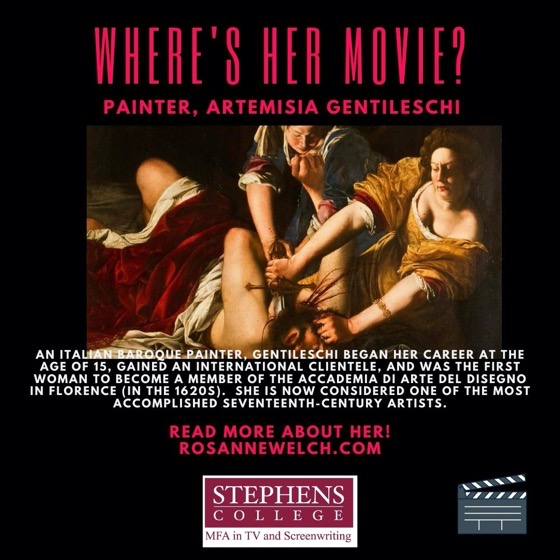
An Italian Baroque painter, Gentileschi began her careet at the age of 15, gained an international clientele, and was the first woman to become a member of the Accademia di Arte del Disegno in Florence (in the 1620s).  
 
She is now considered one of the most accomplished seventeenth-century artists. 

Read more about Artemisia Gentileschi

from Wikipedia…

Artemisia Lomi or Artemisia Gentileschi (US: /ˌdʒɛntiˈlɛski/,[1][2] Italian: [arteˈmiːzja dʒentiˈleski]; July 8, 1593 – c. 1656) was an Italian Baroque painter, now considered one of the most accomplished seventeenth-century artists, initially working in the style of Caravaggio. She was producing professional work by the age of fifteen.[3] In an era when women had few opportunities to pursue artistic training or work as professional artists, Artemisia was the first woman to become a member of the Accademia di Arte del Disegno in Florence and she had an international clientele.[4][5]

Many of Artemisia’s paintings feature women from myths, allegories, and the Bible, including victims, suicides, and warriors.[6] Some of her best known subjects are Susanna and the Elders (particularly the 1610 version in Pommersfelden), Judith Slaying Holofernes (her 1614–1620 version is in the Uffizi gallery), and Judith and Her Maidservant (her version of 1625 is in the Detroit Institute of Arts).

Artemisia was known for being able to depict the female figure with great naturalism,[7][8] and for her skill in handling color to express dimension and drama.[9][10]
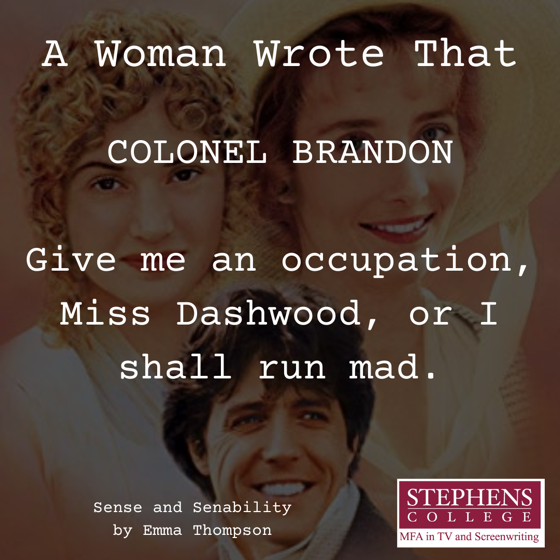
A Woman Wrote That – 5 in a series – Sense and Sensibility by Emma Thompson (1995)

This new “A Woman Wrote That” post is an echo of the Writers Guild campaign of a few years ago (“A Writer Wrote That”) where they noted famous movie quotes and credited the screenwriter rather than the director.  The difference here being that we will be posting lines from films written by female screenwriters.  Feel free to share! — Rosanne

A Woman Wrote That - 5 in a series - Sense and Sensibility by Emma Thompson (1995)

COLONEL BRANDON: “Give me an occupation, Miss Dashwood, or I shall run mad.”

Sense and Sensibility Script

39 My Own Favorite International TV Shows from Why Researching Screenwriters Has Always Mattered [Video] (1 minute 31 seconds)

Watch this entire presentation

39 My Own Favorite International TV Shows from Why Researching Screenwriters Has Always Mattered

Subscribe to Rosanne’s Channel and receive notice of each new video!


Transcript:

In my own Television viewing experience, I’ve had the chance to see all of these programs which I never would have seen. Commisaroio Montalbano is the most famous detective show in Italy. Again, that helps me feel more connected to my cousins and what they’re watching and to my grandparents and the world they grew up in. I can see footage from Italy. I was amazed to find that Doctor Who eventually traveled around the whole world. I’m told the doesn’t play here necessarily but probably geeky people have found it somewhere. Trapped was a miniseries made in Iceland. You can see the Icelandic translation on the bottom and it aired on Netflix and I was amazed to watch eight hours of something that was filmed in Iceland and told me about a culture I could possibly never imagine and might never have the chance to see but because of Netflix. I’ve now experienced this program — and then Call My Agent I find very funny. It’s a French show. You can see the proper title –the French title– on top and it’s about a talent agency. — just as Roger was explaining this morning — in France and how they work with actors and all the problems that happen. It’s a one-hour comedy and what’s cute about it is the characters — the actors who played actors on the show are actually famous French actors pretending to be bad people and causing troubles for their agents. So you’ve recognized actors you’ve seen in movies coming in and talking to the fake agents that they are with. So it’s a charming way to learn more about French films, right, in just one program. So I’ve been so impressed with what I’ve been able to see.

Watch this entire presentation

A Note About This Presentation

A clip from my keynote speech at the 10th Screenwriters´(hi)Stories Seminar for the interdisciplinary Graduation Program in “Education, Art, and History of Culture”, in Mackenzie Presbyterian University, at São Paulo, SP, Brazil, focused on the topic “Why Researching Screenwriters (has Always) Mattered.” I was especially pleased with the passion these young scholars have toward screenwriting and it’s importance in transmitting culture across the man-made borders of our world.

To understand the world we have to understand its stories and to understand the world’s stories we must understand the world’s storytellers. A century ago and longer those people would have been the novelists of any particular country but since the invention of film, the storytellers who reach the most people with their ideas and their lessons have been the screenwriters. My teaching philosophy is that: Words matter, Writers matter, and Women writers matte, r so women writers are my focus because they have been the far less researched and yet they are over half the population. We cannot tell the stories of the people until we know what stories the mothers have passed down to their children. Those are the stories that last. Now is the time to research screenwriters of all cultures and the stories they tell because people are finally recognizing the work of writers and appreciating how their favorite stories took shape on the page long before they were cast, or filmed, or edited. But also because streaming services make the stories of many cultures now available to a much wider world than ever before.

Many thanks to Glaucia Davino for the invitation.


* A portion of each sale from Amazon.com directly supports our blogs
** Many of these books may be available from your local library. Check it out!
† Available from the LA Public Library

The Civil War On Film – 8 in a series – “…Lost Cause adherents deny the immorality and cruelty of slavery….”

The Civil War On Film - 8  in a series -

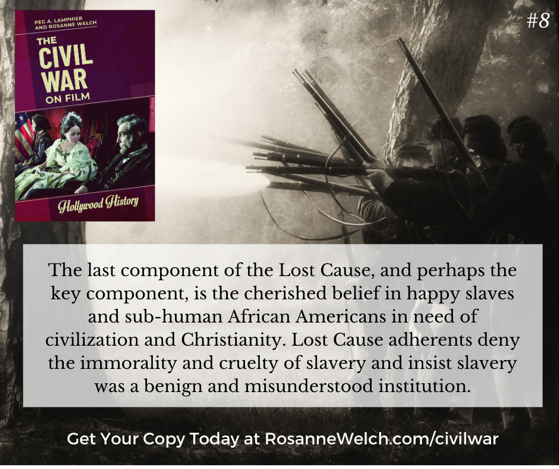
The last component of the Lost Cause, and perhaps the key component, is the cherished belief in happy slaves and sub-human African Americans in need of civilization and Christianity. Lost Cause adherents deny the immorality and cruelty of slavery and insist slavery was a benign and misunderstood institution.

Movies profiled in this book:

From The Journal Of Screenwriting V3 Issue 1: Television and film screenwriters: How to reach a global audience by Philippe Perebinossoff

Highlighting the articles in the past editions of the Journal of Screenwriting, of which I am the Book Reviews Editor. Hopefully these abstracts will entice you to did a little deeper into the history and future of screenwriting. — Rosanne


Television and film screenwriters: How to reach a global audience by Philippe Perebinossoff

The focus of this article will be on an examination of American television and film projects and their inceptions and/or receptions in various marketplaces. In addition, the article will explore some of the specific cultural differences around the world that may be of importance to screenwriters.


The Journal of Screenwriting is an international double-blind peer-reviewed journal that is published three times a year. The journal highlights current academic and professional thinking about the screenplay and intends to promote, stimulate and bring together current research and contemporary debates around the screenplay whilst encouraging groundbreaking research in an international arena. The journal is discursive, critical, rigorous and engages with issues in a dynamic and developing field, linking academic theory to screenwriting practice. 

Get your copy and subscription to the Journal of Screenwriting Today!


* A portion of each sale from Amazon.com directly supports our blogs
** Many of these books may be available from your local library. Check it out!

A Woman Wrote That – 4 in a series – Thelma and Louise by Callie Khouri (1991)

This new “A Woman Wrote That” post is an echo of the Writers Guild campaign of a few years ago (“A Writer Wrote That”) where they noted famous movie quotes and credited the screenwriter rather than the director.  The difference here being that we will be posting lines from films written by female screenwriters.  Feel free to share! — Rosanne

A Woman Wrote That - 4 in a series - Thelma and Louise by Callie Khouri (1991)

Louise: “You get what you settle for.”

Thelma and Louise Script (PDF)


The Civil War On Film – 7 in a series – “…honorable Southern generals stand in contrast to venal, uncouth Northerners.”

The Civil War On Film - 6  in a series -

In keeping with the binary nature of ideologies, the honorable Southern generals stand in contrast to venal, uncouth Northerners. The Lost Cause insists upon the illegitimacy of Abraham Lincoln’s election and his personal villainy as a backwoods barbarian, miscegenationist and all-purpose bad dude.

Movies profiled in this book:

From The Journal Of Screenwriting V3 Issue 1: Irish cinema 1994–2009: The trajectory of script development policy at the Irish Film Board by Díóg O’Connell

Highlighting the articles in the past editions of the Journal of Screenwriting, of which I am the Book Reviews Editor. Hopefully these abstracts will entice you to did a little deeper into the history and future of screenwriting. — Rosanne


Irish cinema 1994–2009: The trajectory of script development policy at the Irish Film Board by Díóg O’Connell

This article explores the changing nature of public policy in Ireland, 1994–2009, as it relates to film and scriptwriting practice. The dominant discourse in Irish cinema studies has centred around ideas of identity, national identity in particular with more recent studies branching off in the direction of genre studies, political economy and narrative studies. This article is framed, broadly speaking, within a political economy discourse, by way of exploring how Irish Film Board policy changed over a specific period as a result of internal and external factors, shaping a structure that would determine how Irish scriptwriters related to the wider field of film production. Through a survey of Irish Film Board policies, newspaper articles and annual reports, this article presents a general historical overview of an evolving film policy as it related directly to scriptwriting and script development. Against this backdrop, other questions surface about Irish cinema and scriptwriting practice, particularly questions centred on local/global issues.


The Journal of Screenwriting is an international double-blind peer-reviewed journal that is published three times a year. The journal highlights current academic and professional thinking about the screenplay and intends to promote, stimulate and bring together current research and contemporary debates around the screenplay whilst encouraging groundbreaking research in an international arena. The journal is discursive, critical, rigorous and engages with issues in a dynamic and developing field, linking academic theory to screenwriting practice. 

Get your copy and subscription to the Journal of Screenwriting Today!


* A portion of each sale from Amazon.com directly supports our blogs
** Many of these books may be available from your local library. Check it out!

A Woman Wrote That – 3 in a series – E.T. the Extra-Terrestrial

This new “A Woman Wrote That” post is an echo of the Writers Guild campaign of a few years ago (“A Writer Wrote That”) where they noted famous movie quotes and credited the screenwriter rather than the director.  The difference here being that we will be posting lines from films written by female screenwriters.  Feel free to share! — Rosanne

A Woman Wrote That - 2 in a series - E.T. the Extra-Terrestrial

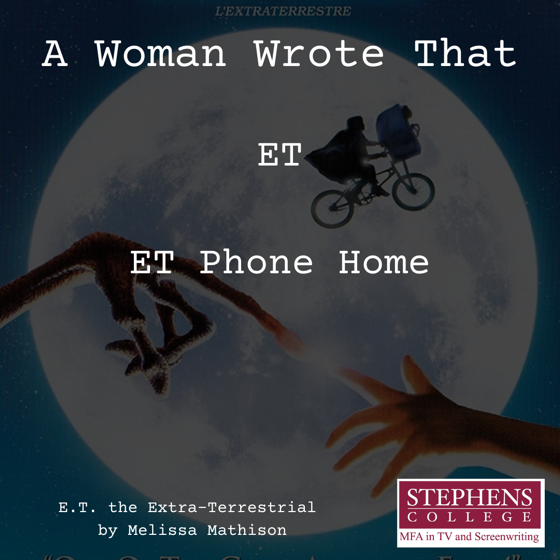
“ET Phone Home”

E.T. the Extra-Terrestrial Shooting Script (PDF)

E.T. the Extra-Terrestrial on IMDB

37 International TV Shows and the US from Why Researching Screenwriters Has Always Mattered [Video] (41 seconds)

Watch this entire presentation

37 International TV Shows and the US from Why Researching Screenwriters Has Always Mattered [Video] (41 seconds)

Subscribe to Rosanne’s Channel and receive notice of each new video!


Transcript:

This is a film — excuse me — a tv show that started in Europe. I learned about it through an Italian screenwriting colleague — Braccialetti Rossi and it’s about a group of young children in a hospital and they wear red bands because they have terminal illnesses and it’s about them banding together and being friends, One of the things that’s good or maybe bad about what’s going on with international television is that I believe we could air the original version in the United States and that enough people would watch it but the networks still believe they need to have an American version — a United States version. I had to learn to stop saying that this week right because I’m in America right now.

Watch this entire presentation

A Note About This Presentation

A clip from my keynote speech at the 10th Screenwriters´(hi)Stories Seminar for the interdisciplinary Graduation Program in “Education, Art, and History of Culture”, in Mackenzie Presbyterian University, at São Paulo, SP, Brazil, focused on the topic “Why Researching Screenwriters (has Always) Mattered.” I was especially pleased with the passion these young scholars have toward screenwriting and it’s importance in transmitting culture across the man-made borders of our world.

To understand the world we have to understand its stories and to understand the world’s stories we must understand the world’s storytellers. A century ago and longer those people would have been the novelists of any particular country but since the invention of film, the storytellers who reach the most people with their ideas and their lessons have been the screenwriters. My teaching philosophy is that: Words matter, Writers matter, and Women writers matte, r so women writers are my focus because they have been the far less researched and yet they are over half the population. We cannot tell the stories of the people until we know what stories the mothers have passed down to their children. Those are the stories that last. Now is the time to research screenwriters of all cultures and the stories they tell because people are finally recognizing the work of writers and appreciating how their favorite stories took shape on the page long before they were cast, or filmed, or edited. But also because streaming services make the stories of many cultures now available to a much wider world than ever before.

Many thanks to Glaucia Davino for the invitation.


* A portion of each sale from Amazon.com directly supports our blogs
** Many of these books may be available from your local library. Check it out!
† Available from the LA Public Library