Months of research went into the creation of the essays in “When Women Wrote Hollywood.” Here are some of the resources used to enlighten today’s film lovers to the female pioneers who helped create it.
With the perspiring assistance of Thomas Mitchell, who acts like a steam locomotive, the Spewacks have tossed another one of those melodramatic lampoons at the newspaper profession in “Clear All Wires,” put on at the Times Square last evening. It is brisk, noisy, extravagant and funny in “The Front Page” and “Broadway” tradition.
* A portion of each sale from Amazon.com directly supports our blogs
** Many of these books may be available from your local library. Check it out!
† Available from the LA Public Library
Highlighting the articles in the past editions of the Journal of Screenwriting, of which I am the Book Reviews Editor. Hopefully these abstracts will entice you to did a little deeper into the history and future of screenwriting. — Rosanne
The article focuses on the invisible role of the screenwriter and makes observations about the screenwriter’s part in the process of writing a screenplay together with a director. By studying the two examples of the collaboration between the screenwriter and poet Tonino Guerra with the directors Michelangelo Antonioni and Andrei Tarkovsky, the intention is to follow the ways in which authorship is both constituted and shared in such a liaison. I observe how the craft of the screenwriter is understood in relation to the different aspects of his task. By focusing on the case study around the writing of the film Nostalghia/Nostalgia (1983), I also consider how responsibility in developing these aspects is shared between screenwriter and director during different phases of a screenwriting process: in gathering ideas, sketching, building the story structure, writing drafts, rewriting and completing the final draft.
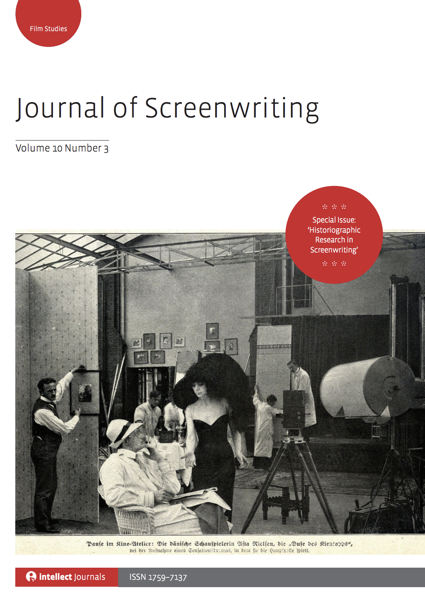
The Journal of Screenwriting is an international double-blind peer-reviewed journal that is published three times a year. The journal highlights current academic and professional thinking about the screenplay and intends to promote, stimulate and bring together current research and contemporary debates around the screenplay whilst encouraging groundbreaking research in an international arena. The journal is discursive, critical, rigorous and engages with issues in a dynamic and developing field, linking academic theory to screenwriting practice.
As a member of the Executive Council of the Screenwriting Research Network (SRN) I have the great pleasure of meeting with colleagues from several continents (Australia, South America, Europe, etc) on a monthly basis to discuss the business of the organization. it continues to amaze me how technology allows us to do this – as it continues to amaze me how lucky I am to have had the chance to meet all of these lovely folks in person at our various conferences. Can’t wait for the next one – in Oxford in 2021!
London, United Kingdom Fri, Apr 24, 2020 at 12:30 am BST
Eastern Time, ET Thu, Apr 23, 2020 at 7:30 pm EDT
Central Time, CT Thu, Apr 23, 2020 at 6:30 pm CDT
Mountain Time, MT Thu, Apr 23, 2020 at 5:30 pm MDT
Pacific Time, PT Thu, Apr 23, 2020 at 4:30 pm PDT
Sydney, Australia Fri, Apr 24, 2020 at 9:30 am AEST
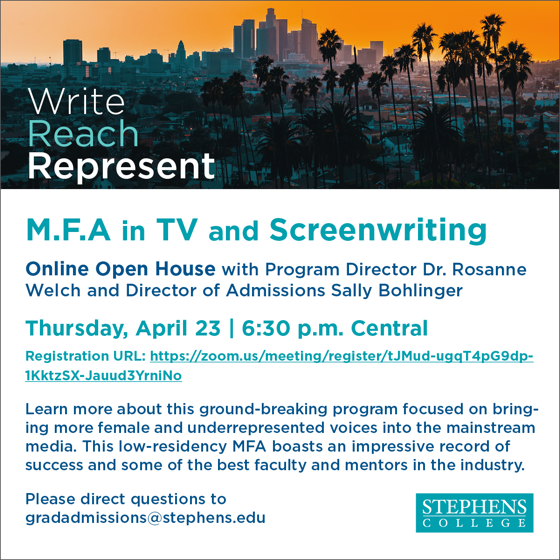
Learn more about this ground-breaking program focused on bringing more female and underrepresented voices into the mainstream media. The MFA boasts an impressive record of success and some of the best faculty and mentors in the industry.
Subscribe to Rosanne’s Channel and receive notice of each new video!
Transcript:
I apologize for the long quote but I am very appreciative when actors recognize the work of writers and so Frances McDormand said this when she won her Oscar basically she said of the writer Martin McDonagh, He did not sketch a blueprint. That’s an insult to a screenplay. He didn’t string together a few words. He wrote and meticulously crafted a tsunami of a story and then he let the actors play there. So she immediately was crediting the writer in a way that many people do not. I believe the stories are important because they transmit our culture around the world. Again, United States has had a corner on that market for far too many years and now we’re beginning to see other stories permeate our culture and that’s only been a good, beneficial thing for us.
A Note About This Presentation
A clip from my keynote speech at the 10th Screenwriters´(hi)Stories Seminar for the interdisciplinary Graduation Program in “Education, Art, and History of Culture”, in Mackenzie Presbyterian University, at São Paulo, SP, Brazil, focused on the topic “Why Researching Screenwriters (has Always) Mattered.” I was especially pleased with the passion these young scholars have toward screenwriting and it’s importance in transmitting culture across the man-made borders of our world.
To understand the world we have to understand its stories and to understand the world’s stories we must understand the world’s storytellers. A century ago and longer those people would have been the novelists of any particular country but since the invention of film, the storytellers who reach the most people with their ideas and their lessons have been the screenwriters. My teaching philosophy is that: Words matter, Writers matter, and Women writers matte, r so women writers are my focus because they have been the far less researched and yet they are over half the population. We cannot tell the stories of the people until we know what stories the mothers have passed down to their children. Those are the stories that last. Now is the time to research screenwriters of all cultures and the stories they tell because people are finally recognizing the work of writers and appreciating how their favorite stories took shape on the page long before they were cast, or filmed, or edited. But also because streaming services make the stories of many cultures now available to a much wider world than ever before.
Many thanks to Glaucia Davino for the invitation.
* A portion of each sale from Amazon.com directly supports our blogs ** Many of these books may be available from your local library. Check it out! † Available from the LA Public Library
Months of research went into the creation of the essays in “When Women Wrote Hollywood.” Here are some of the resources used to enlighten today’s film lovers to the female pioneers who helped create it.
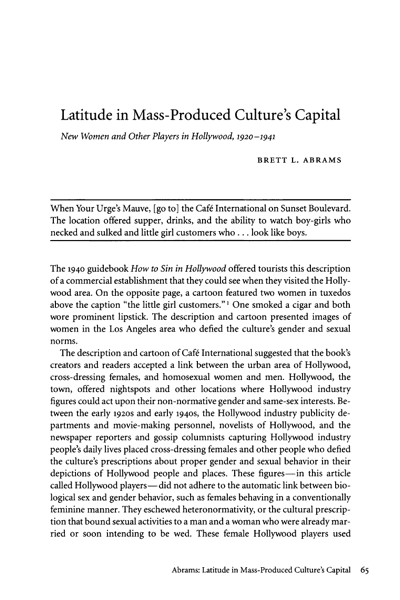
When Your Urge’s Mauve, [go to] the Cafe Intemational on Sunset Boulevard. The location offered supper, drinks, and the ability to watch boy-girls who necked and sulked and little girl customers who … look like boys.
The 1940 guidebook How to Sin in Hollywood offered tourists this description of a commercial establishment that they could see when they visited the Holly-wood area. On the opposite page, a cartoon featured two women in tuxedos above the caption “the little girl customers.”‘ One smoked a cigar and both wore prominent lipstick The description and cartoon presented images of women in the Los Angeles area who defied the culture’s gender and sexual norms.
* A portion of each sale from Amazon.com directly supports our blogs
** Many of these books may be available from your local library. Check it out!
† Available from the LA Public Library
Subscribe to Rosanne’s Channel and receive notice of each new video!
Transcript:
I think that’s what we should remember but we don’t and I think we realize it without realizing it because when you talk about movies to your friends you don’t say, “I loved the camera angle in scene seven.” No! You quote dialogue. You quote the lines from your favorite movies whether they’re Pixar or Disney or The Princess Bride. You know the dialogue and that is the work of the writer. That’s the person you should credit but often when I start a class I have students list their two or three favorite films and then who directed those films and then I ask them who wrote that film and they very often cannot name the person who wrote the film they adore. How can you want to be a writer if you don’t remember the writers yourself. So I think that’s a really important thing for us to remember.
A Note About This Presentation
A clip from my keynote speech at the 10th Screenwriters´(hi)Stories Seminar for the interdisciplinary Graduation Program in “Education, Art, and History of Culture”, in Mackenzie Presbyterian University, at São Paulo, SP, Brazil, focused on the topic “Why Researching Screenwriters (has Always) Mattered.” I was especially pleased with the passion these young scholars have toward screenwriting and it’s importance in transmitting culture across the man-made borders of our world.
To understand the world we have to understand its stories and to understand the world’s stories we must understand the world’s storytellers. A century ago and longer those people would have been the novelists of any particular country but since the invention of film, the storytellers who reach the most people with their ideas and their lessons have been the screenwriters. My teaching philosophy is that: Words matter, Writers matter, and Women writers matte, r so women writers are my focus because they have been the far less researched and yet they are over half the population. We cannot tell the stories of the people until we know what stories the mothers have passed down to their children. Those are the stories that last. Now is the time to research screenwriters of all cultures and the stories they tell because people are finally recognizing the work of writers and appreciating how their favorite stories took shape on the page long before they were cast, or filmed, or edited. But also because streaming services make the stories of many cultures now available to a much wider world than ever before.
Many thanks to Glaucia Davino for the invitation.
* A portion of each sale from Amazon.com directly supports our blogs ** Many of these books may be available from your local library. Check it out! † Available from the LA Public Library
Months of research went into the creation of the essays in “When Women Wrote Hollywood.” Here are some of the resources used to enlighten today’s film lovers to the female pioneers who helped create it.
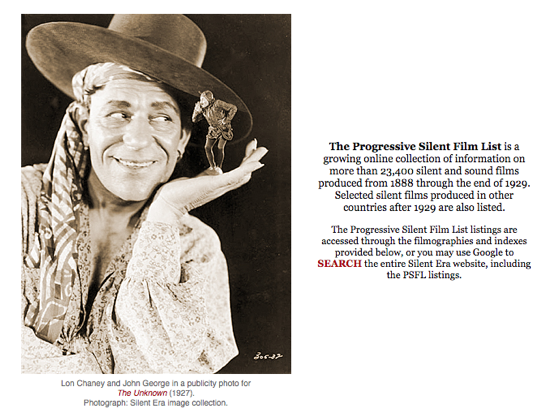
The Progressive Silent Film List is a growing online collection of information on more than 23,400 silent and sound films produced from 1888 through the end of 1929. Selected silent films produced in other countries after 1929 are also listed.
The Progressive Silent Film List listings are accessed through the filmographies and indexes provided below, or you may use Google to SEARCH the entire Silent Era website, including the PSFL listings.
* A portion of each sale from Amazon.com directly supports our blogs
** Many of these books may be available from your local library. Check it out!
† Available from the LA Public Library
Highlighting the articles in the past editions of the Journal of Screenwriting, of which I am the Book Reviews Editor. Hopefully these abstracts will entice you to did a little deeper into the history and future of screenwriting. — Rosanne
Through analysing appropriations of Aristotelian dramatic theory within interactive digital narratives (Laurel 1991, Hiltunen 2002, Mateas and Stern 2005), this article assesses the merits of Aristotle’s Poetics in providing a basis for an interactive screenwriting poetics. From the six components of tragedy (plot, character, thought, diction, melody, spectacle) to mimesis and catharsis, these concepts are examined for their value in a new media context. The hierarchy of the components is challenged and new formal and material causative relations are explored, using the interactive drama Faade (Mateas and Stern, 2005) as an example. With new dramatic configurations emerging (such as spatial plotting and narrative architecture), the question posed is – to what degree can Aristotelian thought really aid the interactive screenwriting process? If this approach can not yield substantial results, what is the alternative?
The Journal of Screenwriting is an international double-blind peer-reviewed journal that is published three times a year. The journal highlights current academic and professional thinking about the screenplay and intends to promote, stimulate and bring together current research and contemporary debates around the screenplay whilst encouraging groundbreaking research in an international arena. The journal is discursive, critical, rigorous and engages with issues in a dynamic and developing field, linking academic theory to screenwriting practice.
Subscribe to Rosanne’s Channel and receive notice of each new video!
Transcript:
My teaching philosophy — I will apologize if the translations aren’t perfect. I used Google Translate — but I think it’s important that words matter, that writers matter, and that women writers matter in this world and we must pay attention to them. I think it’s important to consider writers because writer comes before director when you describe a filmmaker who can do two things. They are writer/ directors. They are not director/writers. That tells me something, right? To me that’s a very important point. I also think that we have to realize that the vision of a movie cannot exist without the screenplay. A director cannot direct nothing. There must be an idea. There must be a philosophy. There must be a theme right? There must be a story. So the writer is of equal importance. Sometimes my students who come from directing think that I am saying we should push the directors down to pull the writers up. I don’t think that’s true. I think they have to be equal partners in this right? I think that’s what we should remember.
A Note About This Presentation
A clip from my keynote speech at the 10th Screenwriters´(hi)Stories Seminar for the interdisciplinary Graduation Program in “Education, Art, and History of Culture”, in Mackenzie Presbyterian University, at São Paulo, SP, Brazil, focused on the topic “Why Researching Screenwriters (has Always) Mattered.” I was especially pleased with the passion these young scholars have toward screenwriting and it’s importance in transmitting culture across the man-made borders of our world.
To understand the world we have to understand its stories and to understand the world’s stories we must understand the world’s storytellers. A century ago and longer those people would have been the novelists of any particular country but since the invention of film, the storytellers who reach the most people with their ideas and their lessons have been the screenwriters. My teaching philosophy is that: Words matter, Writers matter, and Women writers matte, r so women writers are my focus because they have been the far less researched and yet they are over half the population. We cannot tell the stories of the people until we know what stories the mothers have passed down to their children. Those are the stories that last. Now is the time to research screenwriters of all cultures and the stories they tell because people are finally recognizing the work of writers and appreciating how their favorite stories took shape on the page long before they were cast, or filmed, or edited. But also because streaming services make the stories of many cultures now available to a much wider world than ever before.
Many thanks to Glaucia Davino for the invitation.
* A portion of each sale from Amazon.com directly supports our blogs ** Many of these books may be available from your local library. Check it out! † Available from the LA Public Library


![06 Stories Are Important! from Why Researching Screenwriters (has Always) Mattered [Video] (51 seconds)](https://rosannewelch.com/wp-content/uploads/2020/04/rmw-sao-paolo-06.jpeg)
![05 Do You Know Who Wrote Your Favorite Films? from Why Researching Screenwriters (has Always) Mattered [Video] (51 seconds)](https://rosannewelch.com/wp-content/uploads/2020/04/rmw-sao-paolo-05.jpeg)
![04 Writers Matter. Women Writers Matter from Why Researching Screenwriters (has Always) Mattered [Video] (1 minute 5 seconds)](https://rosannewelch.com/wp-content/uploads/2020/04/rmw-sao-paolo-04.jpeg)