27 The Exorcist from When Women Write Horror with Dr. Rosanne Welch [Video] (25 seconds)

Watch this entire presentation

27 The Exorcist from When Women Write Horror with Dr. Rosanne Welch [Video] (25 seconds)

Subscribe to Rosanne’s Channel and receive notice of each new video!


In honor of Halloween – and in service to my teaching philosophy —

“Words Matter. Writers Matter. Women Writers Matter.”

I presented this holiday lecture “When Women Write Horror” on Tuesday, October 29th, 2019. Researching the many, many women who have written horror stories – in novels, films and television – brought new names to my attention who I am excited to start reading. I hope you will be, too!

Transcript:

What’s interesting to me about The Exorcist — again, written by a guy, adapted by a guy — when we think Exorcist we think about Linda Blair and the girl who had the demon in her, but they didn’t sell the movie on that. They sold the movie on the man who saves her — the priest who comes to exorcise the demon. They sold it as a boy’s movie, but it’s a girl’s movie. Right? So I think that’s a problem.

From The Journal Of Screenwriting V2 Issue 2: Lost and gone for ever? The search for early British screenplays by Jacob U. U. Jacob

Highlighting the articles in the past editions of the Journal of Screenwriting, of which I am the Book Reviews Editor. Hopefully these abstracts will entice you to did a little deeper into the history and future of screenwriting. — Rosanne


Lost and gone for ever? The search for early British screenplays by Jacob U. U. Jacob

The systematic collection and preservation of film and TV scripts at a national level has never been implemented in the United Kingdom. While the British Film Institute National Library (BFI) has a respectable collection of around 25,000 scripts, this has been built up from donations over the 75 years of the BFI’s existence. The silent film period, to 1930, is particularly affected by this lack of national care; the BFI has less than 100 British scripts from this period. Researchers from the University of Leeds spent several months in 2007 and 2008 seeking and collating information from around the world, with grant-aid support from the British Academy. The intention was to find out if any British silent film scripts had found a home in both British and foreign institutional collections, or elsewhere. The results were in general as expected – no major new collections were unearthed – but in part surprising. As a result of this a database has been compiled. Why should we search for scripts? It is now being realized that screenplay and other documentation hold information about the provenance and development of the screen idea that a film cannot provide. For some, the script may be a useful substitute for a lost film, but more importantly understanding how the film was envisaged before principal photography can reveal much about the industrial assumptions associated with film production in general, and about that screen idea in particular.


The Journal of Screenwriting is an international double-blind peer-reviewed journal that is published three times a year. The journal highlights current academic and professional thinking about the screenplay and intends to promote, stimulate and bring together current research and contemporary debates around the screenplay whilst encouraging groundbreaking research in an international arena. The journal is discursive, critical, rigorous and engages with issues in a dynamic and developing field, linking academic theory to screenwriting practice. 

Get your copy and subscription to the Journal of Screenwriting Today!


* A portion of each sale from Amazon.com directly supports our blogs
** Many of these books may be available from your local library. Check it out!

26 Jamie Lee Curtis from When Women Write Horror with Dr. Rosanne Welch [Video] (47 seconds)

Watch this entire presentation

26 Jamie Lee Curtis from When Women Write Horror with Dr. Rosanne Welch

Subscribe to Rosanne’s Channel and receive notice of each new video!


In honor of Halloween – and in service to my teaching philosophy —

“Words Matter. Writers Matter. Women Writers Matter.”

I presented this holiday lecture “When Women Write Horror” on Tuesday, October 29th, 2019. Researching the many, many women who have written horror stories – in novels, films and television – brought new names to my attention who I am excited to start reading. I hope you will be, too!

Transcript:

Another famous female in horror films is Jamie Lee Curtis. She also happens to be another Hollywood childhood because her parents are both actors right, but she starts an interesting trend because as a young person doing the first Halloween, which was based on the idea of babysitters being terrorized by a bad evil guy. She is actually — I forgot — as a child actor she could have been Linda Blair in The Exorcist, yeah. She was up for that part and their parents said “No that’s too horrifying. You shouldn’t do that. We don’t want you to go through that experience.” So it happened to Linda Blair whose career was over at the end of that movie. Nobody ever took her seriously after the spinning head and the puking. It was like too much right, whereas Jamie Lee Curtis didn’t do that job, grew up a little more, did Halloween and then has had a 40-year career. So it’s an interesting thought.

From The Journal Of Screenwriting V2 Issue 1: Creative decision making within the contemporary Hollywood studios by Alexander G Ross

Highlighting the articles in the past editions of the Journal of Screenwriting, of which I am the Book Reviews Editor. Hopefully these abstracts will entice you to did a little deeper into the history and future of screenwriting. — Rosanne


Creative decision making within the contemporary Hollywood studios by Alexander G Ross

This article seeks to contribute to the current debate about the decision-making process within the Hollywood studios and the marketing-driven quest to micromanage the creative process in order to manufacture more consistently profitable films. The author outlines the process to which scripts are subjected in order to determine their suitability for production and how this impacts the quality of the scripts. There are compelling questions about whether the current business model hinders relevant, definitive cultural narratives and how this affects both the quality and profitability of contemporary films. In addition to considering the existing literature dealing with the topic, this article also draws on the author’s fifteen years’ experience in Hollywood as a screenwriter, agent and producer.


The Journal of Screenwriting is an international double-blind peer-reviewed journal that is published three times a year. The journal highlights current academic and professional thinking about the screenplay and intends to promote, stimulate and bring together current research and contemporary debates around the screenplay whilst encouraging groundbreaking research in an international arena. The journal is discursive, critical, rigorous and engages with issues in a dynamic and developing field, linking academic theory to screenwriting practice. 

Get your copy and subscription to the Journal of Screenwriting Today!


* A portion of each sale from Amazon.com directly supports our blogs
** Many of these books may be available from your local library. Check it out!

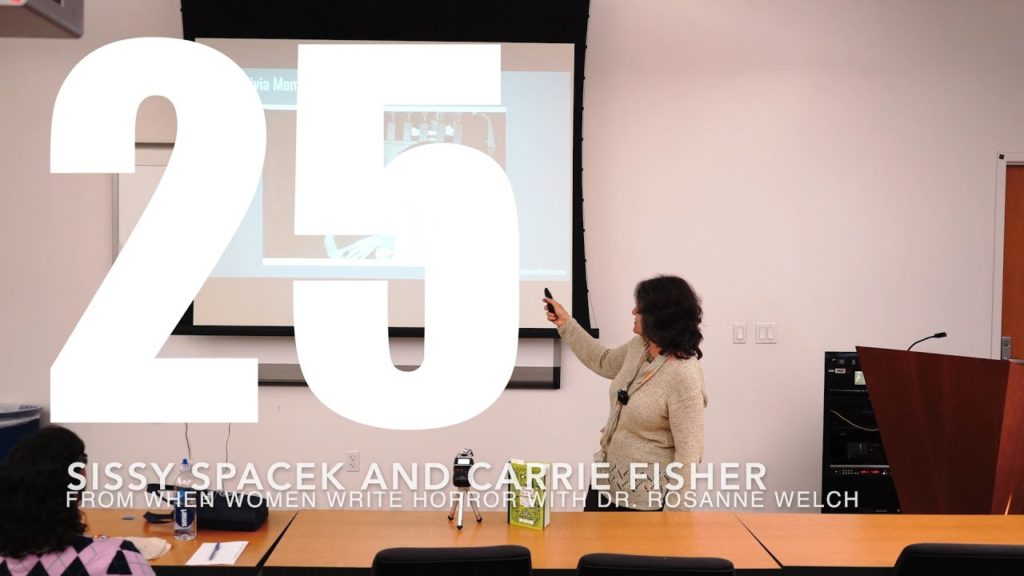
25 Sissy Spacek and Carrie Fisher from When Women Write Horror with Dr. Rosanne Welch [Video] (48 seconds)

Watch this entire presentation

Subscribe to Rosanne’s Channel and receive notice of each new video!

In honor of Halloween – and in service to my teaching philosophy —

“Words Matter. Writers Matter. Women Writers Matter.”

I presented this holiday lecture “When Women Write Horror” on Tuesday, October 29th, 2019. Researching the many, many women who have written horror stories – in novels, films and television – brought new names to my attention who I am excited to start reading. I hope you will be, too!

Transcript:

Sissy Spacek was quite wonderful. Do a little pop culture moment here. That’s Sissy Spacek and she’s with Carrie Fisher. Why would i put those two together in a picture? I’s because long ago and far away onthe day that they each auditioned for their separate movie, the two directors swapped the women. So Sissy Spacek could have been Princess Leia and Carrie Fisher could have been Carrie. Think about how different both of their careers would have gone had that happened and how much that each of them affect the further work they did. Carrie Fisher would always argue and I believe with her Princess Leia was powerful. She wasn’t as powerful as she could be but she was a character that took a weapon and helped with saving herself right? So each of them affected the work they did in the future.

From The Journal Of Screenwriting V2 Issue 1: The plot point, the darkest moment, and the answered question: three ways of modelling the three-quarter-point by Patrick Keating

Highlighting the articles in the past editions of the Journal of Screenwriting, of which I am the Book Reviews Editor. Hopefully these abstracts will entice you to did a little deeper into the history and future of screenwriting. — Rosanne


The plot point, the darkest moment, and the answered question: three ways of modelling the three-quarter-point by Patrick Keating
  
Many contemporary screenplay manuals, following Syd Field, encourage writers to place an act break approximately three-quarters of the way through the story. Although this would appear to be an area of widespread agreement, this essay argues that the manuals do not always define the 3/4-point in the same way. One common approach is to define the 3/4-point as a causally significant plot point; another approach is to regard it as an extreme point on an emotional curve, typically the darkest moment; and a third approach is to conceive of the 3/4-point as the answer to a previously introduced question. Taking a closer look at these three competing models of the 3/4-point can help us uncover the manuals’ competing assumptions about narrative structure, showing how they conceptualize causality, emotion and comprehension.


The Journal of Screenwriting is an international double-blind peer-reviewed journal that is published three times a year. The journal highlights current academic and professional thinking about the screenplay and intends to promote, stimulate and bring together current research and contemporary debates around the screenplay whilst encouraging groundbreaking research in an international arena. The journal is discursive, critical, rigorous and engages with issues in a dynamic and developing field, linking academic theory to screenwriting practice. 

Get your copy and subscription to the Journal of Screenwriting Today!


* A portion of each sale from Amazon.com directly supports our blogs
** Many of these books may be available from your local library. Check it out!

24 Carrie from When Women Write Horror with Dr. Rosanne Welch [Video] (48 seconds)

Watch this entire presentation

24 Carrie from When Women Write Horror with Dr. Rosanne Welch

Subscribe to Rosanne’s Channel and receive notice of each new video!


In honor of Halloween – and in service to my teaching philosophy —

“Words Matter. Writers Matter. Women Writers Matter.”

I presented this holiday lecture “When Women Write Horror” on Tuesday, October 29th, 2019. Researching the many, many women who have written horror stories – in novels, films and television – brought new names to my attention who I am excited to start reading. I hope you will be, too!

Transcript:

So now I want to focus for a second here also now on what happens when women are in horror films and what kind of women kind of female role models are we seeing in that world right? So, in movies, we didn’t have for a long time women doing a lot of writing so the women were represented as the characters in this piece so right? Popular, most famous, of course, being Carrie so now we’re back to Stephen King who wrote that right? So not written by a girl and the movie was actually adapted by Lawrence Cohen, but Carrie’s an interesting study in a girl revenge movie right? This is a chance for “You misused me and I’m going to get you back,” and that wasn’t something frequently that girls had a chance to get. They just got bullied and hurt and then gee who saves the day? She’s going to save her own day when she rises from the dead.

From The Journal Of Screenwriting V2 Issue 1: If it ain’t on the page, it ain’t on the stage: screenwriting, national specificity and the English-Canadian feature film by Janice Kaye and Charles H Davis

Highlighting the articles in the past editions of the Journal of Screenwriting, of which I am the Book Reviews Editor. Hopefully these abstracts will entice you to did a little deeper into the history and future of screenwriting. — Rosanne


If it ain’t on the page, it ain’t on the stage: screenwriting, national specificity and the English-Canadian feature film by Janice Kaye and Charles H Davis
  
Like other film-producing nations, Canada’s movie landscape was long ago colonized by US interests. While other nations also welcome American movies, the Canadian case is extreme: Canada has the lowest market share in the world of its own movies on its own screens. Living next to the world’s most powerful country, Canada occupies geographically, economically, linguistically and culturally a position unique in the world. The historical and ongoing predicament of the lack of success of English-Canadian feature films has been variously attributed to similarities to the United States in language and culture, lower production budgets, and weaknesses in distribution, exhibition, marketing and quality. The role of screenwriting, however, is little understood and rarely broached. In this article, we argue the importance of screenwriting in understanding national cinemas; show that it has institutional, sociological and nation-specific dimensions; and present Canada as an ideal case to begin examining such factors. The first dimension the institutional is defined by auteurism as well as the collaborative nature of production. The second the sociological is greatly affected by exclusionary networks and various levels of discrimination based on such factors as gender, ethnicity/race, age, sexuality and economic class. The nation-specific area pertains to diverse historical, cultural and institutional practices particular or exclusive to the country or region. English-Canada, for instance, experiences a unique and complex cultural policy environment. Moreover, its fractured and regional history is one that has resulted in the production of obsessively performed narratives of national identity, particularly imbricated with Qubec, the United States, Britain and France. Our analysis draws together strands of intersecting disciplines, combining film theory and history with production studies, close textual analyses, political economy and nation theory, calling for a more complete picture of the role of screenwriting in national cinemas.


The Journal of Screenwriting is an international double-blind peer-reviewed journal that is published three times a year. The journal highlights current academic and professional thinking about the screenplay and intends to promote, stimulate and bring together current research and contemporary debates around the screenplay whilst encouraging groundbreaking research in an international arena. The journal is discursive, critical, rigorous and engages with issues in a dynamic and developing field, linking academic theory to screenwriting practice. 

Get your copy and subscription to the Journal of Screenwriting Today!


* A portion of each sale from Amazon.com directly supports our blogs
** Many of these books may be available from your local library. Check it out!

Panel Discussion: More Than A Period: Writing Girls Coming of Age Stories For TV [Video] (1 hour 27 minutes)

Panel Discussion: More Than A Period: Writing Girls Coming of Age Stories For TV

Recently, I had the honor (and the fun) of moderating another panel for the Writers Guild Foundation with a conversation centered around how we write “Girls Coming of Age” stories for television. 

Our panelists included Rheeqrheeq Chainey (The Baby Sitters Club), Sonia Kharkar (On My Block, Never Have I Ever), Ilana Peña (Creator, Diary of a Future President) and Christina Nieves (Generation), an alumna of the Stephens College MFA in TV and Screenwriting, which was the greatest pleasure of the whole event!

Panel Discussion: More Than A Period: Writing Girls Coming of Age Stories For TV [Video] (1 hour 27 minutes)Stephens College MFA. in TV and Screenwriting

For each Workshop the Stephens College MFA in TV and Screenwriting hosts a panel with the Writers Guild Foundation which takes place at the Guild offices in Los Angeles. For this August it will be on Zoom which means many more attendees can RSVP to join us – and we hope you will because this panel is extra-special. 

It’s the second year in a row we’ve been able to invite an MFA alumna to be a panelist because they have become a working writer. Last year it was Class of 2019’s Sahar Jahani (who has written for Ramy and 13 Reasons Why) and on this panel we’ll be welcoming Class of 2020’s Christina Nieves to discuss Writing Girls Coming of Age Stories thanks to her new position as a staff writer on Generation.

We hope you can join me, Dr. Rosanne Welch, Executive Director of Stephens College MFA in TV and Screenwriting as I moderate the discussion.

Panel Discussion: More Than A Period: Writing Girls Coming of Age Stories For TV - Wed, August 12, 2020, 430pm PDT

Photo by Kyle Gregory Devaras on Unsplash

More Than A Period: Writing Girls Coming of Age Stories For TV

Wednesday, August 12, 2020
4:30 PM  6:00 PM

Beyond The Book Panel - Writers Guild Foundation

We at the WGF may have hit a pause on our live events, but thanks to technology, we’re aiming to provide more access to advice and knowledge from film and TV writers while we’re all social distancing. Over the last few months, we’ve been hosting free Zoom panels about craft and all things relevant to writers.

For this session, we team up with Stephens College MFA in TV and Screenwriting for a discussion about crafting girls’ coming-of-age stories. The panel of writers will share how their shows address this formative period for its characters, how their own experiences informed their writing, and why coming-of-age stories are an endless source of stories.

Panelists:

Sonia Kharkar – Executive Story Editor, On My Block, Never Have I Ever
Christina Nieves – Staff Writer, Generation
Ilana Peña – Creator, Diary of a Future President
Moderated by Dr. Rosanne Welch, Director of Stephens College MFA in TV and Screenwriting.

23 Taking Horror Seriously from When Women Write Horror with Dr. Rosanne Welch [Video] (43 seconds)

Watch this entire presentation

23 Taking Horror Seriously from When Women Write Horror with Dr. Rosanne Welch

Subscribe to Rosanne’s Channel and receive notice of each new video!


In honor of Halloween – and in service to my teaching philosophy —

“Words Matter. Writers Matter. Women Writers Matter.”

I presented this holiday lecture “When Women Write Horror” on Tuesday, October 29th, 2019. Researching the many, many women who have written horror stories – in novels, films and television – brought new names to my attention who I am excited to start reading. I hope you will be, too!

Transcript:

It’s one of those questions you find yourself — you know people think, “Oh you’re doing a class on horror. That can’t be anything you take seriously.” Well, we have to because it’s information people are taking in. What is it making you think right? If you’re with a dude who’s scary, do you think oh yeah it was good for her. It all worked out in the end for he.r Maybe not right? Let’s reconsider how we’re taking these fictional stories into our life. So I think that’s really interesting. Twilight of course was put together by Melissa Rosenberg who had come off the tv show, Dexter. So what an interesting background before you’re gonna write about Twilight and vampire romance, she’d written about a serial killer who you know kills once a week. I don’t know but uh she made a good ton of money off that and obviously was pretty successful.