From The Journal Of Screenwriting V5 Issue 3: ‘The Watergate Theory of Screenwriting’: A keynote presentation at SRN, Wisconsin, 2013 by Larry Gross

Highlighting the articles in the past editions of the Journal of Screenwriting, of which I am the Book Reviews Editor. Hopefully these abstracts will entice you to did a little deeper into the history and future of screenwriting. — Rosanne


‘The Watergate Theory of Screenwriting’: A keynote presentation at SRN, Wisconsin, 2013 by Larry Gross
  
One way to start to think about making information in a script interesting is to rephrase the question that was posed by the Watergate investigators about then President Richard Nixon’s knowledge of the criminal deeds of his subordinates. The question reiterated obsessively during the Senate Committee investigation, voiced initially by Tennessee Republican Senator Howard Baker, was … ‘What did the president know, and when did he know it?’. In order to get going, scriptwriters must ask: what do the characters know – about narrative context, about themselves, and about each other, and when do they know it? This essay will explore Akira Kurosawa’s 1952 film, Ikiru (co-written with Shinobu Hashimoto and Hideo Oguni), and how the film is masterfully structured in relation to “who knows what and when.”

'The Watergate Theory of Screenwriting’: A keynote presentation at SRN, Wisconsin, 2013 by Larry Gross


Journal of Screenwriting Cover

The Journal of Screenwriting is an international double-blind peer-reviewed journal that is published three times a year. The journal highlights current academic and professional thinking about the screenplay and intends to promote, stimulate and bring together current research and contemporary debates around the screenplay whilst encouraging groundbreaking research in an international arena. The journal is discursive, critical, rigorous and engages with issues in a dynamic and developing field, linking academic theory to screenwriting practice. 

Get your copy and subscription to the Journal of Screenwriting Today!


* A portion of each sale from Amazon.com directly supports our blogs
** Many of these books may be available from your local library. Check it out!

06 The Right to be in the Room from Concord Days: Margaret Fuller in Italy [Video]

In researching and writing my book on Giuseppe and Anita Garibaldi and the unification of Italy (A Man Of Action Saving Liberty: A Novel Based On The Life Of Giuseppe Garibaldi)  I re-discovered the first American female war correspondent – Margaret Fuller — who I had first met in a college course on the Transcendentalists. I was once again fascinated by a life lived purposefully.

Then I found Tammy Rose’s podcast on the Transcendentalists – Concord Days – and was delighted when she asked me to guest for a discussion of Fuller’s work in Italy as both a journalist – and a nurse. — Rosanne

06 The Right to be in the Room from Concord Days: Margaret Fuller in Italy [Video]

Watch this entire presentation

Concord Days sends love to Margaret Fuller on the anniversary of her death in 1850.

The conversation focuses on Margaret’s exciting days in ITALY!

Dr. Rosanne Welch takes us through her adventures and enthusiastically reminds us what she was like when she was living her best life!

Transcript:


Tammy: …and she’s constantly reinventing herself. Like that one of my favorite things about her is the conversations that she had with women which are kind of like modern-day podcasts where it’s like let’s just get everybody together and just talk. You know.

Rosanne: Well that’s and that goes into the 1960s. Their rap sessions right? That’s it you know consciousness-raising and in every generation, like we often teach that the beginning of women’s right or whatever you know you go back to Mary Wollstonecraft right and then think about that’s England but here in America those same conversations are being had.

Tammy: Yeah Yeah and I and I feel like she had to do so much fighting and but or not even like necessarily fighting but just like to reaffirm her right to be in that room or to you know be working as a correspondent for Horace Greeley’s paper.

05 Margaret’s Education from Concord Days: Margaret Fuller in Italy [Video]

In researching and writing my book on Giuseppe and Anita Garibaldi and the unification of Italy (A Man Of Action Saving Liberty: A Novel Based On The Life Of Giuseppe Garibaldi)  I re-discovered the first American female war correspondent – Margaret Fuller — who I had first met in a college course on the Transcendentalists. I was once again fascinated by a life lived purposefully.

Then I found Tammy Rose’s podcast on the Transcendentalists – Concord Days – and was delighted when she asked me to guest for a discussion of Fuller’s work in Italy as both a journalist – and a nurse. — Rosanne

05 Margaret's Education from Concord Days: Margaret Fuller in Italy [Video]

Watch this entire presentation

Concord Days sends love to Margaret Fuller on the anniversary of her death in 1850.

The conversation focuses on Margaret’s exciting days in ITALY!

Dr. Rosanne Welch takes us through her adventures and enthusiastically reminds us what she was like when she was living her best life!

Transcript:


Tammy: …and it got her all over the place.

Rosanne: It did and I often compare her — when i’m talking to students about her — I compare her to John Quincy Adams, right, who at 10 was translating his own father’s paperwork and knew five or six languages and he’s going to be like — in my opinion — our smartest president. So she’s on par with him but not given the opportunities.

Tammy: Exactly and even in her day she was known as the most widely read woman in America and she talked her way into the Harvard library even though she couldn’t actually attend Harvard you know and she made sure that she could get the education that she wanted. She must have had this like internal drive and curiosity that just kept her going throughout her life.


From The Journal Of Screenwriting V5 Issue 2: ‘Screenwriting research: No longer a lost cause’: A keynote presentation at the SRN Conference 2013 by Jill Nelmes

Highlighting the articles in the past editions of the Journal of Screenwriting, of which I am the Book Reviews Editor. Hopefully these abstracts will entice you to did a little deeper into the history and future of screenwriting. — Rosanne


‘Screenwriting research: No longer a lost cause’: A keynote presentation at the SRN Conference 2013 by Jill Nelmes

The article discusses the past, present and future of screenwriting research from a somewhat personal viewpoint, being US and UK in its focus, partly because of my own lack of knowledge of the researchers in other countries in the ‘dark’ years. Yet the pioneering writers and, more recently, the creation of the Screenwriting Research Network and the Journal of Screenwriting have all encouraged the exchanging of ideas and the realization that there are many of us interested in the same subject. More recently the area has proven to be exciting and dynamic with a diverse range of high quality research from many countries.

From The Journal Of Screenwriting V5 Issue 2: ‘Screenwriting research: No longer a lost cause’: A keynote presentation at the SRN Conference 2013 by Jill Nelmes


Journal of Screenwriting Cover

The Journal of Screenwriting is an international double-blind peer-reviewed journal that is published three times a year. The journal highlights current academic and professional thinking about the screenplay and intends to promote, stimulate and bring together current research and contemporary debates around the screenplay whilst encouraging groundbreaking research in an international arena. The journal is discursive, critical, rigorous and engages with issues in a dynamic and developing field, linking academic theory to screenwriting practice. 

Get your copy and subscription to the Journal of Screenwriting Today!


* A portion of each sale from Amazon.com directly supports our blogs
** Many of these books may be available from your local library. Check it out!

From The Journal Of Screenwriting V5 Issue 2: Writers Guild Foundation Shavelson-Webb Library and Archive by Miranda J. Banks

Highlighting the articles in the past editions of the Journal of Screenwriting, of which I am the Book Reviews Editor. Hopefully these abstracts will entice you to did a little deeper into the history and future of screenwriting. — Rosanne


Writers Guild Foundation Shavelson-Webb Library and Archive by Miranda J. Banks

This article provides an overview of the resources available at the Writers Guild Foundation Shavelson Webb Library in Los Angeles, California. Included is a history of the library, an explanation of the Writers Guild Foundation’s Archive, and discussion of the library and archive’s extensive holdings. The author details resources available online. The article also offers information on how to prepare for a visit to the library and best practices when conducting research or using the Writers Guild Foundation Library and Archive for scholarly or creative work.

From The Journal Of Screenwriting V5 Issue 2: Writers Guild Foundation Shavelson-Webb Library and Archive by Miranda J. Banks


Journal of Screenwriting Cover

The Journal of Screenwriting is an international double-blind peer-reviewed journal that is published three times a year. The journal highlights current academic and professional thinking about the screenplay and intends to promote, stimulate and bring together current research and contemporary debates around the screenplay whilst encouraging groundbreaking research in an international arena. The journal is discursive, critical, rigorous and engages with issues in a dynamic and developing field, linking academic theory to screenwriting practice. 

Get your copy and subscription to the Journal of Screenwriting Today!


* A portion of each sale from Amazon.com directly supports our blogs
** Many of these books may be available from your local library. Check it out!

04 Sex and Marriage from Concord Days: Margaret Fuller in Italy [Video]

In researching and writing my book on Giuseppe and Anita Garibaldi and the unification of Italy (A Man Of Action Saving Liberty: A Novel Based On The Life Of Giuseppe Garibaldi)  I re-discovered the first American female war correspondent – Margaret Fuller — who I had first met in a college course on the Transcendentalists. I was once again fascinated by a life lived purposefully.

Then I found Tammy Rose’s podcast on the Transcendentalists – Concord Days – and was delighted when she asked me to guest for a discussion of Fuller’s work in Italy as both a journalist – and a nurse. — Rosanne

04 Sex and Marriage from Concord Days: Margaret Fuller in Italy [Video]

Watch this entire presentation

Concord Days sends love to Margaret Fuller on the anniversary of her death in 1850.

The conversation focuses on Margaret’s exciting days in ITALY!

Dr. Rosanne Welch takes us through her adventures and enthusiastically reminds us what she was like when she was living her best life!

Transcript:

Rosanne: So they knew sex. They talked about sex and they wanted to be careful about it.

Tammy: Right.

Rosanne: Exactly. So funny.

Tammy: Yeah. Well, and Margaret was especially aware of issues about being a woman in a make society and issues of marriage and how it was very hard to actually have an equal balance between two intellectual individuals because it was not something that she had generally seen or that generally happened.

Rosanne: It didn’t. It wasn’t socially acceptable. Women were supposed to accept that, even if you were semi-smart, you had been allowed some learning, which she got lucky because her father believed in that. Then you gave that up when you went home and then you just took care of the kids if you got married.

Tammy: Right and her father started training her when she was a kid. This is not a little thing. He was a strict disciplinarian and wanted her to be translating The Aeneid by the time she was 10 without any hesitation and without any errors and she had nightmares as a child because he was holding her up to such a high standard, but I think she lived by that high standard for the rest of her life.

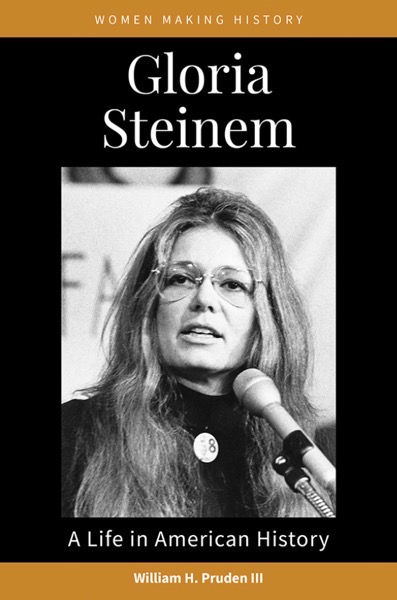
Now Available: Gloria Steinem: A Life in American History by William H. Pruden III, Edited by Drs. Rosanne Welch and Peg Lamphier

Good Morning to all our dedicated authors in the Women Making History series for ABC-Clio.

Peg and I wanted to share the nice news that Book #2 has been published and congratulate author Bill Pruden for all his hard work on the life of Gloria Steinem.  We can’t wait to see the rest of the books in our series come to publication. 

Now Available: Gloria Steinem: A Life in American History by William H. Pruden III, Edited by Drs. Rosanne Welch and Peg Lamphier

We know (being meant for libraries) that the volumes are higher priced so we can’t ask you all to buy a copy  –  but you can alert your local public or school library to their existence and ask that they buy a copy for their stacks (or their Kindle offerings). (Download A PDF Flyer for the book

Stay safe and keep reading! — Rosanne and Peg

From The Journal Of Screenwriting V5 Issue 2: Start me up: Lean screenwriting for American entrepreneurial cinema by Andrew Kenneth Gay

Highlighting the articles in the past editions of the Journal of Screenwriting, of which I am the Book Reviews Editor. Hopefully these abstracts will entice you to did a little deeper into the history and future of screenwriting. — Rosanne


Start me up: Lean screenwriting for American entrepreneurial cinema by Andrew Kenneth Gay
  
This article proposes a new approach to script development modelled after lean software development practices and entrepreneurial startup principles. First, it argues that the Hollywood mode of production and its methods of project development, when applied to microbudget film-making, are inherently wasteful and fail in the face of extreme uncertainty and unpredictability. Second, it argues that entrepreneurial screenwriters and writer/film-makers can adopt lean thinking in order to eliminate waste from their creative labour and enhance learning at every stage of development and production, adding value for their audience. Finally, it argues that inexperienced writer/film-makers are particularly susceptible to the false security of the ‘blueprint’ metaphor, often clinging to an original plan even as it fails them. The flexibility inherent to lean thinking, on the other hand, not only reduces waste but also enhances creativity and collaboration, increasing a project’s chances of success.

From The Journal Of Screenwriting V5 Issue 2: Start me up: Lean screenwriting for American entrepreneurial cinema by Andrew Kenneth Gay


Journal of Screenwriting Cover

The Journal of Screenwriting is an international double-blind peer-reviewed journal that is published three times a year. The journal highlights current academic and professional thinking about the screenplay and intends to promote, stimulate and bring together current research and contemporary debates around the screenplay whilst encouraging groundbreaking research in an international arena. The journal is discursive, critical, rigorous and engages with issues in a dynamic and developing field, linking academic theory to screenwriting practice. 

Get your copy and subscription to the Journal of Screenwriting Today!


* A portion of each sale from Amazon.com directly supports our blogs
** Many of these books may be available from your local library. Check it out!

03 Transcendentalism and the 1960s from Concord Days: Margaret Fuller in Italy [Video]

In researching and writing my book on Giuseppe and Anita Garibaldi and the unification of Italy (A Man Of Action Saving Liberty: A Novel Based On The Life Of Giuseppe Garibaldi)  I re-discovered the first American female war correspondent – Margaret Fuller — who I had first met in a college course on the Transcendentalists. I was once again fascinated by a life lived purposefully.

Then I found Tammy Rose’s podcast on the Transcendentalists – Concord Days – and was delighted when she asked me to guest for a discussion of Fuller’s work in Italy as both a journalist – and a nurse. — Rosanne

03 Transcendentalism and the 1960s from Concord Days: Margaret Fuller in Italy [Video]

Watch this entire presentation

Concord Days sends love to Margaret Fuller on the anniversary of her death in 1850.

The conversation focuses on Margaret’s exciting days in ITALY!

Dr. Rosanne Welch takes us through her adventures and enthusiastically reminds us what she was like when she was living her best life!

Transcript:


Rosanne: When I used to teach a straight history class I would often compare this era of the transcendentalists and all the utopian societies to the 1960s because we have that same urge going on to make the world a better place and I love that and most people — we know about the 60s. We’ve seen it in movies and stuff but they really don’t know that that urge happened so much earlier and that women were part of it.

Tammy: Exactly. Well, and the women were part of it kind of whether they wanted to be or not because these utopian societies were maybe designed by men. You know Bronson was kind of like, all right this is how I want to run the school. I want to be open and honest with the kids and even Elizabeth Peabody you know she wrote a book called the history of that school and in it she’s like we told the children the right answers to all the questions that they had including when they asked about sex. You know we told them honestly.


02 Fuller’s Life and Bronson Alcott from Concord Days: Margaret Fuller in Italy [Video]

In researching and writing my book on Giuseppe and Anita Garibaldi and the unification of Italy (A Man Of Action Saving Liberty: A Novel Based On The Life Of Giuseppe Garibaldi)  I re-discovered the first American female war correspondent – Margaret Fuller — who I had first met in a college course on the Transcendentalists. I was once again fascinated by a life lived purposefully.

Then I found Tammy Rose’s podcast on the Transcendentalists – Concord Days – and was delighted when she asked me to guest for a discussion of Fuller’s work in Italy as both a journalist – and a nurse. — Rosanne

02 Fuller's Life and Bronson Alcott from Concord Days: Margaret Fuller in Italy [Video]

Watch this entire presentation

Concord Days sends love to Margaret Fuller on the anniversary of her death in 1850.

The conversation focuses on Margaret’s exciting days in ITALY!

Dr. Rosanne Welch takes us through her adventures and enthusiastically reminds us what she was like when she was living her best life!

Transcript:

Rosanne: So I was, I was enthralled to find a woman with such a modern mind in that country.

Tammy: Exactly and let’s sort of go through her life. Sort of hit the major time periods before she gets to Italy because she’s in Italy at the very end of her life. So she was born in 1810 in Cambridgeport, Massachusetts, which is like 10 miles away from Concord, and she was kind of born into the world of you know she grew up playing with Thomas Wentworth Higginson you know and she very quickly met Emerson and fell in with the Transcendental crowd just as they were actually starting to get going.

Rosanne: Exactly and I think it’s important that she worked you know when she did her early teaching and things like that she worked with Bronson Alcott, who was also someone that — we all knew Louisa May Alcott — which we should and then it was later that I learned her father was involved and you know was maybe not one of the most successful transcendentalists but was trying with ideas — like an integrated school and it was hurting him financially and Margaret was part of that right, supporting that so you can see early on.