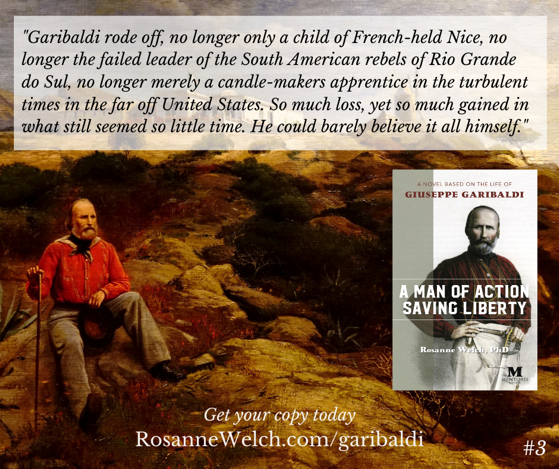
My Latest Book Now Available for Pre-Order: A Man Of Action Saving Liberty: A Novel Based On The Life Of Giuseppe Garibaldi – 99¢ Kindle Pre-Order Sale

I’m happy to announce that the historical novel I wrote about the life of Giuseppe Garibaldi is about to be published on October 1st, 2020. 

You can Pre-Order the Kindle edition NOW for only 99¢ until October 1, when the price becomes $9.99. 

My Latest Book Now Available for Pre-Order: A Man Of Action Saving Liberty: A Novel Based On The Life Of Giuseppe Garibaldi

DSC05589DSC05577

DSC055732672C1FB D626 441B 9C9B 91A12DF5996E

See More Photos taken during our trip to the Museo del Risorgiomento, Italian Reunification Museum, Milano, Italy

I took on this story because I wanted to learn more about the history of the country of my grandparents’ birth but I gained so much more in researching the man who united the country, which I thought would be a largely white male-centered story.

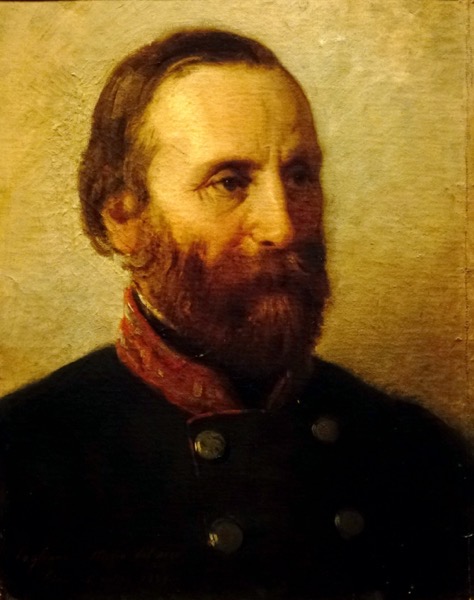
Guiseppe italiaono
Guiseppe Italiano

I discovered a cast list of other brilliant characters beginning with Garibaldi’s amazing Brazilian bride, Anita. She helped plan military strategy and rode into battle beside him while pregnant.

Anita

Anita
Photos taken during our trip to the Museo del Risorgiomento, Italian Reunification Museum, Milano, Italy

I discovered Andrea Aguyar, a formerly enslaved man who fought for freedom alongside Giuseppe and Anita so bravely they named him godfather to their children.

1548462431 8234 Andrea Aguyar
Andrea Aguyar

I discovered Cristina Trivulzio, a noblewoman from Milan who had had a child out of wedlock, an act that scandalized her upper-class society who found herself offering battlefield nursing assistance wherever needed.  

Cristinatrivulzio
Cristina Trivulzio

And I rediscovered my favorite (and the only major female) Transcendentalist, Margaret Fuller, the American journalist sent to Italy by the New York Tribune in 1846 as its first foreign correspondent – male or female – who with Anita and Cristina witnessed the ongoing carnage caused by the siege of Rome in the makeshift hospital they helped create.

Margaret Fuller by Chappel
Margaret Fuller

I deeply enjoyed discovering all these people and writing their story as it’s a story of struggle for a greater good that gives me the chance to wonder why I never learned all this in school…

Guiseppe Garibaldi Statue in MonzaGuisseppe Garibaldo Statue, Milan
We saw Garibaldi everywhere we went in Milan

Get your copy of A Man Of Action Saving Liberty Today!

29 Unspoken Messages in Film from When Women Write Horror with Dr. Rosanne Welch [Video] (53 seconds)

Watch this entire presentation
29 Unspoken Messages in Film from When Women Write Horror with Dr. Rosanne Welch

Subscribe to Rosanne’s Channel and receive notice of each new video!


Transcript:

Now one of the things we have to think about — side note — when we think about horror movies again — is what they’re telling us. In this movie, as we know, spoiler alert, he’s the bad guy. Anthony Perkins was gay and by casting him they knew the audience would feel awkward about him. there would be something wrong with him They didn’t have to say what it was. They just knew society would find him wrong and so they cast him as the bad guy right? And so under all of this, what we’re saying is you can’t trust gay men. They’re dangerous. Don’t be near them. That’s the underlying concept behind Psycho. So I think that’s really — I have to think about what are the messages we’re getting from the stuff we’re watching and the stuff we’re reading and how do we counter those if they’re messages that we don’t want to have but it’s a good movie. It’s a good movie but have to think about that.

A Note About This Presentation

A clip from my keynote speech at the 10th Screenwriters´(hi)Stories Seminar for the interdisciplinary Graduation Program in “Education, Art, and History of Culture”, in Mackenzie Presbyterian University, at São Paulo, SP, Brazil, focused on the topic “Why Researching Screenwriters (has Always) Mattered.” I was especially pleased with the passion these young scholars have toward screenwriting and it’s importance in transmitting culture across the man-made borders of our world.

To understand the world we have to understand its stories and to understand the world’s stories we must understand the world’s storytellers. A century ago and longer those people would have been the novelists of any particular country but since the invention of film, the storytellers who reach the most people with their ideas and their lessons have been the screenwriters. My teaching philosophy is that: Words matter, Writers matter, and Women writers matte, r so women writers are my focus because they have been the far less researched and yet they are over half the population. We cannot tell the stories of the people until we know what stories the mothers have passed down to their children. Those are the stories that last. Now is the time to research screenwriters of all cultures and the stories they tell because people are finally recognizing the work of writers and appreciating how their favorite stories took shape on the page long before they were cast, or filmed, or edited. But also because streaming services make the stories of many cultures now available to a much wider world than ever before.

Many thanks to Glaucia Davino for the invitation.


* A portion of each sale from Amazon.com directly supports our blogs
** Many of these books may be available from your local library. Check it out!
† Available from the LA Public Library

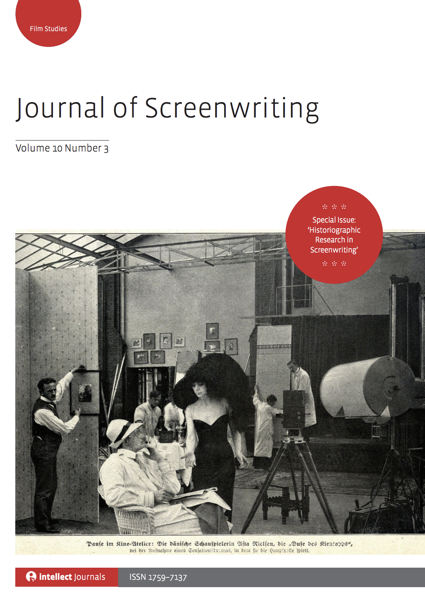
From The Journal Of Screenwriting V2 Issue 2: The first screenplays? American Mutoscope and Biograph scenarios revisited by Steven Price

Highlighting the articles in the past editions of the Journal of Screenwriting, of which I am the Book Reviews Editor. Hopefully these abstracts will entice you to did a little deeper into the history and future of screenwriting. — Rosanne


The first screenplays? American Mutoscope and Biograph scenarios revisited by Steven Price

This article builds on the earlier work of Patrick Loughney in discussing a series of texts written by Frank J. Marion and Wallace McCutcheon, and registered by American Mutoscope & Biograph (AM&B) at the Library of Congress in 1904–05. It assesses the arguments for regarding these as the earliest surviving texts that were written specifically in order to be filmed. Significant historical contexts include copyright disputes between the studios, developments in narrative film since 1902, and the problematic classification system at the Library of Congress that prompted AM&B to register a sequence of films as both ‘photographs’ and ‘dramatic compositions’. A comparison of the scenarios to the films provides evidence that they were written prior to filming. The formal arrangement of the scenarios is almost indistinguishable from that for contemporary playscripts, which may have been due to a deliberate attempt to facilitate their registration as ‘dramatic compositions’.


The Journal of Screenwriting is an international double-blind peer-reviewed journal that is published three times a year. The journal highlights current academic and professional thinking about the screenplay and intends to promote, stimulate and bring together current research and contemporary debates around the screenplay whilst encouraging groundbreaking research in an international arena. The journal is discursive, critical, rigorous and engages with issues in a dynamic and developing field, linking academic theory to screenwriting practice. 

Get your copy and subscription to the Journal of Screenwriting Today!


* A portion of each sale from Amazon.com directly supports our blogs
** Many of these books may be available from your local library. Check it out!

From The “When Women Wrote Hollywood Archives 42: Interpretations, a book of first poems (1912) by Zoë Akins

Months of research went into the creation of the essays in “When Women Wrote Hollywood.” Here are some of the resources used to enlighten today’s film lovers to the female pioneers who helped create it.

From The


Buy “When Women Wrote Hollywood” Today!


When Women Wrote Hollywood: Essays on Female Screenwriters in the Early Film Industry

Paperback Edition | Kindle Edition | Google Play Edition

Help Support Local Bookstores — Buy at Bookshop.org

* A portion of each sale from Amazon.com directly supports our blogs
** Many of these books may be available from your local library. Check it out!
† Available from the LA Public Library

From The Journal Of Screenwriting V2 Issue 2: An uneven marketplace of ideas: Amateur screenwriting, the Library of Congress and the struggle for copyright by Torey Liepa

Highlighting the articles in the past editions of the Journal of Screenwriting, of which I am the Book Reviews Editor. Hopefully these abstracts will entice you to did a little deeper into the history and future of screenwriting. — Rosanne


An uneven marketplace of ideas: Amateur screenwriting, the Library of Congress and the struggle for copyright by Torey Liepa

In 1912, with demand for story material increasing in a growing market, writing was becoming ever more essential to commercial film production in the United States. With several important legal developments that year, however, the marketplace for story material would begin to collapse as amateur screenwriters failed to gain the same legal protections as those producing finished films, rendering their creative material entirely susceptible to piracy from above. Despite several initiatives by advocates for non-professional writers and a few members of Congress, screenwriters would not receive legal protection for unpublished material until 1978. Throughout the Golden Age of Hollywood, then, but dating back to the origins of copyright protection for finished commercial films, US copyright law encouraged Hollywood to produce story material in a closed, intellectually isolated and commercially protected shop, more closely resembling an enigmatic ‘culture industry’ than a ‘people’s art form’. This article examines a convergence of state institutions, private enterprise and commercial trade press that helped to radically re-define the creative processes underwriting film production and the system of compensation for creative material that would delimit relations of production at the beginnings of the American film industry.


The Journal of Screenwriting is an international double-blind peer-reviewed journal that is published three times a year. The journal highlights current academic and professional thinking about the screenplay and intends to promote, stimulate and bring together current research and contemporary debates around the screenplay whilst encouraging groundbreaking research in an international arena. The journal is discursive, critical, rigorous and engages with issues in a dynamic and developing field, linking academic theory to screenwriting practice. 

Get your copy and subscription to the Journal of Screenwriting Today!


* A portion of each sale from Amazon.com directly supports our blogs
** Many of these books may be available from your local library. Check it out!

From The “When Women Wrote Hollywood Archives 41: Grand Design: Hollywood as a Modern Business Enterprise, 1930-1939 by Tino Balio

Months of research went into the creation of the essays in “When Women Wrote Hollywood.” Here are some of the resources used to enlighten today’s film lovers to the female pioneers who helped create it.

From The

The advent of color, big musicals, the studio system, and the beginning of institutionalized censorship made the thirties the defining decade for Hollywood. The year 1939, celebrated as “Hollywood’s greatest year,” saw the release of such memorable films as Gone with the Wind, The Wizard of Oz, and Stagecoach. It was a time when the studios exercised nearly absolute control over their product as well as over such stars as Bette Davis, Clark Gable, and Humphrey Bogart. In this fifth volume of the award-winning series History of the American Cinema, Tino Balio examines every aspect of the filmmaking and film exhibition system as it matured during the Depression era.


Buy “When Women Wrote Hollywood” Today!


When Women Wrote Hollywood: Essays on Female Screenwriters in the Early Film Industry

Paperback Edition | Kindle Edition | Google Play Edition

Help Support Local Bookstores — Buy at Bookshop.org

* A portion of each sale from Amazon.com directly supports our blogs
** Many of these books may be available from your local library. Check it out!
† Available from the LA Public Library

When Women Wrote Hollywood: The Movies – 7 in a series – “it” (1927, Wr: Eleanor Glyn


When Women Wrote Hollywood: The Movies - 7 in a series -

“It” is a 1927 American silent romantic comedy film that tells the story of a shop girl who sets her sights on the handsome, wealthy boss of the department store where she works. It is based on a novella by Elinor Glyn that was originally serialized in Cosmopolitan magazine.

This film turned actress Clara Bow into a major star, and led people to label her the It girl.

The film had its world premiere in Los Angeles on January 14, 1927, followed by a New York showing on February 5, 1927. “It” was released to the general public on February 19, 1927.

The picture was considered lost for many years, but a Nitrate-copy was found in Prague in the 1960s.[1] In 2001, “It” was selected for preservation in the United States National Film Registry by the Library of Congress as being “culturally, historically, or aesthetically significant”.[2][3] Wikipedia

Elinor Glyn (née Sutherland; 17 October 1864 – 23 September 1943) was a British novelist and scriptwriter who specialised in romantic fiction, which was considered scandalous for its time, although her works are relatively tame by modern standards. She popularized the concept of the It-girl, and had tremendous influence on early 20th-century popular culture and, possibly, on the careers of notable Hollywood stars such as Rudolph Valentino, Gloria Swanson and, especially, Clara Bow. — Wikipedia

More about Alice Guy Blaché

* A portion of each sale from Amazon.com directly supports our blogs
** Many of these books may be available from your local library. Check it out!
† Available from the LA Public Library


Buy “When Women Wrote Hollywood” Today!


When Women Wrote Hollywood: Essays on Female Screenwriters in the Early Film Industry

Paperback Edition | Kindle Edition | Google Play Edition

Help Support Local Bookstores — Buy at Bookshop.org

* A portion of each sale from Amazon.com directly supports our blogs
** Many of these books may be available from your local library. Check it out!
† Available from the LA Public Library

27 The Exorcist from When Women Write Horror with Dr. Rosanne Welch [Video] (25 seconds)

Watch this entire presentation

27 The Exorcist from When Women Write Horror with Dr. Rosanne Welch [Video] (25 seconds)

Subscribe to Rosanne’s Channel and receive notice of each new video!


In honor of Halloween – and in service to my teaching philosophy —

“Words Matter. Writers Matter. Women Writers Matter.”

I presented this holiday lecture “When Women Write Horror” on Tuesday, October 29th, 2019. Researching the many, many women who have written horror stories – in novels, films and television – brought new names to my attention who I am excited to start reading. I hope you will be, too!

Transcript:

What’s interesting to me about The Exorcist — again, written by a guy, adapted by a guy — when we think Exorcist we think about Linda Blair and the girl who had the demon in her, but they didn’t sell the movie on that. They sold the movie on the man who saves her — the priest who comes to exorcise the demon. They sold it as a boy’s movie, but it’s a girl’s movie. Right? So I think that’s a problem.

From The Journal Of Screenwriting V2 Issue 2: Lost and gone for ever? The search for early British screenplays by Jacob U. U. Jacob

Highlighting the articles in the past editions of the Journal of Screenwriting, of which I am the Book Reviews Editor. Hopefully these abstracts will entice you to did a little deeper into the history and future of screenwriting. — Rosanne


Lost and gone for ever? The search for early British screenplays by Jacob U. U. Jacob

The systematic collection and preservation of film and TV scripts at a national level has never been implemented in the United Kingdom. While the British Film Institute National Library (BFI) has a respectable collection of around 25,000 scripts, this has been built up from donations over the 75 years of the BFI’s existence. The silent film period, to 1930, is particularly affected by this lack of national care; the BFI has less than 100 British scripts from this period. Researchers from the University of Leeds spent several months in 2007 and 2008 seeking and collating information from around the world, with grant-aid support from the British Academy. The intention was to find out if any British silent film scripts had found a home in both British and foreign institutional collections, or elsewhere. The results were in general as expected – no major new collections were unearthed – but in part surprising. As a result of this a database has been compiled. Why should we search for scripts? It is now being realized that screenplay and other documentation hold information about the provenance and development of the screen idea that a film cannot provide. For some, the script may be a useful substitute for a lost film, but more importantly understanding how the film was envisaged before principal photography can reveal much about the industrial assumptions associated with film production in general, and about that screen idea in particular.


The Journal of Screenwriting is an international double-blind peer-reviewed journal that is published three times a year. The journal highlights current academic and professional thinking about the screenplay and intends to promote, stimulate and bring together current research and contemporary debates around the screenplay whilst encouraging groundbreaking research in an international arena. The journal is discursive, critical, rigorous and engages with issues in a dynamic and developing field, linking academic theory to screenwriting practice. 

Get your copy and subscription to the Journal of Screenwriting Today!


* A portion of each sale from Amazon.com directly supports our blogs
** Many of these books may be available from your local library. Check it out!

A professor’s work is never done via Instagram

A professor’s work is never done via Instagram

I promised to clean my desk before a full semester of online learning began… and I did.  See?  There’s room for my cat Spotted Leaf (named after a character in the Erin Hunter series of books about cats who live in the woods – Warriors).  Spot (as we call her for short) enjoys hearing me talk to students about everything from films to fiction. Maybe in one of her past 9 lives she was a humanities professor, too!

Follow me on Instagram