16 More On Treva Silverman From Women in Early TV for the American Women Writers National Museum [Video]

16 More On Treva Silverman From Women in Early TV for the American Women Writers National Museum [Video]

Many thanks to Janice Law of the American Women Writers National Museum who invited me to give a short talk on The Women of Early TV.

I enjoyed sharing the names and careers of women like Peg Lynch, Gertrude Berg, Selma Diamond, and D.C. Fontana to the members who gathered on Zoom last Wednesday morning. There are so many more I could have talked about whose names don’t appear in mainstream books about the history of television so we have to learn who they are and carry those names forward ourselves.  It’s one of the missions of the Stephens College MFA in TV and Screenwriting – and has been one of my missions all my life.
RMW Rosanne Signature for Web

Transcript:

She moved on from that show, as I said, to win two Emmys for writing this beloved show — The Mary Tyler Moore Show. When James Brooks put that show together and James again a very respectable Executive Producer in television. Love all of what he’s done. He was a very progressive thinking man and he knew that if the show was about a single woman they ought to have a female on staff and so he asked Treva if she would join the show. The Emmys she won twofold. She won this Emmy for writing an episode about Lou Grant. she had single female friends who thought Ed Asner was appealing but his character on the show, Lou, was married and they felt guilty for liking a man who had a wife because it meant that they might be you know stealing a man from another woman. So she came up with the idea that Lou’s wife and he should get a divorce but the progressive new thought was not because Lou did anything bad. He’s not a gambler. He’s not cheating on her. It was that Edie Grant had decided that she wasn’t fulfilled — that she hadn’t done in her life what she wanted to do. She had only ever served him and it was her turn before she got too old and that was such a wildly innovative idea and it was so poignant and so sad because the audience loved him but we liked her as well and we understood that this was such a problem and she had to take this chance. So it was a brilliant episode. It won her an Emmy.

Many thanks to Janice Law of the American Women Writers National Museum who invited me to give a short talk on The Women of Early TV.

I enjoyed sharing the names and careers of women like Peg Lynch, Gertrude Berg, Selma Diamond, and D.C. Fontana to the members who gathered on Zoom last Wednesday morning. There are so many more I could have talked about whose names don’t appear in mainstream books about the history of television so we have to learn who they are and carry those names forward ourselves. It’s one of the missions of the Stephens College MFA in TV and Screenwriting – and has been one of my missions all my life.

Watch this entire presentation


Women pioneers who created, produced, or shepherded many of America’s most wildly popular, early television programs will be profiled by Dr. Rosanne Welch.

Get your copy today!

07 Chibnall’s Earlier Writing…from The Difficulties and Delicacies of Writing the First Female Doctor in 50+ years [Video] [Doctor Who]

It was great to be able to attend this year’s SD WhoCon in San Diego and present this lecture on “The Difficulties and Delicacies of Writing the First Female Doctor in 50+ years” in which I discuss how successful I think showrunner Christopher Chibnall was in making that transition.

It gave me a chance to talk about the creative work of a showrunner/screenwriter while also reconnecting to some friends we had met at this same convention some 3 years ago – and to talk about one of my favorite subjects – Doctor Who!

07 Chibnall's Earlier Writing...from The Difficulties and Delicacies of Writing the First Female Doctor in 50+ years [Video] [Doctor Who]

Transcript:

I think we have to look at his early work to see that he was capable of doing this right? When I think about the early episodes that he wrote obviously before he became the Executive Producer almost every episode had an important leader who was a female and that just sort of glosses over you when you’re looking at it but when you put it all together like every single time he was trying to find a way to show us a woman in charge. So he was really building up to be the guy, the showrunner, who would be able to do a full female character but if you think about this right Hungry Earth we’ve got Dr. Chaudry. That’s a really cool thing. Could have been a boy doctor. Was a girl doctor right? Writers make those choices all the time. Captain Kath in 42 right has to go through that terrible experience. She could have been a male captain of the ship right. It wouldn’t have hurt and then I just adore Kate Lethbridge Stewart. I think she’s marvelous. There’s actually another tv show in the UK called Grantchester. It’s about a vicar. Now his mother is played by the actress who played Kate. So it’s kind of fun to see her in different roles but so he did this — so Chibnalll did this in his early work and now both outside of Doctor Who, I’m really impressed with some of the stuff he’s done again involving strong female characters.


Watch this entire presentation

02 On The Importance of Screenwriters from In Conversation with Dr. Rosanne Welch and Intellect Books [Video]

02 On The Imporatnce of Screenwriters from In Conversation with Dr. Rosanne Welch and Intellect Books [Video]

Transcript:

So I mostly am interested in that and screenwriting because in Hollywood the issue has always been — we have that “Auteur Theory” which has been fought about and we’ve argued about. We’re getting there but you still read in the newspapers the review of a film and they’ll say it belongs to the director. They’ll name you know so and so such and such film and maybe four paragraphs in you’ll find oh that person also wrote it. So they’re a writer-director. Why didn’t you say that right or five paragraphs in they’ll now mention who wrote the thing and you’re like well that’s what I want to know. That’s where the idea came from. I get it. Directors do cool things and they run the set and whatever but the theme and the characters and the dialogue — which is what we quote all the time — came from the writer and that’s the person that I feel like we should be — I don’t say they have to be higher than the director. Let’s get equal again, right, which again we were in the Silent Era. So that stuff interests me a lot.


One of the benefits of attending conferences is that you can meet the editors from the companies that have published some of your books face to face. That happened at the recent SCMS conference where I met Intellect editor James Campbell and he invited me to be a guest on his InstagramLive show.

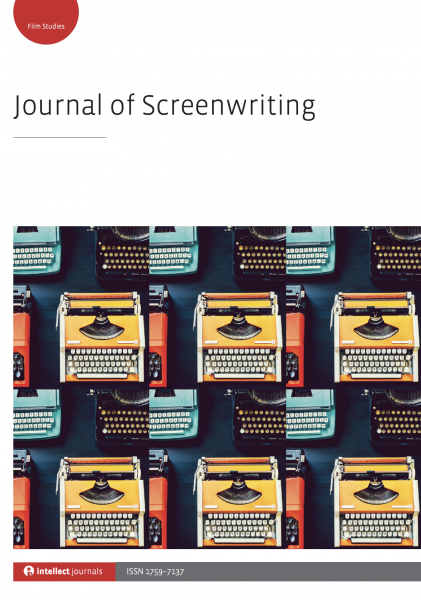
We chatted about my work with the Stephens College MFA in TV and Screenwriting, and then my work with co-editor Rose Ferrell on the Journal of Screenwriting’s special issue on Women in Screenwriting (Volume 11, Number 3) that came out recently and which featured articles about an international set of female screenwriters from Syria, Argentina, China and Canada (to name a few).

We even had time to nerd out on our own favorite classic films across the eras which brought up fun memories of Angels with Dirty Faces, Back to the Future, Bonnie and Clyde, and of course, all things Star Wars from the original 3 to The Mandalorian. It’s always so fun to talk to fellow cinephiles.

RMW Rosanne Signature for Web

Watch this entire presentation

With Intellect Books Editor James Campbell (@IntellectBooks)

Speaking with Dr. Rosanne Welch, Author, teacher, and television screenwriter. Today we cover everything from women in screenwriting to our favorite Jimmy Cagney movies and Friends.

Journal of Screenwriting Cover

15 Treva Silverman From Women in Early TV for the American Women Writers National Museum [Video]

15 Treva Silverman From Women in Early TV for the American Women Writers National Museum [Video]

Many thanks to Janice Law of the American Women Writers National Museum who invited me to give a short talk on The Women of Early TV.

I enjoyed sharing the names and careers of women like Peg Lynch, Gertrude Berg, Selma Diamond, and D.C. Fontana to the members who gathered on Zoom last Wednesday morning. There are so many more I could have talked about whose names don’t appear in mainstream books about the history of television so we have to learn who they are and carry those names forward ourselves.  It’s one of the missions of the Stephens College MFA in TV and Screenwriting – and has been one of my missions all my life.

RMW Rosanne Signature for Web

Transcript:

Moving into the 1960s one of my favorite people is Treva Silverman. She is one of the first female writers to win an Emmy. In fact, she won two in the same year for writing without a male partner. All the previous women who had won had had a male partner. Treva was a solo writer. She originally wrote for The Monkees. One show that I have written an entire book about that I’m very interested in and I will credit her with the fact that in 58 episodes of a show about rock and roll singers, every girl they met had a job and a career. They did not ever date bimbos. They dated girls who were journalists and who were worked at record stores or there was one who was a princess and a princess is a job right? So I think Treva was the feminist voice on that show.

Many thanks to Janice Law of the American Women Writers National Museum who invited me to give a short talk on The Women of Early TV.

I enjoyed sharing the names and careers of women like Peg Lynch, Gertrude Berg, Selma Diamond, and D.C. Fontana to the members who gathered on Zoom last Wednesday morning. There are so many more I could have talked about whose names don’t appear in mainstream books about the history of television so we have to learn who they are and carry those names forward ourselves. It’s one of the missions of the Stephens College MFA in TV and Screenwriting – and has been one of my missions all my life.

Watch this entire presentation


Women pioneers who created, produced, or shepherded many of America’s most wildly popular, early television programs will be profiled by Dr. Rosanne Welch.

Get your copy today!

Failing to Credit Screenwriters Once Again…

Failing to Credit Screenriters Once Again…

A funny thing happened to me on the way to making my own list of 25 Films Written By Women to counter the “52 Films by Women” put out by the WIF (Women In Film). 

Their list only included films directed by women and didn’t even bother listing the names of the writers (some of whom were also women).

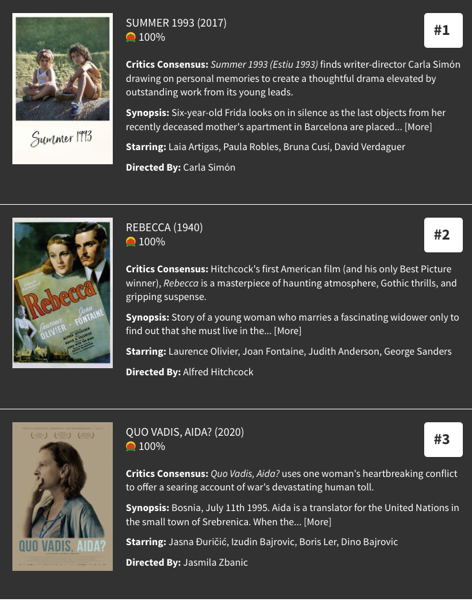
So I Googled ’20 Films Written by Women’ to see what someone else may have collected and found this list of 128 Best Movies Written by Women of All Time”.

Can you find the flaw in the way they list the movies?

I can and it’s driving me CRAZY…

…and then I found that even though they list the writers in the opening paragraphs, they omit the screenwriter’s name from the movie’s details.

WTF?

06 More On “She is wise and unafraid…” from The Difficulties and Delicacies of Writing the First Female Doctor in 50+ years [Video] [Doctor Who]

It was great to be able to attend this year’s SD WhoCon in San Diego and present this lecture on “The Difficulties and Delicacies of Writing the First Female Doctor in 50+ years” in which I discuss how successful I think showrunner Christopher Chibnall was in making that transition.

It gave me a chance to talk about the creative work of a showrunner/screenwriter while also reconnecting to some friends we had met at this same convention some 3 years ago – and to talk about one of my favorite subjects – Doctor Who!

06 More On

Transcript:

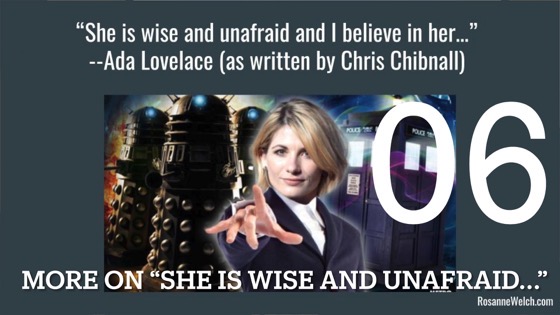
…but this line I really like. I also think it’s an example of how he promised to sort of give the show a bit of a female gaze right and I love all the dudes who’ve ever been on Doctor Who — well maybe not Colin Baker so much — but you know in general do love them all but he made a promise and I think he kept it. I think he didn’t just sort of gloss over and pretend and I think we’ll see that in the choice of guest characters, the choice of people we get to meet, right down to the fact that we met Ada Lovelace, who we’ve kind of heard about but I’ll still mention her in some classes and people don’t know who she is. So the fact that he’s giving a moment here for people to go oh oh that’s an interesting woman I need to know some more about and I think he scattered the show with those types of characters — those types of historical people we would not have met had he not kept in mind, I’ve promised to give this a kind of a different spin right? So that really impresses me.


Watch this entire presentation

01 Introduction and Stephens College MFA In TV and Screenwriting from In Conversation with Dr. Rosanne Welch and Intellect Books [Video]

01 Introduction and Stephens College MFA In TV and Screenwriting from In Conversation with Dr. Rosanne Welch and Intellect Books [Video]


Transcript:

James: I just want to say welcome to everyone who’s joining us today. This is In Conversation. We’ll be chatting for another 45 minutes or so. I’m very pleased to have Dr. Rosanne Welch with me today who is a practicing screenwriter with some serious writing credits to her CV, which we’ll get into as well, but also she runs an MFA program and works as a major researcher involved in Intellect’s Journal of Screenwriting which we can also definitely discuss. So why don’t you tell us a little bit about your research interest? Is it just screenwriting you focus on or is there other aspects of film and history?

Rosanne: Well it’s largely yes film history as well but it kind of always focuses on women in film history because they’ve sort of been left behind on the cutting room floor. We’re getting there we’re seeing more involvement in that. I actually had a great conversation with the documentarian from the BBC who found me because I put a lot of my lectures online and in one of them I discuss research that we’re trying to do into a woman named Jennie Louise Toussaint. She was an African-American screenwriter in the Silent Era but the problem is her work was not preserved right? The films we know disintegrated. There are no paper scripts around. We know she existed because of advertisements in newspapers advertising her films that were playing. So they noticed that I had mentioned her and just said here’s someone we need to find more research on and they’re doing a BBC documentary on famous sisters of famous brothers — on accomplished women who were sisters of famous brothers and her brother was a Harlem Renaissance photographer. So they were like do you know anything more about her so we can do more on her. This is what I have. We’re all building on the knowledge. I mean that’s what a journal is for. We build on the knowledge that other people have found and eventually we get a bigger picture that didn’t exist.

One of the benefits of attending conferences is that you can meet the editors from the companies that have published some of your books face to face. That happened at the recent SCMS conference where I met Intellect editor James Campbell and he invited me to be a guest on his InstagramLive show.

We chatted about my work with the Stephens College MFA in TV and Screenwriting, and then my work with co-editor Rose Ferrell on the Journal of Screenwriting’s special issue on Women in Screenwriting (Volume 11, Number 3) that came out recently and which featured articles about an international set of female screenwriters from Syria, Argentina, China and Canada (to name a few).

We even had time to nerd out on our own favorite classic films across the eras which brought up fun memories of Angels with Dirty Faces, Back to the Future, Bonnie and Clyde, and of course, all things Star Wars from the original 3 to The Mandalorian. It’s always so fun to talk to fellow cinephiles.

RMW Rosanne Signature for Web

Watch this entire presentation

With Intellect Books Editor James Campbell (@IntellectBooks)

Speaking with Dr. Rosanne Welch, Author, teacher, and television screenwriter. Today we cover everything from women in screenwriting to our favorite Jimmy Cagney movies and Friends.

Journal of Screenwriting Cover

14 Joan Harrison From Women in Early TV for the American Women Writers National Museum [Video]

14 Joan Harrison From Women in Early TV for the American Women Writers National Museum [Video]

Many thanks to Janice Law of the American Women Writers National Museum who invited me to give a short talk on The Women of Early TV.

I enjoyed sharing the names and careers of women like Peg Lynch, Gertrude Berg, Selma Diamond, and D.C. Fontana to the members who gathered on Zoom last Wednesday morning. There are so many more I could have talked about whose names don’t appear in mainstream books about the history of television so we have to learn who they are and carry those names forward ourselves.  It’s one of the missions of the Stephens College MFA in TV and Screenwriting – and has been one of my missions all my life.

RMW Rosanne Signature for Web

Transcript:

Joan Harrison is a woman few people know about today because this man, Alfred Hitchcock, overshadowed all the writers of all his movies. We call them Hitchcock films but I find that very very disingenuous because in fact they were written by other people. Often this woman, Joan Harrison. She wrote, in fact, the only movie that Hitchcock ever won an Oscar for — Rebecca. She’s the woman who found the story, adapted it, wrote the script was on the set for all the production of it. She was originally his secretary. She began as the secretary and there were many people who never forgave that title however she wrote many other films. She began to produce films and we’re talking about early in the 40s, 50s. She’s going to move into the 1960s as the producer of the Alfred Hitchcock’s Presents program. So she’ll do TV production, executive producing, long before that ever existed for most people and very recently a friend of mine — I met her online doing other work — Christina Lane –she’s a professor out of the College of Florida. She wrote Phantom Lady. Of course, that’s the name of a film but also it’s the story of Joan Harrison’s life. So it’s the first full biography of a female producer of that time period that takes her work very seriously but notice how the subtitle still has to be “The forgotten woman behind Hitchcock.” That’s the name that we recognize. That’s the name people relate to. So her career has always been overshadowed by the fact that she worked for Hitchcock. There’s another book about writing with Hitchcock by I believe his name is Michael Shane, I’d have to double-check but he wrote several Hitchcock films and he wrote a book about writing with Hitchcock. About what it was like to work with him and as much as we call them Hitchcock films and I’m very against that auteur theory because I think the writer is the person who brings you your theme — that’s what they’re considered. So we have to remember the people behind the directing. They were the writers and this is a beautiful picture of her as a producer looking at a piece of edited film and making some choices. So she did the full gamut of work in these early days of television.

Many thanks to Janice Law of the American Women Writers National Museum who invited me to give a short talk on The Women of Early TV.

I enjoyed sharing the names and careers of women like Peg Lynch, Gertrude Berg, Selma Diamond, and D.C. Fontana to the members who gathered on Zoom last Wednesday morning. There are so many more I could have talked about whose names don’t appear in mainstream books about the history of television so we have to learn who they are and carry those names forward ourselves. It’s one of the missions of the Stephens College MFA in TV and Screenwriting – and has been one of my missions all my life.

Watch this entire presentation


Women pioneers who created, produced, or shepherded many of America’s most wildly popular, early television programs will be profiled by Dr. Rosanne Welch.

Get your copy today!

05 “She is wise and unafraid…” from The Difficulties and Delicacies of Writing the First Female Doctor in 50+ years [Video] [Doctor Who]

It was great to be able to attend this year’s SD WhoCon in San Diego and present this lecture on “The Difficulties and Delicacies of Writing the First Female Doctor in 50+ years” in which I discuss how successful I think showrunner Christopher Chibnall was in making that transition.

It gave me a chance to talk about the creative work of a showrunner/screenwriter while also reconnecting to some friends we had met at this same convention some 3 years ago – and to talk about one of my favorite subjects – Doctor Who!

05


Transcript:

Because I do know — I have two very favorite — yeah my very favorite fandoms are Doctor Who and The Monkees and somebody did this lovely piece of fan art which I just fell in love with so I love how fandom blends together and you know the whole community that you create with other people who love what you love but today we’re going to talk about the writing of this new female Doctor right? I used to actually have a Matt outfit I like to wear and I had a Peter outfit that I like to wear but now I’m going to have to kind of have to go with the fact that hello I bought this two years ago here at WhoCon, so it’s really fun. Anyway, this was actually the title and this is a line right from the first episode. What I loved is this business right? “She’s wise and unafraid and I believe in her.” One of the things I noticed about what Chibnall had to do right away and I know that we all have some gripes about some of the stuff he’s done but I think that he made some very good choices in the beginning and a lot of that has to do with writing and hiring some other very good writers who brought in some aspects of the show we hadn’t had before.


Watch this entire presentation

27 Conclusion from “Female Creatives & A Star Is Born” [Video]

27 Conclusion from

Transcript:

So I think she’s a pretty cool lady all around. I think it’s cool to realize how much of an effect this movie has had on film history. If you are a die-hard fan and you watch it for Christmas, even though it’s not a Christmas movie, you’ll notice the big moment at the end is that all through the movie she’s defined herself as Holly Gennaro which is her maiden name because they’re separated but in the end when they make up and she runs to the police and they say something about our you so and so she says Holly Maclean. She takes his name back. So she’s doing exactly a homage to that moment. In the same way, some 20 years later — this is 1988 — in Notting Hill, we finally have a guy who doesn’t mind when they call him Mr Scott which is Anna Scott’s name right? That’s not his last name but he’s now fine with a wife who is five million times more famous than he will ever be. So our society had come to this point one assumes in 1999 and Dorothy yourself has been homaged and written about. Fitzgerald who knew her personally wrote about her in The Last Tycoon. She’s one of the characters in there. She’s in this Broadway play as a character and if you like the Gilmore Girls at all Amy Sherman Palladino’s production company is called “Dorothy Parker Drank Here.” That’s how popular she maintains in the modern world. I got a bunch of clips you can see at another time because we don’t have time. I always like to offer up a bibliography because you should know there’s a lot of stuff you could study and that’s it. That’s everything I can say in a nutshell about A Star is Born.

Watch this entire presentation

Connections at conferences matter! Through the most recent SCMS, I met Vicki Callahan, whose film history focus right now is on Mabel Normand. When she learned I could put together a lecture on the importance of the female voice in the A Star is Born franchise she asked me to give that lecture to her master students.

It made for a great opportunity for me to hone the ideas I’m working on for a chapter on that franchise that I’m writing for a new book from Bloomsbury: The Bloomsbury Handbook Of International Screenplay Theory. It’s always nice when one piece of research can be purposed in other ways – and it’s always fun revisiting such a female-centric film franchise – one that drew the talents of such powerful performers as Janet Gaynor, Judy Garland, Barbara Streisand, and Lady Gaga.

Find out why in this lecture!

RMW Rosanne Signature for Web


Watch this entire presentation