If you have friends who were interested in reading but low on cash, tell them to check it out.
And this is a reminder that if you want your local library to carry a copy, you need to ask a librarian. They have a form you can fill out that requests what books you’d like in their stacks. You can also send or give them this flyer with all the pertinent information!
* A portion of each sale from Amazon.com directly supports our blogs ** Many of these books may be available from your local library. Check it out! † Available from the LA Public Library
* A portion of each sale from Amazon.com directly supports our blogs ** Many of these books may be available from your local library. Check it out! † Available from the LA Public Library
KPFK’s Andrew Tonkovitch interviewed Paperback L.A. Editor Susan La Tempa for Bibliocracy Radio last weekend and they had nice things to say about how fun my piece on the writers of The Monkees and how much he had misunderstood the band until he read my article.
They discuss the whole anthology in this interview, and touch on The Monkees around the 20:20 mark.
Host Andrew Tonkovitch interviews editor Susan LaTempa, June 16, 2019 about the Paperback L.A. Book 3, A Casual Anthology: Secrets. SigAlerts. Ravines. Records.
He says, “This one is titled, joyfully, ‘Secrets, Sigalerts, Ravines, Records.’ Once again, this compendium-meets-literary/artistic collage includes both new discoveries and reminders, with a multi-media collection including fiction, nonfiction, photography, lists– a free-form provocation which, after reading, will inspire readers to pursue recommended or featured writers, topics, historical moments, artists and places. It’s a little hard to describe but you will know it — and love it! — when you see it.”
Editor Susan La Tempa hosted all the local contributors at the event space in the Helms Bakery district, which gave us a chance to check out that lovely landmark. Then I had the chance to meet Lisa See – author of On Gold Mountain, which tells the story of 4 generations of her Chinese-American family living in Los Angeles and running a factory, an antique shop and a restaurant popular with the Hollywood crowd of the 1930s and 40s. We had first heard of her book when Doug and I were docents at the Autry Western Heritage Museum in Griffith Park and they had a whole exhibit dedicated to telling the story of the book (which it turns out Lisa curated!) It was so popular an exhibit that it hung around long enough for Joseph to be born and to become old enough to play in the little mini restaurant they set up with pots and plates and menus. So it was wonderful to hear Lisa read an excerpt from the book and then to talk to her during the book signing segment of the afternoon.
I was also deeply impressed by the way Susan opened the event with a native Tongva greeting – something I had only seen done at the public events we attended in New Zealand where everyone began events with the traditional Maori greeting where you introduce yourself in terms of what is your mountain, your river, and your ancestry. Beautiful! So hearing it in Los Angeles was a lovely idea we all ought to emulate.
Then the super cool thing was that several friends made the trip down to Culver City – thanks Duke and Dena Jackels and Dan and Liz Forer – and Euphemia – for coming to the reading, and for buying books!
While we at Screenwriting Research Network strive to force a focus on screenwriters, we need allies in the non-academic world to properly credit them.
In that vein, I recently wrote to the Guardian’s film critic about a moment in his review of ‘Gangs of New York’ where he credited the director for a visual moment that occurred, clearly and firstly, in the original script — something that happens far too frequently. Often, such letters yield nothing outside of getting the issue off my chest, but today I received this response:
“Dear Dr Welch: many thanks for your email, which has been passed on to me. Your comment is entirely fair: I should have credited this moment to the screenwriters: Jay Cocks, Steven Zaillian and Kenneth Lonergan. With all good wishes,”
I received this response after sending this email to The Guardian’s film desk:
“As a professor of Screenwriting History for an MFA program in the U.S. I greatly enjoy sharing your reviews of American films with my students, so I hope you don’t mind my noting a small mistake I found while researching your review of Gangs of New York – but again, being a professor of Screenwriting History (not film history because film history is the history of directors) I found you fell victim to one of the age-old issues of the old auteur theory. You credited a visual moment to the director when, in fact, it had existed in the original script, therefore the credit ought to have gone to the writer(s) and their imaginations and use of quality research.”
“The streets erupt in a saturnalia of lawlessness, to which the director adds an inspired touch: an escaped elephant from Barnum’s circus trumpeting down the rubble-strewn streets.”
Yet that elephant was in the script (which I researched at the WGA Library in Los Angeles) all along, as you can see:
“116 EXT. CANAL STREET DAWN
The first thing we see is an ELEPHANT, who trumpets fearfully at the sudden sound of the shattered door. The gang stops, wary of this huge refugee from Barnum’s Museum, but the animal is more frightened of them. It hurries on down the street…”
I only make this point because those kinds of errors lead to the continued idea that directors are the only authors of a film – an idea most film programs are debunking by the day. I hope critics (since they are also writers) will remember screenwriters more prominently in their work in the future. I have taken to reminding people that, when you speak of your favorite films you rarely recount memorable camera angles, but in fact you recount your favorite dialogue and that is the realm of the writer. Often, as in this instance, many of the visuals credited to directors were first imagined by writers as well.
So let’s talk about some women you know and some women you don’t know and hopefully, you will — as I said. These are ladies, hopefully, you’ll recognize. Anybody? (Audience: Shonda Rhimes) Shonda Rhimes! Thank goodness. We must all know Shonda Rhimes. (Audience: Is that Diablo Cody?) That’s Diablo Cody. Exactly, from Juno. This lady — you have probably seen more movies than any of theirs combined. (Audience: Is that Jane Fonda?) No, looks a lot like her though. doesn’t she? Nora Ephron. Nora Ephron, right? Incredible. So these are people that I think you recognize. There’s Nora Ephron. Nora Ephron is probably the queen of screenwriting. She passed away a few years ago, but you’ve seen probably all these films or you’ve heard about them mentioned in popular culture places. You’ve seen parodied on The Simpsons. That’s how embedded in popular culture they are, right? I mean, “When Harry Met Sally” is a classic. it is something that everyone references when they think of rom-coms.
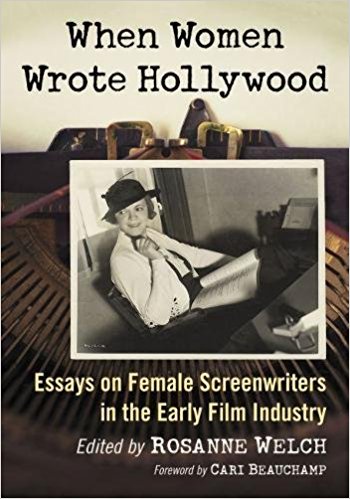
Dr. Rosanne Welch discusses the women in her new book “When Women Wrote Hollywood” which covers female screenwriters from the Silents through the early 1940s when women wrote over 50% of films and Frances Marion was the highest paid screenwriter (male or female) and the first to win 2 Oscars. Yet, she fails to appear in film history books, which continue to regurgitate the myth that male directors did it all – even though it’s been proven that the only profitable movies Cecil B. de Mille ever directed were all written by Jeannie Macpherson film ever won for Best Picture was written by Robert E. Sherwood (who people have heard of, mostly due to his connection to Dorothy Parker) and Joan Harrison.
* A portion of each sale from Amazon.com directly supports our blogs ** Many of these books may be available from your local library. Check it out! † Available from the LA Public Library
Jeanie Macpherson herself repeatedly notes in press releases and interviews that Cecil B. DeMille was notoriously hard to please, requesting endless drafts of scripts, but that, “He will take advice from anyone – if it’s right. He won’t take it from anyone if it’s wrong.” Over the years, Macpherson was one of the few people who was able to appease “Mr. Hard to Please.”
Jeanie Macpherson: A Life Unknown by Amelia Phillips
* A portion of each sale from Amazon.com directly supports our blogs ** Many of these books may be available from your local library. Check it out! † Available from the LA Public Library
The Write Or Die Chicks, founded by 3 of my former MFA alums from Cal State Fullerton (Deanna Gomez, Mercedes Milner, and Angela Thomas) were kind enough recently to name me on their Writer Crush Wednesday post which made my day.
After their graduation a year ago May, they came out of the dust of the classroom (CP 126) where they spent so much time for two years ready to take over the town with their writing and their energy.
wish them all the luck they’ll need (because they already have all the talent required). Starting such a writers group is always a great way to continue creating new material with caring collaborators.
Dr. Rosanne Welch, PhD is this week’s #WriterCrushWednesday We thank her for being an inspiring and influential Screenwriter, Author, Professor and Mentor from her work on #TouchedByAnAngel to her lectures at CSUF and every publication in between.
In fact, John Steinbeck who was writing about how his movie was adapted, wrote that not only Johnson the man who did it did better than his own novel. So the man who wrote Grapes of Wrath was crediting the man who adapted it and yet our own way of doing news and writing about films always privileges the director. Which makes me crazy I don’t believe in that. It’s also sad and easy for men to dismiss women in their memoirs. We all know the picture of this guy. He is very famous for being a director. People think about his films. He admits in his memoirs that he learned everything he knows from some middle-aged American woman whose name was Eve Unsell she was a producer for Universal Studios the first woman to have her own production company they sent her to England to fix their production company in England and she trained him. Could he at least mention her name in the memoir? Right? And people researching her might find her mentioned and be able to do more work on her. So it’s very easy to dismiss people.
Dr. Rosanne Welch discusses the women in her new book “When Women Wrote Hollywood” which covers female screenwriters from the Silents through the early 1940s when women wrote over 50% of films and Frances Marion was the highest paid screenwriter (male or female) and the first to win 2 Oscars. Yet, she fails to appear in film history books, which continue to regurgitate the myth that male directors did it all – even though it’s been proven that the only profitable movies Cecil B. de Mille ever directed were all written by Jeannie Macpherson film ever won for Best Picture was written by Robert E. Sherwood (who people have heard of, mostly due to his connection to Dorothy Parker) and Joan Harrison.
* A portion of each sale from Amazon.com directly supports our blogs ** Many of these books may be available from your local library. Check it out! † Available from the LA Public Library
I met up for dinner with several @mfascreenwriter alums and authors from “When Women Wrote Hollywood” before our presentation at @denverpopculturecon last week.
Always great seeing familiar faces and catching up their lives and careers.
A Denver local recommend @osteriamarcodenver and it was tasty!