14 Fuller, Women, and War from Concord Days: Margaret Fuller in Italy [Video]

In researching and writing my book on Giuseppe and Anita Garibaldi and the unification of Italy (A Man Of Action Saving Liberty: A Novel Based On The Life Of Giuseppe Garibaldi)  I re-discovered the first American female war correspondent – Margaret Fuller — who I had first met in a college course on the Transcendentalists. I was once again fascinated by a life lived purposefully.

Then I found Tammy Rose’s podcast on the Transcendentalists – Concord Days – and was delighted when she asked me to guest for a discussion of Fuller’s work in Italy as both a journalist – and a nurse. — Rosanne

14 Fuller, Women, and War from Concord Days: Margaret Fuller in Italy [Video]

Watch this entire presentation

Concord Days sends love to Margaret Fuller on the anniversary of her death in 1850.

The conversation focuses on Margaret’s exciting days in ITALY!

Dr. Rosanne Welch takes us through her adventures and enthusiastically reminds us what she was like when she was living her best life!

Transcript:

Tammy: In America, we don’t really have titles. We don’t really understand that level of society but over there it’s a thing.

Rosanne: Even if there’s no money associated with it, there’s an honor to it. You are of the upper classes even if you don’t have the money to go with it and that’s a big deal.

Tammy: Exactly. Exactly. yeah so and and and also another important point you had you had mentioned this before, so Garibaldi’s wife had like gone into battle like really with a baby like on her. It’s like she’s literally — she’s not just a nurse she’s she’s also nursing like while she’s on the battlefront right?

Rosanne: That’s so beautifully said. That’s exactly right, right? They end up having four children and there’s a statue of her in Rome because Mussolini tried to use her reputation to support his work. Look how dedicated she was to her country. There’s a statue of her with the child at her breast while she’s riding and she was a great horsewoman and she trained the cavalry. The men trusted her because Garibaldi trusted her but of course after they had a couple of kids when they’re in Rieti and they’re doing all this stuff it was like now you can’t risk yourself dying. So please stay behind and behind meant you’re dealing with the bloody leftovers. You know we’re not even in M*A*S*H days where you’ve got legitimate drugs to help people. I mean they’re just — it’s carnage and that’s what her and Margaret were doing — working together in this hospital while they had their kids around and their men were off and maybe that report the next body that comes in could be your husband.

21 You Can’t Keep Up With TV Shows from Worry and Wonder | The Courier Thirteen Podcast [Video]

Watch the entire presentation – Worry and Wonder | The Courier Thirteen Podcast | Episode # 29 here

21 You Can't Keep Up With TV Shows from Worry and Wonder | The Courier Thirteen Podcast [Video]

Transcript:

Host: Was it called the little things?

Rosanne: Yeah it just came out on me on Netflix or HBO sorry.

Host: Yeah HBO Max.

Rosanne: Brand new so, again, you can’t keep up with 420 TV shows

Host: No, you can’t yeah.

Roanne: That’s that’s why buzz and word of mouth is now one of the most important things. It kind of always was but when there were only three or four channels or even 50 cable channels, you found things that people gelled around, and then it became a big event like Mad Men or something like that or Breaking Bad. Now it really becomes your little circle of friends. You recommend a show. I watch it. I tell somebody else I know outside of that circle. They might tell their group. That has become such an important sort of Venn diagram. Who’s seen this and who’s seen that and if you like this you’ll like that and we — that’s where we get our information from. So it’s a really important conversation for people to have for the benefit of the programs to get their audiences.

It’s always fun to sit down with students and share stories about entering the television industry and how things work at all stages and I had that opportunity the other day.

Daniela Torres, a just-graduated (Congratulations!) student of the Columbia College Semester in LA program asked me to guest on a podcast she had recently begun hosting with another college student she met during her internship (good example of networking in action!).

We could have talked all morning (the benefit of a 3 hour class session) but we held it to about an hour and fifteen minutes or so. Hopefully, along the way I answered some questions you might have about how the business works. So often it amounts to working hard at being a better writer and gathering a group of other talented, hard-working people around you so you can all rise together.

Dr. Rosanne Welch is a television writer with credits that include Beverly Hills 90210, Picket Fences, ABCNEWS: Nightline and Touched by an Angel. She also teaches Television Writing and the Art of Film at San Jose State University.

Rosanne discusses what made shows like Beverly Hills 90210 compelling, what to do and not to do when attempting to pitch a show to broadcast or streaming, what most young writers neglect in their writing process, and much more!

The Courier Thirteen Podcast is available on YouTube, Spotify, Apple Podcasts, SoundCloud, and Audible.

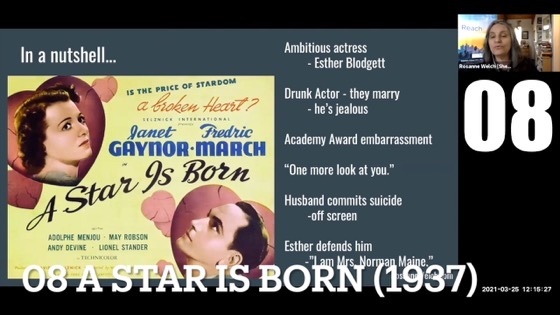
08 A Star Is Born (1937) from “Female Creatives & A Star Is Born” [Video]

08 A Star Is Born (1937) from

Transcript:

In a nutshell, what do we see in the first version of A Star Is Born?” We have this ambitious actress. We have a drunken actor, not a director. They do marry and he is jealous of her despite how bad that makes him feel. We have this classic scene where she wins an Academy Award and he shows up drunk and destroys and humiliates the evening right? We have this classic line “Can I have one more look at you”, right before I kill myself but you don’t know that’s what I’m about to do right? We have the husband committing suicide off-screen. We’re going to see him walk off into the ocean. We’re not going to see him dead on our screen and of course, we’re going to have this ending where she defends him to the society that destroyed him — to Hollywood — by saying “I am Mrs. Norman Maine” and there’s a lot — we’ll talk about this a little if we have some time — there’s some argument. My undergrad students nowadays will say they hate that line and they’re seeing it as her stepping back and losing her identity and I don’t think that’s how it was intended. I think if we think again about the time period, this was her asserting this man meant something and you people ruined him and I will not forget him right? So it’s an interesting line to see. Everything changes as we move through society and we bring our own baggage to what we watch. So we have to think about that. It was intended to be a monument to him and not a detriment to her at this point.

Watch this entire presentation

Connections at conferences matter! Through the most recent SCMS, I met Vicki Callahan, whose film history focus right now is on Mabel Normand. When she learned I could put together a lecture on the importance of the female voice in the A Star is Born franchise she asked me to give that lecture to her master students.

It made for a great opportunity for me to hone the ideas I’m working on for a chapter on that franchise that I’m writing for a new book from Bloomsbury: The Bloomsbury Handbook Of International Screenplay Theory. It’s always nice when one piece of research can be purposed in other ways – and it’s always fun revisiting such a female-centric film franchise – one that drew the talents of such powerful performers as Janet Gaynor, Judy Garland, Barbara Streisand, and Lady Gaga.

Find out why in this lecture!

RMW Rosanne Signature for Web


47 Selling Your Nightmares from There And Back Again: Writing and Developing for American TV [Video]

47 Selling Your Nightmares from There And Back Again: Writing and Developing for American TV [Video]

Thanks to the gracious invitation from my Screenwriting Research Network colleague Paolo Russo – and a grant he was able to procure (and in the before-Covid time) I was able to spend a week at Oxford Brookes University working with the screenwriting masters students in Paolo’s course. At the culmination of the week, I gave this lecture on how writers rooms worked in the States.

Transcript:

What I learned from being in a writer’s room is the things you need to do most are the things you learn in English and Humanities classes. First of all, you’re selling your nightmares. What are the worst things you can imagine happening? Make stories out of that. They’re the what-ifs of your life. That whole Down Syndrome baby thing. I was pregnant when I wrote that. You have no idea when you’re going to have a kid right unless you get all the tests and even if you get all the tests you’re not sure until the day the kid shows up and you imagine all the awful things that might happen right? So I was in the middle of that when I wrote that episode. So that was my true emotion that was happening. I wrote an episode once about what if your husband committed suicide. I’ve got all kinds of episodes. I just thought what are the worst things that could happen to me and bam they became episodes over and over again right? So you’ve got to mine your nightmares and manage them.

Watch this entire presentation

Subscribe to Rosanne’s Channel and receive notice of each new video!


* A portion of each sale from Amazon.com directly supports our blogs
** Many of these books may be available from your local library. Check it out!
† Available from the LA Public Library

The Difficulties and Delicacies of Writing the First Female Doctor in 50+ years (Complete) [Video]

It was great to be able to attend this year’s SD WhoCon in San Diego and present this lecture on “The Difficulties and Delicacies of Writing the First Female Doctor in 50+ years” in which I discuss how successful I think showrunner Christopher Chibnall was in making that transition.

It gave me a chance to talk about the creative work of a showrunner/screenwriter while also reconnecting to some friends we had met at this same convention some 3 years ago – and to talk about one of my favorite subjects – Doctor Who!

The Difficulties and Delicacies of Writing the First Female Doctor in 50+ years (Complete) [Video]


13 Fuller and Her Relationships from Concord Days: Margaret Fuller in Italy [Video]

In researching and writing my book on Giuseppe and Anita Garibaldi and the unification of Italy (A Man Of Action Saving Liberty: A Novel Based On The Life Of Giuseppe Garibaldi)  I re-discovered the first American female war correspondent – Margaret Fuller — who I had first met in a college course on the Transcendentalists. I was once again fascinated by a life lived purposefully.

Then I found Tammy Rose’s podcast on the Transcendentalists – Concord Days – and was delighted when she asked me to guest for a discussion of Fuller’s work in Italy as both a journalist – and a nurse. — Rosanne

13 Fuller and Her Relationships from Concord Days: Margaret Fuller in Italy [Video]

Watch this entire presentation

Concord Days sends love to Margaret Fuller on the anniversary of her death in 1850.

The conversation focuses on Margaret’s exciting days in ITALY!

Dr. Rosanne Welch takes us through her adventures and enthusiastically reminds us what she was like when she was living her best life!

Transcript:

Rosanne:…and it fascinates me because they’re also having relationships in their lives because Anita had been married to someone else and she ran away with Garibaldi. Her husband was an abuser and a terrible guy and then he eventually died. So they were able to get married but they had a couple kids outside of wedlock.

Tammy: That sounds familiar yeah

Rosanne: Exactly and yeah hello Margaret’s going to show up right with Ossoli who’s a beautiful gorgeous man who’s also fighting for Italy and they’re not married but they do get that little secret marriage in before the baby’s born because that’s very careful.

Tammy: As long as everything’s legal right like that’s that that’s actually what matters yeah.

Rosanne: Well because you know we forget nowadays because it’s not a big deal to us but it was all about inheritance, If you were not the legal child, you would not inherit any of the father’s money or land or title in this case. So you know she definitely wanted to make — I assume she wanted to make sure her child would be given all that he was owed.

20 Screenwriting: Television Vs. Film from Worry and Wonder | The Courier Thirteen Podcast [Video]

Watch the entire presentation – Worry and Wonder | The Courier Thirteen Podcast | Episode # 29 here

20 Screenwriting: Television Vs. Film from Worry and Wonder | The Courier Thirteen Podcast [Video]

Transcript:

You know, the difference between TV, obviously, and movies — movies you are going to tell me the most interesting 2 hours in someone’s life. What are the most crazy, interesting 2 hours and we’re done. Maybe there’ll be sequels, of course, blah, blah, blah — but, in general, that’s what you’re going for. In a TV show — especially a pilot — you need to give me enough fodder to understand that there are at least 20 hours — nowadays with streaming, 40 — used to be 100 — in order to get to syndication — but that there’s that much interesting embedded conflict among this group of people that I’m going to be constantly interested in watching them overcome whatever their problem might be. Whatever their issue might be. So, every show has what we would call an overarching dramatic question that is trying to be answered. It’s like — and it can be — it should be — the bigger it is, the more universal. So, for me, an easy example is Bones, right, which some people realize what was — she’s uber-smart and autistic and he’s uber-Catholic and, you know, goes for the emotion. Which, of course, is a flip to what we think gender-wise. It should be the dude being super-logical and the girl being super-emotional, but they flipped it so that’s interesting. But really it’s a show about science versus religion and the 2 characters represent those 2 points of view and there’s never going to be an answer to that question. Except if you accept that the answer is you need them both and that’s how they solve their crimes is the 2 of them together are better than each separately. So, you’re overarching question every week is being addressed. The individual question each week is simply who committed this murder. That’s always going to be solved but the overarching dramatic question can never be solved or your show’s over.

It’s always fun to sit down with students and share stories about entering the television industry and how things work at all stages and I had that opportunity the other day.

Daniela Torres, a just-graduated (Congratulations!) student of the Columbia College Semester in LA program asked me to guest on a podcast she had recently begun hosting with another college student she met during her internship (good example of networking in action!).

We could have talked all morning (the benefit of a 3 hour class session) but we held it to about an hour and fifteen minutes or so. Hopefully, along the way I answered some questions you might have about how the business works. So often it amounts to working hard at being a better writer and gathering a group of other talented, hard-working people around you so you can all rise together.

Dr. Rosanne Welch is a television writer with credits that include Beverly Hills 90210, Picket Fences, ABCNEWS: Nightline and Touched by an Angel. She also teaches Television Writing and the Art of Film at San Jose State University.

Rosanne discusses what made shows like Beverly Hills 90210 compelling, what to do and not to do when attempting to pitch a show to broadcast or streaming, what most young writers neglect in their writing process, and much more!

The Courier Thirteen Podcast is available on YouTube, Spotify, Apple Podcasts, SoundCloud, and Audible.

46 The Importance of Pronouns from There And Back Again: Writing and Developing for American TV [Video]

46 The Importance of Pronouns from There And Back Again: Writing and Developing for American TV [Video]

Thanks to the gracious invitation from my Screenwriting Research Network colleague Paolo Russo – and a grant he was able to procure (and in the before-Covid time) I was able to spend a week at Oxford Brookes University working with the screenwriting masters students in Paolo’s course. At the culmination of the week, I gave this lecture on how writers rooms worked in the States.

Transcript:

So that was fine. Renoly was marvelous and we had a marvelous time working on that. One of the things I learned was remembering the importance of words. The simple act of in one scene, of course, he gets shot, right — because he’s in a gang — they had to go to the hospital and all I had to do was write “The doctor walks in and SHE says…” and they hired a lady as the doctor. If I had not used that pronoun they would have hired a man because that’s what an extra casting director would simply have gone to — his stereotype. Doctors are boys, right? So just because of the word she I got a woman a job and little girls in America the chances to know that doctors are girls. Now y’all, as I said better over here right because that’s very cool but that’s what Shonda Rhimes has built her whole career on right, colorblind casting and gender blind casting. Let’s just get in good actors to do these parts and see where we go from there, which I think is a really brilliant thing and what she’s built her whole thing on.

Watch this entire presentation

Subscribe to Rosanne’s Channel and receive notice of each new video!


* A portion of each sale from Amazon.com directly supports our blogs
** Many of these books may be available from your local library. Check it out!
† Available from the LA Public Library

07 More On Dorothy Parker from “Female Creatives & A Star Is Born” [Video]

07 More On Dorothy Parker from

Transcript:

Also has been said about her, her stories feature female characters trying to square exhilarating new choices with the enduring bold constraints of social expectation. The social expectation in A Star Is Born is that a man should be more successful than his wife. That is something that happened in any particular level of the society at the time. Also, her heroines are lovelorn and there are always suicidal alcoholics in so many of her pieces and this appears in other films she wrote without Alan. They did effect eventually split up and get divorced. So she wrote for Hitchcock. He specifically sought her out. He wanted a writer as famous as she and she got an Oscar nomination both for A Star Is Born and for Smash-Up, the story of a woman which was about a female alcoholic. So clearly these are all pieces of her little ingredient book that she threw together into A Star Is Born.

Watch this entire presentation

Connections at conferences matter! Through the most recent SCMS, I met Vicki Callahan, whose film history focus right now is on Mabel Normand. When she learned I could put together a lecture on the importance of the female voice in the A Star is Born franchise she asked me to give that lecture to her master students.

It made for a great opportunity for me to hone the ideas I’m working on for a chapter on that franchise that I’m writing for a new book from Bloomsbury: The Bloomsbury Handbook Of International Screenplay Theory. It’s always nice when one piece of research can be purposed in other ways – and it’s always fun revisiting such a female-centric film franchise – one that drew the talents of such powerful performers as Janet Gaynor, Judy Garland, Barbara Streisand, and Lady Gaga.

Find out why in this lecture!

RMW Rosanne Signature for Web


12 Fuller and Garibaldi from Concord Days: Margaret Fuller in Italy [Video]

In researching and writing my book on Giuseppe and Anita Garibaldi and the unification of Italy (A Man Of Action Saving Liberty: A Novel Based On The Life Of Giuseppe Garibaldi)  I re-discovered the first American female war correspondent – Margaret Fuller — who I had first met in a college course on the Transcendentalists. I was once again fascinated by a life lived purposefully.

Then I found Tammy Rose’s podcast on the Transcendentalists – Concord Days – and was delighted when she asked me to guest for a discussion of Fuller’s work in Italy as both a journalist – and a nurse. — Rosanne

12 Fuller and Garibaldi from Concord Days: Margaret Fuller in Italy [Video]

Watch this entire presentation

Concord Days sends love to Margaret Fuller on the anniversary of her death in 1850.

The conversation focuses on Margaret’s exciting days in ITALY!

Dr. Rosanne Welch takes us through her adventures and enthusiastically reminds us what she was like when she was living her best life!

Transcript:

Tammy: So she gets to Italy and like what is her assignment? To like write every week or just whenever she wants or…

Rosanne: Whatever dispatches. So because of course, we don’t have as fast communication as one would love. So you’ve got to get whatever you get when you get it. you have to get to a place where you can transmit that information in the midst of there’s little battles happening everywhere you know. She’s just in Reiti, which is right outside of Rome and that’s where Giuseppe Garibaldi — who is the man who united Italy right — that’s his thing and that’s where I came more modern-day.

Tammy: Ooo look at that.

Rosanne: Yeah I was actually…

Tammy: I feel like during this conversation you should just be like and this is the book I wrote and then this is the book…

Rosanne: Well this one I was asked to do a historical novel based on Garibaldi who is this hero in Italy for organizing and what happened was he and his wife Anita — who’s a Brazilian woman — because he left Italy. He went to Brazil. Tried to get some stuff happening in Brazil. Didn’t work. He failed but he learned so much and there were a ton of Italian people living in brazil and they knew that his goal was to unite Italy, their home country, and so his wife Anita came with him to do that and she’s another fascinating woman and the fact that she and Margaret are going to become friends because they become nurses together taking care of the soldiers who fall in this battle.

Tammy: Wow

Rosanne:…and that fascinates me.