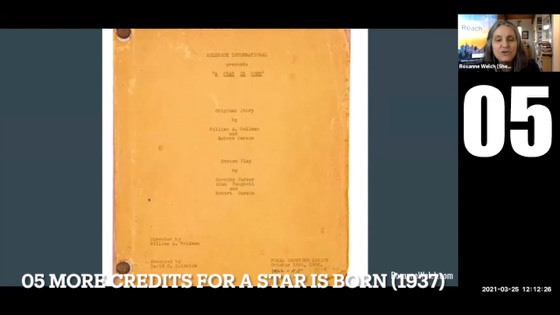
04 The Writers of A Star Is Born (1937) from “Female Creatives & A Star Is Born” [Video]

04 The Writers of A Star Is Born (1937) from

Transcript:

So when we come along and redo it, it’s going to be this team that is assigned — can you do this differently? Can you do this better? Dorothy Parker, who I adore. Her husband, Alan Campbell who no one has probably ever heard of and that’s maybe fair. Maybe not. he was an actor on Broadway when he met her and they got married. He was her second husband. He wanted to come to Hollywood and be a writer. She did not. She was, as we mentioned earlier, a member of the Algonquin Round Table. She wrote witty things for the New Yorker, She did not want to live in Hollywood, but she did what her husband wanted because she wanted him to be happy, These other gentlemen — Carson and William — came along. They’d done some polishes, some pieces, but I’m going to maintain that the voice of A Star is Born — and that carries across almost all four of the iterations — is Dorothy Parker’s voice and to me, that’s what’s interesting — a screenwriter’s voice.

Watch this entire presentation

Connections at conferences matter! Through the most recent SCMS, I met Vicki Callahan, whose film history focus right now is on Mabel Normand. When she learned I could put together a lecture on the importance of the female voice in the A Star is Born franchise she asked me to give that lecture to her master students.

It made for a great opportunity for me to hone the ideas I’m working on for a chapter on that franchise that I’m writing for a new book from Bloomsbury: The Bloomsbury Handbook Of International Screenplay Theory. It’s always nice when one piece of research can be purposed in other ways – and it’s always fun revisiting such a female-centric film franchise – one that drew the talents of such powerful performers as Janet Gaynor, Judy Garland, Barbara Streisand, and Lady Gaga.

Find out why in this lecture!

RMW Rosanne Signature for Web


09 Why Italy? from Concord Days: Margaret Fuller in Italy [Video]

In researching and writing my book on Giuseppe and Anita Garibaldi and the unification of Italy (A Man Of Action Saving Liberty: A Novel Based On The Life Of Giuseppe Garibaldi)  I re-discovered the first American female war correspondent – Margaret Fuller — who I had first met in a college course on the Transcendentalists. I was once again fascinated by a life lived purposefully.

Then I found Tammy Rose’s podcast on the Transcendentalists – Concord Days – and was delighted when she asked me to guest for a discussion of Fuller’s work in Italy as both a journalist – and a nurse. — Rosanne

09 Why Italy? from Concord Days: Margaret Fuller in Italy

Watch this entire presentation

Concord Days sends love to Margaret Fuller on the anniversary of her death in 1850.

The conversation focuses on Margaret’s exciting days in ITALY!

Dr. Rosanne Welch takes us through her adventures and enthusiastically reminds us what she was like when she was living her best life!

Transcript:

Tammy: Why does she go to Italy? What is going on and what is she excited about?

Rosanne: You know Italy — we forget because we had our founding right but in Italy, they were a scattering of different city-states basically up until we’re talking the 1860s is when this finally gets settled and it’s in the 1830s that this roiling begins. We should be all one country. Remember the roman empire. We owned the whole world. Now we can’t even own this little boot that’s part of us

Tammy: Right and Italy was all these like little like city-states and it wasn’t really the Italy that we know today.

Rosane: Austria owned some parts of it right and France owned some parts of it. Sicily was its own country. It was not part of Italy.

17 More On Wynonna Earp from Worry and Wonder | The Courier Thirteen Podcast [Video]

Watch the entire presentation – Worry and Wonder | The Courier Thirteen Podcast | Episode # 29 here

17 More On Wynonna Earp from Worry and Wonder | The Courier Thirteen Podcast [Video]

Transcript:

Well, many things worked about the show. One of which was her sister was a lesbian and she and the female sheriff in town had a relationship and Emily Andreas, who produced the show in Canada knew the trope of killing your gays and she made a promise upfront that neither of these women would ever die and, sure enough, as you get to the end of the 4th season, the last episode is their wedding which is really quite beautiful after you’ve watched the characters across 4 years. but the fact that she did that to counter this negative thing that had been happening in tv and because you knew that. the fun was in always getting one of those 2 women in a terrible situation that they should have died and you knew they were going to have to work their way out of it and so often you would say “Oh, don’t tell me how something’s going to end because I need the tension of worrying.” I didn’t have to worry about them dying but I had to wonder — so it’s worry and wonder, are the 2 most important things for an audience that pulls them through a show — I had to wonder how’d they get out of it. So it still worked and I thought that was brilliant. So I think that’s a really good show and people probably think it’s an American show because it was on American TV as well.

It’s always fun to sit down with students and share stories about entering the television industry and how things work at all stages and I had that opportunity the other day.

Daniela Torres, a just-graduated (Congratulations!) student of the Columbia College Semester in LA program asked me to guest on a podcast she had recently begun hosting with another college student she met during her internship (good example of networking in action!).

We could have talked all morning (the benefit of a 3 hour class session) but we held it to about an hour and fifteen minutes or so. Hopefully, along the way I answered some questions you might have about how the business works. So often it amounts to working hard at being a better writer and gathering a group of other talented, hard-working people around you so you can all rise together.

Dr. Rosanne Welch is a television writer with credits that include Beverly Hills 90210, Picket Fences, ABCNEWS: Nightline and Touched by an Angel. She also teaches Television Writing and the Art of Film at San Jose State University.

Rosanne discusses what made shows like Beverly Hills 90210 compelling, what to do and not to do when attempting to pitch a show to broadcast or streaming, what most young writers neglect in their writing process, and much more!

The Courier Thirteen Podcast is available on YouTube, Spotify, Apple Podcasts, SoundCloud, and Audible.

From The Journal Of Screenwriting V5 Issue 3: The continuing story: Experiments with serial narrative in 1960s prime-time television by Caryn Murphy

Highlighting the articles in the past editions of the Journal of Screenwriting, of which I am the Book Reviews Editor. Hopefully these abstracts will entice you to did a little deeper into the history and future of screenwriting. — Rosanne


The continuing story: Experiments with serial narrative in 1960s prime-time television by Caryn Murphy
 
This article examines innovations in prime-time narratives in US prime-time television in the 1960s, using archival evidence to trace the goals, concerns and conflicts of screenwriters and producers on series including The Defenders (CBS, 1961-65), The Fugitive (ABC, 1963-67), Peyton Place (ABC, 1964-69), and Dr. Kildare (NBC, 1961-66). During this decade, television writers and producers innovated in response to outside concerns regarding the content of popular episodic programmes, and as a method of encouraging audience engagement and habit viewership. Historical evidence demonstrates that prime-time writers specifically sought to make a distinction between prime-time continuing narratives and those that aired during the daytime hours, in order to elevate what they considered to be a new form of television storytelling.

From The Journal Of Screenwriting V5 Issue 3: The continuing story: Experiments with serial narrative in 1960s prime-time television by Caryn Murphy


Journal of Screenwriting Cover

The Journal of Screenwriting is an international double-blind peer-reviewed journal that is published three times a year. The journal highlights current academic and professional thinking about the screenplay and intends to promote, stimulate and bring together current research and contemporary debates around the screenplay whilst encouraging groundbreaking research in an international arena. The journal is discursive, critical, rigorous and engages with issues in a dynamic and developing field, linking academic theory to screenwriting practice. 

Get your copy and subscription to the Journal of Screenwriting Today!


* A portion of each sale from Amazon.com directly supports our blogs
** Many of these books may be available from your local library. Check it out!

16 Wynonna Earp from Worry and Wonder | The Courier Thirteen Podcast [Video]

Watch the entire presentation – Worry and Wonder | The Courier Thirteen Podcast | Episode # 29 here

16 Wynonna Earp from Worry and Wonder | The Courier Thirteen Podcast [Video]

Transcript:

Actually, I’ll tell you what. It’s actually not an American show but it aired on the Sci-Fi channel. It’s from Canada. It was Wynonna Earp which just wrapped up after four seasons — four and a half seasons and I love that. It was the story — science fiction, of course. Wynonna Earp is the great great great granddaughter of Wyatt Earp of the OK Corral, the gunfight and Tombstone, and all that stuff and in their envisioning — it’s based on comic books — the first person in every generation after Wyatt Earp is gifted this gun called the Peacemaker and all the people that Wyatt Earp killed in his life come back to life as ghosts and the only thing that will kill them is this gun and so you’re stuck with the job of fixing the mistakes he made in the past. This guy you never met and it was really well done because you’re watching her go through this obligation. So the little coverage of Buffy the Vampire Slayer — you’re born in this generation to take care of this problem but she had much more more problems. She was a drunk and all those things.

It’s always fun to sit down with students and share stories about entering the television industry and how things work at all stages and I had that opportunity the other day.

Daniela Torres, a just-graduated (Congratulations!) student of the Columbia College Semester in LA program asked me to guest on a podcast she had recently begun hosting with another college student she met during her internship (good example of networking in action!).

We could have talked all morning (the benefit of a 3 hour class session) but we held it to about an hour and fifteen minutes or so. Hopefully, along the way I answered some questions you might have about how the business works. So often it amounts to working hard at being a better writer and gathering a group of other talented, hard-working people around you so you can all rise together.

Dr. Rosanne Welch is a television writer with credits that include Beverly Hills 90210, Picket Fences, ABCNEWS: Nightline and Touched by an Angel. She also teaches Television Writing and the Art of Film at San Jose State University.

Rosanne discusses what made shows like Beverly Hills 90210 compelling, what to do and not to do when attempting to pitch a show to broadcast or streaming, what most young writers neglect in their writing process, and much more!

The Courier Thirteen Podcast is available on YouTube, Spotify, Apple Podcasts, SoundCloud, and Audible.

Contract or No Contract, Bess Meredyth Made Movie Magic — Dr. Rosanne Welch, Script magazine, September 2021

Contract or No Contract, Bess Meredyth Made Movie Magic -- Dr. Rosanne Welch, Script magazine, September 2021

Bess Meredyth is one more name to add to that list of Silent Hollywood’s most prolific and respected screenwriters yet few textbooks mention her name – or her work as both a writer and producer in that period. In fact, when her son John Meredyth Lucas wrote a memoir of his own screenwriting career he never thought to interview her about her career. That’s how easy it can be to be forgotten and why it is so important to highlight these stories today.

Read Contract or No Contract, Bess Meredyth Made Movie Magic — Dr. Rosanne Welch, Script magazine, September 2021


Read about more women from early Hollywood


From The Journal Of Screenwriting V5 Issue 3: Unspoken Desires: Lore as case study on shadow narrative by Margot Nash

Highlighting the articles in the past editions of the Journal of Screenwriting, of which I am the Book Reviews Editor. Hopefully these abstracts will entice you to did a little deeper into the history and future of screenwriting. — Rosanne


Unspoken Desires: Lore as case study on shadow narrative by Margot Nash

This article explores the concept of a shadow narrative lying under the surface of the main film narrative through a case study of the 2012 film Lore. The film is based on the second story in Rachel Seiffert’s book The Dark Room. It was adapted for the screen by British screenwriter Robin Mukherjee and Australian director and screenwriter Cate Shortland. I will search for the structure of this narrative through an analysis of key emotional scenes, moments or spectral traces when the unspoken desires of the protagonist, Lore, surface and take form, when subtext becomes text and nothing is ever the same again. Using film analyst Paul Gulino’s argument that most narrative films consist of eight major sequences, each between eight and fifteen minutes, I will break the film into eight sequences and then identify one key emotional scene in each sequence. I will then analyse the eight key scenes and discuss the development of Lore’s shadow or unspoken narrative of desire. Some of these key scenes re-imagine or extend narrative moments from the book, but most are new, created by the screenwriters in order to make visible the invisible transformation of character and to heighten themes introduced in the first story in the book and brought to a resolution in the third.

From The Journal Of Screenwriting V5 Issue 3: Unspoken Desires: Lore as case study on shadow narrative by Margot Nash


Journal of Screenwriting Cover

The Journal of Screenwriting is an international double-blind peer-reviewed journal that is published three times a year. The journal highlights current academic and professional thinking about the screenplay and intends to promote, stimulate and bring together current research and contemporary debates around the screenplay whilst encouraging groundbreaking research in an international arena. The journal is discursive, critical, rigorous and engages with issues in a dynamic and developing field, linking academic theory to screenwriting practice. 

Get your copy and subscription to the Journal of Screenwriting Today!


* A portion of each sale from Amazon.com directly supports our blogs
** Many of these books may be available from your local library. Check it out!

08 Smart Women and Transcendentalism from Concord Days: Margaret Fuller in Italy [Video]

In researching and writing my book on Giuseppe and Anita Garibaldi and the unification of Italy (A Man Of Action Saving Liberty: A Novel Based On The Life Of Giuseppe Garibaldi)  I re-discovered the first American female war correspondent – Margaret Fuller — who I had first met in a college course on the Transcendentalists. I was once again fascinated by a life lived purposefully.

Then I found Tammy Rose’s podcast on the Transcendentalists – Concord Days – and was delighted when she asked me to guest for a discussion of Fuller’s work in Italy as both a journalist – and a nurse. — Rosanne

08 Smart Women and Transcendentalism from Concord Days: Margaret Fuller in Italy [Video]

Watch this entire presentation

Concord Days sends love to Margaret Fuller on the anniversary of her death in 1850.

The conversation focuses on Margaret’s exciting days in ITALY!

Dr. Rosanne Welch takes us through her adventures and enthusiastically reminds us what she was like when she was living her best life!

Transcript:

It’s such an interesting thing because they — they spouted ideas about equality but it’s a different thing to have the intellectual idea that women should be and then here’s like — you use the word intimidated — and I think that is the perfect description because imagine like well I said it could happen but I didn’t know I’d run into someone who’s going to challenge my — I’m the smart guy in the room — like you get that right? You can — you can see how that would have, it would have shocked them and maybe their own wives had that capacity but weren’t given the ability to show it off.

15 Stumptown from Worry and Wonder | The Courier Thirteen Podcast [Video]

Watch the entire presentation – Worry and Wonder | The Courier Thirteen Podcast | Episode # 29 here

15 Stumptown from Worry and Wonder | The Courier Thirteen Podcast [Video]

Transcript:

Host: Yeah, it seems like your not — not that into — not that engrossed in American television. Which, I mean, I do understand on a level.

Rosanne: I do agree. Now there was a great show like two years ago now, which got canceled too soon called Stumptownand it was the story of a woman who became a detective because she kind of couldn’t do anything else very well and she lived in Portland where there were reservations and Native American casinos and so she was sort of working in that world. She had a friend who ran a bar who was a former convict, so that was an interesting characterization and then they made a deal right away that they would never have a love relationship. They were just going to be friends and that was lovely to watch and that was really good because it was about real people going through problems.

It’s always fun to sit down with students and share stories about entering the television industry and how things work at all stages and I had that opportunity the other day.

Daniela Torres, a just-graduated (Congratulations!) student of the Columbia College Semester in LA program asked me to guest on a podcast she had recently begun hosting with another college student she met during her internship (good example of networking in action!).

We could have talked all morning (the benefit of a 3 hour class session) but we held it to about an hour and fifteen minutes or so. Hopefully, along the way I answered some questions you might have about how the business works. So often it amounts to working hard at being a better writer and gathering a group of other talented, hard-working people around you so you can all rise together.

Dr. Rosanne Welch is a television writer with credits that include Beverly Hills 90210, Picket Fences, ABCNEWS: Nightline and Touched by an Angel. She also teaches Television Writing and the Art of Film at San Jose State University.

Rosanne discusses what made shows like Beverly Hills 90210 compelling, what to do and not to do when attempting to pitch a show to broadcast or streaming, what most young writers neglect in their writing process, and much more!

The Courier Thirteen Podcast is available on YouTube, Spotify, Apple Podcasts, SoundCloud, and Audible.

From The Journal Of Screenwriting V5 Issue 3: That was then this is now …  The Canyons – with Paul, Bret, James and Lindsay by Alex Munt

Highlighting the articles in the past editions of the Journal of Screenwriting, of which I am the Book Reviews Editor. Hopefully these abstracts will entice you to did a little deeper into the history and future of screenwriting. — Rosanne


That was then this is now …  The Canyons – with Paul, Bret, James and Lindsay by Alex Munt
 
New Hollywood, from the late 1960s to early 1980s, was marked by an innovation in film business (production, marketing, audience) together with an opening up of film form. Today, some 50 years later, film culture is again in flux with new models of funding, production and distribution for the digital age. The impact of these developments on screenwriting is (necessarily) speculative at this stage. The focus of this article is on screenwriter/director Paul Schrader, a jump-cut from Taxi Driver (1976) to The Canyons (2013) – his experiment in ‘post-theatrical cinema’ with novelist/screenwriter Bret Easton Ellis. The film was written for microbudget and crowdfunded on the Kickstarter platform. It assembles the notorious cast of porn star James Deen and celebrity maelstrom Lindsay Lohan. The Canyons rolled out with an aggressive online marketing strategy and innovative ‘day and date’ distribution model with an eye to video on demand. Larry Gross has described the film as belonging to ‘this cultural moment’. In this analysis of The Canyons I ask: What does it mean to conceive, and write, a screenplay for the present, for ‘now’? How does screenplay development and creative collaboration differ in a crowdfunded/microbudget environment? How does the film interact with new forms, and aesthetics, appropriate to this ‘cultural moment’? In the final part of the article I attempt to situate the film within a wider narrative framework via Schrader’s diagnosis of ‘narrative exhaustion’, Douglas Rushkoff’s theory of ‘present shock’ and Ellis’ rumination on the American ‘post-empire’ condition.

From The Journal Of Screenwriting V5 Issue 3: That was then this is now …  The Canyons – with Paul, Bret, James and Lindsay by Alex Munt


Journal of Screenwriting Cover

The Journal of Screenwriting is an international double-blind peer-reviewed journal that is published three times a year. The journal highlights current academic and professional thinking about the screenplay and intends to promote, stimulate and bring together current research and contemporary debates around the screenplay whilst encouraging groundbreaking research in an international arena. The journal is discursive, critical, rigorous and engages with issues in a dynamic and developing field, linking academic theory to screenwriting practice. 

Get your copy and subscription to the Journal of Screenwriting Today!


* A portion of each sale from Amazon.com directly supports our blogs
** Many of these books may be available from your local library. Check it out!