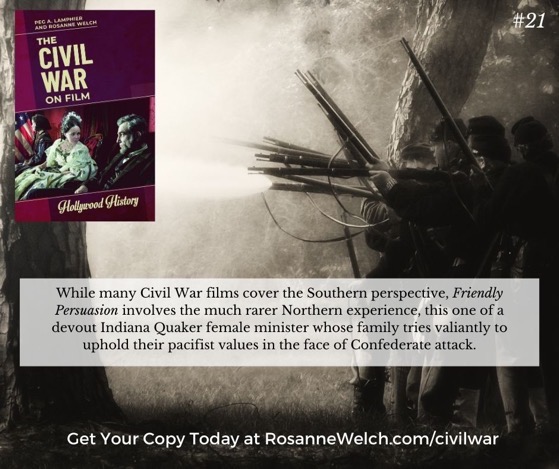
While many Civil War films cover the Southern perspective, Friendly Persuasion involves the much rarer Northern experience, this one of a devout Indiana Quaker female minister whose family tries valiantly to uphold their pacifist values in the face of Confederate attack.
Subscribe to Rosanne’s Channel and receive notice of each new video!
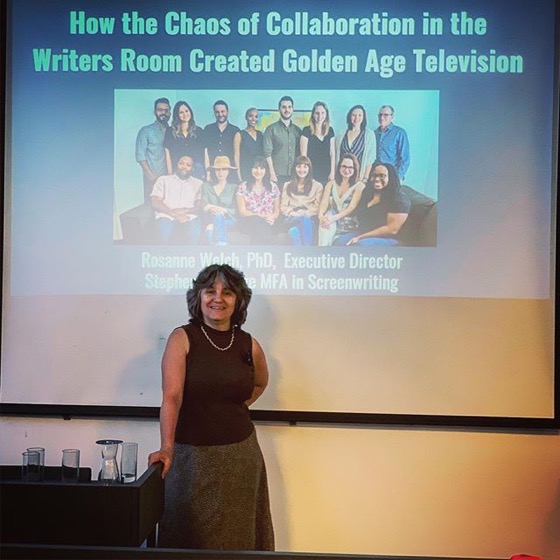
When the folks hosting the conference announced their theme as “Screen Narratives: Chaos and Order” the word ‘chaos’ immediately brought to mind writers rooms. I offered a quick history of writers rooms (the presentations are only 20 minutes long) and then quoted several current showrunners on how they compose their rooms and how they run them.
Transcript
This is my teaching philosophy. Words Matter. Writers Matter. Women Writers Matter, and that’s something I try to focus on as much as possible. There’s a lot of women who never get mentioned and that bothers me but that’s a different lecture so — I did that last year this year. We’re talking about why writers are important and how the writers room works. As far as I’m concerned we have to remember that writer precedes director so I want more of our students to know the names of the writers of their favorite films not always just the directors because when you talk about a film you don’t say “Do you remember that beautiful camera angle in scene seven?” You say “My name is Inigo Montoya. You killed my father. Prepare to die” and that is something the writer did so I think we have to remember that the dialogue is what makes movies special and the characters.
This new “A Woman Wrote That” post is an echo of the Writers Guild campaign of a few years ago (“A Writer Wrote That”) where they noted famous movie quotes and credited the screenwriter rather than the director. The difference here being that we will be posting lines from films written by female screenwriters. Feel free to share! — Rosanne
GEORGE
“The good news, however, is that this overreacting… tends to get proportionately less by generation. So, your kids could be normal.”
MFA Executive Director Dr. Rosanne Welch will give a Zoom presentation on “When Women Wrote Hollywood” for the Empire State Center for the Book, the New York State affiliate of the Library of Congress Center for the Book. This event begins at 7 p.m. Eastern/6 p.m. Central on Tuesday, March 9, and is free and open to the public.
Dr. Welch will discuss many highly successful female screenwriters of early Hollywood and explain why they don’t appear in most mainstream histories of the era.
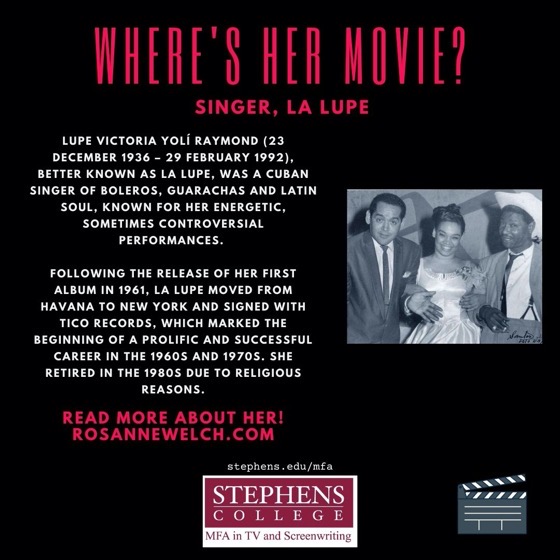
“Where’s HER Movie” posts will highlight interesting and accomplished women from a variety of professional backgrounds who deserve to have movies written about them as much as all the male scientists, authors, performers, and geniuses have had written about them across the over 100 years of film. This is our attempt to help write these women back into mainstream history. — Rosanne
Lupe Victoria Yolí Raymond (23 December 1936 – 29 February 1992),[1][2] better known as La Lupe, was a Cuban singer of boleros, guarachas and Latin soul, known for her energetic, sometimes controversial performances. Following the release of her first album in 1961, La Lupe moved from Havana to New York and signed with Tico Records, which marked the beginning of a prolific and successful career in the 1960s and 1970s. She retired in the 1980s due to religious reason — Wikipedia
Rosanne is speaking at the 2021 SCMS Conference on Thursday, March 18, 2021. If you are attending the conference virtually, please tune into this collection of excellent presentations on the “unreliable narrator” and more.
THURSDAY, MARCH 18 SESSION E – 12:00 PM Central Time
Chair: Christina Lane, University of Miami
Co-Chair: Vicki Callahan, University of Southern California
Vicki Callahan, University of Southern California, “Still Looking for Mabel Normand”
Philana Payton, University of Southern California, “Eartha Kitt vs. Eartha Mae: Black Women, Self-Fragmentation, and the Politics of Hollywood Stardom”
Rosanne Welch, Stephens College, “When Men Forget Women: The Many Ways Male Screenwriters Fail to Mention their Female Colleagues in Oral Histories”
Christina Lane, University of Miami, “Alternative Writing Strategies: Notes on Discovering the ‘Women Who Knew’ Joan Harrison”
##Teaching one of my 3 ##classes today for Cal Poly Pomona. This has been my classroom for the last year, like so many others. *DW (from Rosanne’s Prod)
Thanks to the gracious invitation from my Screenwriting Research Network colleague Paolo Russo – and a grant he was able to procure (and in the before-Covid time) I was able to spend a week at Oxford Brookes University working with the screenwriting masters students in Paolo’s course. At the culmination of the week, I gave this lecture on how writers rooms worked in the States.
Transcript:
All right, so. what I wanted to do for about half a minute is describe this woman. Visually describe this character. Her name is Erin Brockovich. You may or may not have seen this movie all right. So we might know something about her from the movie but visually — and she’s Julia Roberts, you can tell — quickly how would you describe her if you’re writing that action line in your script? If nothing else, think of three adjectives. We always start with that. Style comes from what you do in the action lines because the dialogue has to sound like your characters but the action lines sound like you alright. Shy doesn’t work in the writers’ room. If you don’t have an idea, I’ll stop paying you a contract and you go home. I always tell my students when they have to pitch, you better have an idea right away because you’re turning down $38,000 because if there’s a new script and we need one done next week and you don’t do it your friend just got that much money. That’s a lot of money to turn down because you’re too shy to open your mouth. So school is when you practice not being shy.
Watch this entire presentation
Subscribe to Rosanne’s Channel and receive notice of each new video!
* A portion of each sale from Amazon.com directly supports our blogs ** Many of these books may be available from your local library. Check it out! † Available from the LA Public Library
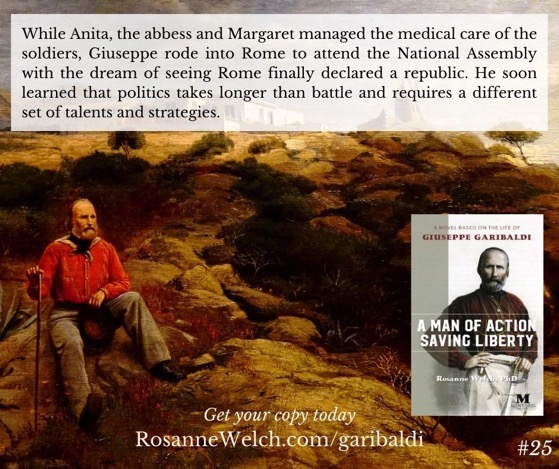
While Anita, the abbess and Margaret managed the medical care of the soldiers, Giuseppe rode into Rome to attend the National Assembly with the dream of seeing Rome finally declared a republic. He soon learned that politics takes longer than battle and requires a different set of talents and strategies.