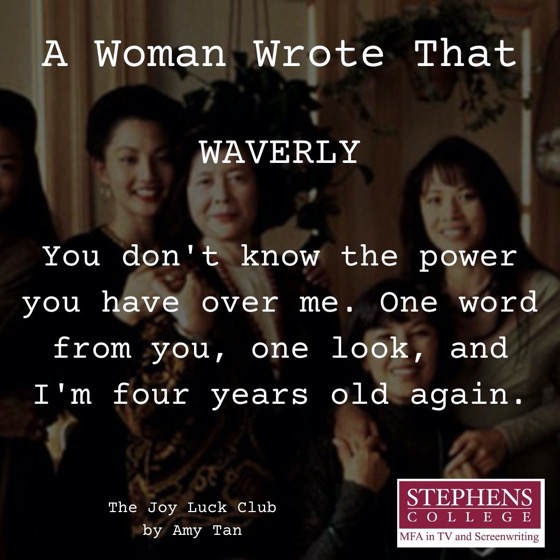
This new “A Woman Wrote That” post is an echo of the Writers Guild campaign of a few years ago (“A Writer Wrote That”) where they noted famous movie quotes and credited the screenwriter rather than the director. The difference here being that we will be posting lines from films written by female screenwriters. Feel free to share! — Rosanne
WAVERLY: “You don’t know the power you have over me. One word from you, one look, and I’m four years old again.”
Subscribe to Rosanne’s Channel and receive notice of each new video!
Transcript:
This is actually a program from New Zealand. Who knew New Zealand made television, but I have my students write spec scripts — speculative scripts — which are their own versions of a show that already exists to teach the art of copying, because if you’re going to write television you have to copy what exists and then you make your own story, but you have to know how the characters sound. So, I have them pitch ideas from programs they are watching, but they have to write a United States show because that’s what the people are going to read in the United States. This young man pitched an episode of this show because he saw it on Netflix and he didn’t even realize it wasn’t from the United States. he didn’t even notice that they were using city names from New — he didn’t know what New Zealand was really, but the TV showed him and I stay that we learn the mythology of other cultures. This is a show about Norse mythology. the young boys on the program discover that they are the re-born versions of Norse gods and their goal is to get together with the other Norse gods and eventually go back to heaven together and rule the world. It’s adorable and I wouldn’t have heard about it except for Netflix.
Watch this entire presentation
A Note About This Presentation
A clip from my keynote speech at the 10th Screenwriters´(hi)Stories Seminar for the interdisciplinary Graduation Program in “Education, Art, and History of Culture”, in Mackenzie Presbyterian University, at São Paulo, SP, Brazil, focused on the topic “Why Researching Screenwriters (has Always) Mattered.” I was especially pleased with the passion these young scholars have toward screenwriting and it’s importance in transmitting culture across the man-made borders of our world.
To understand the world we have to understand its stories and to understand the world’s stories we must understand the world’s storytellers. A century ago and longer those people would have been the novelists of any particular country but since the invention of film, the storytellers who reach the most people with their ideas and their lessons have been the screenwriters. My teaching philosophy is that: Words matter, Writers matter, and Women writers matte, r so women writers are my focus because they have been the far less researched and yet they are over half the population. We cannot tell the stories of the people until we know what stories the mothers have passed down to their children. Those are the stories that last. Now is the time to research screenwriters of all cultures and the stories they tell because people are finally recognizing the work of writers and appreciating how their favorite stories took shape on the page long before they were cast, or filmed, or edited. But also because streaming services make the stories of many cultures now available to a much wider world than ever before.
Many thanks to Glaucia Davino for the invitation.
* A portion of each sale from Amazon.com directly supports our blogs ** Many of these books may be available from your local library. Check it out! † Available from the LA Public Library
“Where’s HER Movie” posts will highlight interesting and accomplished women from a variety of professional backgrounds who deserve to have movies written about them as much as all the male scientists, authors, performers, and geniuses have had written about them across the over 100 years of film. This is our attempt to help write these women back into mainstream history. — Rosanne
After graduating college, she worked at the Harvard Observatory and taught in private schools in the Boston area. In 1912, an astronomical fellowship was created for women to work at Maria Mitchell Observatory; Harwood was the first recipient of the fellowship, receiving $1,000.[2][3] In 1916, at 30 years old, Harwood was named director of Mitchell Observatory, and worked there from 1916 until her retirement in 1957.[2] Her specialty, photometry, involved measuring variation in the light of stars and asteroids, particularly that of the small planet Eros. A member of the American Astronomical Society and Fellow of the Royal Astronomical Society, she traveled widely in Europe and the United States. She was the first woman to gain access to the Mount Wilson Observatory, the world’s largest observatory at the time.[4]
In 1917, she discovered the asteroid 886 Washingtonia four days before its formal recognition by George Peters.[5] At the time, “senior people around her advised her not to report it as a new discovery because it was inappropriate that a woman should be thrust into the limelight with such a claim”.[6][7] However, Harwood did send her photographs of her discovery to Peters for him to include in his study of the asteroid’s orbit.[6] In 1960, an asteroid discovered at Palomar, was named in her honor, 7040 Harwood.[6][3]
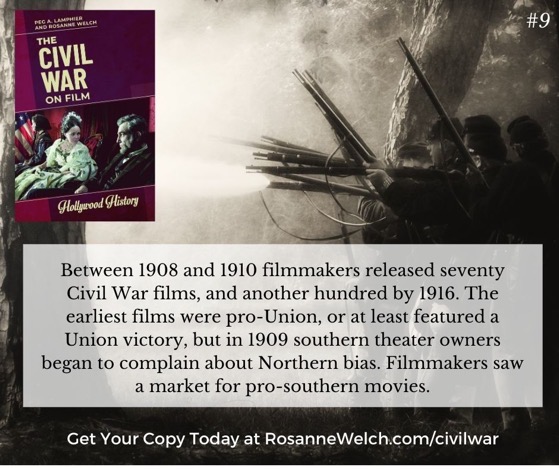
Between 1908 and 1910 filmmakers released seventy Civil War films, and another hundred by 1916. The earliest films were pro-Union, or at least featured a Union victory, but in 1909 southern theater owners began to complain about Northern bias. Filmmakers saw a market for pro-southern movies.
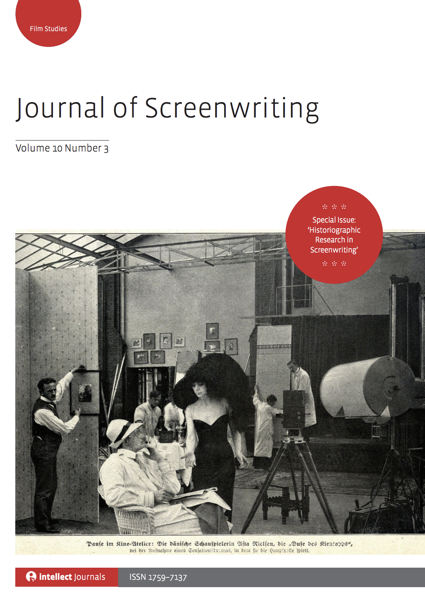
Highlighting the articles in the past editions of the Journal of Screenwriting, of which I am the Book Reviews Editor. Hopefully these abstracts will entice you to did a little deeper into the history and future of screenwriting. — Rosanne
My investigations into transmedia and multi-platform production practices reveal that writers for film and TV could soon need to become content creators (directors or producers or craftspeople in addition to being writers), blurring the distinctions between concept, creation, production and post-production. This article explores this phenomenon of multi-platform/transmedia production, mostly in the United Kingdom, and in particular its storytelling processes through a study of a small but successful company, Bellyfeel, based in Manchester, United Kingdom. Bellyfeel have given me complete access to their work and established an online environment where I can study their practice/writing. I will contextualize the creative practice of the company with the work of Henry Jenkins, and suggest that, in the contemporary marketplace, it may be necessary for the writer to be focused on the production process and the technological aspects of this process in order to understand how product is created and functions in this new environment.
The Journal of Screenwriting is an international double-blind peer-reviewed journal that is published three times a year. The journal highlights current academic and professional thinking about the screenplay and intends to promote, stimulate and bring together current research and contemporary debates around the screenplay whilst encouraging groundbreaking research in an international arena. The journal is discursive, critical, rigorous and engages with issues in a dynamic and developing field, linking academic theory to screenwriting practice.
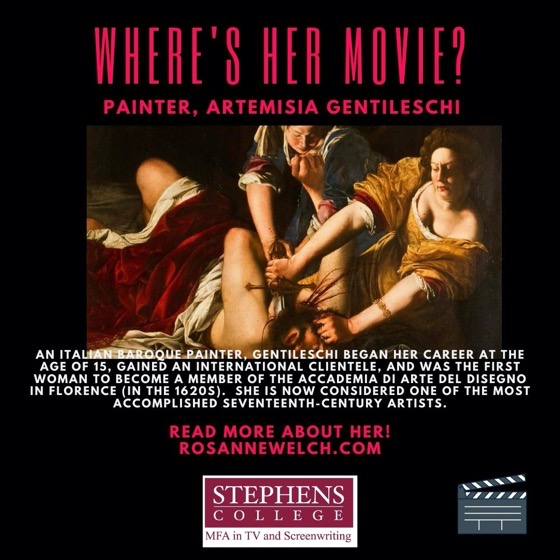
“Where’s HER Movie” posts will highlight interesting and accomplished women from a variety of professional backgrounds who deserve to have movies written about them as much as all the male scientists, authors, performers, and geniuses have had written about them across the over 100 years of film. This is our attempt to help write these women back into mainstream history. — Rosanne
An Italian Baroque painter, Gentileschi began her careet at the age of 15, gained an international clientele, and was the first woman to become a member of the Accademia di Arte del Disegno in Florence (in the 1620s).
She is now considered one of the most accomplished seventeenth-century artists.
Artemisia Lomi or Artemisia Gentileschi (US: /ˌdʒɛntiˈlɛski/,[1][2] Italian: [arteˈmiːzja dʒentiˈleski]; July 8, 1593 – c. 1656) was an Italian Baroque painter, now considered one of the most accomplished seventeenth-century artists, initially working in the style of Caravaggio. She was producing professional work by the age of fifteen.[3] In an era when women had few opportunities to pursue artistic training or work as professional artists, Artemisia was the first woman to become a member of the Accademia di Arte del Disegno in Florence and she had an international clientele.[4][5]
Many of Artemisia’s paintings feature women from myths, allegories, and the Bible, including victims, suicides, and warriors.[6] Some of her best known subjects are Susanna and the Elders (particularly the 1610 version in Pommersfelden), Judith Slaying Holofernes (her 1614–1620 version is in the Uffizi gallery), and Judith and Her Maidservant (her version of 1625 is in the Detroit Institute of Arts).
Artemisia was known for being able to depict the female figure with great naturalism,[7][8] and for her skill in handling color to express dimension and drama.[9][10]
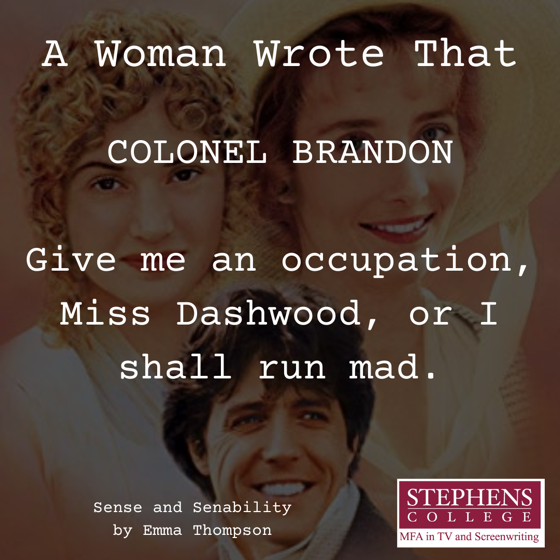
This new “A Woman Wrote That” post is an echo of the Writers Guild campaign of a few years ago (“A Writer Wrote That”) where they noted famous movie quotes and credited the screenwriter rather than the director. The difference here being that we will be posting lines from films written by female screenwriters. Feel free to share! — Rosanne
COLONEL BRANDON: “Give me an occupation, Miss Dashwood, or I shall run mad.”
Subscribe to Rosanne’s Channel and receive notice of each new video!
Transcript:
In my own Television viewing experience, I’ve had the chance to see all of these programs which I never would have seen. Commisaroio Montalbano is the most famous detective show in Italy. Again, that helps me feel more connected to my cousins and what they’re watching and to my grandparents and the world they grew up in. I can see footage from Italy. I was amazed to find that Doctor Who eventually traveled around the whole world. I’m told the doesn’t play here necessarily but probably geeky people have found it somewhere. Trapped was a miniseries made in Iceland. You can see the Icelandic translation on the bottom and it aired on Netflix and I was amazed to watch eight hours of something that was filmed in Iceland and told me about a culture I could possibly never imagine and might never have the chance to see but because of Netflix. I’ve now experienced this program — and then Call My Agent I find very funny. It’s a French show. You can see the proper title –the French title– on top and it’s about a talent agency. — just as Roger was explaining this morning — in France and how they work with actors and all the problems that happen. It’s a one-hour comedy and what’s cute about it is the characters — the actors who played actors on the show are actually famous French actors pretending to be bad people and causing troubles for their agents. So you’ve recognized actors you’ve seen in movies coming in and talking to the fake agents that they are with. So it’s a charming way to learn more about French films, right, in just one program. So I’ve been so impressed with what I’ve been able to see.
Watch this entire presentation
A Note About This Presentation
A clip from my keynote speech at the 10th Screenwriters´(hi)Stories Seminar for the interdisciplinary Graduation Program in “Education, Art, and History of Culture”, in Mackenzie Presbyterian University, at São Paulo, SP, Brazil, focused on the topic “Why Researching Screenwriters (has Always) Mattered.” I was especially pleased with the passion these young scholars have toward screenwriting and it’s importance in transmitting culture across the man-made borders of our world.
To understand the world we have to understand its stories and to understand the world’s stories we must understand the world’s storytellers. A century ago and longer those people would have been the novelists of any particular country but since the invention of film, the storytellers who reach the most people with their ideas and their lessons have been the screenwriters. My teaching philosophy is that: Words matter, Writers matter, and Women writers matte, r so women writers are my focus because they have been the far less researched and yet they are over half the population. We cannot tell the stories of the people until we know what stories the mothers have passed down to their children. Those are the stories that last. Now is the time to research screenwriters of all cultures and the stories they tell because people are finally recognizing the work of writers and appreciating how their favorite stories took shape on the page long before they were cast, or filmed, or edited. But also because streaming services make the stories of many cultures now available to a much wider world than ever before.
Many thanks to Glaucia Davino for the invitation.
* A portion of each sale from Amazon.com directly supports our blogs ** Many of these books may be available from your local library. Check it out! † Available from the LA Public Library
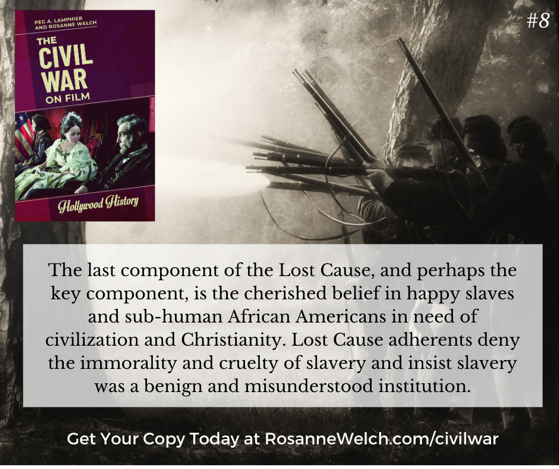
The last component of the Lost Cause, and perhaps the key component, is the cherished belief in happy slaves and sub-human African Americans in need of civilization and Christianity. Lost Cause adherents deny the immorality and cruelty of slavery and insist slavery was a benign and misunderstood institution.
![40 The Almighty Johnsons from New Zealand from Why Researching Screenwriters Has Always Mattered [Video] (1 minute 12 seconds)](https://rosannewelch.com/wp-content/uploads/2020/12/rmw-sao-paolo-40.png)

![39 My Own Favorite International TV Shows from Why Researching Screenwriters Has Always Mattered [Video] (1 minute 31 seconds)](https://rosannewelch.com/wp-content/uploads/2020/12/rmw-sao-paolo-39.png)