48 Do Your Research and Speak Up There And Back Again: Writing and Developing for American TV [Video]

48 Do Your Research and Speak Up There And Back Again: Writing and Developing for American TV [Video]

Thanks to the gracious invitation from my Screenwriting Research Network colleague Paolo Russo – and a grant he was able to procure (and in the before-Covid time) I was able to spend a week at Oxford Brookes University working with the screenwriting masters students in Paolo’s course. At the culmination of the week, I gave this lecture on how writers rooms worked in the States.

Transcript:

You have to always do research. You don’t know everything and you don’t have to but you have to be willing to look. I’ve got a whole lecture I do on the tv show Gidget from the 60s that I discovered every episode written by a woman treated the Gidget character like a real human being and every episode written by a male writer treated her like sort of a doofy, stupid girl and I thought they didn’t even go into reading the book that that show was based on to understand her mentality. Her dad was a college professor and she was studying literature in college. She’s not a ditz right but they didn’t even research that. So you have to really look into everything. You have to like research right? That is something a writer must do.

You have to speak up. You all are shy. I’ll give you that right? You don’t know me so it’s a new thing but you can’t be shy in the room. If you don’t open your mouth, what are they paying you for? You’re only going to write two episodes of a tv show that runs 13 episodes. You get two a year. All those other episodes is you talking. What makes this one better for this writer so we all keep employed next year? So you have to speak up.

Watch this entire presentation

Subscribe to Rosanne’s Channel and receive notice of each new video!


* A portion of each sale from Amazon.com directly supports our blogs
** Many of these books may be available from your local library. Check it out!
† Available from the LA Public Library

21 You Can’t Keep Up With TV Shows from Worry and Wonder | The Courier Thirteen Podcast [Video]

Watch the entire presentation – Worry and Wonder | The Courier Thirteen Podcast | Episode # 29 here

21 You Can't Keep Up With TV Shows from Worry and Wonder | The Courier Thirteen Podcast [Video]

Transcript:

Host: Was it called the little things?

Rosanne: Yeah it just came out on me on Netflix or HBO sorry.

Host: Yeah HBO Max.

Rosanne: Brand new so, again, you can’t keep up with 420 TV shows

Host: No, you can’t yeah.

Roanne: That’s that’s why buzz and word of mouth is now one of the most important things. It kind of always was but when there were only three or four channels or even 50 cable channels, you found things that people gelled around, and then it became a big event like Mad Men or something like that or Breaking Bad. Now it really becomes your little circle of friends. You recommend a show. I watch it. I tell somebody else I know outside of that circle. They might tell their group. That has become such an important sort of Venn diagram. Who’s seen this and who’s seen that and if you like this you’ll like that and we — that’s where we get our information from. So it’s a really important conversation for people to have for the benefit of the programs to get their audiences.

It’s always fun to sit down with students and share stories about entering the television industry and how things work at all stages and I had that opportunity the other day.

Daniela Torres, a just-graduated (Congratulations!) student of the Columbia College Semester in LA program asked me to guest on a podcast she had recently begun hosting with another college student she met during her internship (good example of networking in action!).

We could have talked all morning (the benefit of a 3 hour class session) but we held it to about an hour and fifteen minutes or so. Hopefully, along the way I answered some questions you might have about how the business works. So often it amounts to working hard at being a better writer and gathering a group of other talented, hard-working people around you so you can all rise together.

Dr. Rosanne Welch is a television writer with credits that include Beverly Hills 90210, Picket Fences, ABCNEWS: Nightline and Touched by an Angel. She also teaches Television Writing and the Art of Film at San Jose State University.

Rosanne discusses what made shows like Beverly Hills 90210 compelling, what to do and not to do when attempting to pitch a show to broadcast or streaming, what most young writers neglect in their writing process, and much more!

The Courier Thirteen Podcast is available on YouTube, Spotify, Apple Podcasts, SoundCloud, and Audible.

All About The Almighty Johnsons with the Fake Geek Girls Podcast – Episode 165 [Audio]

As we’ve all been advised, if you put something out on the internet folks will stumble over you and your work and offer you new opportunities.

That happened last month when Melissa Banks, who co-hosts the Fake Geek Girls podcast found an essay I had written and recorded to my blog in 2015 (How the Female Characters in The Almighty Johnsons were Misused – and how that likely lead to the early end of a great series…). 

All About The Almighty Johnsons with the Fake Geek Girls Podcast - Episode 165

It’s about a New Zealand show called The Almighty Johnsons and my opinion had to do with how I felt the writers had done a disservice to the female characters on the show. So here in 2021 Melissa and her co-host were planning an episode around the show, found my essay and asked for permission to quote it, which I happily gave.

If you know the Almighty Johnsons this whole episode will be of interest; if not my quote comes into the conversation here at 1:18:25  when they Introduce to the section on gender in the show and then at 1:19:22 – when they begin using my quotes.

Listen to All About The Almighty Johnsons with the Fake Geek Girls Podcast – Episode 165

47 Selling Your Nightmares from There And Back Again: Writing and Developing for American TV [Video]

47 Selling Your Nightmares from There And Back Again: Writing and Developing for American TV [Video]

Thanks to the gracious invitation from my Screenwriting Research Network colleague Paolo Russo – and a grant he was able to procure (and in the before-Covid time) I was able to spend a week at Oxford Brookes University working with the screenwriting masters students in Paolo’s course. At the culmination of the week, I gave this lecture on how writers rooms worked in the States.

Transcript:

What I learned from being in a writer’s room is the things you need to do most are the things you learn in English and Humanities classes. First of all, you’re selling your nightmares. What are the worst things you can imagine happening? Make stories out of that. They’re the what-ifs of your life. That whole Down Syndrome baby thing. I was pregnant when I wrote that. You have no idea when you’re going to have a kid right unless you get all the tests and even if you get all the tests you’re not sure until the day the kid shows up and you imagine all the awful things that might happen right? So I was in the middle of that when I wrote that episode. So that was my true emotion that was happening. I wrote an episode once about what if your husband committed suicide. I’ve got all kinds of episodes. I just thought what are the worst things that could happen to me and bam they became episodes over and over again right? So you’ve got to mine your nightmares and manage them.

Watch this entire presentation

Subscribe to Rosanne’s Channel and receive notice of each new video!


* A portion of each sale from Amazon.com directly supports our blogs
** Many of these books may be available from your local library. Check it out!
† Available from the LA Public Library

From The Journal Of Screenwriting V6 Issue 1: The writer as director: A case study – Brothers and Sisters (1981) by Richard Woolley

Highlighting the articles in the past editions of the Journal of Screenwriting, of which I am the Book Reviews Editor. Hopefully these abstracts will entice you to did a little deeper into the history and future of screenwriting. — Rosanne


The writer as director: A case study – Brothers and Sisters (1981) by Richard Woolley

This is a practitioner’s case history of a particular, personal scripting process, in the context of Arts public funding of film in the United Kingdom, before the rise of the current screenwriting orthodoxy. The role of the script for an auteur writer-director is, here, seen more clearly as a personal tool for the development of the screen idea; format, for example, works creatively for the director rather than as a standardized part of the conventional memorandum for others it has become. Using the experience of scripting Brothers and Sisters (1981) I reflect on the interconnection between script and eventual film as a whole process, rather than as a separate set of skills, and conclude that the best way of achieving those representational goals in the screenplay context should remain open to continual experiment and debate by researchers and practitioners alike, and not be closed off for all time by absolutist formulas and set-in-stone formats.

From The Journal Of Screenwriting V6 Issue 1: The writer as director: A case study – Brothers and Sisters (1981) by Richard Woolley


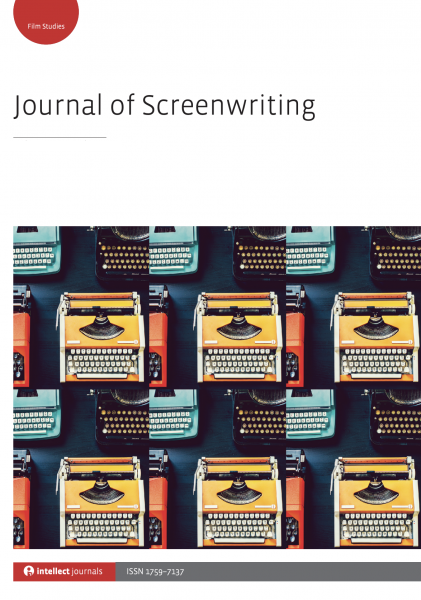
Journal of Screenwriting Cover

The Journal of Screenwriting is an international double-blind peer-reviewed journal that is published three times a year. The journal highlights current academic and professional thinking about the screenplay and intends to promote, stimulate and bring together current research and contemporary debates around the screenplay whilst encouraging groundbreaking research in an international arena. The journal is discursive, critical, rigorous and engages with issues in a dynamic and developing field, linking academic theory to screenwriting practice. 

Get your copy and subscription to the Journal of Screenwriting Today!


* A portion of each sale from Amazon.com directly supports our blogs
** Many of these books may be available from your local library. Check it out!

TARDIS Console Display at #sandiegowhocon via Instagram

TARDIS Console Display at #sandiegowhocon via Instagram

From a lovely interactive TARDIS console on display at #sandiegowhocon

Follow Me On Instagram

From my Instagram Feed


The Difficulties and Delicacies of Writing the First Female Doctor in 50+ years (Complete) [Video]

It was great to be able to attend this year’s SD WhoCon in San Diego and present this lecture on “The Difficulties and Delicacies of Writing the First Female Doctor in 50+ years” in which I discuss how successful I think showrunner Christopher Chibnall was in making that transition.

It gave me a chance to talk about the creative work of a showrunner/screenwriter while also reconnecting to some friends we had met at this same convention some 3 years ago – and to talk about one of my favorite subjects – Doctor Who!

The Difficulties and Delicacies of Writing the First Female Doctor in 50+ years (Complete) [Video]


20 Screenwriting: Television Vs. Film from Worry and Wonder | The Courier Thirteen Podcast [Video]

Watch the entire presentation – Worry and Wonder | The Courier Thirteen Podcast | Episode # 29 here

20 Screenwriting: Television Vs. Film from Worry and Wonder | The Courier Thirteen Podcast [Video]

Transcript:

You know, the difference between TV, obviously, and movies — movies you are going to tell me the most interesting 2 hours in someone’s life. What are the most crazy, interesting 2 hours and we’re done. Maybe there’ll be sequels, of course, blah, blah, blah — but, in general, that’s what you’re going for. In a TV show — especially a pilot — you need to give me enough fodder to understand that there are at least 20 hours — nowadays with streaming, 40 — used to be 100 — in order to get to syndication — but that there’s that much interesting embedded conflict among this group of people that I’m going to be constantly interested in watching them overcome whatever their problem might be. Whatever their issue might be. So, every show has what we would call an overarching dramatic question that is trying to be answered. It’s like — and it can be — it should be — the bigger it is, the more universal. So, for me, an easy example is Bones, right, which some people realize what was — she’s uber-smart and autistic and he’s uber-Catholic and, you know, goes for the emotion. Which, of course, is a flip to what we think gender-wise. It should be the dude being super-logical and the girl being super-emotional, but they flipped it so that’s interesting. But really it’s a show about science versus religion and the 2 characters represent those 2 points of view and there’s never going to be an answer to that question. Except if you accept that the answer is you need them both and that’s how they solve their crimes is the 2 of them together are better than each separately. So, you’re overarching question every week is being addressed. The individual question each week is simply who committed this murder. That’s always going to be solved but the overarching dramatic question can never be solved or your show’s over.

It’s always fun to sit down with students and share stories about entering the television industry and how things work at all stages and I had that opportunity the other day.

Daniela Torres, a just-graduated (Congratulations!) student of the Columbia College Semester in LA program asked me to guest on a podcast she had recently begun hosting with another college student she met during her internship (good example of networking in action!).

We could have talked all morning (the benefit of a 3 hour class session) but we held it to about an hour and fifteen minutes or so. Hopefully, along the way I answered some questions you might have about how the business works. So often it amounts to working hard at being a better writer and gathering a group of other talented, hard-working people around you so you can all rise together.

Dr. Rosanne Welch is a television writer with credits that include Beverly Hills 90210, Picket Fences, ABCNEWS: Nightline and Touched by an Angel. She also teaches Television Writing and the Art of Film at San Jose State University.

Rosanne discusses what made shows like Beverly Hills 90210 compelling, what to do and not to do when attempting to pitch a show to broadcast or streaming, what most young writers neglect in their writing process, and much more!

The Courier Thirteen Podcast is available on YouTube, Spotify, Apple Podcasts, SoundCloud, and Audible.

46 The Importance of Pronouns from There And Back Again: Writing and Developing for American TV [Video]

46 The Importance of Pronouns from There And Back Again: Writing and Developing for American TV [Video]

Thanks to the gracious invitation from my Screenwriting Research Network colleague Paolo Russo – and a grant he was able to procure (and in the before-Covid time) I was able to spend a week at Oxford Brookes University working with the screenwriting masters students in Paolo’s course. At the culmination of the week, I gave this lecture on how writers rooms worked in the States.

Transcript:

So that was fine. Renoly was marvelous and we had a marvelous time working on that. One of the things I learned was remembering the importance of words. The simple act of in one scene, of course, he gets shot, right — because he’s in a gang — they had to go to the hospital and all I had to do was write “The doctor walks in and SHE says…” and they hired a lady as the doctor. If I had not used that pronoun they would have hired a man because that’s what an extra casting director would simply have gone to — his stereotype. Doctors are boys, right? So just because of the word she I got a woman a job and little girls in America the chances to know that doctors are girls. Now y’all, as I said better over here right because that’s very cool but that’s what Shonda Rhimes has built her whole career on right, colorblind casting and gender blind casting. Let’s just get in good actors to do these parts and see where we go from there, which I think is a really brilliant thing and what she’s built her whole thing on.

Watch this entire presentation

Subscribe to Rosanne’s Channel and receive notice of each new video!


* A portion of each sale from Amazon.com directly supports our blogs
** Many of these books may be available from your local library. Check it out!
† Available from the LA Public Library

“I mean, who doesn’t love Capt. Jack?!” via Instagram

“I mean, who doesn’t love Capt. Jack?!” via Instagram

I had a great time a speaking on Why Torchwood Still Matters at San Diego Whocon.

Follow me in Instagram