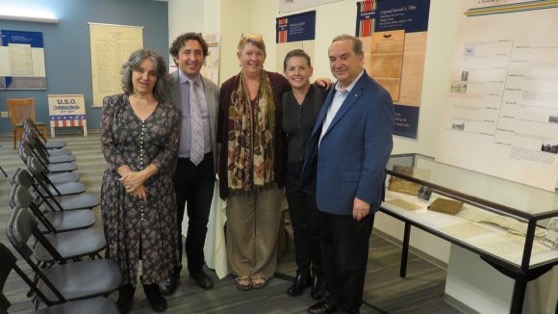
On Saturday, November 3rd, 2018 several of the contributors to When Women Wrote Hollywood gathered at the Skylark Bookshop in Columbia, Missouri for a signing and launch party that functioned like a mini-reunion of the Stephens College MFA in TV and Screenwriting Class of 2017.
Many thanks to all who came to hear them each speak with passion about the research subjects who became whole chapters in this book of essays on female screenwriters from the Silent Era into the 1940s.
* A portion of each sale from Amazon.com directly supports our blogs ** Many of these books may be available from your local library. Check it out! † Available from the LA Public Library
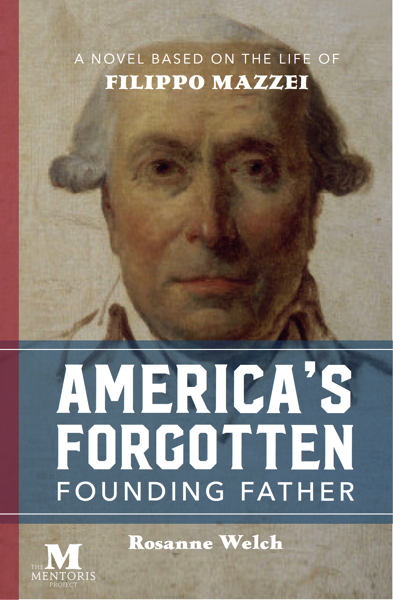
Learn more about the American Revolution through the eyes of an important, Italian Immigrant, Filippo Mazzei. Read his story today!
““Just the other day General Washington sent a letter to General Howe,” Filippo began. “demanding respectable treatment for our Colonel or we’d do the same by their Brigadier-General, man by the name of Prescott.”
“Washington’d prefer trading ‘em to having to keep ‘em,” clearly the barkeep also liked being the most informed man in the room, and didn’t like the idea that Filippo bested him with the most current news.”
Once again I’m honored to be included in one of ATB Publishing’s pop culture collections, this one focused on perhaps my favorite TV series to teach: Buffy the Vampire Slayer.
Among the 139 essays covering all 139 episodes included in Outside In Takes a Stab you’ll find my essay on the Emmy-nominated episode “Hush”. It’s called “As Silent as ABC” as it offers a scene by scene breakdown, illustrating how this episode offers the perfect template to A, B, and C storylines for new writers of one-hour dramas. So it’s for Buffy geeks AND TV writing geeks. One cool fact is that Editor Robert Smith? donates 50% of the proceeds of all sales to Avert, a UK-based HIV/AIDS charity. Another cool fact is that my Stephens MFA student Mary Gwen Scott (who wrote her graduate thesis on the enduring influence of Buffy and Harry Potter on the generations that have followed them) will have an essay in their upcoming volume on the Buffy spinoff Angel.
Put ten Buffy fans in a room, and you’ll wind up with eleven opinions, fourteen heated debates about the nature of the soul and somebody cosplaying Mirror Willow as an Initiative-produced demon hybrid with a stake in her arm. That’s because Buffy fans are gloriously weird, uniquely different and sometimes entirely outlandish. And so is this book.
Celebrating over 25 years of Buffy the Vampire Slayer, OUTSIDE IN TAKES A STAB is a collection of 139 reviews, one for every story of the television series, plus the movie and a couple extras. Well, we say “reviews”, but we mean that loosely: within these pages, you’ll find mix tapes, mazes, recipes, speeches, games, songs, crosswords, plays, policy documents, D&D manuals, documentaries, term papers and a Turing machine. Not to mention insightful and thoughtful articles, examining the world of Sunnydale from just about every aspect imaginable… and then some!
Provocative, engrossing, hilarious and utterly gonzo. These aren’t your mother’s reviews.
Featuring contributions from Susanne Lambdin, Jill Sherwin, Rosanne Welch, Keith R.A. DeCandido, Robert Greenberger, Rich Handley, David A. McIntee, and over a hundred more!
As with all previous OUTSIDE IN volumes, 5% of the full retail price of all sales of this book will be donated to Avert, a UK-based HIV/AIDS charity.
You’ll notice in this particular poster it’s Frank Capra’s film and we have to really down here to see who wrote the movie right? Who broke the movie is this marvelous couple Albert Hackett and Frances Goodrich, a married couple who wrote for 50 years together. They wrote the play and the film version of The Diary of Anne Frank. They won a Pulitzer Prize for that. Capra never won a Pulitzer Prize. Why is that Capra’s It’s a Wonderful Life? Explain that to me. I don’t like that. They also adapted the Thin Man films which were highly successful and there’s a book about them which is lovely but much less read than the biography of Frank Capra. There is a Capra story that I tell my students it may be anecdotal but Robert Riskin — who wrote many of Capra’s best films and won Academy Awards in his life — was said to have heard often Frank Capra say “I have the Capra touch”. It makes the movies beautiful and one day Riskin handed in 200 blank pages said put your fucking touch on that! Excuse the Americanism but seriously Riskin in the man who made all those films. Why is it we are not talking about him?
* A portion of each sale from Amazon.com directly supports our blogs ** Many of these books may be available from your local library. Check it out! † Available from the LA Public Library
On Saturday, November 3rd, 2018 several of the contributors to When Women Wrote Hollywood gathered at the Skylark Bookshop in Columbia, Missouri for a signing and launch party that functioned like a mini-reunion of the Stephens College MFA in TV and Screenwriting Class of 2017.
Many thanks to all who came to hear them each speak with passion about the research subjects who became whole chapters in this book of essays on female screenwriters from the Silent Era into the 1940s.
* A portion of each sale from Amazon.com directly supports our blogs ** Many of these books may be available from your local library. Check it out! † Available from the LA Public Library
All kudos to the library staff at Chapman University for posting this lovely article about the presentations my colleague and fellow writer Peg and I made on our individual books for the Mentoris Project. Publisher Robert Barbera sponsored the event – and donated the set of books to the university library – and we enjoyed speaking to the Italian Studies students who gathered that evening about Filippo Mazzei and Louis Palma de Cesnola. — Rosanne
When Robert J. Barbera founded The Mentoris Project as a part of The Barbera Foundation, his goal was to add to the canon of names most U.S. students learn over and over again from fifth grade through high school. He remembered hearing the names of people like George Washington, Benjamin Franklin, Thomas Jefferson, and Abraham Lincoln repeated from year to year, but realized that two very important populations were missing from the standard U.S. history books and narratives: Italians and Italian-Americans. With that in mind, he started The Mentoris Project, which publishes biographies and novels based on the lives of prominent Italians and Italian-Americans, specifically those who can be considered as mentors. In the words of The Mentoris Project, these books are intended “to inspire the reader in a very tangible way: To finish the book saying, ‘I can do something great, too.’” The books published by The Mentoris Project are written by a variety of scholars and authors, and cover subjects from Christopher Columbus to Enrico Fermi.
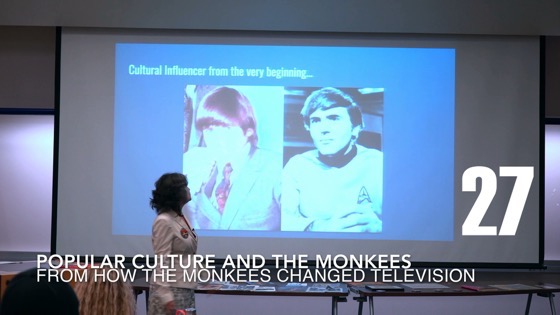
Rosanne Welch, PhD, Author of Why The Monkees Matter, presents “How The Monkees Changed Television” at a Cal State Fullerton Lunch Lecture on May 8, 2018.
In this talk, she shows how The Monkees, and specifically their presence on television, set the stage for large changes to come in the late 1960s.
Transcript
Identity construction was a mess for these guys and it really I think was sad cuz now we’re a little better. We understand Jim Parsons is not just Sheldon. He’s now on Broadway in the Boys in the Band. He did act of God which toured here in California. We understand he’s an actor he can play other parts right? Now because there was this idea that they weren’t very important and they disappeared I like to show how culturally connected they were. It is proven in a memo from Gene Roddenberry that when Star Trek went for the second season and they’re gonna have Walter Koenig play Chekov he wrote I need him to have a haircut that matches that guy on the Monkees because that’s what girls want right now and they literally planned that his character should be connecting with the girls who like the Monkees and Star Trek obviously culturally kind of important a little bit. Of course back in the day they were part of commercials because everybody is part of commercials. you go to YouTube you’ll see their their Nerf ball commercial and then they have a Schick razor commercial. They did everything but this was at the end of the show often.
A hit television show about a fictitious rock band, The Monkees (1966-1968) earned two Emmys–Outstanding Comedy Series and Outstanding Directorial Acheivement in Comedy.
Capitalizing on the show’s success, the actual band formed by the actors, at their peak, sold more albums than The Beatles and The Rolling Stones combined, and set the stage for other musical TV characters from The Partridge Family to Hannah Montana. In the late 1980s, the Monkees began a series of reunion tours that continued into their 50th anniversary.
This book tells the story of The Monkees and how the show changed television, introducing a new generation to the fourth-wall-breaking slapstick created by Laurel and Hardy and the Marx Brothers.
Its creators contributed to the innovative film and television of 1970s with projects like Bob & Carol & Ted & Alice, The Mary Tyler Moore Show, Laugh-In and Welcome Back, Kotter. Immense profits from the show, its music and its merchandising funded the producers’ move into films such as Head, Easy Riderand Five Easy Pieces.
…And I speak fast so I apologize but I want to get through it and I’m sort of Italian not really in this country but in America I qualify as Italian. We should teach during writing because writer precedes director when describing a filmmaker skills and we allow people to forget that in class and I don’t like that. When you remember a film to your friends you do not speak of camera angles. You speak of dialogue you speak of the lines that you repeat with your friends so the writer is the person that we should credit I believe with most of the work and if you’re studying to be a screenwriter how can you forget the names of the people who write your films? I want to say or even don’t you to the auteur theory because I think it’s nonsense because it is not the director it is the writer who comes up with it and I want to get rid of disrespect to writers which has existed forever
* A portion of each sale from Amazon.com directly supports our blogs ** Many of these books may be available from your local library. Check it out! † Available from the LA Public Library
Notes on the background of Justin Peter Plumard de Rieux and Maria Margherita Martini de Rieux
Philip Mazzei [A physician, born in 1730 near Florence practiced surgery briefly, then moved to Leghorn in 1752] “rented a large house in London [in 1764]. It was his plan to use the ground floor as a shop, to live on the second floor, to rent out the third floor furnished, and the fourth unfurnished . . . . He opened his shop selling champagne, burgundy, oil from Lucca, cheese, shoots of lemon trees, candied fruits, and silks from Florence . . . . He determined never to be seen in his shop, and adopted the name “Martini and Company,” under which he did business.
“Before he could rent out the upper floors of his four-story house, Mazzei had to have the rooms re-papered. A young man named Joseph Martin [or Martini; he was from Savoy] was sent by the wall paper manufacturer to take charge of the job. After he had finished, he asked if he might rent the top floor. It was agreed, and he, his wife [Maria Hautefeuille “Petronille” Martin(i) was born into an established family in Calais. Being very willful in her youth, she ran away from home and went to London where she adopted the name “Petronille” and married Joseph Martin] and small daughter [Maria Margherita Martin(i) was born in 1761] moved in.
“Soon after the Martin family moved in Mrs. Martin gave birth to a son . . . . At the age of about ten months this baby died, and poor Martin, overcome with grief, died shortly after, towards the end of the year 1764. During the year of their acquaintance Mazzei had become intensely fond of the Martin family, and Martin had begun to look upon Mazzei as his dearest friend. On his deathbed he besought Mazzei to look after and care for his widow and his little daughter. This, . . . Mazzei promised to do.” (Richard C. Garlick, Jr., Philip Mazzei, Friend of Jefferson: His Life and Letters, 1933, pp.23-24)




 and Follow