“A Man Of Action Saving Liberty: A Novel Based On The Life Of Giuseppe Garibaldi” – 34 in a series

“I am guilty of no crime save that of being an Italian like yourself,” Bassi said in his defense. “I have risked my life for Italy, and your duty is to do good to those who have suffered for her.” The Austrians convicted both men of bearing arms against the State, sentenced them to death and on August 8, 1849, executed Father Bassi and Count Livraghi by firing squad.

Get your copy of A Man Of Action Saving Liberty Today!

From The Journal Of Screenwriting V4 Issue 3: Chaos, culture and fantasy: The television plays of Howard Schuman by Leah Panos

Highlighting the articles in the past editions of the Journal of Screenwriting, of which I am the Book Reviews Editor. Hopefully these abstracts will entice you to did a little deeper into the history and future of screenwriting. — Rosanne


Chaos, culture and fantasy: The television plays of Howard Schuman by Leah Panos
 
The single plays of American ex-pat playwright Howard Schuman produced for British television between 1973 and 1983 have received little critical attention. Written in a distinctly un-British madcap, non-naturalistic and often pulpy ‘B movie’ style, they centre around caricatured, hysterical and/or camp characters and make frequent references to popular culture. This article provides a general survey of Schuman’s plays and analyses his sensibility as a screenwriter, drawing extensively on material from interviews with the writer. The article’s particular focus is how and why different cultural forms including music, film and theatre are used and referred to in Schuman’s plays, and how this conditions the plays’ narrative content and visual and aural form. It also considers the reception of Schuman’s plays and their status as non-naturalistic dramas that engage heavily with American pop culture, within the context of British drama. Finally, it explores the writer’s relationship to style and aesthetics, and considers how his written works have been enhanced through creative design decisions, comparing his directions (in one of his scripts) with the realized play to reflect on the use of key devices.
From The Journal Of Screenwriting V4 Issue 3: Chaos, culture and fantasy: The television plays of Howard Schuman by Leah Panos


Journal of Screenwriting Cover

The Journal of Screenwriting is an international double-blind peer-reviewed journal that is published three times a year. The journal highlights current academic and professional thinking about the screenplay and intends to promote, stimulate and bring together current research and contemporary debates around the screenplay whilst encouraging groundbreaking research in an international arena. The journal is discursive, critical, rigorous and engages with issues in a dynamic and developing field, linking academic theory to screenwriting practice. 

Get your copy and subscription to the Journal of Screenwriting Today!


* A portion of each sale from Amazon.com directly supports our blogs
** Many of these books may be available from your local library. Check it out!

The Civil War On Film – 29 in a series – “…his attitude about the futility and ridiculousness of war comes from his own experiences as a child during World War II.”

The Civil War On Film - 29 in a series -

Many film historians attribute anti-Vietnam war sentiment to Sergio Leone personally, but this is not particularly accurate. Leone is Italian and he wasn’t making films for the American market, at least not until United Artists approached his producer with a film deal, at which point the first two films in the trilogy had already been made. Leone’s attitude about the futility and ridiculousness of war comes from his own experiences as a child during World War II.

Movies profiled in this book:

10 Steven Bochco from How The Chaos Of Collaboration in the Writers Room Created Golden Age Television [Video]

With the full recording of “How The Chaos Of Collaboration in the Writers Room Created Golden Age Television”

10 Steven Bocbco from How The Chaos Of Collaboration in the Writers Room Created Golden Age Television [Video]

Subscribe to Rosanne’s Channel and receive notice of each new video!


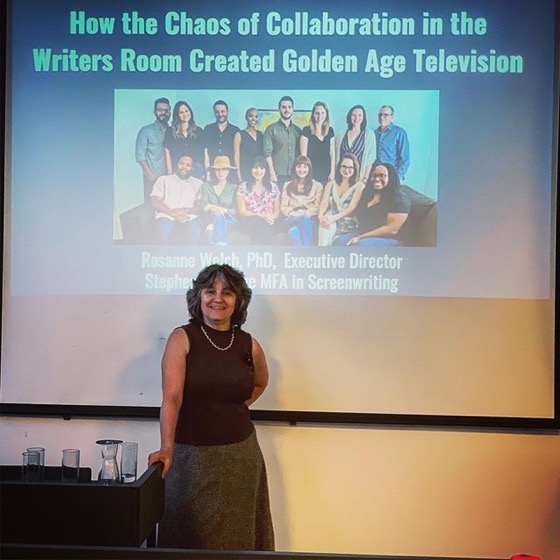
When the folks hosting the conference announced their theme as “Screen Narratives: Chaos and Order” the word ‘chaos’ immediately brought to mind writers rooms. I offered a quick history of writers rooms (the presentations are only 20 minutes long) and then quoted several current showrunners on how they compose their rooms and how they run them.

Transcript

Then, of course , we have Steven Bochco, who gave us — he, as was said in the keynote, the multi-level story, many characters with different goals. He brought that to television in a way that hadn’t existed before. Adam-12 is a very basic, two guys do cop things all day. This was now groups of people. Here we had the policemen with their own personal lives at home. Later will have LA Law. The lawyers with their own personal lives and NYPD Lue. So that was what Bochco brought to television.

For more information on the Screenwriting Research Network, visit

Screenwriting Research Network Conference, Porto, Portugal, All Sessions


Ready to present my talk yesterday at the Screenwriting Research Conference here in Porto, Portugal via Instagram

Follow me on Instagram


* A portion of each sale from Amazon.com directly supports our blogs
** Many of these books may be available from your local library. Check it out!

A Woman Wrote That – 25 in a series – Thelma and Louise (1991), Writer, Callie Khouri

This new “A Woman Wrote That” post is an echo of the Writers Guild campaign of a few years ago (“A Writer Wrote That”) where they noted famous movie quotes and credited the screenwriter rather than the director.  The difference here being that we will be posting lines from films written by female screenwriters.  Feel free to share! — Rosanne

A Woman Wrote That - 25 in a series - Thelma and Louise (1991), Writer, Callie Khouri

THELMA

I don’t ever remember feeling this awake..

Where’s Her Movie? Actress, Maria Félix – 18 in a series

“Where’s HER Movie” posts will highlight interesting and accomplished women from a variety of professional backgrounds who deserve to have movies written about them as much as all the male scientists, authors, performers, and geniuses have had written about them across the over 100 years of film.  This is our attempt to help write these women back into mainstream history.  — Rosanne

Where's Her Movie? Actress, Maria Félix  - 18 in a series

María de los Ángeles Félix Güereña, known as María Félix (Spanish: [maˈɾi.a ˈfeliks]; 8 April 1914 – 8 April 2002), was a Mexican film actress and singer. Along with Pedro Armendáriz and Dolores del Río, she was one of the most successful figures of Latin American cinema in the 1940s and 1950s. Considered one of the most beautiful actresses of Mexican cinema, her taste for the finesse and strong personality garnered her the title of diva early in her career.[3] She was known as La Doña, a name derived from her character in the film Doña Bárbara (1943), and María Bonita, thanks to the anthem composed exclusively for her, as a wedding gift by her second husband, the Mexican composer Agustín Lara. She completed a film career that included 47 films made in Mexico, SpainFranceItaly and Argentina.[4] She was also considered one of the most important female figures in the Golden Age of Mexican cinemaWikipedia

20 More On Russell T Davies from There And Back Again: Writing and Developing for American TV [Video]

20 More On  Russell T Davies from There And Back Again: Writing and Developing for American TV [Video]

Thanks to the gracious invitation from my Screenwriting Research Network colleague Paolo Russo – and a grant he was able to procure (and in the before-Covid time) I was able to spend a week at Oxford Brookes University working with the screenwriting masters students in Paolo’s course. At the culmination of the week, I gave this lecture on how writers rooms worked in the States.

Transcript:

This book here, I highly recommend if you like Doctor Who, but if you like writing, Benjamin Cook, the writer, the journalist asked Russell Davies in the last season of David Tennant’s era, could I email you across this year and just ask you questions like — what are you thinking of today and Russell was like sure and so it’s this it’s the collection of their emails as he wrote the last season. So you’ll start with something like well today I’m thinking what if water was deadly? I don’t know what to do with that but that’s on my brain today and a few weeks later it was — what if some astronauts were on Mars and Martian water was deadly and by the time you’re done we have an episode called Waters of Mars right? So he watched the progress and development of a story through these emails with Russell Davies.

Watch this entire presentation

Subscribe to Rosanne’s Channel and receive notice of each new video!


* A portion of each sale from Amazon.com directly supports our blogs
** Many of these books may be available from your local library. Check it out!
† Available from the LA Public Library

“A Man Of Action Saving Liberty: A Novel Based On The Life Of Giuseppe Garibaldi” – 33 in a series

Giuseppe saw all this as he struggled to carry Anita, pregnant with their fifth child and sick from the malaria she had been trying to hide, to shore. Most of his remaining men scattered into the woods, on the run from the Austrians. One man, Leggero, stayed behind to help Giuseppe carry Anita and lay her in a cornfield out of sight. Then Leggero went in search of help.

Get your copy of A Man Of Action Saving Liberty Today!

From The Journal Of Screenwriting V4 Issue 3: Bridges and gaps: The Singing Detective’s serial afterlife by Sean O’Sullivan

Highlighting the articles in the past editions of the Journal of Screenwriting, of which I am the Book Reviews Editor. Hopefully these abstracts will entice you to did a little deeper into the history and future of screenwriting. — Rosanne


Bridges and gaps: The Singing Detective’s serial afterlife by Sean O’Sullivan

The Singing Detective has long been considered a high point of televisual storytelling. But what is its specific legacy as a serial narrative, particularly in the contemporary U.S. context of ambitious dramas? In many ways, the experiment of The Singing Detective remains an outlier. If the likes of Mad Men and The Sopranos have re-invigorated seriality by emphasizing the gaps between episodes—by making the narrative broken rather than connected—The Singing Detective’s continuing contribution lies in its insistence on bridging the disparate parts that make a serial: old and new, sound and image, memory and imagination, ritual and eccentricity.

From The Journal Of Screenwriting V4 Issue 3: Bridges and gaps: The Singing Detective’s serial afterlife by Sean O’Sullivan


Journal of Screenwriting Cover

The Journal of Screenwriting is an international double-blind peer-reviewed journal that is published three times a year. The journal highlights current academic and professional thinking about the screenplay and intends to promote, stimulate and bring together current research and contemporary debates around the screenplay whilst encouraging groundbreaking research in an international arena. The journal is discursive, critical, rigorous and engages with issues in a dynamic and developing field, linking academic theory to screenwriting practice. 

Get your copy and subscription to the Journal of Screenwriting Today!


* A portion of each sale from Amazon.com directly supports our blogs
** Many of these books may be available from your local library. Check it out!

The Civil War On Film – 28 in a series – “…except for them it was a conflict of beliefs.”

The Civil War On Film - 28 in a series -

In terms of the American Civil War, the Friends experienced the same conflicts of brother against brother that infused the North and the South, except for them it was a conflict of beliefs. They had declared their adamant opposition to the importation of slaves as early as 1696 at their Society of Friends (Quaker) Yearly Meeting. As slavery took hold of the South anyway, many became fervent abolitionists willingly breaking the law to aid enslaved people on their escapes via the Underground Railroad.

Movies profiled in this book: