Join us for the first public read of Mount Wilson, a drama pilot which follows Edwin Hubble, a rising astronomer, as he navigates his own web of lies as he works to disprove the theories of some of the greatest minds of the 20th Century. Hubble finds an unlikely alliance in Milton Humason, a maintenance worker at the Mount Wilson Observatory, who may just hold the key to the secrets of the Universe. Mount Wilson was written in partnership with the SeriesFest Writers Room Initiative and produced by Dilettante Productions and Unreal Media.
Nearly two years ago I had the pleasure of being invited to join a panel at the then upcoming SCMS (Society of Cinema and Media Studies) conference set for Seattle. As you know that was canceled due to Covid with the hopes of reconvening in Colorado in 2021. That became a virtual conference but our group decided to reapply our panel and we four were able to ‘meet’ on Zoom on Sunday and present: Writing Between the Lines: Feminist Strategies for Historical Absences, Cliché, and the Unreliable Narrator.
Here you can watch a clip from my part of the presentation,
“When Men Forget Women: The Many Ways Male Screenwriters Fail to Mention their Female Colleagues in Oral Histories”
Transcript:
Joan Harrison as we think about Alfred Hitchcock and we’re gonna hear all more about her later. So I won’t go into it but let’s remember that we call them Hitchcock films but they were written by other people. Hitchcock is not a writer all right. she wrote Rebecca which got the academy award nomination and there’s also in the corner here just a little bit on John Michael Hayes who wrote several other Hitchcock films. I really hate the fact that directors get authorship but that’s another story. Look at this picture. Almost everybody can name Cecil B. DeMille whether you recognize him or not. If I say his name you’ve heard it a million times in film history. So you know Jeannie Mcpherson? Jeannie Mcpherson wrote almost all of the films that Cecil B. DeMille made that made money and when they stopped working together his films stopped making money but when he was giving an oral history later in life, she had already died. He said “She was not a good writer. She would bring in wonderful ideas but she could not carry a story all the way through. I carried the story” and his word is the last word we have on her career because she died too young for people to start doing oral histories and by the way she was a pilot too. That’s not from her acting. She was actually a pilot. She was his private pilot.
It was great to be able to attend this year’s SD WhoCon in San Diego and present this lecture on “The Difficulties and Delicacies of Writing the First Female Doctor in 50+ years” in which I discuss how successful I think showrunner Christopher Chibnall was in making that transition.
It gave me a chance to talk about the creative work of a showrunner/screenwriter while also reconnecting to some friends we had met at this same convention some 3 years ago – and to talk about one of my favorite subjects – Doctor Who!
Transcript:
…and of course, Graham is overcoming cancer, so likewise could be is a stronger man but he’s actually stronger emotionally which I think is really, again, an interesting role model for us. So this was a lot of thinking. As we know, with any of the showrunners every time they invent a companion they have to really think through what am I providing the show and I think that Chibnall did a good job with that.
I recently presented a talk on Torchwood (Why Torchwood Still Matters) where I highlighted a few ways in which the show (airing from 2006 to 2011) came up with progressive and innovative ideas that are being used by other franchises today.
I always enjoy attending the SD (San Diego) WhoCon because the audiences are so well-informed on the Whoniverse and Whovians love Captain Jack and the crew that made this spinoff program so engaging.
Transcript:
Now we know it was invented by Russell and Russell comes to us from Queer As Folk which was a huge sort of new thing and this starts in the UK before it even comes to the States and the States kind of ruined it. I don’t know if you see the English version it’s much better than the American version. It is trippy. Isn’t it sad? This sadly – I mean please, please, please, I never want an American version of Doctor Who and they’ve talked about it, and then they kind of kibosh it. Yeah, they’ve talked about it. It’s like oh no no no no no but so so we know that his career was built – I mean he starts in soap operas as we know and soap operas get disrespected but in fact some of the most innovative stuff happens on tv first in soap operas and that’s true in the States as well right? There were gay characters for the first time. There were interracial marriages for the first time. These happened on soap operas because only women were watching and they were stay-at-home mommies or wives and so who cares what they’re watching right? Nobody gave it a thought except that’s how then stories seeded into prime time right and we finally grow and like that. So he starts in soaps and he moves into Queer As Folk and then he moves into Doctor Who.
I’m happy to announce the public table reading of a new script I’ve co-written with 3 alums of the Stephens College MFA in TV and Screenwriting (Betsy Leighton, Misty Brawner, Adam Parker). We were all involved in a mini-writers room earlier last year to come up with the outline for a 4-hour mini-series based on a book about the life of Edwin Hubble (of Hubble Telescope fame) – and we did. Then the 4 of us wrote the pilot. Now we’ll all be attending the reading at the Gates Planetarium in Denver as part of SeriesFest.
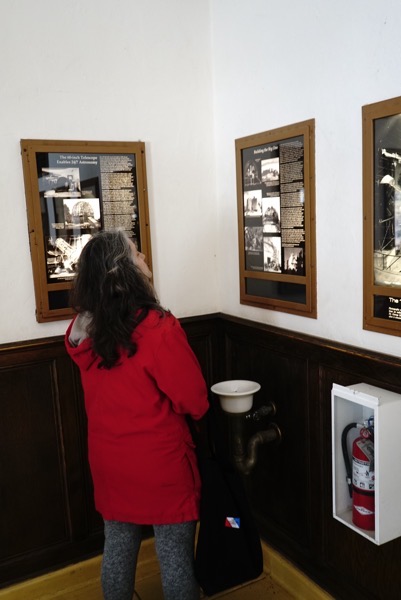
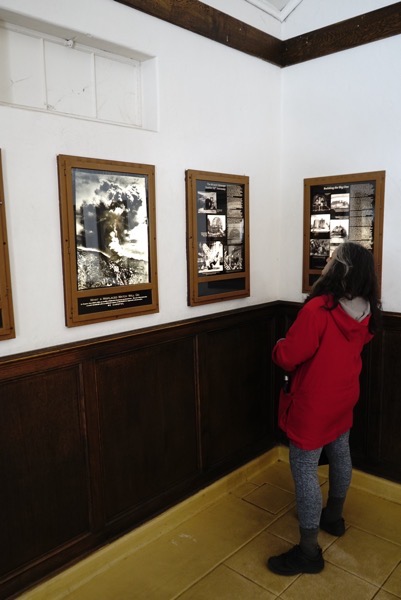
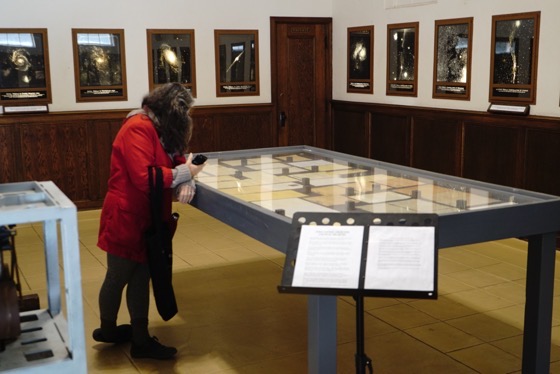
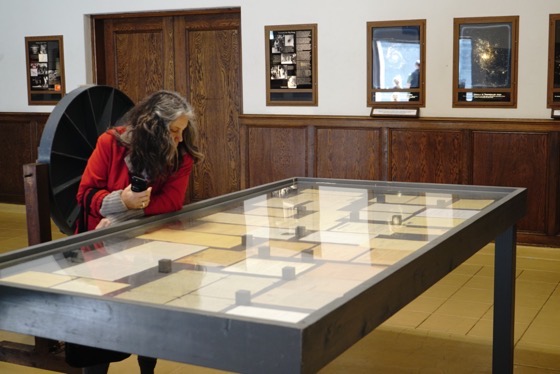
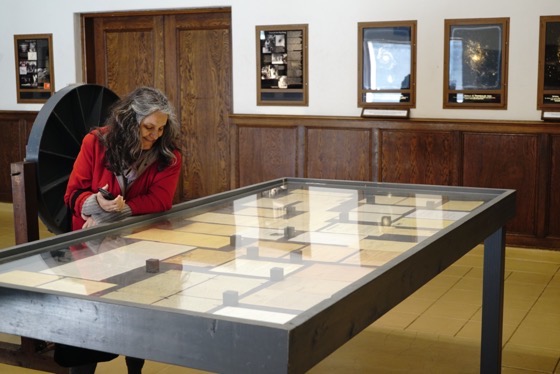
In honor of that project Douglas and I recently visited Mt. Wilson once again in this almost-post pandemic world and took photos of things like Hubble’s desk, and the wooden ladder they used to reach the platform – and, of course, the 100-inch telescope from which he made his major discoveries about the galaxy.
What were these discoveries? Well, you’ll have to attend the table reading – or watch the series when it sells – to find out.
Nearly two years ago I had the pleasure of being invited to join a panel at the then upcoming SCMS (Society of Cinema and Media Studies) conference set for Seattle. As you know that was canceled due to Covid with the hopes of reconvening in Colorado in 2021. That became a virtual conference but our group decided to reapply our panel and we four were able to ‘meet’ on Zoom on Sunday and present: Writing Between the Lines: Feminist Strategies for Historical Absences, Cliché, and the Unreliable Narrator.
Here you can watch a clip from my part of the presentation,
“When Men Forget Women: The Many Ways Male Screenwriters Fail to Mention their Female Colleagues in Oral Histories”
Transcript:
I don’t teach the history of film. I teach the history of screenwriting because the history of film equals the history of directors which becomes a history of great men and great men are very unreliable narrators. They just are right? So let’s start with directors. Directors are terrible narrators. Alfred Hitchcock in his biographies has said that he learned everything he knew about making movies from a middle-aged American woman. He did not even name her, all right? He did not even name her which means she disappears in history but she was, in fact, Eve Unsell. Eve Unsell had been discovered by Beatrice DeMille, more than the mother to Cecil B. DeMille. She was, in fact, a screenwriter and a playwright and she helped many women get started in the business. Eve became a writer for Famous Players Laskey. She had her own production company – one of the earliest women to have her own production company – and she was so beloved by Famous Players Laskey – they sent her to England to right the mixed up studio they had started there and while in England she trained this young kid named Alfred what’s his name again. She told him everything she knew about making films and he can’t even remember to put her name in a book about him. That makes me crazy.
It was great to be able to attend this year’s SD WhoCon in San Diego and present this lecture on “The Difficulties and Delicacies of Writing the First Female Doctor in 50+ years” in which I discuss how successful I think showrunner Christopher Chibnall was in making that transition.
It gave me a chance to talk about the creative work of a showrunner/screenwriter while also reconnecting to some friends we had met at this same convention some 3 years ago – and to talk about one of my favorite subjects – Doctor Who!
Transcript:
What she had to do – what she – what Chibnall had to do is we’ve fallen into a pattern where all the companions fall in love with The Doctor and that was cool with Amy. That was like okay. Romantic storyline and I frankly love the fact that Martha had the guts to say dude you’re never gonna feel the way I feel and I’m not wasting my time. That to me was like the most grown-up thing I had seen a woman do. So very cool. That’s when I – yes. She really like then you’re like oh she’s like one of my favorite companions. So all right so we’re falling into that right? So how do you avoid that with the first female Doctor? Well pretty smart. We’re going to give you a young man who’s at least 15 years younger than the – of course, The Doctors years and years old – but the visual person so if you think about it Tosin is about 15 years younger than her and Graham is about 15 years older. So our brains aren’t going to immediately go hey are they going to fall in love. So he avoided that but he also had to think about the male characters. They can’t be stronger than her because that would ruin her ability to be the most important character. So we’ve got a very young man. Ryan should be as strong or stronger than as Jody Whitaker appears in life. So they gave him dyspraxia, right? They gave him a bit of a handicap that puts him a little bit behind right? So I had to think about that. It’s not a bad one. It’s not one that you know gets in the way too much but it keeps him from jumping in and saving the day, which you have to think about.
I recently presented a talk on Torchwood (Why Torchwood Still Matters) where I highlighted a few ways in which the show (airing from 2006 to 2011) came up with progressive and innovative ideas that are being used by other franchises today.
I always enjoy attending the SD (San Diego) WhoCon because the audiences are so well-informed on the Whoniverse and Whovians love Captain Jack and the crew that made this spinoff program so engaging.
Transcript:
One of my other fandoms is The Monkees and I have a whole book on The Monkees and about the fact that when I was a kid watching them as a child I would assume, looking back at it as a grown-up, that like all the women on the show must have been bimbos and cheerleaders and all the boys would hang out with them and when I looked at as an adult I discovered that every single girl they ever dated had a job and she was a girl who took care of herself and I thought, Is that a message that seeped into my brain when I was a kid? That if I wanted to marry a Monkee I had to be a woman of some substance of something. All right, so really I think messages do come to us. So, I think Torchwood had a lot of really good messages.
Nearly two years ago I had the pleasure of being invited to join a panel at the then upcoming SCMS (Society of Cinema and Media Studies) conference set for Seattle. As you know that was canceled due to Covid with the hopes of reconvening in Colorado in 2021. That became a virtual conference but our group decided to reapply our panel and we four were able to ‘meet’ on Zoom on Sunday and present: Writing Between the Lines: Feminist Strategies for Historical Absences, Cliché, and the Unreliable Narrator.
Here you can watch a clip from my part of the presentation,
“When Men Forget Women: The Many Ways Male Screenwriters Fail to Mention their Female Colleagues in Oral Histories”
Transcript: My teaching philosophy is Words Matter. Writers Matter. Women Writers Matter and we need to pay more attention to them. So we’re back to what I’m originally talking about. How do we get forgotten in the books? Well, this is a lovely example not from screenwriting but from art. When this painting sold – the painting of David And Goliath – it was assumed to belong to Giovanni Francesco but in fact, it belonged to Artemisia and Artemisia Gentileschi is just now coming out as someone that we’re going to learn more about in the art world. So this happens to us all the time – it happens to women all the time.
(technical issues)
She painted that. Artemisia that’s her self-portrait. she painted David and Goliath. We’re doing this in all the different worlds and I think we need to pay attention to how we’re doing it in Hollywood.
Our intrepid panel leader, Christina Lane (author of Phantom Lady – the new biography of writer-producer Joan Harrison) kept us connected across the time. Other panel participants included Philana Payton (UCLA) who is researching the memoirs of Eartha Kitt and Vicki Callahan (USC) who covered the career of Mabel Normand. I was happy to highlight the many female screenwriters whose histories were left on the cutting room floor thanks to the unreliable narrators of their work who included directors, film reviewers, and husbands – all who left the female writers out of their own memories.
It was great to be able to attend this year’s SD WhoCon in San Diego and present this lecture on “The Difficulties and Delicacies of Writing the First Female Doctor in 50+ years” in which I discuss how successful I think showrunner Christopher Chibnall was in making that transition.
It gave me a chance to talk about the creative work of a showrunner/screenwriter while also reconnecting to some friends we had met at this same convention some 3 years ago – and to talk about one of my favorite subjects – Doctor Who!
Transcript:
If we look here, obviously, we have, again, female leadership. The police person is Yasmin, right? It’s a woman police officer who’s gonna come and join. So now we’re gonna have two relatively powerful women running things and that’s different for us. I mean I like Tegan too. She was fun but you know a little screamy goofy right and Nyssa was a doctor. So Nyssa, I really enjoyed Nyssa. So finding two strong women in stories is very interesting.
![The live reading cast of “Mount Wilson” at @seriesfest runs through their tech rehearsal for tonight’s show. [Photos]](https://rosannewelch.com/wp-content/uploads/2022/05/mt-wilson-cast.jpg)
![04 Joan Harrison & Jeannie Macpherson from When Men Forget Women: The Many Ways Male Screenwriters Fail to Mention their Female Colleagues [Video]](https://rosannewelch.com/wp-content/uploads/2022/05/rmw-scms-2021-04.jpg)
![14 Even More On The Companions from The Difficulties and Delicacies of Writing the First Female Doctor in 50+ years [Video] [Doctor Who]](https://rosannewelch.com/wp-content/uploads/2022/05/rmw-whocon-2021-chibnall-14.jpg)

![05 Russell T Davies from Why Torchwood Still Matters with Dr. Rosanne Welch, San Diego Who Con 2021 [Video]](https://rosannewelch.com/wp-content/uploads/2022/05/rmw-whocon-2021-torchwood-05.jpg)


![03 Teaching the History of Screenwriting from When Men Forget Women: The Many Ways Male Screenwriters Fail to Mention their Female Colleagues [Video]](https://rosannewelch.com/wp-content/uploads/2022/05/rmw-scms-2021-03.jpg)
![13 More On The Companions from The Difficulties and Delicacies of Writing the First Female Doctor in 50+ years [Video] [Doctor Who]](https://rosannewelch.com/wp-content/uploads/2022/04/rmw-whocon-2021-chibnall-13.jpg)
![04 Other Interests from Why Torchwood Still Matters with Dr. Rosanne Welch, San Diego Who Con 2021 [Video]](https://rosannewelch.com/wp-content/uploads/2022/04/rmw-whocon-2021-torchwood-04.jpg)
![02 How Do We Get Forgotten? from When Men Forget Women: The Many Ways Male Screenwriters Fail to Mention their Female Colleagues [Video]](https://rosannewelch.com/wp-content/uploads/2022/04/rmw-scms-2021-02.jpg)
![12 Her Companions from The Difficulties and Delicacies of Writing the First Female Doctor in 50+ years [Video] [Doctor Who]](https://rosannewelch.com/wp-content/uploads/2022/04/rmw-whocon-2021-chibnall-12.jpg)