“A Man Of Action Saving Liberty: A Novel Based On The Life Of Giuseppe Garibaldi” – 28 in a series

Gariba

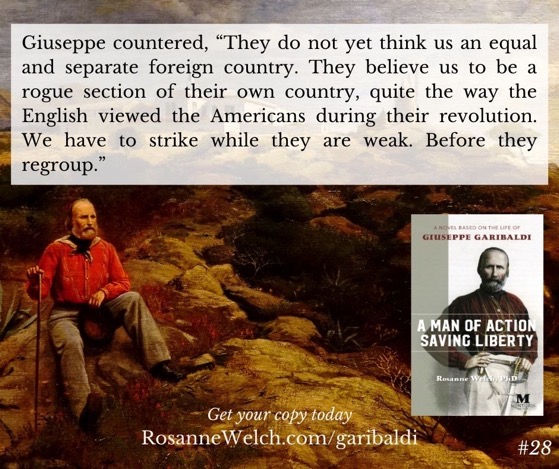
Giuseppe countered, “They do not yet think us an equal and separate foreign country. They believe us to be a rogue section of their own country, quite the way the English viewed the Americans during their revolution. We have to strike while they are weak. Before they regroup.”

Get your copy of A Man Of Action Saving Liberty Today!

From The Journal Of Screenwriting V4 Issue 2: Unknown spaces and uncertainty in film development by Margot Nash

Highlighting the articles in the past editions of the Journal of Screenwriting, of which I am the Book Reviews Editor. Hopefully these abstracts will entice you to did a little deeper into the history and future of screenwriting. — Rosanne


Unknown spaces and uncertainty in film development by Margot Nash

This article examines a discovery-driven process to script development as opposed to a formula-driven one. It is an investigation into the uncertain nature of the creative process in general, and the all-pervasive quest for certainty in film development in particular. Development strategies that value a discovery-driven process are few and far between, as are strategies to explore the gaps, or elisions, within a screenplay where subtext thrives, yet these are transformative spaces that invite an active and creative response. In this article I engage in practice-based research as a writer/director and as a teacher, and investigate two particular areas of film development. The first is early-stage script development where ideas are still struggling to find form; the second is latter-stage script development where a screenplay is refined in order to create spaces where others might respond imaginatively. I advocate risk taking, and the use of unconventional models, in order to create new spaces for students to explore their creativity, and I examine the ‘unknown’ and the ‘uncertain’ as active spaces, both for a screenwriter developing new work and for those who engage creatively with a screenplay as it transforms into a film. I argue that gaps or spaces within a screenplay offer opportunities for directors, actors, key creative crew and eventually an audience to actively participate, and that a development process that values the unknown offers the screenwriter a gateway to adventure and innovation. Screenwriting textbooks rarely enter the unknown and uncertain spaces of creativity yet, as many artists (albeit working in less-expensive mediums) seem to know instinctively, it is within the interplay of the known and the unknown, of passion and reason, and of logic and intuition – that creativity lies.

From The Journal Of Screenwriting V4 Issue 2: Unknown spaces and uncertainty in film development by Margot Nash


Journal of Screenwriting Cover

The Journal of Screenwriting is an international double-blind peer-reviewed journal that is published three times a year. The journal highlights current academic and professional thinking about the screenplay and intends to promote, stimulate and bring together current research and contemporary debates around the screenplay whilst encouraging groundbreaking research in an international arena. The journal is discursive, critical, rigorous and engages with issues in a dynamic and developing field, linking academic theory to screenwriting practice. 

Get your copy and subscription to the Journal of Screenwriting Today!


* A portion of each sale from Amazon.com directly supports our blogs
** Many of these books may be available from your local library. Check it out!
The Civil War On Film – 23 in a series – “Many historians and critics consider Glory the best American Civil War movie ever made.”

The Civil War On Film - 22 in a series -

Many historians and critics consider Glory the best American Civil War movie ever made. The film shatters the great taboo of Civil War movies—making race and slavery central to the story and using black characters to do so (Chadwick 2001).

Movies profiled in this book:

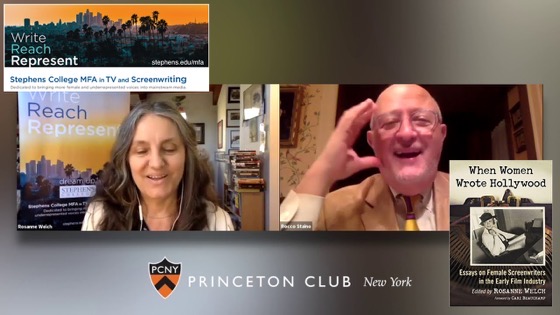
Watch this presentation on “When Women Wrote Hollywood” for the Empire State Center for the Book [Video] (1 hour)

Event: When Women Wrote Hollywood presentation for the Empire State Center for the Book - Tuesday, March 9, 2021 – 7 pm EST

Watch this presentation on

MFA Executive Director Dr. Rosanne Welch gave a Zoom presentation onWhen Women Wrote Hollywood for the Empire State Center for the Book, the New York State affiliate of the Library of Congress Center for the Book.

Dr. Welch discussed many highly successful female screenwriters of early Hollywood and explained why they don’t appear in most mainstream histories of the era.

The essays in this book were written by the alumni of the  inaugural class of the Stephens College MFA in TV and Screenwriting and come from the stories of the many brilliant female screenwriters studied in our History of Screenwriting courses and collected into When Women Wrote Hollywood.

Stephens College MFA In TV And Screenwriting Workshop

“A Man Of Action Saving Liberty: A Novel Based On The Life Of Giuseppe Garibaldi” – 27 in a series

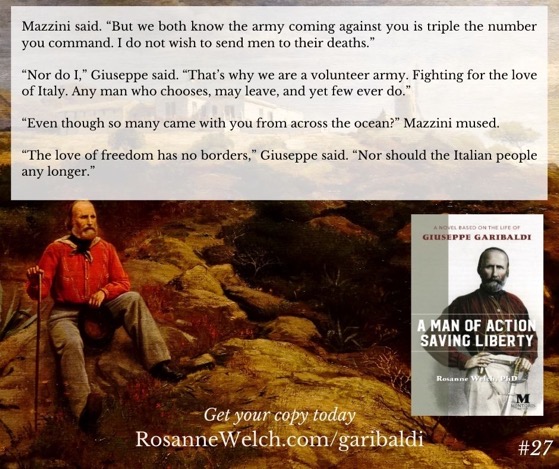
Mazzini said. “But we both know the army coming against you is triple the number you command. I do not wish to send men to their deaths.”

“Nor do I,” Giuseppe said. “That’s why we are a volunteer army. Fighting for the love of Italy. Any man who chooses, may leave, and yet few ever do.”

“Even though so many came with you from across the ocean?” Mazzini mused.

“The love of freedom has no borders,” Giuseppe said. “Nor should the Italian people any longer.” 

Get your copy of A Man Of Action Saving Liberty Today!

From The Journal Of Screenwriting V4 Issue 2: Tracing the voice of the auteur: Persona and the Ingmar Bergman Archive by Anna Sofia Rossholm

Highlighting the articles in the past editions of the Journal of Screenwriting, of which I am the Book Reviews Editor. Hopefully these abstracts will entice you to did a little deeper into the history and future of screenwriting. — Rosanne


Tracing the voice of the auteur: Persona and the Ingmar Bergman Archive by Anna Sofia Rossholm

This article discusses the Ingmar Bergman Archive, a donation by Bergman himself, mainly consisting of notebooks, manuscripts, production documents and letters, as well as the screenwriting process behind the film Persona (1966). The study approaches the digital manuscript archive as an interface that lends itself to an understanding of the artwork as continuous movement of transformation across media, an understanding that also links to aesthetical ideas on the relations between words and images expressed in Bergman’s cinematographic work. The study opens with a discussion of these issues and continues with a reading of the self-reflexive film Persona in order to examine how the explicit reflections on the mediation are negotiated across notebook drafts and scripts. The different phases in the process of creation – from notes and drafts to script versions and film – reflect on the transitory nature of the text as well as drawing on the specificities of each form of expression.

From The Journal Of Screenwriting V4 Issue 2: Tracing the voice of the auteur: Persona and the Ingmar Bergman Archive by Anna Sofia Rossholm


Journal of Screenwriting Cover

The Journal of Screenwriting is an international double-blind peer-reviewed journal that is published three times a year. The journal highlights current academic and professional thinking about the screenplay and intends to promote, stimulate and bring together current research and contemporary debates around the screenplay whilst encouraging groundbreaking research in an international arena. The journal is discursive, critical, rigorous and engages with issues in a dynamic and developing field, linking academic theory to screenwriting practice. 

Get your copy and subscription to the Journal of Screenwriting Today!


* A portion of each sale from Amazon.com directly supports our blogs
** Many of these books may be available from your local library. Check it out!

The Civil War On Film – 22 in a series – “…but allowed filmmakers to avoid the contentious issue of slavery.”

The Civil War On Film - 22 in a series -

In the decades before World War II, Civil War films were largely set in the Eastern theater, but as the center for movie making shifted west to California and studios built permanent western sets (so as to make a great number of inexpensive western films), filmmakers began combining the two film genres. The innovation not only expanded the kind of movie stories that could be told, but allowed filmmakers to avoid the contentious issue of slavery.

Movies profiled in this book:

A Big Thank You For World Book Day!

In honor of World Book Day I wanted to say thanks to all the Readers of all my books -- and to all the Librarians who have purchased books to be read!  What would we do without librarians and libraries?  Writers need them for our research and readers need them as homes away from home.  I can't count the summer days I spent in the local library gathering a cart of books to take home and read. As an only child, books were my summer companions.  Now it's amazing to me to think books with my name on them sit on shelves beside all the ones I loved.  
Read a book today to celebrate a Happy World Book Day!

In honor of World Book Day I wanted to say thanks to all the Readers of all my books — and to all the Librarians who have purchased books to be read!

What would we do without librarians and libraries?  Writers need them for our research and readers need them as homes away from home.  I can’t count the summer days I spent in the local library gathering a cart of books to take home and read. As an only child, books were my summer companions.  Now it’s amazing to me to think books with my name on them sit on shelves beside all the ones I loved.  

Read a book today to celebrate a Happy World Book Day! 

RMW PHD signature 2015

“A Man Of Action Saving Liberty: A Novel Based On The Life Of Giuseppe Garibaldi” – 26 in a series

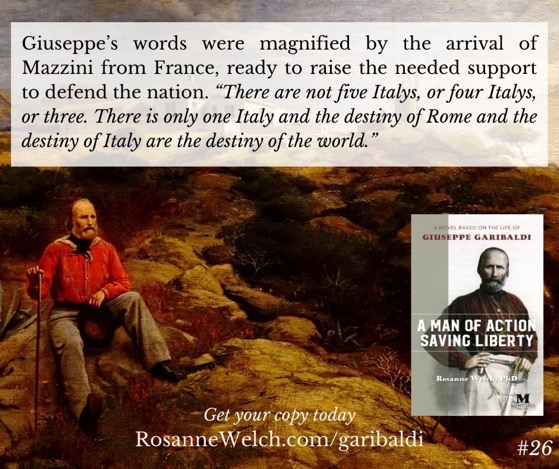
Giuseppe’s words were magnified by the arrival of Mazzini from France, ready to raise the needed support to defend the nation. “There are not five Italys, or four Italys, or three. There is only one Italy and the destiny of Rome and the destiny of Italy are the destiny of the world.”

Get your copy of A Man Of Action Saving Liberty Today!

From The Journal Of Screenwriting V4 Issue 2: Writing With Light: The screenplay and photography by Kathryn Millard

Highlighting the articles in the past editions of the Journal of Screenwriting, of which I am the Book Reviews Editor. Hopefully these abstracts will entice you to did a little deeper into the history and future of screenwriting. — Rosanne


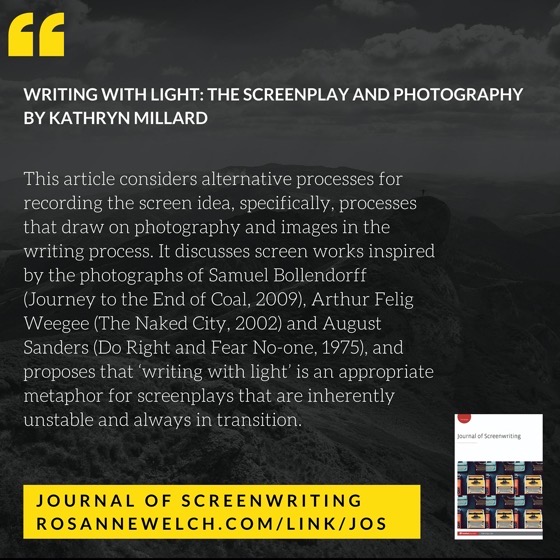
Writing With Light: The screenplay and photography by Kathryn Millard

This article considers alternative processes for recording the screen idea, specifically, processes that draw on photography and images in the writing process. It discusses screen works inspired by the photographs of Samuel Bollendorff (Journey to the End of Coal, 2009), Arthur Felig Weegee (The Naked City, 2002) and August Sanders (Do Right and Fear No-one, 1975), and proposes that ‘writing with light’ is an appropriate metaphor for screenplays that are inherently unstable and always in transition.

From The Journal Of Screenwriting V4 Issue 2: Writing With Light: The screenplay and photography by Kathryn Millard


Journal of Screenwriting Cover

The Journal of Screenwriting is an international double-blind peer-reviewed journal that is published three times a year. The journal highlights current academic and professional thinking about the screenplay and intends to promote, stimulate and bring together current research and contemporary debates around the screenplay whilst encouraging groundbreaking research in an international arena. The journal is discursive, critical, rigorous and engages with issues in a dynamic and developing field, linking academic theory to screenwriting practice. 

Get your copy and subscription to the Journal of Screenwriting Today!


* A portion of each sale from Amazon.com directly supports our blogs
** Many of these books may be available from your local library. Check it out!