From The Journal Of Screenwriting V4 Issue 2: Screenwriter Rafael Azcona, writing of his times by Julia Sabina Gutiérrez

Highlighting the articles in the past editions of the Journal of Screenwriting, of which I am the Book Reviews Editor. Hopefully these abstracts will entice you to did a little deeper into the history and future of screenwriting. — Rosanne


Screenwriter Rafael Azcona, writing of his times by Julia Sabina Gutiérrez

The aim of this article is to introduce the screenwriter Rafael Azcona, a key figure in the development of Spanish cinema, to an international audience. And rather than analyse his screenwriting work as simply a writer, I wish to look on his work as a spatial screenwriter, a creator of unforgettable images, situations and places in which his stories play out and his characters become unique. The concept of ‘space’ in his work is in reference to the relationship between the character and what André Gardies has referred to as ‘the cinematic narrative in relation to space’ or ‘narrative space’.

From The Journal Of Screenwriting V4 Issue 2: Screenwriter Rafael Azcona, writing of his times by Julia Sabina Gutiérrez


Journal of Screenwriting Cover

The Journal of Screenwriting is an international double-blind peer-reviewed journal that is published three times a year. The journal highlights current academic and professional thinking about the screenplay and intends to promote, stimulate and bring together current research and contemporary debates around the screenplay whilst encouraging groundbreaking research in an international arena. The journal is discursive, critical, rigorous and engages with issues in a dynamic and developing field, linking academic theory to screenwriting practice. 

Get your copy and subscription to the Journal of Screenwriting Today!


* A portion of each sale from Amazon.com directly supports our blogs
** Many of these books may be available from your local library. Check it out!

The Civil War On Film – 25 in a series – “Not surprisingly, few Civil War movies explore the prisoner of war experience…”

The Civil War On Film - 25 in a series -

Andersonville tells the story of Camp Sumter, better known as Andersonville Prison. Not surprisingly, few Civil War movies explore the prisoner of war experience, probably because the topic is so unremittingly unpleasant. Set in 1864, the film is grimly unpitying and while it contains historical inaccuracies, it gets closer to Civil War prison camp realities than any film before or after.

Movies profiled in this book:

Dr. Rosanne Welch and Intellect Editor James Campbell Talk Stephens College MFA in TV and Screenwriting, The Journal of Screenwriting, and Other Work [Video] (1 hour)

One of the benefits of attending conferences is that you can meet the editors from the companies that have published some of your books face to face. That happened at the recent SCMS conference where I met Intellect editor James Campbell and he invited me to be a guest on his InstagramLive show.

We chatted about my work with the Stephens College MFA in TV and Screenwriting, and then my work with co-editor Rose Ferrell on the Journal of Screenwriting’s special issue on Women in Screenwriting (Volume 11, Number 3) that came out recently and which featured articles about an international set of female screenwriters from Syria, Argentina, China and Canada (to name a few).

We even had time to nerd out on our own favorite classic films across the eras which brought up fun memories of Angels with Dirty Faces, Back to the Future, Bonnie and Clyde, and of course, all things Star Wars from the original 3 to The Mandalorian. It’s always so fun to talk to fellow cinephiles.

RMW Rosanne Signature for Web

Dr. Rosanne Welch and Intellect Editor James Campbell Talk Stephens College MFA in TV and Screenwriting, The Journal of Screenwriting, and Other Work [Video] (1 hour)


With Intellect Books Editor James Campbell (@IntellectBooks)

Speaking with Dr. Rosanne Welch, Author, teacher, and television screenwriter. Today we cover everything from women in screenwriting to our favorite Jimmy Cagney movies and Friends.

Journal of Screenwriting Cover

Drs. Rosanne Welch and Dr. Sarah Clark discuss The Monkees “I’ve Got a Little Song Here” episode on the Zilch Podcast’s Monkees 101 Series [Audio]

In the latest installment of Monkees 101 – a segment of the Zilch: A Monkees Podcast which I co-host with Dr. Sarah Clark. We’re covering all 58 episodes of the show one at a time. 

In this show we analyze “I’ve Got a Little Song Here”  (written by the amazing, future Emmy-winning Treva Silverman), which aired November 28, 1966.

In the story Mike writes a new song, but the publishing company he tries to sell it to tries to rip him off and his musician pals come to his rescue.  Lots of fun meta-moments for all the cast.

RMW Rosanne Signature for Web

Drs. Rosanne Welch and Dr. Sarah Clark discuss The Monkees “I’ve Got a Little Song Here” episode on the Zilch Podcast's Monkees 101 Series [Audio]

The Zilch Staff drops Tour News AND the “Dolenz Sings Nesmith” track lists before a double-header episode! First up Sarah talks to Nashville musician Walter Cherry about his ambitious 5(!) album Monkees cover project, and then it’s time for Monkees 101! Sarah and Rosanne talk I’ve Got a Little Song here, which aired November 28, 1966. Mike writes a new song, but the publishing company he tries to sell it to tries to rip him off.

Aired 3/22/21

Listen Now

“A Man Of Action Saving Liberty: A Novel Based On The Life Of Giuseppe Garibaldi” – 29 in a series

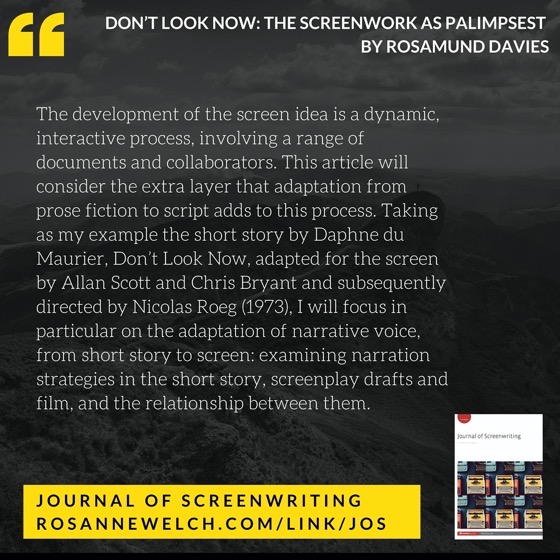
Loyalties among the citizens changed hands daily based on each victory and each loss. Those who favored Mazzini’s push for diplomacy and negotiation with Napoleon one day would support Giuseppe’s push for hard fighting the next.

Get your copy of A Man Of Action Saving Liberty Today!

From The Journal Of Screenwriting V4 Issue 2: The screenwork as palimpsest by Rosamund Davies

Highlighting the articles in the past editions of the Journal of Screenwriting, of which I am the Book Reviews Editor. Hopefully these abstracts will entice you to did a little deeper into the history and future of screenwriting. — Rosanne


Don’t Look Now: The screenwork as palimpsest by Rosamund Davies

The development of the screen idea is a dynamic, interactive process, involving a range of documents and collaborators. This article will consider the extra layer that adaptation from prose fiction to script adds to this process. Taking as my example the short story by Daphne du Maurier, Don’t Look Now, adapted for the screen by Allan Scott and Chris Bryant and subsequently directed by Nicolas Roeg (1973), I will focus in particular on the adaptation of narrative voice, from short story to screen: examining narration strategies in the short story, screenplay drafts and film, and the relationship between them. My discussion will explore the relevance of Ferrer and Groden’s notion of the creative process as an ‘always virtually present’ background process, of which each element of text and avant-texte constitutes but one manifestation. It will also introduce the figure of the palimpsest, considering how it might illuminate an understanding of the screenwork as constructed through the various layers that have contributed to its genesis, producing a multiple rather than a singular entity.
From The Journal Of Screenwriting V4 Issue 2: The screenwork as palimpsest by Rosamund Davies


Journal of Screenwriting Cover

The Journal of Screenwriting is an international double-blind peer-reviewed journal that is published three times a year. The journal highlights current academic and professional thinking about the screenplay and intends to promote, stimulate and bring together current research and contemporary debates around the screenplay whilst encouraging groundbreaking research in an international arena. The journal is discursive, critical, rigorous and engages with issues in a dynamic and developing field, linking academic theory to screenwriting practice. 

Get your copy and subscription to the Journal of Screenwriting Today!


* A portion of each sale from Amazon.com directly supports our blogs
** Many of these books may be available from your local library. Check it out!

The Civil War On Film – 24 in a series – “…to be filmed on the actual Gettysburg battlefield itself…”

The Civil War On Film - 24 in a series -

Realizing the location would be as much a character as any person, Turner negotiated for some of the scenes to be filmed on the actual Gettysburg battlefield itself, an unprecedented National Park Service allowance, though strict federal regulations ruled out any scenes showing opposing fire or combat. In this way, Turner can be compared to David O. Selznick in terms of the way he too obsessed over every detail of the production in ways producers do not always do.

Movies profiled in this book:

Dr. Rosanne Welch and Intellect Editor James Campbell Talk The Journal of Screenwriting and Others – Instagram Live – Wed, March 24, 2021, 10am PDT

Dr. Rosanne Welch and Intellect Editor James Campbell Talk The Journal of Screenwriting and Others - Instagram Live - Wed, March 24, 2021, 10am PDT

JOIN US!

Instagram Live – Wed, March 24, 2021, 10am PDT

on the Intellect Instagram Account


I’ll be joining Intellect editor James Campbell this Wednesday the 24th for his Instagram Live segment. 

We’ll be discussing the Special Issue of the Journal of Screenwriting that I co-edited with Rose Ferrell which covered international Women in Screenwriting

We’ll also be talking about how and why to write for journals and how to use them in your courses.

Journal of Screenwriting Cover

“A Man Of Action Saving Liberty: A Novel Based On The Life Of Giuseppe Garibaldi” – 28 in a series

Gariba

Giuseppe countered, “They do not yet think us an equal and separate foreign country. They believe us to be a rogue section of their own country, quite the way the English viewed the Americans during their revolution. We have to strike while they are weak. Before they regroup.”

Get your copy of A Man Of Action Saving Liberty Today!

From The Journal Of Screenwriting V4 Issue 2: Unknown spaces and uncertainty in film development by Margot Nash

Highlighting the articles in the past editions of the Journal of Screenwriting, of which I am the Book Reviews Editor. Hopefully these abstracts will entice you to did a little deeper into the history and future of screenwriting. — Rosanne


Unknown spaces and uncertainty in film development by Margot Nash

This article examines a discovery-driven process to script development as opposed to a formula-driven one. It is an investigation into the uncertain nature of the creative process in general, and the all-pervasive quest for certainty in film development in particular. Development strategies that value a discovery-driven process are few and far between, as are strategies to explore the gaps, or elisions, within a screenplay where subtext thrives, yet these are transformative spaces that invite an active and creative response. In this article I engage in practice-based research as a writer/director and as a teacher, and investigate two particular areas of film development. The first is early-stage script development where ideas are still struggling to find form; the second is latter-stage script development where a screenplay is refined in order to create spaces where others might respond imaginatively. I advocate risk taking, and the use of unconventional models, in order to create new spaces for students to explore their creativity, and I examine the ‘unknown’ and the ‘uncertain’ as active spaces, both for a screenwriter developing new work and for those who engage creatively with a screenplay as it transforms into a film. I argue that gaps or spaces within a screenplay offer opportunities for directors, actors, key creative crew and eventually an audience to actively participate, and that a development process that values the unknown offers the screenwriter a gateway to adventure and innovation. Screenwriting textbooks rarely enter the unknown and uncertain spaces of creativity yet, as many artists (albeit working in less-expensive mediums) seem to know instinctively, it is within the interplay of the known and the unknown, of passion and reason, and of logic and intuition – that creativity lies.

From The Journal Of Screenwriting V4 Issue 2: Unknown spaces and uncertainty in film development by Margot Nash


Journal of Screenwriting Cover

The Journal of Screenwriting is an international double-blind peer-reviewed journal that is published three times a year. The journal highlights current academic and professional thinking about the screenplay and intends to promote, stimulate and bring together current research and contemporary debates around the screenplay whilst encouraging groundbreaking research in an international arena. The journal is discursive, critical, rigorous and engages with issues in a dynamic and developing field, linking academic theory to screenwriting practice. 

Get your copy and subscription to the Journal of Screenwriting Today!


* A portion of each sale from Amazon.com directly supports our blogs
** Many of these books may be available from your local library. Check it out!