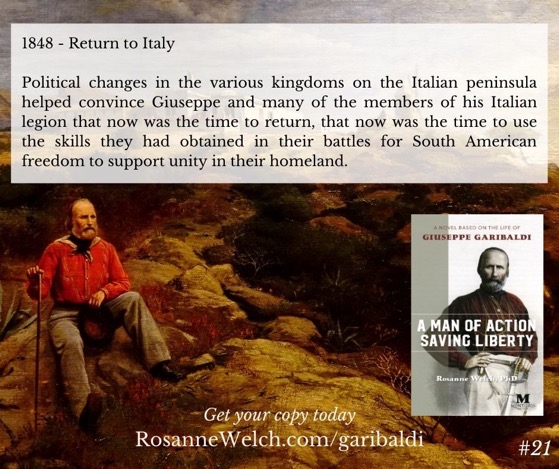
1848 – Return to Italy
Political changes in the various kingdoms on the Italian peninsula helped convince Giuseppe and many of the members of his Italian legion that now was the time to return, that now was the time to use the skills they had obtained in their battles for South American freedom to support unity in their homeland.
Category: Books
The Civil War On Film – 16 in a series – As a producer interested in maximizing his profits, Selznick worked hard to head off any possible protest.
As a producer interested in maximizing his profits, Selznick worked hard to head off any possible protest. The NAACP took issue with the use of the n-word in the book, so the script used the word “freedmen” instead. Selznick also conceded to veterans of the Union army. In the book, Scarlett shoots one of Sherman’s soldiers after he menaces her with rape. In the film the soldier becomes a deserter who was going against Sherman’s orders to not harm citizens on the March to the Sea.
Movies profiled in this book:
From The Journal Of Screenwriting V4 Issue 1: ‘To make you see’: Screenwriting, description and the ‘lens-based’tradition by Adam Ganz
Highlighting the articles in the past editions of the Journal of Screenwriting, of which I am the Book Reviews Editor. Hopefully these abstracts will entice you to did a little deeper into the history and future of screenwriting. — Rosanne
‘To make you see’: Screenwriting, description and the ‘lens-based’tradition by Adam Ganz
In this article I look at the descriptive writing in the screenplay, and link this to a tradition of ‘lens-based writing’, the precise visual description of phenomena observed through a lens for an audience unable to see what was described, which can be traced from the writing of Galileo and van Leeuwenhoek, through scientific and travel writing, to early fiction (with particular emphasis on Robinson Crusoe). I identify the most significant features of lens-based writing – the use of simple language and the separation of observation and deduction to communicate what has been seen through a simultaneous act of looking and framing, and show the similarities between this and screenwriting practice. I also make some observations about what this model can offer screenwriting research.
The Journal of Screenwriting is an international double-blind peer-reviewed journal that is published three times a year. The journal highlights current academic and professional thinking about the screenplay and intends to promote, stimulate and bring together current research and contemporary debates around the screenplay whilst encouraging groundbreaking research in an international arena. The journal is discursive, critical, rigorous and engages with issues in a dynamic and developing field, linking academic theory to screenwriting practice.
Get your copy and subscription to the Journal of Screenwriting Today!
* A portion of each sale from Amazon.com directly supports our blogs
** Many of these books may be available from your local library. Check it out!
Watch Dr. Rosanne Welch on What Is a Western? Interview Series: When Women Wrote Westerns from the Autry Museum of the American West [Video] (27 minutes)
The Stephens College MFA in TV and Screenwriting is building a relationship with the Autry Museum of the American West since both organizations are devoted to bringing out more diverse and untold stories. Last year we were able to take our cohort of graduating MFA candidates to the museum’s theatre for a showing of Michael Wilson’s Salt of the Earth and we had plans to present a film of our choice this year – but of course the pandemic changed all that. Instead, Autry Curator Josh Garrett-Davis asked me if I would sit for an interview about female screenwriters in the western genre and so “When Women Wrote Westerns” came to be a part of their “What Is a Western? Interview Series”.
I had a great time discussing so many wonderful women writers – from Jeanne MacPherson to D.C. Fontana to Edna Ferber to Emily Andras. If you love westerns I suggest you watch Josh’s other interviews covering everything from the work of Native Americans in Western movies to films in the western-horror hybrid. — ![]()
As part of a series exploring the significance of the Western genre and the ways in which the movies shape our understanding of the American West, Autry Curator Josh Garrett-Davis interviews Professor Rosanne Welch about the women screenwriters of Hollywood and their contributions to the Western genre.
Find more information at the Autry Museum of the American West
Podcast: Play in new window | Download
Subscribe: RSS
New Book by IGE Lecturers Critique the Civil War in Films via PolyCentric [News]
Recently my co-author Peg Lamphier and I sat for an interview about our Civil War on Film book to discuss the American film industry’s depiction of the American Civil War and the mythologies and ideologies surrounding the experience of that war.
We completely destroy any idea that there is something noble and admirable about the Confederacy. There is not. They fought to preserve human bondage. That should be morally revolting to all twenty-first century Americans and the fact that it is not is a testament to how far we still have to go to heal the wounds of our nation’s history of slavery.
Suddenly, the book seems even more timely than when we began writing it 2 years ago. — Rosanne
New Book by IGE Lecturers Critique the Civil War in Films
For their third book project, lecturers Peg Lamphier and Roseanne Welch, in the Department of Interdisciplinary General Education, decided to write a book examining the American film industry’s depiction of the American Civil War. In their book, “The Civil War on Film,” the authors contend that American films are filled with mythologies and ideologies surrounding the experience of the war and further research is required to uncover the full, real history.
Peg Lamphier and Roseanne Welch, lecturers in the Department of Interdisciplinary General Education, team up on their third book, which examines the American film industry’s depiction of the American Civil War.
According to the authors, the Civil War, which occurred from 1861-1865, is contested ground both among historians and the general public. They argue that most are clear about the anti-slavery aims of the war, as well as the fundamentally treasonous nature of succession, but neo-Confederates cast the war in terms favorable to their white supremacist agenda.
In a joint statement, Lamphier and Welch wrote, “Our book is entirely unsympathetic to the Neo-Con/Lost Cause agenda and so we’re engaged in a vigorous refutation of a number of pro-Confederate myths that serve to hamper racial equality in modern America. We hope readers will better understand the nature of the war and the troubled way it’s been filmed as they work through our book. We also hope it shows readers that films always engage in a bit of fictionalization in order to heighten the drama.”
Other Welch/Lamphier Books
“A Man Of Action Saving Liberty: A Novel Based On The Life Of Giuseppe Garibaldi” – 20 in a series
There were four thousand Italian families in Montevideo at the time. When the city was put under siege Giuseppe put together a force of Italians to help defend the city. The fame the newspapers generated brought hundreds of those Italians to join Giuseppe’s forces with a two-fold promise: they would fight for freedom for Uruguay and use this fight as a training ground so they could all return to Italy and unite their own beloved country.
From The Journal Of Screenwriting V3 Issue 2: Development of a fundamental ’19-Sequence Model’ of screenplay and narrative film structure by Melvyn P. Heyes
Highlighting the articles in the past editions of the Journal of Screenwriting, of which I am the Book Reviews Editor. Hopefully these abstracts will entice you to did a little deeper into the history and future of screenwriting. — Rosanne
To understand the utility and value of sequences in the construction of screenplay narratives and the emotional experiences of audiences, I developed and utilized composite definitions of ‘sequence’ and ‘scene’ to quantify the sequence content of 133 feature-length Hollywood-style and independent films made between 1941 and 2010 that were produced in the United States, Great Britain, Russia, Germany and Japan. The 3-Act Model was used as familiar reference points. I also contrasted the results to Frank Daniels’ 8-Sequence Model as described by Gulino. I argue the results directly support a fundamental 19-Sequence Model of screenplay and film narrative structure. I propose that sequences expand vicarious and empathic emotional experiences of audiences into ‘contextual emotional meaning’, where significant autonomous emotions are generated that create the enjoyable and satisfying experience of what the story means to both the characters and viewer.
The Journal of Screenwriting is an international double-blind peer-reviewed journal that is published three times a year. The journal highlights current academic and professional thinking about the screenplay and intends to promote, stimulate and bring together current research and contemporary debates around the screenplay whilst encouraging groundbreaking research in an international arena. The journal is discursive, critical, rigorous and engages with issues in a dynamic and developing field, linking academic theory to screenwriting practice.
Get your copy and subscription to the Journal of Screenwriting Today!
* A portion of each sale from Amazon.com directly supports our blogs
** Many of these books may be available from your local library. Check it out!
The Civil War On Film – 15 in a series – “…a Civilization gone with the wind.”
Then the scrolling text promises the audience a story about “a land of Cavaliers and Cotton Fields called the Old South. Here in this pretty world, Gallantry took its last bow. Here was the last ever to be seen of Knights and their Ladies Fair, of Master and of Slave. Look for it only in books, for it is no more than a dream remembered, a Civilization gone with the wind.”
Movies profiled in this book:
“A Man Of Action Saving Liberty: A Novel Based On The Life Of Giuseppe Garibaldi” – 19 in a series
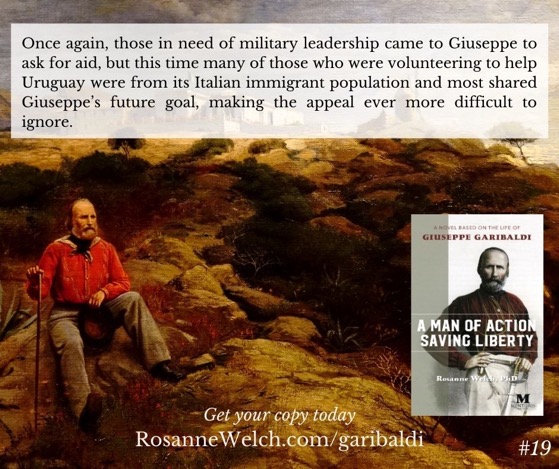
Once again, those in need of military leadership came to Giuseppe to ask for aid, but this time many of those who were volunteering to help Uruguay were from its Italian immigrant population and most shared Giuseppe’s future goal, making the appeal ever more difficult to ignore.
From The Journal Of Screenwriting V3 Issue 2: Storytelling in Bhutanese cinema: Research context and case study of a film in development by Shohini Chaudhuri, Sue Clayton
Highlighting the articles in the past editions of the Journal of Screenwriting, of which I am the Book Reviews Editor. Hopefully these abstracts will entice you to did a little deeper into the history and future of screenwriting. — Rosanne
Screenwriter and director Sue Clayton and academic Shohini Chaudhuri consider storytelling structures in Bhutan, a country that has, until recently, been relatively culturally isolated but is now moving towards entering the global stage. As in the rest of South Asia, the dominant cinematic model in Bhutan is that of Bollywood, yet Buddhism, the oral tradition and supernatural beliefs form a rich repertoire of stories that screenwriters of the emerging film industry are increasingly attempting to mine. In this article, we show how cinematic storytelling in Bhutan functions as a kind of ‘secondary orality’ through our analyses of an earlier international co-production Travellers and Magicians (2003), two local DV films, and the film project that Clayton is developing in dialogue with Bhutanese writers, Jumolhari. We argue that Bhutan’s Buddhist, animist and oral traditions challenge and transform classically established cinema conventions of story structure, decentring individual human subjectivity as the controlling force and producing an altogether different kind of hero’s journey.
The Journal of Screenwriting is an international double-blind peer-reviewed journal that is published three times a year. The journal highlights current academic and professional thinking about the screenplay and intends to promote, stimulate and bring together current research and contemporary debates around the screenplay whilst encouraging groundbreaking research in an international arena. The journal is discursive, critical, rigorous and engages with issues in a dynamic and developing field, linking academic theory to screenwriting practice.
Get your copy and subscription to the Journal of Screenwriting Today!
* A portion of each sale from Amazon.com directly supports our blogs
** Many of these books may be available from your local library. Check it out!

![Watch Dr. Rosanne Welch on What Is a Western? Interview Series: When Women Wrote Westerns from the Autry Museum of the American West [Video] (27 minutes)](https://rosannewelch.com/wp-content/uploads/2021/01/rmw-autry-interview-w3h-20210122.jpg)
![New Book by IGE Lecturers Critique the Civil War in Films via PolyCentric [News]](https://rosannewelch.com/wp-content/uploads/2021/01/Welch-and-Lamphier.jpg)