Where’s Her Movie? Activist, Claudette Colvin – 16 in a series

“Where’s HER Movie” posts will highlight interesting and accomplished women from a variety of professional backgrounds who deserve to have movies written about them as much as all the male scientists, authors, performers, and geniuses have had written about them across the over 100 years of film.  This is our attempt to help write these women back into mainstream history.  — Rosanne

Where's Her Movie? Activist, Claudette Colvin  - 16 in a series

Claudette Colvin (born Claudette Austin, September 5, 1939)[1][2] is a pioneer of the 1950s civil rights movement and retired nurse aide. On March 2, 1955, she was arrested at the age of 15 in Montgomery, Alabama, for refusing to give up her seat to a white woman on a crowded, segregated bus. This occurred nine months before the more widely known incident in which Rosa Parks, secretary of the local chapter of the National Association for the Advancement of Colored People (NAACP), helped spark the 1955 Montgomery bus boycott.[3]

Colvin was one of five plaintiffs in the first federal court case filed by civil rights attorney Fred Gray on February 1, 1956, as Browder v. Gayle, to challenge bus segregation in the city. In a United States district court, she testified before the three-judge panel that heard the case. On June 13, 1956, the judges determined that the state and local laws requiring bus segregation in Alabama were unconstitutional. The case went to the United States Supreme Court on appeal by the state, and it upheld the district court’s ruling on November 13, 1956. One month later, the Supreme Court affirmed the order to Montgomery and the state of Alabama to end bus segregation. The Montgomery bus boycott was then called off. Wikipedia

18 Where Are The Women? from There And Back Again: Writing and Developing for American TV [Video] (40 seconds)

18 Where Are The Women? from There And Back Again: Writing and Developing for American TV [Video] (40 seconds)

Thanks to the gracious invitation from my Screenwriting Research Network colleague Paolo Russo – and a grant he was able to procure (and in the before-Covid time) I was able to spend a week at Oxford Brookes University working with the screenwriting masters students in Paolo’s course. At the culmination of the week, I gave this lecture on how writers rooms worked in the States.

Transcript:

Kenny moved into The Incredible Hulk really the first superhero show on tv that ever survived and then he did “V” which was redone a few years ago and then he did Alien Nation which is where I met him. I worked on that show. So but in all these early drama rooms, there’s something missing. Who’s not in that picture? Audience: Any woman. Thank you. There you go. That’s the problem because most all these stories are being funneled through the minds of guys and you can’t blame a person for writing about what they know and what means something to them. That’s what writers do and that’s why a room wants as much inclusivity as possible right? So we don’t have any girls.

Watch this entire presentation

Subscribe to Rosanne’s Channel and receive notice of each new video!


* A portion of each sale from Amazon.com directly supports our blogs
** Many of these books may be available from your local library. Check it out!
† Available from the LA Public Library

“A Man Of Action Saving Liberty: A Novel Based On The Life Of Giuseppe Garibaldi” – 31 in a series

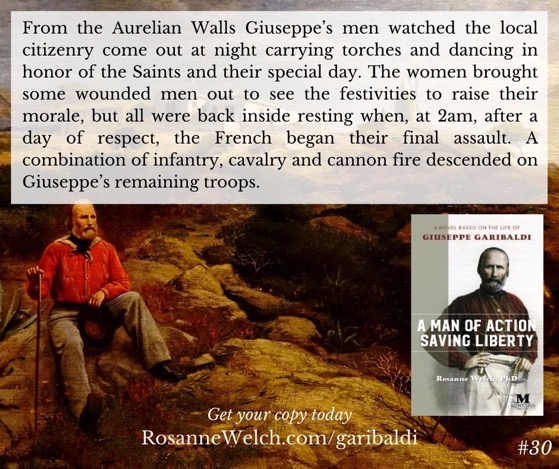
From the Aurelian Walls Giuseppe’s men watched the local citizenry come out at night carrying torches and dancing in honor of the Saints and their special day. The women brought some wounded men out to see the festivities to raise their morale, but all were back inside resting when, at 2am, after a day of respect, the French began their final assault. A combination of infantry, cavalry and cannon fire descended on Giuseppe’s remaining troops.

Get your copy of A Man Of Action Saving Liberty Today!

From The Journal Of Screenwriting V4 Issue 3: And the beat goes on: The continuing influence of The Singing Detective by Glen Creeber

Highlighting the articles in the past editions of the Journal of Screenwriting, of which I am the Book Reviews Editor. Hopefully these abstracts will entice you to did a little deeper into the history and future of screenwriting. — Rosanne


And the beat goes on: The continuing influence of The Singing Detective by Glen Creeber

From the 25 years of its original broadcast on British television in December 1986, this article aims to assess the continued influence of the British TV serial, The Singing Detective (BBC). It aims to clarify many of the major techniques employed in the programme and suggest ways in which its particular style and non-naturalistic aesthetic (with its roots dating back to the early 1960s) has influenced a whole generation of TV drama since. In particular, it will draw direct parallels between writer Dennis Potter’s work and serials such as Twin Peaks, Oz, Six Feet Under and The Sopranos, citing various sources that suggest these connections are more than just hypothetical. The American cable channel HBO (Home Box Office) will come under particular focus, with the author drawing links between its current remit to produce experimental and adult-themed drama and Potter’s own work. It will then investigate the state of contemporary British television drama and suggest why it arguably refuses to take as many risks as some of its American counterparts, citing various sources which suggest that contemporary British hard-hitting drama appears to have been forsaken for a plethora of heritage and period-based serials. In conclusion, it will argue that while the influence of The Singing Detective appears to have been profoundly significant elsewhere, its dramatic legacy is now surprisingly missing from British TV screens.

From The Journal Of Screenwriting V4 Issue 3: And the beat goes on: The continuing influence of The Singing Detective by Glen Creeber


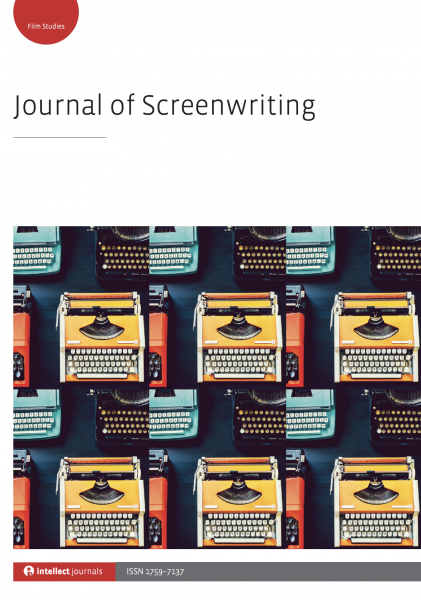
Journal of Screenwriting Cover

The Journal of Screenwriting is an international double-blind peer-reviewed journal that is published three times a year. The journal highlights current academic and professional thinking about the screenplay and intends to promote, stimulate and bring together current research and contemporary debates around the screenplay whilst encouraging groundbreaking research in an international arena. The journal is discursive, critical, rigorous and engages with issues in a dynamic and developing field, linking academic theory to screenwriting practice. 

Get your copy and subscription to the Journal of Screenwriting Today!


* A portion of each sale from Amazon.com directly supports our blogs
** Many of these books may be available from your local library. Check it out!

The Civil War On Film – 26 in a series – “…the movie is greatly esteemed by persons sympathetic with the Confederacy…”

The Civil War On Film - 26 in a series -

Ang Lee and writer James Schamus’s thesis for Ride with the Devil, suggests there was no right and wrong in the Civil War and that both sides were equally violent in their dealings with the other. While the movie is greatly esteemed by persons sympathetic with the Confederacy, viewers and movie critics were considerably less enthusiastic.

Movies profiled in this book:

07 The Writer’s Voice from How The Chaos Of Collaboration in the Writers Room Created Golden Age Television [Video]

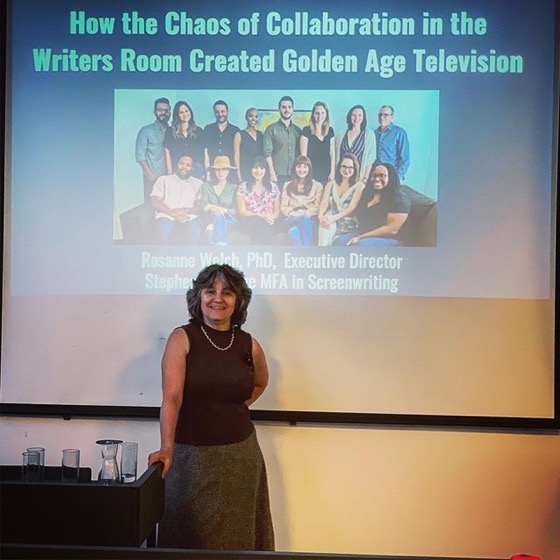
With the full recording of “How The Chaos Of Collaboration in the Writers Room Created Golden Age Television”

Srn port07 The Writer's Voice from How The Chaos Of Collaboration in the Writers Room Created Golden Age Television [Video]

Subscribe to Rosanne’s Channel and receive notice of each new video!


When the folks hosting the conference announced their theme as “Screen Narratives: Chaos and Order” the word ‘chaos’ immediately brought to mind writers rooms. I offered a quick history of writers rooms (the presentations are only 20 minutes long) and then quoted several current showrunners on how they compose their rooms and how they run them.

Transcript

And I think that’s where we started to learn that, particularly in television, you had to find people with a defined voice and that is something you could build a show around and so when I define voice everyone has a slightly different concept but to me, it’s a simple matter of your opinion and the style in which you deliver it and that tells us your different voice and I think some of the shows I’m going to mention — it’s very clear they have very unique voices and that’s where they come from. So we started to recognize that the idea of the creator and television was the writer and that person should run the entire show themselves and should begin to gather about them a group of people who could mimic their voice while still keeping their own. That was the difficult job of television which is also still a difficult thing to teach students to write a spec script that sounds like, but doesn’t obliterate, your own voice, and that’s what you’re trying to do in the room, which again, is more chaotic than I would say.

For more information on the Screenwriting Research Network, visit

Screenwriting Research Network Conference, Porto, Portugal, All Sessions


Ready to present my talk yesterday at the Screenwriting Research Conference here in Porto, Portugal via Instagram

Follow me on Instagram


* A portion of each sale from Amazon.com directly supports our blogs
** Many of these books may be available from your local library. Check it out!

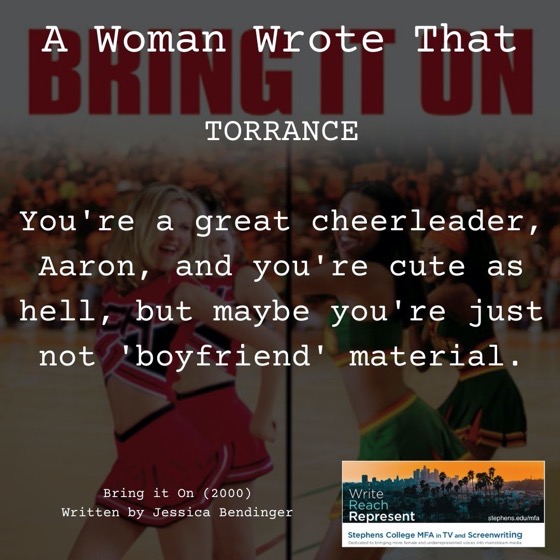
A Woman Wrote That – 22 in a series – Bring It On! (2000), Writer, Jessica Bendinger

This new “A Woman Wrote That” post is an echo of the Writers Guild campaign of a few years ago (“A Writer Wrote That”) where they noted famous movie quotes and credited the screenwriter rather than the director.  The difference here being that we will be posting lines from films written by female screenwriters.  Feel free to share! — Rosanne

A Woman Wrote That - 22 in a series - Bring It On! (2000), Writer, Jessica Bendinger

TORRANCE

You’re a great cheerleader, Aaron, and you’re cute as hell, but maybe you’re just not ‘boyfriend’ material.

Where’s Her Movie? Sculptor, Selma Burke – 15 in a series

“Where’s HER Movie” posts will highlight interesting and accomplished women from a variety of professional backgrounds who deserve to have movies written about them as much as all the male scientists, authors, performers, and geniuses have had written about them across the over 100 years of film.  This is our attempt to help write these women back into mainstream history.  — Rosanne

Where's Her Movie? Sculptor, Selma Burke - 14 in a series

Selma Hortense Burke (December 31, 1900 – August 29, 1995) was an American sculptor and a member of the Harlem Renaissance movement.[1] Burke is best known for a bas relief portrait of President Franklin D. Roosevelt that inspired the profile found on the obverse of the dime.[2] She described herself as “a people’s sculptor” and created many pieces of public art, often portraits of prominent African-American figures like Duke EllingtonMary McLeod Bethune and Booker T. Washington.[3][4] In 1979, she was awarded the Women’s Caucus for Art Lifetime Achievement Award[5]

Wikipedia

17 The Bionic Woman from There And Back Again: Writing and Developing for American TV [Video] (56 seconds)

17 The Bionic Woman from There And Back Again: Writing and Developing for American TV [Video] (56 seconds)

Thanks to the gracious invitation from my Screenwriting Research Network colleague Paolo Russo – and a grant he was able to procure (and in the before-Covid time) I was able to spend a week at Oxford Brookes University working with the screenwriting masters students in Paolo’s course. At the culmination of the week, I gave this lecture on how writers rooms worked in the States.

Transcript:

And better than, that she was the last episode of the first season of this show and the studio killed her so that there’d be a great tragic ending and Kenny, who was a young writer then, said this is like the middle of the second wave of the feminist movement. You can’t kill the most engaging woman that you have had on your program and the network said yes we can. Nobody wants a love interest for the lead character because women want to imagine he’ll fall in love with them and they don’t want to get in some of the girl’s way. That’s rude, right? So they killed her and the mail — because there wasn’t yet email — that they got complaining that they had the audacity to kill the most accomplished woman who had ever appeared on that show meant that miraculously at the beginning of season two she wasn’t actually dead. They had bionically saved her and then she got her own program and Kenny became an Executive Producer of his own program because of his creativity because he had come up with that character. He now owned that character.

Watch this entire presentation

Subscribe to Rosanne’s Channel and receive notice of each new video!


* A portion of each sale from Amazon.com directly supports our blogs
** Many of these books may be available from your local library. Check it out!
† Available from the LA Public Library

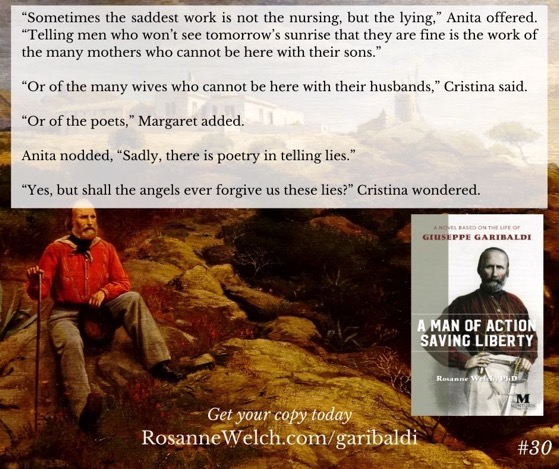
“A Man Of Action Saving Liberty: A Novel Based On The Life Of Giuseppe Garibaldi” – 30 in a series

“Sometimes the saddest work is not the nursing, but the lying,” Anita offered. “Telling men who won’t see tomorrow’s sunrise that they are fine is the work of the many mothers who cannot be here with their sons.”

“Or of the many wives who cannot be here with their husbands,” Cristina said.

“Or of the poets,” Margaret added.

Anita nodded, “Sadly, there is poetry in telling lies.”

“Yes, but shall the angels ever forgive us these lies?” Cristina wondered.

Get your copy of A Man Of Action Saving Liberty Today!