Students in the second year of the Stephens College MFA in TV and Screenwriting work on writing prompts with creativity coach JoAnn Braheny during their January workshop meetings at the Henson Studios in Hollywood. Applications are open now for the fall class!
Subscribe to Rosanne’s Channel and receive notice of each new video!
This one allowed me to riff on some of my favorite female science fiction writers across time, whether they be novelists or television writers. It also opened up a good conversation on what art we support and include in our lives – and what that art says to us and about us. — Rosanne
Transcript:
And of course, it brought us many other powerful engaging women right? We got Rei. We’re dealing with Padme from the earlier session. We had Jyn Erso. I really like Rogue One more than I even like the new Star Wars, but that’s just me. Then we have Rose Tiko which was a big move right and then there are people kind of Oh, what’s she doing in there. She doesn’t have any place in the movie. She does. She’s showing us that people of Asian descent show up in the future. That’s a huge message right and again she does it mostly peacefully you know there’s a gun in there someone but we get rid of that pretty quick and then it’s about your skill with it with lightsaber stuff. Moving forward we all know or we think we know Alien right and Sigourney Weaver. Sadly the rumor in Hollywood is that the reason that character is so strong and interesting is the it was written to be a man and when they couldn’t get a male to star in the movie they just threw it to Sigourney Weaver and they never rewrote it girl-ify it up. So she’s powerful because she’s doing all the things we expect men to do in movies without having to be a guy.
* A portion of each sale from Amazon.com directly supports our blogs ** Many of these books may be available from your local library. Check it out!
Tom Stempel, (historian and author of one of the textbooks used in our MFA – Framework: a History of Screenwriting) has a blog – Understanding Screenwriting — where he analyzes the work of recent screenplays, many of which you may have just seen.
Highlighting the articles in the past editions of the Journal of Screenwriting, of which I am the Book Reviews Editor. Hopefully these abstracts will entice you to did a little deeper into the history and future of screenwriting. — Rosanne
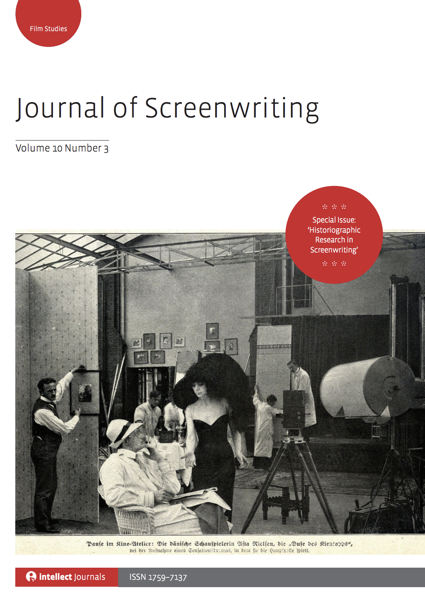
This article examines the screenwriting practice in Czech silent cinema in the late 1910s and 1920s. It focuses on Jan Stanislav Kolár’s narrative poetics as a case study of specific storytelling choices within the transitional era from one- or two-reelers to the feature-length format in the context of local technological restrictions in exhibition – inevitable breaks of changing film reels in single-projector cinemas. Poetological analysis of Kolár’s Řina (1926) with his other surviving scenarios and pictures shows that meant not only the necessity of adapting to these limitations, but also became a productive way of achieving particular effects on the audience. Semi-independent narrative acts, thrilling moments occurring at the end of the reel, or significant shifts in space and time between two reels were integral parts of his own original stories as well as adaptations of various novels. Nevertheless, the article outlines more general perspective in relation to film reels as structural narrative units and screenwriting practice among Czech filmmakers as well.
The Journal of Screenwriting is an international double-blind peer-reviewed journal that is published three times a year. The journal highlights current academic and professional thinking about the screenplay and intends to promote, stimulate and bring together current research and contemporary debates around the screenplay whilst encouraging groundbreaking research in an international arena. The journal is discursive, critical, rigorous and engages with issues in a dynamic and developing field, linking academic theory to screenwriting practice.
Subscribe to Rosanne’s Channel and receive notice of each new video!
Transcript:
Elaine May is another name that’s fallen out of history and shouldn’t. Now we’re in the 70s. Elaine I think is a brilliant writer. Heaven Can Wait wouldn’t be what it was. Warren Beatty got tons of focus for that but she wrote it. She came out of doing nightclub things with Mike Nichols. They were Nichols in May and they wrote all their routines. It was like a traveling SNL sketch. You probably still know who Mike Nichols is, but Elaine May has fallen out of history because at a certain point she started directing. Which is cool, but she directed a movie called Ishtar which lost a ton of money and she was never given a directing job again. I can name you many a man who has directed a film that lost a ton of money and somehow they still got a second and a third and a fourth job. Elaine Mae was never given the right to direct a film again. Her writing is brilliant and as you know she still continued writing she did Primary Colors.
Dr. Rosanne Welch discusses the women in her new book “When Women Wrote Hollywood” which covers female screenwriters from the Silents through the early 1940s when women wrote over 50% of films and Frances Marion was the highest paid screenwriter (male or female) and the first to win 2 Oscars. Yet, she fails to appear in film history books, which continue to regurgitate the myth that male directors did it all – even though it’s been proven that the only profitable movies Cecil B. de Mille ever directed were all written by Jeannie Macpherson film ever won for Best Picture was written by Robert E. Sherwood (who people have heard of, mostly due to his connection to Dorothy Parker) and Joan Harrison.
* A portion of each sale from Amazon.com directly supports our blogs ** Many of these books may be available from your local library. Check it out! † Available from the LA Public Library
Wherever you go, you find Monkees fans and the Denver Popular Culture Con was no different. Amid rooms full of caped crusaders and cosplay creations, I was initially not sure how many folks would attend a talk on a TV show from the 1960s – but happily I was met by a nice, engaged audience for my talk on Why the Monkees Matter – and afterward they bought books! What more could an author ask for?
Subscribe to Rosanne’s Channel and receive notice of each new video!
Transcript
But part of what made them last, we all know, it’s the TV show and it’s the music. The music mattered very much to them. There was, of course in the beginning, the first two albums. The first two up there More Of The Monkees and The Monkees, they sang everything. They played nothing. Not their fault. It was played by The Wrecking Crew who were the band that played The Beach Boys albums for the Beach Boys. They played for lots of famous bands in the day. It’s just that people got very angry that The Monkees were famous so quickly because they had a TV show, and so they got a bad reputation, but because of that reputation, the third album Headquarters is entirely them. Every song is written by one of the four of them. Every tune is sung by all of them and all the instrumentation is all of them. They have nothing else. That is to prove they could do it. That album was second the entire summer of 68. The first album all summer was Sgt. Pepper’s. That’s not too shabby. If you think about it, if there wasn’t Sgt. Pepper they would have been number one the whole summer. So that’s how much the music mattered. It’s a pretty good album. There’s quite a lot of good music on that album.
A hit television show about a fictitious rock band, The Monkees (1966-1968) earned two Emmys–Outstanding Comedy Series and Outstanding Directorial Acheivement in Comedy.
Capitalizing on the show’s success, the actual band formed by the actors, at their peak, sold more albums than The Beatles and The Rolling Stones combined, and set the stage for other musical TV characters from The Partridge Family to Hannah Montana. In the late 1980s, the Monkees began a series of reunion tours that continued into their 50th anniversary.
This book tells the story of The Monkees and how the show changed television, introducing a new generation to the fourth-wall-breaking slapstick created by Laurel and Hardy and the Marx Brothers.
Its creators contributed to the innovative film and television of 1970s with projects like Bob & Carol & Ted & Alice, The Mary Tyler Moore Show, Laugh-In and Welcome Back, Kotter. Immense profits from the show, its music and its merchandising funded the producers’ move into films such as Head, Easy Riderand Five Easy Pieces.
The Stephens College MFA in TV and Screenwriting program teamed up with the Writers Guild Foundation to pull the covers back on a topic that still makes viewers blush: sex. On this special evening, our panel of TV writers and producers share how they approach writing about sex, from intimate scenes to revealing dialogue, and the nuances they consider when crafting stories about sex and sexuality.
Panelists:
Michelle Ashford – Masters of Sex, The Pacific
Cindy Chupack – I’m Dying Up Here, Divorce, Sex and the City
Sahar Jahani – 13 Reasons Why, Ramy
Dayna Lynne North – Insecure, Single Ladies, Lincoln Heights
Born in Italy at the tumultuous end of France’s influence in Europe, Giuseppe Verdi went on to become the world’s most recognizable name in opera.
Set against the rise of the Italian states in the middle of the nineteenth century, The Faithful depicts an artist bedeviled by his role not just as a composer, but as an unassuming icon of the Italian Unification and the birth of modern Italy.
Through chance encounters in gilded Milanese salons and the hushed politics of the Italian opera, we experience the struggles of a man conflicted by his role as an artist and by his commitment to a country yearning for independence.
About the Author
Collin Mitchell is a graduate of UC Santa Barbara, with a degree in Comparative Literature and Film Studies. Originally from the Bay Area, he now resides in Los Angeles.
Months of research went into the creation of the essays in “When Women Wrote Hollywood.” Here are some of the resources used to enlighten today’s film lovers to the female pioneers who helped create it.
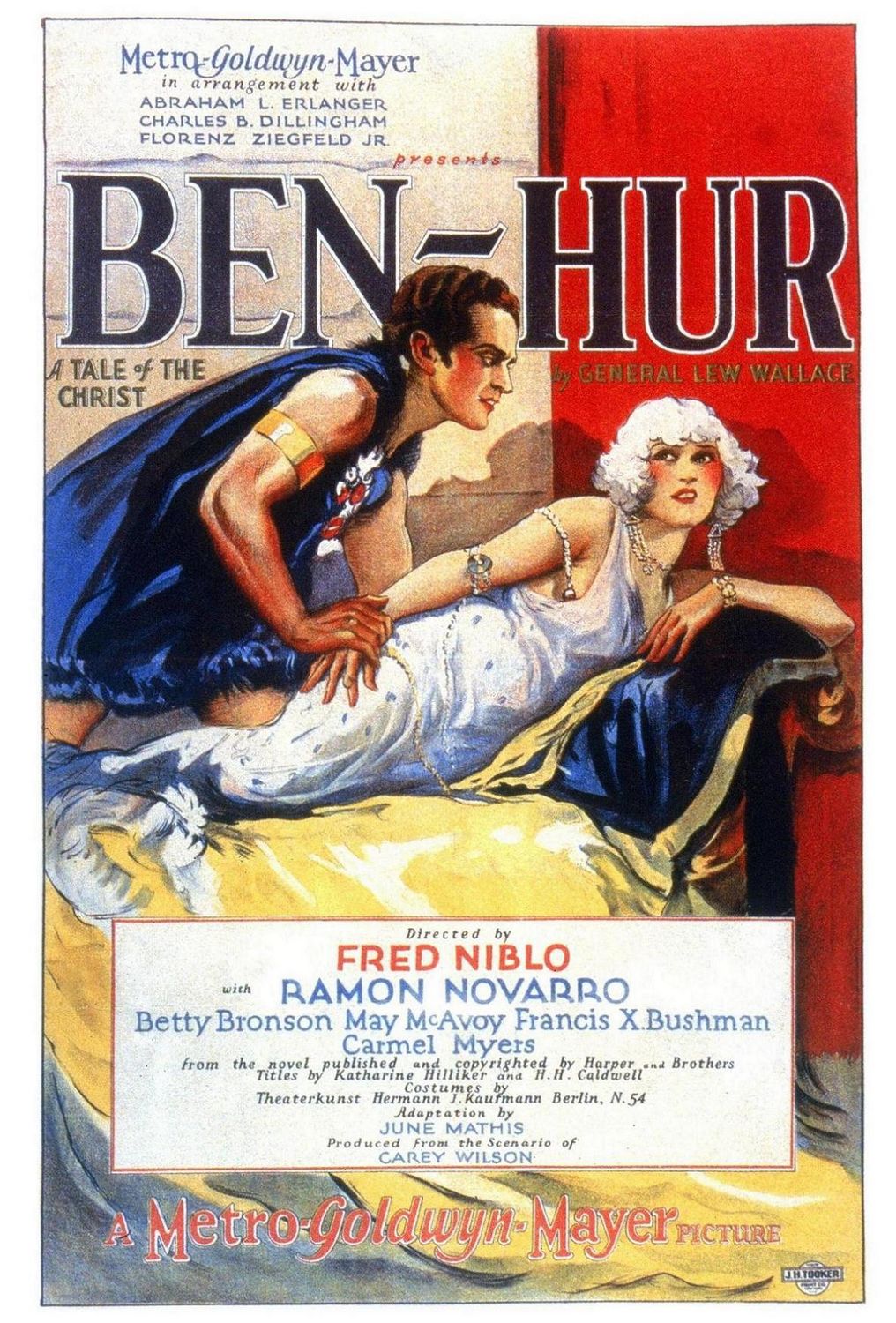
Ben-Hur: A Tale of the Christ is a 1925 American silent epic adventure-drama film directed by Fred Niblo and written by June Mathis based on the 1880 novel Ben-Hur: A Tale of the Christ by General Lew Wallace. Starring Ramon Novarro as the title character, the film is the first feature-length adaptation of the novel and second overall, following the 1907 short.
In 1997, Ben-Hur was selected for preservation in the United States National Film Registry by the Library of Congress as being “culturally, historically, or aesthetically significant.” — Wikipedia
* A portion of each sale from Amazon.com directly supports our blogs
** Many of these books may be available from your local library. Check it out!
† Available from the LA Public Library
The Stephens College MFA in TV and Screenwriting program teamed up with the Writers Guild Foundation to pull the covers back on a topic that still makes viewers blush: sex. On this special evening, our panel of TV writers and producers share how they approach writing about sex, from intimate scenes to revealing dialogue, and the nuances they consider when crafting stories about sex and sexuality.
Panelists:
Michelle Ashford – Masters of Sex, The Pacific
Cindy Chupack – I’m Dying Up Here, Divorce, Sex and the City
Sahar Jahani – 13 Reasons Why, Ramy
Dayna Lynne North – Insecure, Single Ladies, Lincoln Heights

![36 Star Wars, Alien, and Women Characters from The Sisterhood of Science Fiction – Dr. Rosanne Welch [Video] (1 minute)](https://rosannewelch.com/wp-content/uploads/2020/01/scifi-rmw-cpp-36.jpeg)

![38 Elaine May from “When Women Wrote Hollywood” with Dr. Rosanne Welch [Video] (53 seconds)](https://rosannewelch.com/wp-content/uploads/2020/01/csuf-rmw-w3h-38.jpeg)
![23 Music and The Monkees from “Why The Monkees Matter: Even 50 Years Later [Video] (1 minute 9 seconds)](https://rosannewelch.com/wp-content/uploads/2020/01/monkees-popcon-2019-23.jpeg)


![Listen to “Between the Sheets: Writing About Sex on TV” from the Writers Guild Foundation and Stephens College MFA in TV and Screenwriting [Audio]](https://rosannewelch.com/wp-content/uploads/2020/01/WGAF-Sheets-131.jpg)