15 The Operation of a Writer’s Room Part 2 from How The Chaos Of Collaboration in the Writers Room Created Golden Age Television [Video]

With the full recording of “How The Chaos Of Collaboration in the Writers Room Created Golden Age Television”

15 The Operation of a Writer's Room Part 2 from How The Chaos Of Collaboration in the Writers Room Created Golden Age Television [Video]

Subscribe to Rosanne’s Channel and receive notice of each new video!


When the folks hosting the conference announced their theme as “Screen Narratives: Chaos and Order” the word ‘chaos’ immediately brought to mind writers rooms. I offered a quick history of writers rooms (the presentations are only 20 minutes long) and then quoted several current showrunners on how they compose their rooms and how they run them.

Transcript

…and she tells a lovely story about one scene in which she had two — this is, of course, about the pre— the days of the Czar — and so you have lovely rich people fencing. Two lovely young men having a fencing match — a practice — and at the end of it they take off their attire and they put on their nice shirts with the lace and they walk away. And the men in her writing room — the Russian men — said “well, the scene is over when we know who won the match,” and she said “No, this is a soap opera. The scene is over when the women see their chests.” So, she was teaching them what you need inside a soap opera. So they wanted a teaching writer’s room and that’s what she was able to provide.

For more information on the Screenwriting Research Network, visit

Screenwriting Research Network Conference, Porto, Portugal, All Sessions


Ready to present my talk yesterday at the Screenwriting Research Conference here in Porto, Portugal via Instagram

Follow me on Instagram


* A portion of each sale from Amazon.com directly supports our blogs
** Many of these books may be available from your local library. Check it out!

01 On Giving Notes from Worry and Wonder | The Courier Thirteen Podcast | Episode # 29 [Video]

Watch the entire presentation – Worry and Wonder | The Courier Thirteen Podcast | Episode # 29 here

01 On Giving Notes from Worry and Wonder | The Courier Thirteen Podcast | Episode # 29 [Video]

Transcript:

I always tell people you get hired to write on a television show. Look at them. They have eight episodes now or 12 maybe. You’re gonna write one and you’re going to have to give good notes on the other 10 or 11 for people who want you to stick around. It’s your job to make their work better so the show doesn’t get canceled and you don’t keep your job. So notes are one of the most important things to understand how to do.

Dr. Rosanne Welch is a television writer with credits that include Beverly Hills 90210, Picket Fences, ABCNEWS: Nightline and Touched by an Angel. She also teaches Television Writing and the Art of Film at San Jose State University.

Rosanne discusses what made shows like Beverly Hills 90210 compelling, what to do and not to do when attempting to pitch a show to broadcast or streaming, what most young writers neglect in their writing process, and much more!

The Courier Thirteen Podcast is available on YouTube, Spotify, Apple Podcasts, SoundCloud, and Audible.

Where’s Her Movie? Lawyer, Charlotte E. Ray – 23 In A Series

“Where’s HER Movie” posts will highlight interesting and accomplished women from a variety of professional backgrounds who deserve to have movies written about them as much as all the male scientists, authors, performers, and geniuses have had written about them across the over 100 years of film.  This is our attempt to help write these women back into mainstream history.  — Rosanne

Where's Her Movie? Lawyer, Charlotte E. Ray  - 23 In A Series

Charlotte E. Ray (January 13, 1850 – January 4, 1911) was an American lawyer. She was the first black American female lawyer in the United States.[1][2] Ray graduated from Howard University School of Law in 1872. She was also the first female admitted to the District of Columbia Bar, and the first woman admitted to practice before the Supreme Court of the District of Columbia.[3] Her admission was used as a precedent by women in other states who sought admission to the bar.[4]

Ray opened her own law office, advertising in a newspaper run by Frederick Douglass.[5] However, she practiced law for only a few years because prejudice against African Americans and women made her business unsustainable.[6] Ray eventually moved to New York, where she became a teacher in Brooklyn. She was involved in the women’s suffrage movement[7] and joined the National Association of Colored Women.[8] — Wikipedia

On Screenwriting: The Mary Tyler Moore Show, Title IV, and Today [Essay]

Working on this chapter about how the life of Ruth Bader Ginsburg was adapted for the screen in On the Basis of Sex, I was reminded of the interview scene in the pilot of The Mary Tyler Moore Show where Lou Grant asks her if she’s married and what religion she is.

On Screenwriting: The Mary Tyler Moore Show, Title IV, and Today [Essay]

In 1970 those questions were illegal thanks to Title IV of the Civil Rights Act of 1964.  But RBG had graduated in 1959 so the Act had not been around to help her.  She was turned down because she was a woman and because she was Jewish – despite achievements like graduating first in her class and the distinction of being the first woman to work on two major law reviews: the Harvard Law Review and Columbia Law Review.

Then I did some searching on the MTM script and found this article about how, though the scene was written in 1970 by James Brooks and Allan Burns, it is still relevant today.  Fascinating statistics between now and then including the fact that by 2017 in 38 percent of heterosexual marriages, women outearn their husbands.

3 ways ‘The Mary Tyler Moore Show’ pilot is still relevant today from the Washington Post

After Mary Tyler Moore’s death Wednesday, I watched the pilot episode of “The Mary Tyler Moore Show.” Though the show was revolutionary for its time for its portrayal of a single woman, working in journalism and living alone — I didn’t expect it to hold up all that well. Forty-seven years after the pilot aired, there are parts that are certainly retro. Louis “Lou” Grant (Edward Asner), for example, flat-out tells Mary Richards (Mary Tyler Moore) during a job interview: “I figured I’d hire a man for it, but we can talk about it.” But there’s a lot in that first episode that’s still relevant for single women today.

Read 3 ways ‘The Mary Tyler Moore Show’ pilot is still relevant today

And watch the scene if you don’t know it…

“A Man Of Action Saving Liberty: A Novel Based On The Life Of Giuseppe Garibaldi” – 39 in a series

“If only more men understood, as you do, the value of having women in their ranks. In the military, in politics, in all seats of power,” Manuela mused. She had dedicated the end of her life to the fight for women’s rights to property, position and safety from abuse.

“I can only imagine how far we might have gone if I could have made my Anita the true general she deserved to be,” Giuseppe said.

“It is too late for Anita,” Manuela said. “But not for her daughters. Or granddaughters. Or great granddaughters if you work toward such a goal with as much passion as you bring to the goal of unity.”

Get your copy of A Man Of Action Saving Liberty Today!

14 The Operation of a Writer’s Room from How The Chaos Of Collaboration in the Writers Room Created Golden Age Television [Video]

With the full recording of “How The Chaos Of Collaboration in the Writers Room Created Golden Age Television”

14 The Operation of a Writer's Room from How The Chaos Of Collaboration in the Writers Room Created Golden Age Television [Video]

Subscribe to Rosanne’s Channel and receive notice of each new video!


When the folks hosting the conference announced their theme as “Screen Narratives: Chaos and Order” the word ‘chaos’ immediately brought to mind writers rooms. I offered a quick history of writers rooms (the presentations are only 20 minutes long) and then quoted several current showrunners on how they compose their rooms and how they run them.

Transcript

I wanted to talk about what it’s like. What’s the “operation” of a writer’s room and I love that this game is, of course, based on Rick & Morty, a TV show. So, we’re blending TV into all these other mediums now. You have to think about what kind of writer’s room you’re working. There are different kinds we’ve had experience with. My friend, Lisa Seidman, is a writer from Los Angeles. Some Russian producers came to Los Angeles. They wanted a woman –a person — who had written soap operas — both afternoon and evening soap operas — who could speak Russian and who had been a screenwriting teacher, because they wanted that person to move to Russia for a few years, start the show, Anastasia, Poor Anastasia, and teach a writing room how it should work. So that she could then leave and they could manage it themselves.

For more information on the Screenwriting Research Network, visit
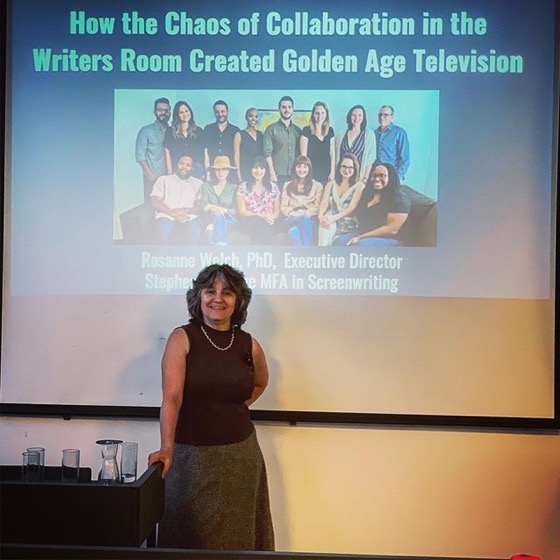
Screenwriting Research Network Conference, Porto, Portugal, All Sessions


Ready to present my talk yesterday at the Screenwriting Research Conference here in Porto, Portugal via Instagram

Follow me on Instagram


* A portion of each sale from Amazon.com directly supports our blogs
** Many of these books may be available from your local library. Check it out!

The Civil War On Film – 34 in a series – “…purports to be a history of the gangs of New York…”

The Civil War On Film - 34 in a series -

Judging the truth of the history portrayed on screen begins by judging the truth of the history portrayed in the original source material. While Asbury’s book is shelved with non-fiction and purports to be a history of the gangs of New York, the subtitle admits it is “An Informal History of the Underworld.” On top of that, unlike other films adapted from books, which work hard to remain loyal to the text, when Scorsese thought about making Gangs he admitted being more interested in being loyal to the town than its residents.

Movies profiled in this book:

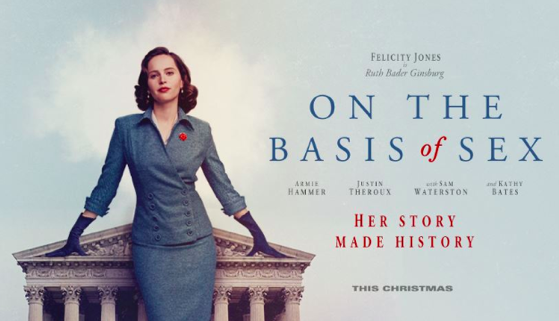
“On The Basis Of Sex” and Justice Ruth Bader Ginsberg’s Harvard Classmates

Working on a chapter about the film On the Basis of Sex which is a biopic based on the early life and career of Supreme Court associate Justice Ruth Bader Ginsburg I came across this podcast that researched the other 8 women who were part of her Harvard Law School class of 1956. 

If you’ve seen the film (and you should because it’s good!) or read much about the Justice you’ll have heard the story of how the Dean of the law school invited them along with some male students to his house for dinner.  Then he asked each of the women in the class to stand up and explain why she’s at Harvard, taking the place of a man. 

Ugh! 

We all know Ginsburg’s career was such a skyrocket that it put that jerk in his place – but then some journalists thought about researching those other 8 women to see how their careers went – and they started a podcast about the women’s lives. 

I love finds like this!

Read more about Justice Ruth Bader Ginsberg in the book series I am editing — Women Making History from ABC-CLIO.


Ruth Bader Ginsburg: A Life in American History (Women Making History) by Nancy Hendriks

Ruth Bader Ginsburg: A Life in American History explores Ginsburg’s path to holding the highest position in the judicial branch of U.S. government as a Supreme Court justice for almost three decades. Readers will learn about the choices, challenges, and triumphs that this remarkable American has lived through, and about the values that shape the United States.=

Ginsburg, sometimes referred to as The Notorious RBG or RBG was a professor of law, a member of the American Civil Liberties Union, an advocate for women’s rights, and more, before her tenure as Supreme Court justice. She has weighed in on decisions, such as Bush v. Gore (2000); King v. Burwell (2015); and Masterpiece Cakeshop v. Colorado Civil Rights Commission (2018), that continue to guide lawmaking and politics. Ginsburg’s crossover to stardom was unprecedented, though perhaps not surprising. Where some Americans see the Supreme Court as a decrepit institution, others see Ginsburg as an embodiment of the timeless principles on which America was founded.

“A Man Of Action Saving Liberty: A Novel Based On The Life Of Giuseppe Garibaldi” – 38 in a series

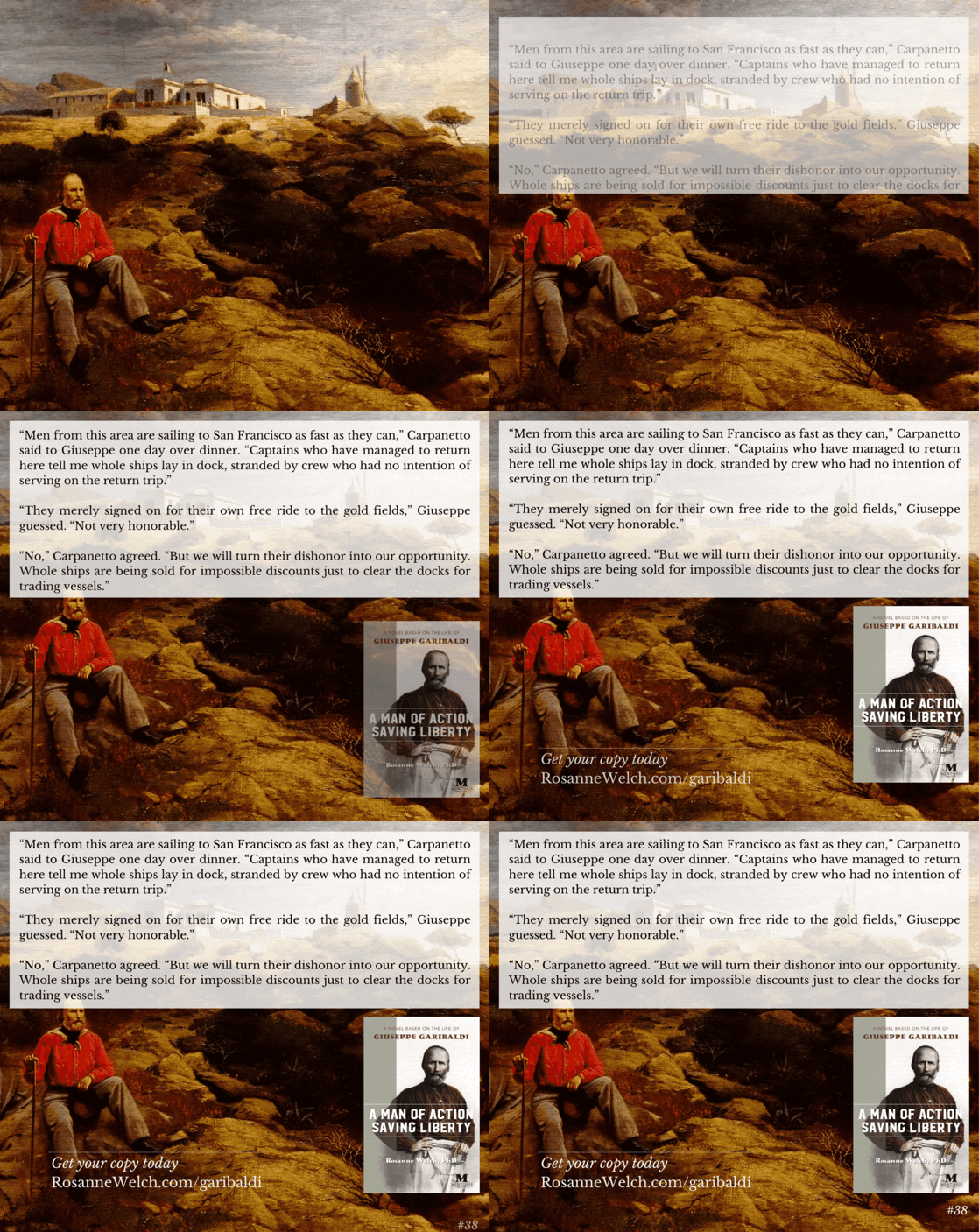
“Men from this area are sailing to San Francisco as fast as they can,” Carpanetto said to Giuseppe one day over dinner. “Captains who have managed to return here tell me whole ships lay in dock, stranded by crew who had no intention of serving on the return trip.”

 “They merely signed on for their own free ride to the gold fields,” Giuseppe guessed. “Not very honorable.”

“No,” Carpanetto agreed. “But we will turn their dishonor into our opportunity. Whole ships are being sold for impossible discounts just to clear the docks for trading vessels.”

Get your copy of A Man Of Action Saving Liberty Today!

The Civil War On Film – 33 in a series – “…the conflict that arose in Kansas in the seven years before the Civil War known as “Bleeding Kansas.”

The Civil War On Film - 33 in a series -

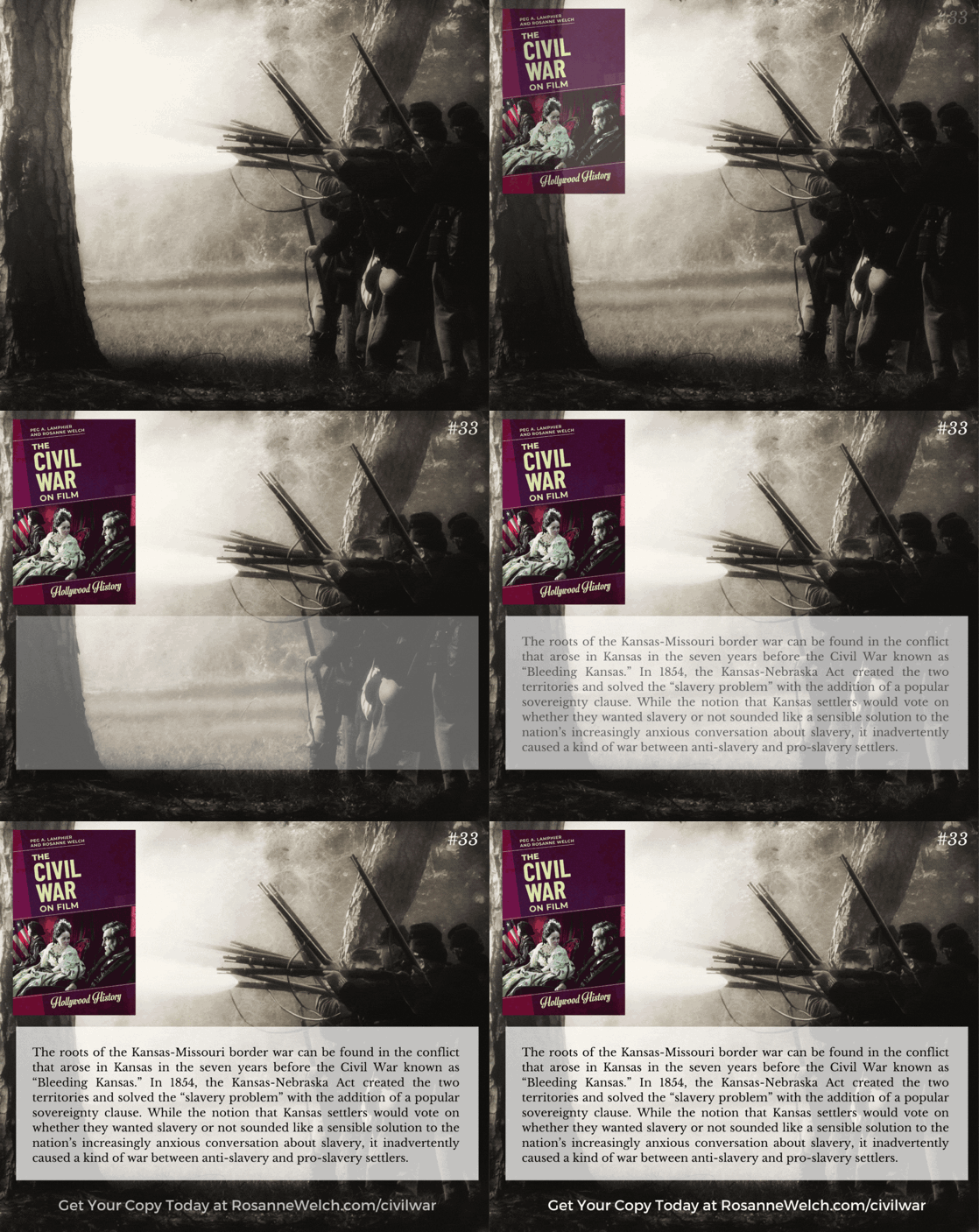
The roots of the Kansas-Missouri border war can be found in the conflict that arose in Kansas in the seven years before the Civil War known as “Bleeding Kansas.” In 1854, the Kansas-Nebraska Act created the two territories and solved the “slavery problem” with the addition of a popular sovereignty clause. While the notion that Kansas settlers would vote on whether they wanted slavery or not sounded like a sensible solution to the nation’s increasingly anxious conversation about slavery, it inadvertently caused a kind of war between anti-slavery and pro-slavery settlers.

Movies profiled in this book: