Ang Lee and writer James Schamus’s thesis for Ride with the Devil, suggests there was no right and wrong in the Civil War and that both sides were equally violent in their dealings with the other. While the movie is greatly esteemed by persons sympathetic with the Confederacy, viewers and movie critics were considerably less enthusiastic.
Subscribe to Rosanne’s Channel and receive notice of each new video!
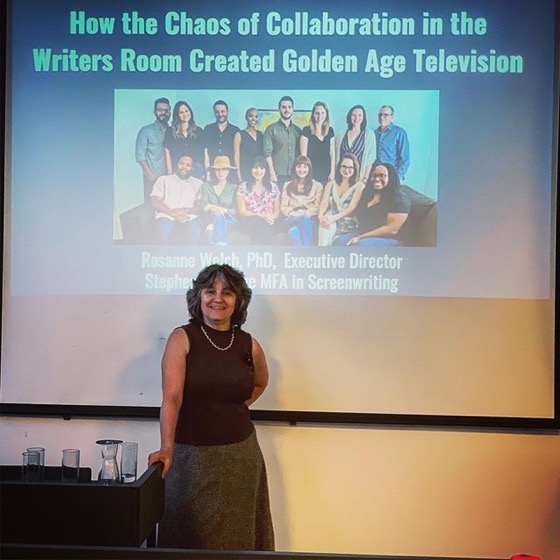
When the folks hosting the conference announced their theme as “Screen Narratives: Chaos and Order” the word ‘chaos’ immediately brought to mind writers rooms. I offered a quick history of writers rooms (the presentations are only 20 minutes long) and then quoted several current showrunners on how they compose their rooms and how they run them.
Transcript
And I think that’s where we started to learn that, particularly in television, you had to find people with a defined voice and that is something you could build a show around and so when I define voice everyone has a slightly different concept but to me, it’s a simple matter of your opinion and the style in which you deliver it and that tells us your different voice and I think some of the shows I’m going to mention — it’s very clear they have very unique voices and that’s where they come from. So we started to recognize that the idea of the creator and television was the writer and that person should run the entire show themselves and should begin to gather about them a group of people who could mimic their voice while still keeping their own. That was the difficult job of television which is also still a difficult thing to teach students to write a spec script that sounds like, but doesn’t obliterate, your own voice, and that’s what you’re trying to do in the room, which again, is more chaotic than I would say.
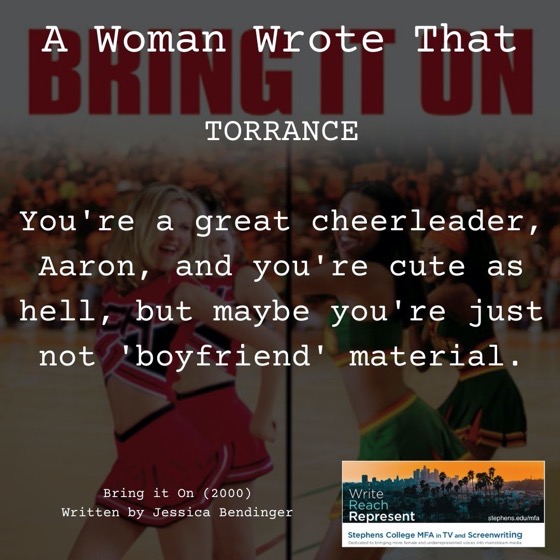
This new “A Woman Wrote That” post is an echo of the Writers Guild campaign of a few years ago (“A Writer Wrote That”) where they noted famous movie quotes and credited the screenwriter rather than the director. The difference here being that we will be posting lines from films written by female screenwriters. Feel free to share! — Rosanne
TORRANCE
You’re a great cheerleader, Aaron, and you’re cute as hell, but maybe you’re just not ‘boyfriend’ material.
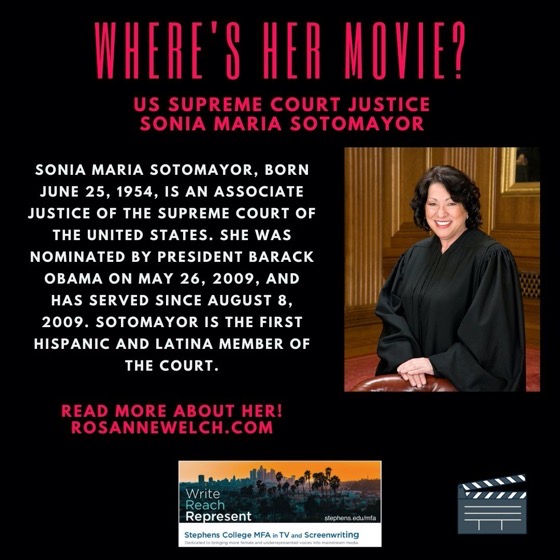
“Where’s HER Movie” posts will highlight interesting and accomplished women from a variety of professional backgrounds who deserve to have movies written about them as much as all the male scientists, authors, performers, and geniuses have had written about them across the over 100 years of film. This is our attempt to help write these women back into mainstream history. — Rosanne
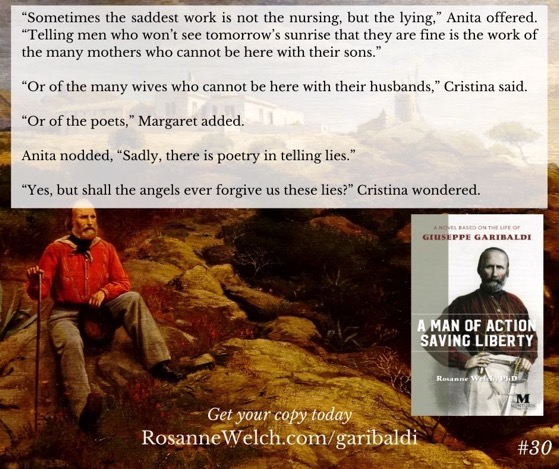
“Sometimes the saddest work is not the nursing, but the lying,” Anita offered. “Telling men who won’t see tomorrow’s sunrise that they are fine is the work of the many mothers who cannot be here with their sons.”
“Or of the many wives who cannot be here with their husbands,” Cristina said.
“Or of the poets,” Margaret added.
Anita nodded, “Sadly, there is poetry in telling lies.”
“Yes, but shall the angels ever forgive us these lies?” Cristina wondered.
Andersonville tells the story of Camp Sumter, better known as Andersonville Prison. Not surprisingly, few Civil War movies explore the prisoner of war experience, probably because the topic is so unremittingly unpleasant. Set in 1864, the film is grimly unpitying and while it contains historical inaccuracies, it gets closer to Civil War prison camp realities than any film before or after.
Subscribe to Rosanne’s Channel and receive notice of each new video!
When the folks hosting the conference announced their theme as “Screen Narratives: Chaos and Order” the word ‘chaos’ immediately brought to mind writers rooms. I offered a quick history of writers rooms (the presentations are only 20 minutes long) and then quoted several current showrunners on how they compose their rooms and how they run them.
Transcript
But one-hour dramas did not involve writer’s rooms in the beginning and I find that very fascinating because we rely on them now, but they did not in fact — they literally had writer pools and if you were running a show — so you were the creator of the show — you would walk down the hallway to the pool, of course, that’s the typing pool, and it was a bunch of guys not too many women involved at that time and you would say I need an episode of Columbo. Who’s free this week and that person would have to come up with an episode of Columbo. The NBC Mystery Movie was a perfect example of that because every Sunday there was a different one of these shows. They weren’t a weekly show and so you had some time to prepare it. So you’d walk down the street and say I don’t know which of these shows would we need this next week and that’s — so writer’s rooms took freelance ideas and you didn’t sit in the room and break the story together and that has been something that’s evolved over time I think is interesting. In this writer’s pool at Universal, which contributed to that show, were all these men who became the show runners of the second golden age of television and they all are men whose shows have run on television incessantly.
This new “A Woman Wrote That” post is an echo of the Writers Guild campaign of a few years ago (“A Writer Wrote That”) where they noted famous movie quotes and credited the screenwriter rather than the director. The difference here being that we will be posting lines from films written by female screenwriters. Feel free to share! — Rosanne
UNCLE ARTHUR
Do you want the long version or the short version? Keep in mind, the long version is in Aramaic.
Connections at conferences matter! Through the most recent SCMS, I met Vicki Callahan, whose film history focus right now is on Mabel Normand. When she learned I could put together a lecture on the importance of the female voice in the A Star is Born franchise she asked me to give that lecture to her master students.
It made for a great opportunity for me to hone the ideas I’m working on for a chapter on that franchise that I’m writing for a new book from Bloomsbury: The Bloomsbury Handbook Of International Screenplay Theory. It’s always nice when one piece of research can be purposed in other ways – and it’s always fun revisiting such a female-centric film franchise – one that drew the talents of such powerful performers as Janet Gaynor, Judy Garland, Barbara Streisand, and Lady Gaga.
“Where’s HER Movie” posts will highlight interesting and accomplished women from a variety of professional backgrounds who deserve to have movies written about them as much as all the male scientists, authors, performers, and geniuses have had written about them across the over 100 years of film. This is our attempt to help write these women back into mainstream history. — Rosanne

![07 The Writer’s Voice from How The Chaos Of Collaboration in the Writers Room Created Golden Age Television [Video]](https://rosannewelch.com/wp-content/uploads/2021/04/srn-porto-07-1.jpg)



![06 The Universal Studios Writers Pool from How The Chaos Of Collaboration in the Writers Room Created Golden Age Television [Video]](https://rosannewelch.com/wp-content/uploads/2021/03/srn-porto-06.jpg)

![Dr. Rosanne Welch Presents “Female Creatives & A Star Is Born” [Video]](https://rosannewelch.com/wp-content/uploads/2021/03/rmw-women-creatives-star-is-born-usc.jpg)