01 Introduction from “VISIBLE STARS: Women in Early TV” for the American Women Writers National Museum [Video]

01 Introduction from

Many thanks to Janice Law of the American Women Writers National Museum who invited me to give a short talk on The Women of Early TV.

I enjoyed sharing the names and careers of women like Peg Lynch, Gerturde Berg, Selma Diamond and D.C. Fontana to the members who gathered on Zoom last Wednesday morning. There are so many more I could have talked about whose names don’t appear in mainstream books about the history of television so we have to learn who they are and carry those names forward ourselves.  It’s one of the missions of the Stephens College MFA in TV and Screenwriting – and has been one of my missions all my life.

RMW Rosanne Signature for Web

Transcript:

Well good morning everybody. I am going to dive right in so that we have a chance to get started. So I’m going to share my screen and you’re going to be able to see some photographs of some of these most wonderful women who are part of early Hollywood and early television and to me, they’re the people that we’re here to talk about right? So one of the beautiful things we have to do is look at who came before us. I teach a class in tv and screenwriting and I want people to recognize the people on whose shoulders we stand. So today we’re going to talk about the women of early tv. There are many more women to love than just Lucy. She’s the only one we hear about. She’s done some good work and we want to talk about that but we want to speak to all these other women who are so important. A little background on me very quickly. I’m a television writer. I worked on these programs. Touched by an Angel. Beverly Hills 90210 and Picket Fences which was a marvelous show and I also did a little documentary work with ABC News Nightline. So very excited about that. I’m also very happy with the fact that these are books that I have written. Particularly this one is about women in early Hollywood screenwriters and that interests me very much. So of course this is also an Encyclopedia on Women in American History and the Arts. It’s a four-volume set we put out a couple of years ago and we won a couple of awards from National Library Associations so we’re happy about that. I’m also on the board — the editorial board — for the Journal of Screenwriting and Written By magazine which is the magazine of the Writers Guild where we interview certain tv writers every week and also movie writers and it is free online at writtenby.org, if you’re interested in reading about people in the arts these days in the media arts.

Many thanks to Janice Law of the American Women Writers National Museum who invited me to give a short talk on The Women of Early TV.

I enjoyed sharing the names and careers of women like Peg Lynch, Gerturde Berg, Selma Diamond and D.C. Fontana to the members who gathered on Zoom last Wednesday morning. There are so many more I could have talked about whose names don’t appear in mainstream books about the history of television so we have to learn who they are and carry those names forward ourselves. It’s one of the missions of the Stephens College MFA in TV and Screenwriting – and has been one of my missions all my life.

Watch this entire presentation


Women pioneers who created, produced or shepherded many of America’s most wildly popular, early television programs will be profiled by Dr. Rosanne Welch.

Get your copy today!

26 Controversy Scares Broadcasters from Worry and Wonder | The Courier Thirteen Podcast [Video]

Watch the entire presentation – Worry and Wonder | The Courier Thirteen Podcast | Episode # 29 here

26 Controversy Scares Broadcasters  from Worry and Wonder | The Courier Thirteen Podcast [Video]

Transcript:

Controversy scares broadcasters because it of course the word broad means they need the biggest audience possible because they’re selling advertising time and promising the biggest eyeballs on your ads. So if you do something controversial they’ll get less viewers and then the ad people will want to pay them less. So they have a bigger you know a bigger obligation to make the advertisers to not scare the audience away. Which is why you get stuff that’s much more progressive on cable and then eventually in streaming.

It’s always fun to sit down with students and share stories about entering the television industry and how things work at all stages and I had that opportunity the other day.

Daniela Torres, a just-graduated (Congratulations!) student of the Columbia College Semester in LA program asked me to guest on a podcast she had recently begun hosting with another college student she met during her internship (good example of networking in action!).

We could have talked all morning (the benefit of a 3 hour class session) but we held it to about an hour and fifteen minutes or so. Hopefully, along the way I answered some questions you might have about how the business works. So often it amounts to working hard at being a better writer and gathering a group of other talented, hard-working people around you so you can all rise together.

Dr. Rosanne Welch is a television writer with credits that include Beverly Hills 90210, Picket Fences, ABCNEWS: Nightline and Touched by an Angel. She also teaches Television Writing and the Art of Film at San Jose State University.

Rosanne discusses what made shows like Beverly Hills 90210 compelling, what to do and not to do when attempting to pitch a show to broadcast or streaming, what most young writers neglect in their writing process, and much more!

The Courier Thirteen Podcast is available on YouTube, Spotify, Apple Podcasts, SoundCloud, and Audible.

14 What Changed?…from “Female Creatives & A Star Is Born” [Video]

14 What Changed?...from

Transcript:

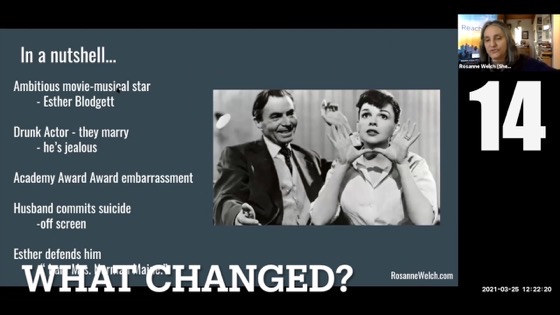
So let’s look at what changed. First, we’ve got to move her into it being a musical star because this is Judy Garland. She’s going to have to sing musical numbers in this particular remake. We’re still going to have our drunken actor and they’re going to marry and he’s going to be jealous. This is something that remains the same all the way until we get to Bradley Cooper and we’ll talk about why that changes. We’re going to have our Academy Award moment because musicals were things that earned Academy Awards back in the day of course. He’s going to commit suicide off-screen. He’s going to walk off into the ocean as the noble man that he is and she too will introduce herself as Mrs. Norman Maine. So these things remain exactly the same. When the Writer’s Guild arbitrates a script to decide who should get final credit, they look at all versions of a script. They have a blind group of writers who sign up to do this and they get the scripts –writer one, writer two, writer three. You don’t get any names and then you decide statistically how much of a percentage of this person’s original work made it to the end and that’s how they decide credit. So I am looking at this as if I’m arbitrating the various versions of this script to see how much credit Dorothy Parker still deserves. In this case, I think a lot right? They’re borrowing a lot of what she did.

Watch this entire presentation

Connections at conferences matter! Through the most recent SCMS, I met Vicki Callahan, whose film history focus right now is on Mabel Normand. When she learned I could put together a lecture on the importance of the female voice in the A Star is Born franchise she asked me to give that lecture to her master students.

It made for a great opportunity for me to hone the ideas I’m working on for a chapter on that franchise that I’m writing for a new book from Bloomsbury: The Bloomsbury Handbook Of International Screenplay Theory. It’s always nice when one piece of research can be purposed in other ways – and it’s always fun revisiting such a female-centric film franchise – one that drew the talents of such powerful performers as Janet Gaynor, Judy Garland, Barbara Streisand, and Lady Gaga.

Find out why in this lecture!

RMW Rosanne Signature for Web


13 1954 Credits…from “Female Creatives & A Star Is Born” [Video]

13 1954 Credits...from

Transcript:

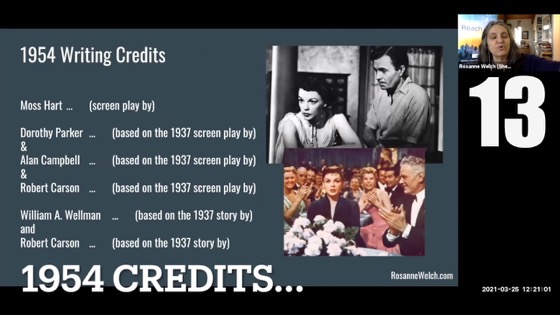
Where, first of all, let’s look at these credits. One of the things I want to make point of so here’s Moss Hart. He takes full credit for the screenplay but it is based on the one that Dorothy did with Alan and Robert right? So this is how our credits read properly. What’s interesting about this is he says when he’s asked during his rewrites about some things he did not change at all and he didn’t for this very reason. He felt they were perfect the way they were. They were perfect the way she wrote them. He could not top those lines. So the 1954 version is still an echo and a mimic of Dorothy Parker in my opinion based on Moss Hart’s confession. If you want to put it that way and Moss Hart if you’ve never read Act One, this is his autobiography of growing up poor in New York, working in some summer camps that are very much like dirty dancing summer camp, and eventually making it on Broadway. It’s quite a good book if you’re interested in that period. Of course, the joke is how much of it is true and how much did he elaborate on. We will never really know. There is then obviously a real biography of him if you are interested but here’s the man who’s rewriting this version of A Star Is Born, so I will say though it is written solely by a man, it is a man relying on and reusing the words of a woman’s. The female imprint is still highly there in this version.

Watch this entire presentation

Connections at conferences matter! Through the most recent SCMS, I met Vicki Callahan, whose film history focus right now is on Mabel Normand. When she learned I could put together a lecture on the importance of the female voice in the A Star is Born franchise she asked me to give that lecture to her master students.

It made for a great opportunity for me to hone the ideas I’m working on for a chapter on that franchise that I’m writing for a new book from Bloomsbury: The Bloomsbury Handbook Of International Screenplay Theory. It’s always nice when one piece of research can be purposed in other ways – and it’s always fun revisiting such a female-centric film franchise – one that drew the talents of such powerful performers as Janet Gaynor, Judy Garland, Barbara Streisand, and Lady Gaga.

Find out why in this lecture!

RMW Rosanne Signature for Web


25 More On Network Notes from Worry and Wonder | The Courier Thirteen Podcast [Video]

Watch the entire presentation – Worry and Wonder | The Courier Thirteen Podcast | Episode # 29 here

25 More On Network Notes from Worry and Wonder | The Courier Thirteen Podcast [Video]

Transcript:

The idea was that the little boy would want to be popular in school and he would stumble on some internet pornography and print it and hand it around at school so the bigger boys would think he was cool and then, of course, he would have to pay the price for that and get suspended for a couple of days. His parent would be upset. We’d have to talk about the problem with pornography and what it does to the way people believe – think about women and all of that. And the network came back and said they thought it would be more engaging if the little boy didn’t copy what he found on the internet, but he created his own and I about wanted to go kill myself because I did not believe in that family — that boy — whatever — had that inclination, but I wasn’t running the show. I was just selling an episode then and the Executive Producer, Jeff Melvoin, did argue and argue, and that one we didn’t win. So, in that episode, the boy actually takes a picture of someone who’s naked on the Internet and puts his teacher’s face on it and it’s like Oooo, look he photoshopped it before there even Photoshop, I think, and I hated that so much, but I didn’t have any control to change it, so you just had to got with it and make sure that the ending — there was a big discussion about how and why that was wrong and how depressed the father was that his son would behave in that fashion and it really showed that there wasn’t anything cool or wonderful about what he had done. So we had to sort of overwrite the ending to make up for a beginning that we didn’t appreciate, but you know, it was their — they had enough — it was only the 3rd season of that show so they still had a chance to say no and they often did.

It’s always fun to sit down with students and share stories about entering the television industry and how things work at all stages and I had that opportunity the other day.

Daniela Torres, a just-graduated (Congratulations!) student of the Columbia College Semester in LA program asked me to guest on a podcast she had recently begun hosting with another college student she met during her internship (good example of networking in action!).

We could have talked all morning (the benefit of a 3 hour class session) but we held it to about an hour and fifteen minutes or so. Hopefully, along the way I answered some questions you might have about how the business works. So often it amounts to working hard at being a better writer and gathering a group of other talented, hard-working people around you so you can all rise together.

Dr. Rosanne Welch is a television writer with credits that include Beverly Hills 90210, Picket Fences, ABCNEWS: Nightline and Touched by an Angel. She also teaches Television Writing and the Art of Film at San Jose State University.

Rosanne discusses what made shows like Beverly Hills 90210 compelling, what to do and not to do when attempting to pitch a show to broadcast or streaming, what most young writers neglect in their writing process, and much more!

The Courier Thirteen Podcast is available on YouTube, Spotify, Apple Podcasts, SoundCloud, and Audible.

Alice Burton Russell Micheaux: “Breaking Barriers on Two Fronts” — Dr. Rosanne Welch, Script magazine, November 2021

Alice Burton Russell Micheaux: “Breaking Barriers on Two Fronts” -- Dr. Rosanne Welch, Script magazine, November 2021


Film history texts often neglect female screenwriters and completely omit the names of women of color such as Alice Burton Russell Micheaux, wife of filmmaker Oscar Micheaux. Script contributor Dr. Rosanne Welch rightly so celebrates the female screenwriters who came before us with attainable insight about filmmaker Alice Burton Russell Micheaux.

Read Alice Burton Russell Micheaux: “Breaking Barriers on Two Fronts” — Dr. Rosanne Welch, Script magazine, November 2021


Read about more women from early Hollywood


12 Here Comes Judy…from “Female Creatives & A Star Is Born” [Video]

12 Here Comes Judy...from

Transcript:

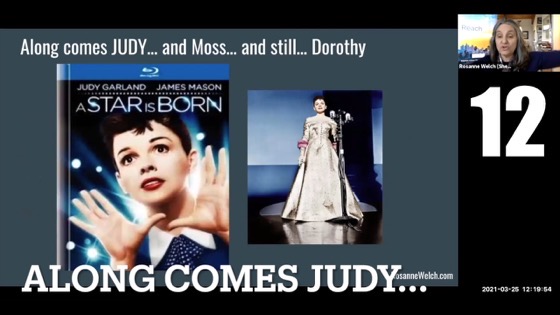
1937. Huge Movie. It winds awards. It has everyone paying attention. Janet Gaynor is a very important actress. So, it’s a big deal. 1954 comes around. There is a movie we can remake and remember that in the era when they were remaking these films, there were no DVDs. There was no streaming. The film was done after it played in a theater for 2 weeks or 10 weeks — however successful it was. You would never see that film again. 1954. There’s no TV reruns of that film. That’s it. If your mother saw it in ’37, that’s it. Nobody has seen it since then. So remaking a movie made some sense. So, we’re going to come into this with a guy named Moss Hart. He’s a very famous Broadway playwright. He worked with George S. Kaufman, but he also worked on his own and he is invited to come and re-do this for Judy Garland as the star and it’s going to be a comeback film. She’s had trouble (Oh no) with drugs and alcohol AND it’s affected her career. So she needs a big vehicle and this is recognized as a showpiece for a female performer, but she’s Judy Garland, so we’ve got to change something.

Watch this entire presentation

Connections at conferences matter! Through the most recent SCMS, I met Vicki Callahan, whose film history focus right now is on Mabel Normand. When she learned I could put together a lecture on the importance of the female voice in the A Star is Born franchise she asked me to give that lecture to her master students.

It made for a great opportunity for me to hone the ideas I’m working on for a chapter on that franchise that I’m writing for a new book from Bloomsbury: The Bloomsbury Handbook Of International Screenplay Theory. It’s always nice when one piece of research can be purposed in other ways – and it’s always fun revisiting such a female-centric film franchise – one that drew the talents of such powerful performers as Janet Gaynor, Judy Garland, Barbara Streisand, and Lady Gaga.

Find out why in this lecture!

RMW Rosanne Signature for Web


24 Network Notes from Worry and Wonder | The Courier Thirteen Podcast [Video]

Watch the entire presentation – Worry and Wonder | The Courier Thirteen Podcast | Episode # 29 here


24 Network Notes from Worry and Wonder | The Courier Thirteen Podcast [Video]

Transcript:

Host: Was there a specific instance where you had written an episode of a television show and the networking was like, we don’t like this. We don’t like this. We don’t want this and you had to be like, No and how did you do — how did you do that? How did you go about that?

Rosanne: That actually happened in my actually my second episode was a show called Picket Fences which was by David E Kelly who’d come off of LA Law and he’s done a million things since then. Quite brilliant. He wasn’t there anymore. He left the show to another producer named Jeff Melvoin who’s quite another wonderful producer in town — writer/producer — and he’s got Emmys and whatnot is brilliant, but came in to do that and it was a show about small-town America. Dad was a cop — sheriff — and mom was a doctor. So you kind of had the mix of cop and doctor shows all in one. You could decide what the episode would be and I thought that was brilliant. They had three kids right they lived in a small town and we had done — I was still a partner then — we did an episode where the younger boy, who’s about 10-ish or 11, wanted to be popular in school and we were looking at the internet and wanting to say the good and the bad. So overarching dramatic question is the internet a good influence or bad influence and of course, there’s much good about it. You can watch all kinds of educational things. You can be exposed to all kinds of things from the past that we didn’t know about. We can learn so much more about history, other countries, like I just said about Netflix shows all of that, but we wanted to balance that with okay what are the problems?

It’s always fun to sit down with students and share stories about entering the television industry and how things work at all stages and I had that opportunity the other day.

Daniela Torres, a just-graduated (Congratulations!) student of the Columbia College Semester in LA program asked me to guest on a podcast she had recently begun hosting with another college student she met during her internship (good example of networking in action!).

We could have talked all morning (the benefit of a 3 hour class session) but we held it to about an hour and fifteen minutes or so. Hopefully, along the way I answered some questions you might have about how the business works. So often it amounts to working hard at being a better writer and gathering a group of other talented, hard-working people around you so you can all rise together.

Dr. Rosanne Welch is a television writer with credits that include Beverly Hills 90210, Picket Fences, ABCNEWS: Nightline and Touched by an Angel. She also teaches Television Writing and the Art of Film at San Jose State University.

Rosanne discusses what made shows like Beverly Hills 90210 compelling, what to do and not to do when attempting to pitch a show to broadcast or streaming, what most young writers neglect in their writing process, and much more!

The Courier Thirteen Podcast is available on YouTube, Spotify, Apple Podcasts, SoundCloud, and Audible.

11 More on Dorothy Parker’s Voice from “Female Creatives & A Star Is Born” [Video]

11 More on Dorothy Parker's Voice from


Transcript:

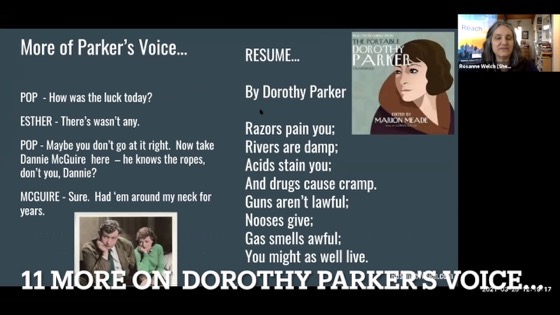
I think you’ll notice also in the lines here, this is a great bit —

“How’s your luck?

There wasn’t any.

Maybe you don’t do it right. No, take Danny McGuire here. He knows the ropes, don’t you, Danny?

Sure. Had ’em around my neck for years.”

She’s always thinking about suicide. Sadly. She’s always thinking about ways to kill yourself and this is best evidenced in this poem that she’s famous for. I don’t know if you’ve ever seen it before. You’re probably reading it to yourself right now, so I shall not read it out loud but it is quite brilliant, and look what she’s focusing on and that’s her “resume.” Think about the title and think about the words there and how they come across inside A Star Is Born.”

Watch this entire presentation

Connections at conferences matter! Through the most recent SCMS, I met Vicki Callahan, whose film history focus right now is on Mabel Normand. When she learned I could put together a lecture on the importance of the female voice in the A Star is Born franchise she asked me to give that lecture to her master students.

It made for a great opportunity for me to hone the ideas I’m working on for a chapter on that franchise that I’m writing for a new book from Bloomsbury: The Bloomsbury Handbook Of International Screenplay Theory. It’s always nice when one piece of research can be purposed in other ways – and it’s always fun revisiting such a female-centric film franchise – one that drew the talents of such powerful performers as Janet Gaynor, Judy Garland, Barbara Streisand, and Lady Gaga.

Find out why in this lecture!

RMW Rosanne Signature for Web


23 Production Company Influence from Worry and Wonder | The Courier Thirteen Podcast [Video]

Watch the entire presentation – Worry and Wonder | The Courier Thirteen Podcast | Episode # 29 here

23 Production Company Influence from Worry and Wonder | The Courier Thirteen Podcast [Video]

Transcript:

Host: Do most production companies, most executives, once the pilot is out there and people respond to it, do they normally just kind of back up after that. They’re like okay it seems like you’ve got a show on your hands. We’ll let you do it the way you want to do it.

Rosanne: It depends on your relationship with the network. Obviously, the kinds of people like Shonda Rhimes, as I mentioned, someone who’s got a track record like that can say I know what I’m doing leave me alone. Netflix basically promises that. That’s how they wooed people away from broadcast and cable. They’re like we promise not to give you notes. Just whatever you like to do, you go do it, and yay for you, right? So Ryan Murphy’s doing Pose and things like that. They’re not going to give a ton of notes. If you’re new, they might still because they’re trying to form what is going to be a sort of a Netflix brand. If you’re new in the network world or the cable world yeah you’ll get that kind of stuff for a little bit until you have a track record and can say I don’t — or you’ll still get notes but you have much more ability to say no can’t do that changes the trajectory of the show or that’s wrong for my character. Whatever those things are and that’s part of what I was saying about them earlier, you learn how to manage notes. You learn how to say all right I’ll give you this but I’m keeping that. Or we going to do this because we want this kind of an episode and if you don’t like it that’s too bad. Next week we’ll do this kind of episode which will you know smooth down some feathers if people have a problem with whatever storyline we gave last week. So your ability to be more autonomous grows as your career grows.

It’s always fun to sit down with students and share stories about entering the television industry and how things work at all stages and I had that opportunity the other day.

Daniela Torres, a just-graduated (Congratulations!) student of the Columbia College Semester in LA program asked me to guest on a podcast she had recently begun hosting with another college student she met during her internship (good example of networking in action!).

We could have talked all morning (the benefit of a 3 hour class session) but we held it to about an hour and fifteen minutes or so. Hopefully, along the way I answered some questions you might have about how the business works. So often it amounts to working hard at being a better writer and gathering a group of other talented, hard-working people around you so you can all rise together.

Dr. Rosanne Welch is a television writer with credits that include Beverly Hills 90210, Picket Fences, ABCNEWS: Nightline and Touched by an Angel. She also teaches Television Writing and the Art of Film at San Jose State University.

Rosanne discusses what made shows like Beverly Hills 90210 compelling, what to do and not to do when attempting to pitch a show to broadcast or streaming, what most young writers neglect in their writing process, and much more!

The Courier Thirteen Podcast is available on YouTube, Spotify, Apple Podcasts, SoundCloud, and Audible.