03 Inside The Writer’s Room Part 2 from Worry and Wonder | The Courier Thirteen Podcast | Episode # 29 [Video]

Watch the entire presentation – Worry and Wonder | The Courier Thirteen Podcast | Episode # 29 here

03 Inside The Writer's Room Part 2 from Worry and Wonder | The Courier Thirteen Podcast | Episode # 29 [Video]

Transcript:

The best thing I learned was that everybody has their own different way. You can’t try and copy somebody else or it’s just like a bad tv show that’s a rip-off of a ripoff of a ripoff. You know it and it’s very doesn’t have any emotion or passion to it. So it was really important to learn that you’ve got to do it your way and you’ve got to get better at it. You can’t be that shy person in the corner waiting for someone to offer you a turn that’s never going to happen because a room full of writers is a room full of performers and they’re all wanting to tell you their story. So they’re not going to turn around and say and what do you think about that? So you have to be comfortable doing that. So it was a really good lesson. I really say of course that is the jumping-off job for television writers. You need to get a job as an assistant because you need to study that little world before you dive into it because then you won’t know the people management part of it. You might be a really good writer — and that happens to a lot of people — but if you can’t manage the people aspect, you’re not going to be successful in the writer’s room.

Dr. Rosanne Welch is a television writer with credits that include Beverly Hills 90210, Picket Fences, ABCNEWS: Nightline and Touched by an Angel. She also teaches Television Writing and the Art of Film at San Jose State University.

Rosanne discusses what made shows like Beverly Hills 90210 compelling, what to do and not to do when attempting to pitch a show to broadcast or streaming, what most young writers neglect in their writing process, and much more!

The Courier Thirteen Podcast is available on YouTube, Spotify, Apple Podcasts, SoundCloud, and Audible.

29 Write What (Emotions) You Know from There And Back Again: Writing and Developing for American TV [Video]

29 Write What (Emotions) You Know from There And Back Again: Writing and Developing for American TV [Video]

Thanks to the gracious invitation from my Screenwriting Research Network colleague Paolo Russo – and a grant he was able to procure (and in the before-Covid time) I was able to spend a week at Oxford Brookes University working with the screenwriting masters students in Paolo’s course. At the culmination of the week, I gave this lecture on how writers rooms worked in the States.

Transcript:

And I think that writing what you know emotionally is an important thing to think about because you have to be comfortable doing that to be a writer. Tennessee Williams, who is a famous American playwright, once said that writers write from the first — the emotions of the first six years of their lives. Which I kind of thought was like, how do you make that up and then I look back at a bunch of scripts I’ve written in my life and I have this recurrent theme which is telling men that they should be good fathers — that raising — that having a child doesn’t make you a man — raising a child makes you a man. I’ve used that line several times accidentally in different scripts. My dad left when I was six. So either Tennessee Williams was right or that’s a nice coincidence. I don’t know but that’s an important thing to remember. You don’t just have to write the history of the life you’ve led. It’s the history of the emotions you’ve lived. That can bring you anywhere right because JK Rowling didn’t go to Hogwarts. She doesn’t do magic but she understood being lonely as a child right.

Watch this entire presentation

Subscribe to Rosanne’s Channel and receive notice of each new video!


* A portion of each sale from Amazon.com directly supports our blogs
** Many of these books may be available from your local library. Check it out!
† Available from the LA Public Library

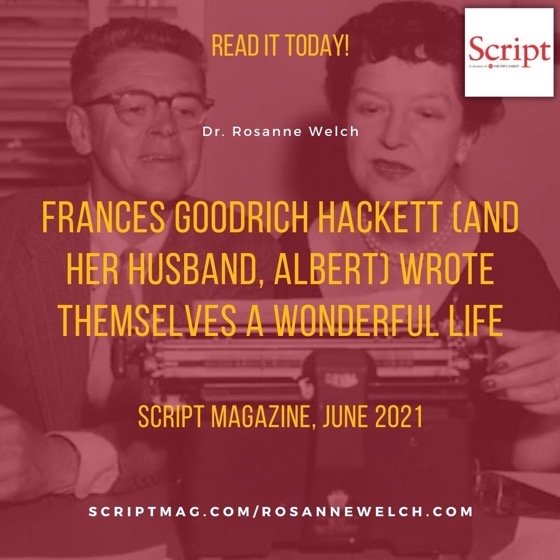
Frances Goodrich Hackett (and Her Husband, Albert) Wrote Themselves a Wonderful Life, Dr. Rosanne Welch, Script magazine, June 2021

Frances Goodrich Hackett (and Her Husband, Albert) Wrote Themselves a Wonderful Life, Dr. Rosanne Welch, Script magazine, June 2021

You have watched countless films written or adapted by Frances Goodrich Hackett. She has four Academy Award nominations for screenplays AND a Pulitzer Prize. Yet I bet you didn’t know her name until now. True to the title of one of her most enduring creations Frances had A Wonderful Life. Yep, she (and her writing partner and husband Albert Hackett) developed that beloved film from the bare bones of a postcard.

Though she was born in 1890, Goodrich found herself in an atypical family — one that accepted the idea of the theatre as a career — and she lived an atypical life for a woman of that era. Goodrich married three times (with the third to Albert being the charm that lasted over 50 years). When Goodrich showed an interest in the stage after her graduation from Vassar in 1912, her father arranged for her to join the Northampton Players stock company in Massachusetts. There her performances convinced her father that she should move to New York where she quickly earned bit parts on the Broadway stage.

Eventually, she started writing plays and asked a fellow actor, ten years her junior to read her script, give her notes, and help her on the rewrite. The play was Up Pops the Devil and the younger actor was Albert. When Metro-Goldwyn-Mayer studios offered the Hacketts a six-month writing contract at $750 per week in the midst of the Great Depression, they jumped on the steady money and made the move to Hollywood.

Like Wonderful Life the other stories the Hacketts brought to American films have made an indelible mark on our culture. They earned an Academy Award nomination for their adaption of the Edward Streeter novel Father of the Bride which became so entrenched in American memory it — and the sequel they also wrote– were remade in the 1990s for Steve Martin and Diane Keaton to headline (screenplay by then-also-married-screenwriting-couple Nancy Meyers & Charles Shyer). Few high school or college students graduate without once watching the film the Hacketts adapted from their own Broadway play, The Diary of Anne Frank (for which they earned a Pulitzer).

When Frances and Albert approached their first adaption – bringing The Thin Man (written by Dashiell Hammett) to the screen in 1934 — Nick and Nora Charles became synonymous with the emerging ideas of equality in modern marriage. Film studies have long held that the detective couple were patterned after Hammett and his companion, playwright Lillian Hellman. According to The Real Nick and Nora By Frances Goodrich & Albert Hackett, written by their nephew David L. Goodrich the relationship of Nick and Nora as it appears on film is in fact more closely connected to the relationship of the Hacketts.

Their marriage made their written work deeper and more sophisticated and whose shared work lives made the marriage stronger and more capable of lasting fifty-three years (ending only in Goodrich’s death in 1984.) In fact, as Nick and Nora are often referred to as the screen’s most beloved couple, Frances Goodrich Hackett and her husband Albert were often described as the “most beloved couple in Hollywood”.

Read Frances Goodrich Hackett (and Her Husband, Albert) Wrote Themselves a Wonderful Life on the Script web site


Read about more women from early Hollywood


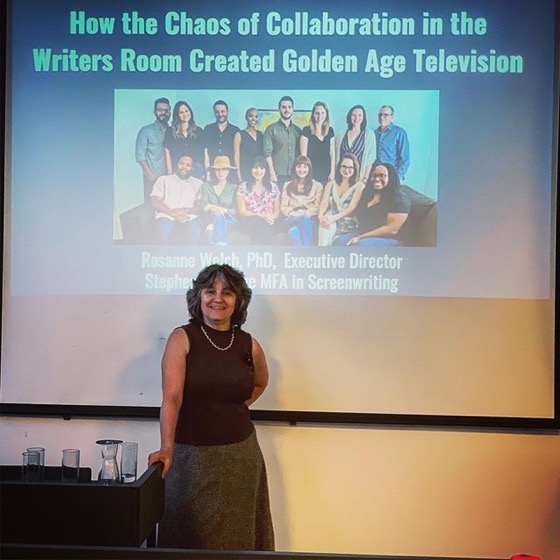
16 Vida from How The Chaos Of Collaboration in the Writers Room Created Golden Age Television [Video]

With the full recording of “How The Chaos Of Collaboration in the Writers Room Created Golden Age Television”

16 Vida  from How The Chaos Of Collaboration in the Writers Room Created Golden Age Television [Video]


Subscribe to Rosanne’s Channel and receive notice of each new video!


When the folks hosting the conference announced their theme as “Screen Narratives: Chaos and Order” the word ‘chaos’ immediately brought to mind writers rooms. I offered a quick history of writers rooms (the presentations are only 20 minutes long) and then quoted several current showrunners on how they compose their rooms and how they run them.

Transcript

In the case of this show on Starz, Vida, it’s the story of three LatinX women in Los Angeles who had moved away but come home when their mother dies and they discover that they’ve inherited a bar and the bigger discovery is that they’ve co-inherited it with their mother’s lesbian lover. So, now they’ve learned their mother’s a lesbian and they own a bar and they’re living in a part of LA that is going under gentrification. The entire show is staffed by female LatinX writers and so having a room that is entirely inclusive of the people on the show has been very special to them. Whether or not they are missing other perspectives, I can’t say, but that’s an experience that’s making it an open place for them to tell their stories, which is very important. Queen Sugar is a director-led writer’s room. Ava Devernay, who’s done several films, she now ran the show, she created it and she brought in a team of writers who are in charge. So now she’s — everything comes from the visual with her and you have to start with the visual when you tell a story. She has hired someone else to run the room, but they’re thinking of her desire as they do it. So that’s important.

For more information on the Screenwriting Research Network, visit

Screenwriting Research Network Conference, Porto, Portugal, All Sessions


Ready to present my talk yesterday at the Screenwriting Research Conference here in Porto, Portugal via Instagram

Follow me on Instagram


* A portion of each sale from Amazon.com directly supports our blogs
** Many of these books may be available from your local library. Check it out!

02 Inside The Writer’s Room from Worry and Wonder | The Courier Thirteen Podcast | Episode # 29 [Video]

Watch the entire presentation – Worry and Wonder | The Courier Thirteen Podcast | Episode # 29 here

02 Inside The Writer's Room from Worry and Wonder | The Courier Thirteen Podcast | Episode # 29 [Video]

Transcript:

I did. I did live in several writer’s rooms both as an assistant before I was a full-time writer and then as a writer, so i saw it in both ways through both perspectives. How are those perspectives different? When you’re an assistant, of course, you’re very wrapped up in I’ve got to get down everything they’re saying and make sure we know who told the funny joke or whose idea was the one we went forward with and you’re very focused but you’re also listening to how they banter ideas about and who gets paid attention to and how you learn how to run a room and it doesn’t just mean when you become the show running you’re going to run the room but when you’re pitching an idea, you are truly performing and making sure the other people in the room are focusing in on you. So I got to watch different people do that in their own different way.

Dr. Rosanne Welch is a television writer with credits that include Beverly Hills 90210, Picket Fences, ABCNEWS: Nightline and Touched by an Angel. She also teaches Television Writing and the Art of Film at San Jose State University.

Rosanne discusses what made shows like Beverly Hills 90210 compelling, what to do and not to do when attempting to pitch a show to broadcast or streaming, what most young writers neglect in their writing process, and much more!

The Courier Thirteen Podcast is available on YouTube, Spotify, Apple Podcasts, SoundCloud, and Audible.

28 Bruce Miller from There And Back Again: Writing and Developing for American TV [Video]

28 Bruce Miller from There And Back Again: Writing and Developing for American TV [Video]

Thanks to the gracious invitation from my Screenwriting Research Network colleague Paolo Russo – and a grant he was able to procure (and in the before-Covid time) I was able to spend a week at Oxford Brookes University working with the screenwriting masters students in Paolo’s course. At the culmination of the week, I gave this lecture on how writers rooms worked in the States.

Transcript:

Bruce Miller. He’s running The Handmaid’s Tale and there’s a whole lot of questions about that. He’s a guy and he’s running the handmaid’s tale, but he had the best take on the story. One of the things people will tell you in writing is to write what you know and you think that means write the experiences you’ve had but you can’t just write that or you’d be done right? So that’s where research comes in. So what do you actually know? What you know are the emotions you’ve had in your life. That’s what you know and anyone can recognize emotions of abandonment and fear and loneliness and all those things and bruce miller happened to come up with the best version of a pilot based on this novel of all the other people that they brought in.

Watch this entire presentation

Subscribe to Rosanne’s Channel and receive notice of each new video!


* A portion of each sale from Amazon.com directly supports our blogs
** Many of these books may be available from your local library. Check it out!
† Available from the LA Public Library

A Woman Wrote That – 30 in a series – Sleepless in Seattle (1993)

This new “A Woman Wrote That” post is an echo of the Writers Guild campaign of a few years ago (“A Writer Wrote That”) where they noted famous movie quotes and credited the screenwriter rather than the director.  The difference here being that we will be posting lines from films written by female screenwriters.  Feel free to share! — Rosanne 

“Destiny is something that we’ve invented because we can’t stand the fact that everything that happens is accidental.”

ANNIE

“Destiny is something that we’ve invented because we can’t stand the fact that everything that happens is accidental.”

15 The Operation of a Writer’s Room Part 2 from How The Chaos Of Collaboration in the Writers Room Created Golden Age Television [Video]

With the full recording of “How The Chaos Of Collaboration in the Writers Room Created Golden Age Television”

15 The Operation of a Writer's Room Part 2 from How The Chaos Of Collaboration in the Writers Room Created Golden Age Television [Video]

Subscribe to Rosanne’s Channel and receive notice of each new video!


When the folks hosting the conference announced their theme as “Screen Narratives: Chaos and Order” the word ‘chaos’ immediately brought to mind writers rooms. I offered a quick history of writers rooms (the presentations are only 20 minutes long) and then quoted several current showrunners on how they compose their rooms and how they run them.

Transcript

…and she tells a lovely story about one scene in which she had two — this is, of course, about the pre— the days of the Czar — and so you have lovely rich people fencing. Two lovely young men having a fencing match — a practice — and at the end of it they take off their attire and they put on their nice shirts with the lace and they walk away. And the men in her writing room — the Russian men — said “well, the scene is over when we know who won the match,” and she said “No, this is a soap opera. The scene is over when the women see their chests.” So, she was teaching them what you need inside a soap opera. So they wanted a teaching writer’s room and that’s what she was able to provide.

For more information on the Screenwriting Research Network, visit

Screenwriting Research Network Conference, Porto, Portugal, All Sessions


Ready to present my talk yesterday at the Screenwriting Research Conference here in Porto, Portugal via Instagram

Follow me on Instagram


* A portion of each sale from Amazon.com directly supports our blogs
** Many of these books may be available from your local library. Check it out!

01 On Giving Notes from Worry and Wonder | The Courier Thirteen Podcast | Episode # 29 [Video]

Watch the entire presentation – Worry and Wonder | The Courier Thirteen Podcast | Episode # 29 here

01 On Giving Notes from Worry and Wonder | The Courier Thirteen Podcast | Episode # 29 [Video]

Transcript:

I always tell people you get hired to write on a television show. Look at them. They have eight episodes now or 12 maybe. You’re gonna write one and you’re going to have to give good notes on the other 10 or 11 for people who want you to stick around. It’s your job to make their work better so the show doesn’t get canceled and you don’t keep your job. So notes are one of the most important things to understand how to do.

Dr. Rosanne Welch is a television writer with credits that include Beverly Hills 90210, Picket Fences, ABCNEWS: Nightline and Touched by an Angel. She also teaches Television Writing and the Art of Film at San Jose State University.

Rosanne discusses what made shows like Beverly Hills 90210 compelling, what to do and not to do when attempting to pitch a show to broadcast or streaming, what most young writers neglect in their writing process, and much more!

The Courier Thirteen Podcast is available on YouTube, Spotify, Apple Podcasts, SoundCloud, and Audible.

On Screenwriting: The Mary Tyler Moore Show, Title IV, and Today [Essay]

Working on this chapter about how the life of Ruth Bader Ginsburg was adapted for the screen in On the Basis of Sex, I was reminded of the interview scene in the pilot of The Mary Tyler Moore Show where Lou Grant asks her if she’s married and what religion she is.

On Screenwriting: The Mary Tyler Moore Show, Title IV, and Today [Essay]

In 1970 those questions were illegal thanks to Title IV of the Civil Rights Act of 1964.  But RBG had graduated in 1959 so the Act had not been around to help her.  She was turned down because she was a woman and because she was Jewish – despite achievements like graduating first in her class and the distinction of being the first woman to work on two major law reviews: the Harvard Law Review and Columbia Law Review.

Then I did some searching on the MTM script and found this article about how, though the scene was written in 1970 by James Brooks and Allan Burns, it is still relevant today.  Fascinating statistics between now and then including the fact that by 2017 in 38 percent of heterosexual marriages, women outearn their husbands.

3 ways ‘The Mary Tyler Moore Show’ pilot is still relevant today from the Washington Post

After Mary Tyler Moore’s death Wednesday, I watched the pilot episode of “The Mary Tyler Moore Show.” Though the show was revolutionary for its time for its portrayal of a single woman, working in journalism and living alone — I didn’t expect it to hold up all that well. Forty-seven years after the pilot aired, there are parts that are certainly retro. Louis “Lou” Grant (Edward Asner), for example, flat-out tells Mary Richards (Mary Tyler Moore) during a job interview: “I figured I’d hire a man for it, but we can talk about it.” But there’s a lot in that first episode that’s still relevant for single women today.

Read 3 ways ‘The Mary Tyler Moore Show’ pilot is still relevant today

And watch the scene if you don’t know it…