Drs. Rosanne Welch and Sarah Clark discuss The Monkees “Monkees A La Carte” episode on the Zilch Podcast’s Monkees 101 Series [Audio]

It’s time for another Monkees 101, co-hosted by myself and Dr. Sarah Clark on the Zilch podcast. This time we discuss and debate “Monkees A La Carte” where the show spoofs all the classic gangster characters.  I always enjoy chatting with Dr. Clark since she’s the Monkees music uber fan to match my TV show uber fan-ness – all with a dash of the kind of research we both do in our day gigs as professors!

RMW Rosanne Signature for Web

Drs. Rosanne Welch and Sarah Clark discuss The Monkees “Monkees A La Carte” episode on the Zilch Podcast's Monkees 101 Series [Audio]

Zilch & The PTFB Team, Sarah Clark, and Tim Powers are co-hosting a Stranger Things Have Happened Zoom Listening Party on FEBRUARY 13 AT 4:00 Eastern, featuring appearances by Glenn Gretlund, Mark Kleiner, James Lee Stanley, and others!

Register Here

After Tim and Sarah plug the listening party (and get a little silly), Sarah and Rosanne discuss “Monkees a la Carte, which aired November 21, 1966. “A gangster has taken over the boys’ favorite Italian restaurant, so they disguise themselves as The Purple Flower Gang.”

Listen Now

From The Journal Of Screenwriting V4 Issue 1: Communication and the various voices of the screenplay text by Ann Igelström

Highlighting the articles in the past editions of the Journal of Screenwriting, of which I am the Book Reviews Editor. Hopefully these abstracts will entice you to did a little deeper into the history and future of screenwriting. — Rosanne


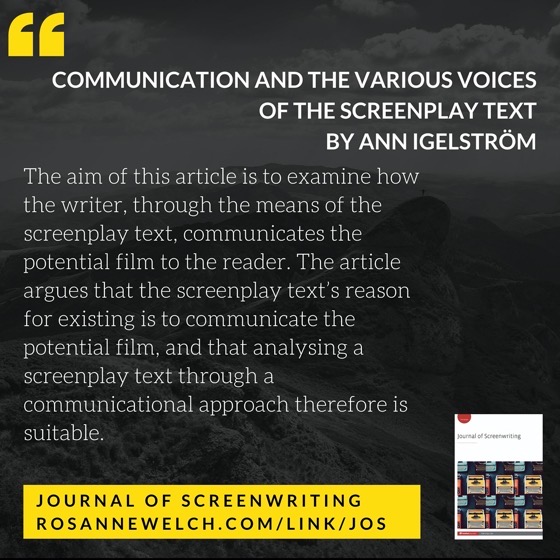
Communication and the various voices of the screenplay text by Ann Igelström

The aim of this article is to examine how the writer, through the means of the screenplay text, communicates the potential film to the reader. The article argues that the screenplay text’s reason for existing is to communicate the potential film, and that analysing a screenplay text through a communicational approach therefore is suitable. The author will ask what type of information is communicated, who it is that communicates and how the communication appears in the text. The article will propose a model that displays the different narrating voices that can be found in screenplay texts, and a set terminology for the narrating voices that clearly position them in relation to the text and the information they provide will be proposed. The examination of extracts from published screenplays further enables the author to identify how the use of the different narrating voices situates the reader at a certain distance from the story.
From The Journal Of Screenwriting V4 Issue 1: Communication and the various voices of the screenplay text by Ann Igelström


Journal of Screenwriting Cover

The Journal of Screenwriting is an international double-blind peer-reviewed journal that is published three times a year. The journal highlights current academic and professional thinking about the screenplay and intends to promote, stimulate and bring together current research and contemporary debates around the screenplay whilst encouraging groundbreaking research in an international arena. The journal is discursive, critical, rigorous and engages with issues in a dynamic and developing field, linking academic theory to screenwriting practice. 

Get your copy and subscription to the Journal of Screenwriting Today!


* A portion of each sale from Amazon.com directly supports our blogs
** Many of these books may be available from your local library. Check it out!

The Civil War On Film – 18 in a series – Mitchell was writing from the only perspective she had been taught, the myth of the benevolent slave master

The Civil War On Film - 18 in a series - Mitchell was writing from the only perspective she had been taught, the myth of the benevolent slave master

The criticism GWTW engendered then and now center on the omission of any real depiction of the horrors of slavery. Outside of Scarlett slapping Prissy on the day the maid admits knowing nothing about childbirth (despite bragging about her expertise for weeks), none of the major characters ever mistreats a slave. Critics might fault Mitchell for not doing enough historical research before undertaking the story, but Mitchell was writing from the only perspective she had been taught, the myth of the benevolent slave master, not from the perspective of an enslaved main character. Still, this first error of omission is the most blatant error.

Movies profiled in this book:

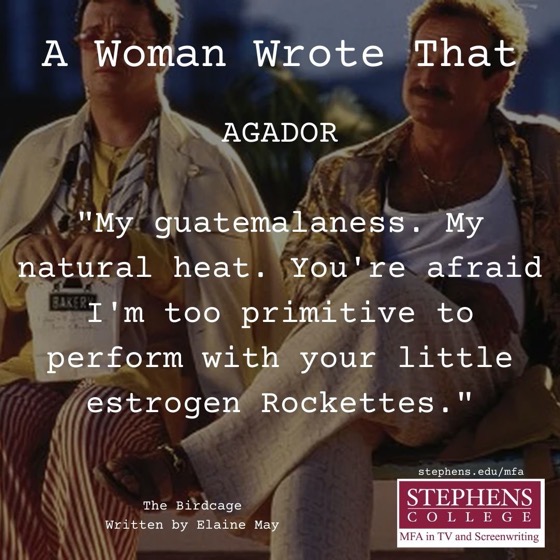
A Woman Wrote That – 14 in a series – The Birdcage (1996) Wr: Elaine May

This new “A Woman Wrote That” post is an echo of the Writers Guild campaign of a few years ago (“A Writer Wrote That”) where they noted famous movie quotes and credited the screenwriter rather than the director.  The difference here being that we will be posting lines from films written by female screenwriters.  Feel free to share! — Rosanne

AGADOR

“My guatemalaness. My natural heat. You’re afraid I’m too primitive to perform with your little estrogen Rockettes.”

09 Studio Contract Writers from There And Back Again: Writing and Developing for American TV [Video] (46 seconds)

09 Studio Contract Writers from There And Back Again: Writing and Developing for American TV [Video] (46 seconds)


Thanks to the gracious invitation from my Screenwriting Research Network colleague Paolo Russo – and a grant he was able to procure (and in the before-Covid time) I was able to spend a week at Oxford Brookes University working with the screenwriting masters students in Paolo’s course. At the culmination of the week, I gave this lecture on how writers rooms worked in the States.

Transcript:

Men — because they were mostly men — worked in writer’s pools. So you got a contract with the studio to be a Universal writer and then people who ran different shows — so they’d be just like in England is today — one guy, again generally a guy, who was in charge of the show and that person would go into the writer’s pool and say “Who’s free this week? I need an episode of…Generally, it was these kinds of shows. Columbo is still kind of famous today. The NBC Mystery Movie was like that. So they go I need a Columbo who’s got an idea and somebody would raise their hand and go “I’ve got an idea” and then they would write next week’s Columbo right? So they were in a pool of writers. Out of that pool came these men who were icons of the 80s and early 90s and it was because of their originality that they began to stand out and I really can’t stress that enough.

Watch this entire presentation

Subscribe to Rosanne’s Channel and receive notice of each new video!


* A portion of each sale from Amazon.com directly supports our blogs
** Many of these books may be available from your local library. Check it out!
† Available from the LA Public Library

The Civil War On Film – 17 in a series – Often these maids were related to their mistresses, as in the case of Sally Hemmings…

The Civil War On Film - 17 in a series - Often these maids were related to their mistresses, as in the case of Sally Hemmings...

Supervision of the drudgery work done by enslaved women kept women of both positions in daily contact. Enslaved maids slept on pallets on the floors of their various mistresses’ rooms to be awoken whenever necessary through the night. Often these maids were related to their mistresses, as in the case of Sally Hemmings, maid and half-sister to Martha Jefferson on the Monticello plantation, which created complex relationships and widely reported whispers among women of both stations of life.

Movies profiled in this book:

From The Journal Of Screenwriting V4 Issue 1: The strange case of Ronald Tavel: Andy Warhol’s only screenwriter by J. J. Murphy

Highlighting the articles in the past editions of the Journal of Screenwriting, of which I am the Book Reviews Editor. Hopefully these abstracts will entice you to did a little deeper into the history and future of screenwriting. — Rosanne


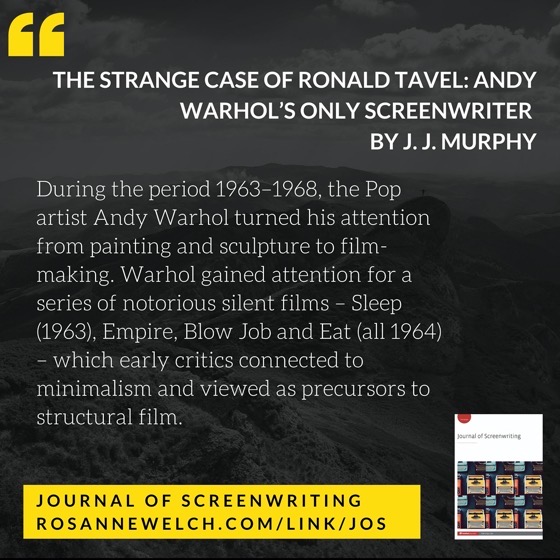
The strange case of Ronald Tavel: Andy Warhol’s only screenwriter by J. J. Murphy

During the period 1963–1968, the Pop artist Andy Warhol turned his attention from painting and sculpture to film-making. Warhol gained attention for a series of notorious silent films – Sleep (1963), Empire, Blow Job and Eat (all 1964) – which early critics connected to minimalism and viewed as precursors to structural film. Warhol, however, confounded early admirers by collaborating with the writer Ronald Tavel on a number of sync-sound, more narrative films, beginning with Harlot (1964). The collaboration proved unlike any other between a director and screenwriter with Warhol incorporating the frustrations and tensions that often exist between screenwriters and directors as an essential part of the work.

From The Journal Of Screenwriting V4 Issue 1: The strange case of Ronald Tavel: Andy Warhol’s only screenwriter by J. J. Murphy


Journal of Screenwriting Cover

The Journal of Screenwriting is an international double-blind peer-reviewed journal that is published three times a year. The journal highlights current academic and professional thinking about the screenplay and intends to promote, stimulate and bring together current research and contemporary debates around the screenplay whilst encouraging groundbreaking research in an international arena. The journal is discursive, critical, rigorous and engages with issues in a dynamic and developing field, linking academic theory to screenwriting practice. 

Get your copy and subscription to the Journal of Screenwriting Today!


* A portion of each sale from Amazon.com directly supports our blogs
** Many of these books may be available from your local library. Check it out!

A Woman Wrote That – 13 in a series – Star Wars: The Empire Strikes Back (1980)

This new “A Woman Wrote That” post is an echo of the Writers Guild campaign of a few years ago (“A Writer Wrote That”) where they noted famous movie quotes and credited the screenwriter rather than the director.  The difference here being that we will be posting lines from films written by female screenwriters.  Feel free to share! — Rosanne

A Woman Wrote That - 13 in a series - Star Wars: The Empire Strikes Back (1980)

PRINCESS LEIA

Why, you stuck up, half-witted, scruffy-looking… nerf-herder.

People are beginning to read screenplays as literature…

People are beginning to read screenplays as literature...


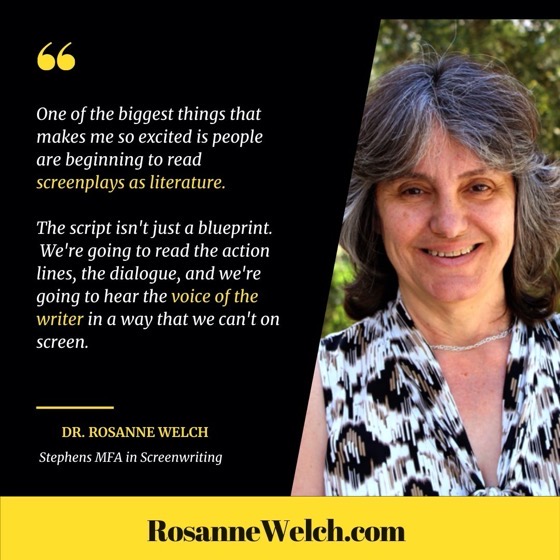
One of the biggest things that makes me so excited is people are beginning to read screenplays as literature.

The script isn’t just a blueprint. We’re going to read the action lines, the dialogue, and we’re going to hear the voice of the writer in a way that we can’t on screen.


Follow me on Instagram


08 Monkees Writers and History from There And Back Again: Writing and Developing for American TV [Video] (1 minute)

08 Monkees Writers and History from There And Back Again: Writing and Developing for American TV [Video] (1 minute)

Thanks to the gracious invitation from my Screenwriting Research Network colleague Paolo Russo – and a grant he was able to procure (and in the before-Covid time) I was able to spend a week at Oxford Brookes University working with the screenwriting masters students in Paolo’s course. At the culmination of the week, I gave this lecture on how writers rooms worked in the States.

Transcript:

I wrote this article for Written By which is about these writers and it was very interesting to go back and speak to them in their 80s about what their experience had been to write hippie characters in the 60s and it was all about how they shared stories. Some of them were more conservative. Some of them were already becoming hippies. Treva tells a funny story about her mother not understanding what it meant when she said she smoked pot. Her mother thought she was doing something in the kitchen. She didn’t divest her of that opinion right? So they all had a different attitude toward how they wrote but in one-hour dramas, things were done differently back in the day as everyone is fond of saying. They used writer pools. They would simply hire you under contract at a studio — Universal, Warner Brothers, Disney, whatever it was — and you literally sat on the line now that’s a that’s a pool of women typing. That’s how scripts were done before there were computers right? They had a bunch of women in a room. They had that ditto paper and you type and you get three copies with the little purple stuff and think about that. You’re doing that 24/7. If you’re doing Gone with the Wind, how many copies of that script do you have to consistently keep typing so that it’s ready.

Watch this entire presentation

Subscribe to Rosanne’s Channel and receive notice of each new video!


* A portion of each sale from Amazon.com directly supports our blogs
** Many of these books may be available from your local library. Check it out!
† Available from the LA Public Library