23 Taking Horror Seriously from When Women Write Horror with Dr. Rosanne Welch [Video] (43 seconds)

Watch this entire presentation

23 Taking Horror Seriously from When Women Write Horror with Dr. Rosanne Welch

Subscribe to Rosanne’s Channel and receive notice of each new video!


In honor of Halloween – and in service to my teaching philosophy —

“Words Matter. Writers Matter. Women Writers Matter.”

I presented this holiday lecture “When Women Write Horror” on Tuesday, October 29th, 2019. Researching the many, many women who have written horror stories – in novels, films and television – brought new names to my attention who I am excited to start reading. I hope you will be, too!

Transcript:

It’s one of those questions you find yourself — you know people think, “Oh you’re doing a class on horror. That can’t be anything you take seriously.” Well, we have to because it’s information people are taking in. What is it making you think right? If you’re with a dude who’s scary, do you think oh yeah it was good for her. It all worked out in the end for he.r Maybe not right? Let’s reconsider how we’re taking these fictional stories into our life. So I think that’s really interesting. Twilight of course was put together by Melissa Rosenberg who had come off the tv show, Dexter. So what an interesting background before you’re gonna write about Twilight and vampire romance, she’d written about a serial killer who you know kills once a week. I don’t know but uh she made a good ton of money off that and obviously was pretty successful.

From The Journal Of Screenwriting V2 Issue 1: An evolving present within a past a history of screenwriting practices in popular Hindi cinema by Anubha Yadav

Highlighting the articles in the past editions of the Journal of Screenwriting, of which I am the Book Reviews Editor. Hopefully these abstracts will entice you to did a little deeper into the history and future of screenwriting. — Rosanne


An evolving present within a past a history of screenwriting practices in popular Hindi cinema by Anubha Yadav

This article studies the mutual and exclusive relationship between the history of popular Hindi cinema and the writing of the screenplay by finding dominant points of reference in their individual and overlapping histories. It connects the unique storytelling tradition of Hindi cinema with the subsumed creative identity of a screenwriter. To do this the article focuses on significant historical markers in Hindi cinema: the Silent era, the Talkies, the Golden era of the 1950s, the New Wave of the 1960s, the SalimJaved era of the 1970s and the New New Wave of today. The New New Wave in Hindi popular cinema aims to recognize and legitimize the presence of the story and the screenwriter. The article studies the evolution of this recent phenomenon and examines the academic and industrial variants that have led to the coming of this change in Hindi cinema.


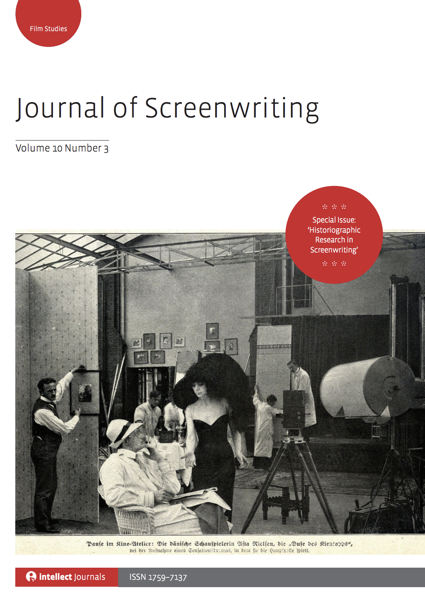
The Journal of Screenwriting is an international double-blind peer-reviewed journal that is published three times a year. The journal highlights current academic and professional thinking about the screenplay and intends to promote, stimulate and bring together current research and contemporary debates around the screenplay whilst encouraging groundbreaking research in an international arena. The journal is discursive, critical, rigorous and engages with issues in a dynamic and developing field, linking academic theory to screenwriting practice. 

Get your copy and subscription to the Journal of Screenwriting Today!


* A portion of each sale from Amazon.com directly supports our blogs
** Many of these books may be available from your local library. Check it out!

22 Modern-Day Vampires from When Women Write Horror with Dr. Rosanne Welch [Video] (1 minute)

Watch this entire presentation

22 Modern-Day Vampires from When Women Write Horror with Dr. Rosanne Welch

Subscribe to Rosanne’s Channel and receive notice of each new video!


In honor of Halloween – and in service to my teaching philosophy —

“Words Matter. Writers Matter. Women Writers Matter.”

I presented this holiday lecture “When Women Write Horror” on Tuesday, October 29th, 2019. Researching the many, many women who have written horror stories – in novels, films and television – brought new names to my attention who I am excited to start reading. I hope you will be, too!

Transcript:

We also then, of course, know about The Vampire Diaries. Julie Pleck put that out, but now she has Legacies which is a sequel to that and Origins which is another one. Interesting because here she’s also turning them more into the sexy dudes and we’re starting to talk about that concept. The problem behind it is at what point does the super-sexy guy really become a way to hide the toxic romance that’s going on when we think about vampires, because vampires are, in fact, capable of killing you. This is a boyfriend who can kill you and you are agreeing to be with him knowing how dangerous that is. That’s a definition of domestic violence in its own way and yet we’re turning it into pop culture hot oh boy which one do I pick? Which team are you on? Right? so is that, again, defanging them, or is that accidentally empowering those kinds of relationships?

From The Journal Of Screenwriting V2 Issue 1: The aesthetic independence of the screenplay by M.-R Koivumki

Highlighting the articles in the past editions of the Journal of Screenwriting, of which I am the Book Reviews Editor. Hopefully these abstracts will entice you to did a little deeper into the history and future of screenwriting. — Rosanne


The aesthetic independence of the screenplay by M.-R Koivumki
  
The aesthetic independence of an artwork is usually defined by the direct relationship between the viewer and the artwork. The screenplay, however, is actualized for the viewer only via cinematic performance. Therefore, we should ask how the viewer experiences the performance and to what extent this experience is created by the contribution of the screenplay, and especially which elements are realized in the presentation and contribute to building up the performance for the viewer to experience.The approach I am leaning on, and through which I am hoping to gain new insights into the aesthetic independence, is dramaturgical and thus practice-based. The common hermeneutic approach in artistic research usually defines what the artworks are and how they exist in our world as cultural phenomena. Through the dramaturgical approach I explore how the screenplay functions within the presentational process.I discuss the contribution of the screenplay as a literary artwork by asking how the literary characteristics of the screenplay appear in a film and their function in the performance. I also explore the screenplay’s contribution from the viewer’s point of view. Here I am not leaning on the perception theories; instead I am using my own observation of the cinematic performance. Lastly, I discuss the dramaturgical process as an interpretive continuum that leads from the screenwriter to the viewer.


The Journal of Screenwriting is an international double-blind peer-reviewed journal that is published three times a year. The journal highlights current academic and professional thinking about the screenplay and intends to promote, stimulate and bring together current research and contemporary debates around the screenplay whilst encouraging groundbreaking research in an international arena. The journal is discursive, critical, rigorous and engages with issues in a dynamic and developing field, linking academic theory to screenwriting practice. 

Get your copy and subscription to the Journal of Screenwriting Today!


* A portion of each sale from Amazon.com directly supports our blogs
** Many of these books may be available from your local library. Check it out!

21 Buffy and Masculinity from When Women Write Horror with Dr. Rosanne Welch [Video] (1 minute 9 seconds)

Watch this entire presentation

21 Buffy and Masculinity from When Women Write Horror with Dr. Rosanne Welch

Subscribe to Rosanne’s Channel and receive notice of each new video!


In honor of Halloween – and in service to my teaching philosophy —

“Words Matter. Writers Matter. Women Writers Matter.”

I presented this holiday lecture “When Women Write Horror” on Tuesday, October 29th, 2019. Researching the many, many women who have written horror stories – in novels, films and television – brought new names to my attention who I am excited to start reading. I hope you will be, too!

Transcript:

The other thing that was going on with Buffy and a couple of other shows we’ll talk about, is that we’re taking vampires who were the other and the scary and the bad and we’re making them sexy and hot, which is a female perspective but then we have to ask ourselves is that good or is that bad? Is that good because in a way when you make the men the objectified sexual object are you taking power away from them and therefore giving that power to the women? That’s a question because you can’t deny David Boreanaz was hot. This is all there is to it. He’s still hot. I know through Buffy through Bones and through Seal Team that man just… but I think it’s a great credit to this actor. We have to recognize he could manage to be deeply, deeply masculine while not being the most important person in the story. He could be the supportive man beside her and that made him all the more man and that’s a different way to define what manhood is and that’s I think a really important thing we’re seeing in some newer literature. So that I think is fascinating.

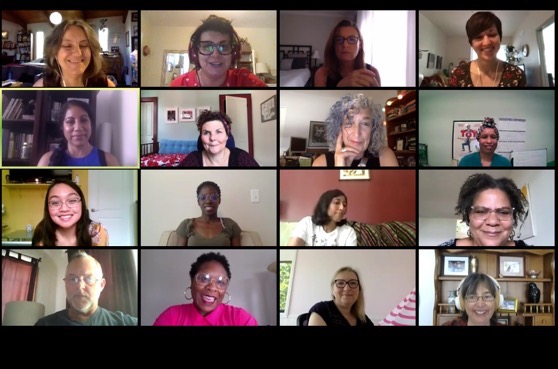
Rosanne Hosting Screenwriting Discussion at The Athena TV Lab

Athena film festival logo

Rosanne Hosting Screenwriting Discussion at The Athena TV Lab Via Zoom

Rosanne Hosting Screenwriting Discussion at The Athena TV Lab Via Zoom

Many thanks to the many great MFA mentors who are doing double duty as mentors to this year’s Athena TV Lab. You can find them on the last two lines of this (now familiar) Zoom grid (starting on the 3rd tier/4th spot): Dawn Comer Jefferson, Jon Vandergriff, Rashaan Dozier-Escalante (also alumna of the MFA Class of 2018), Amy Straus, and Laura Brennan. And there are 2 MFA alums here, too (Sydney Haven and Pam Winfrey).

The Athena Film Festival Virtual Writers Lab

The Athena Film Festival at Barnard College Virtual Writers Lab is for emerging women writers who have not had a feature-length narrative script produced within the past 10 years. Writers must submit a screenplay that includes a woman or women characters in a leadership role or position at the center of the story. Scripts must be feature-length narratives (between 80 and 120 pages).

The Athena Film Festival at Barnard College Virtual Writers Lab provides women identified storytellers with training, skills, and a robust supportive network. Participants will have several one-on-one mentoring sessions with experienced screenwriters as well as peer-to-peer and group sessions.

The Athena Film Festival at Barnard College Virtual Writers Lab will also include industry events where participants will learn about how to navigate the industry as well as a keynote conversation from an established filmmaker. Past panels have included: The Fluidity of Writing, How Does Representation Work, and The Art of Pitching and past keynotes have come from Gina Prince-Bythewood and Kat Candler.

From The Journal Of Screenwriting V2 Issue 1: Competitive writing: BBC Public Service television light entertainment and comedy in the 1970s and 1980s by Heather Sutherland

Highlighting the articles in the past editions of the Journal of Screenwriting, of which I am the Book Reviews Editor. Hopefully these abstracts will entice you to did a little deeper into the history and future of screenwriting. — Rosanne


Competitive writing: BBC Public Service television light entertainment and comedy in the 1970s and 1980s by Heather Sutherland

Comedy has always been the least plausibly public service genre. It is entertaining and consequently seen as trivial, closest to commercial and often close to vulgar. Yet comedy remains the key to attracting audiences and is the aspect of programming most greedily eyed by the BBC’s competitors. This article examines how, facing severe competition during the 1970s and 1980s, in the shape of ITV and the arrival of Channel 4 in 1982, the BBC responded to the challenges of this competitive landscape, highlighting the Corporation’s approach to comedy writers and writing as a key competitive tactic. Whilst ITV and Channel 4 had their successes, the BBC, through its emphasis on organic as opposed to formula comedy forms, was able to articulate clearly the differences between its light entertainment and comedy scripts and those of the competitors. For instance, the absence of a commercial break allowed the development of more intricate plots and sub-plots, alongside in-depth characters; the structure of joke-telling adopted a more dramatic form, bringing to light wider themes, and resulting in comedic work that could inform, educate and entertain all at once. Furthermore, the nurturing approach experienced by writers working for the Corporation allowed the encouragement of new writers (to address new niche audiences) and the taking of risks in writing (particularly those under the heading alternative comedy), ultimately enabling writers to produce scripts that allowed the BBC to not only match its competitors, but to exceed them, principally with regard to the idea of what is termed here popular quality programming. As such, the history of the BBC’s approach to comedy writers and the styles and forms of BBC comedy writing can be a means of access to the core debates about what the BBC should do and produce as a public service; here is one strategy that was key to the Corporation’s defence of its public broadcaster status and its funding by licence fee. Its comedy department, scriptwriters and scripts act as an illustration of the shifts and tensions being experienced behind the scenes in the Corporation overall at this particular point in time.

The Journal of Screenwriting is an international double-blind peer-reviewed journal that is published three times a year. The journal highlights current academic and professional thinking about the screenplay and intends to promote, stimulate and bring together current research and contemporary debates around the screenplay whilst encouraging groundbreaking research in an international arena. The journal is discursive, critical, rigorous and engages with issues in a dynamic and developing field, linking academic theory to screenwriting practice. 

Get your copy and subscription to the Journal of Screenwriting Today!


* A portion of each sale from Amazon.com directly supports our blogs
** Many of these books may be available from your local library. Check it out!
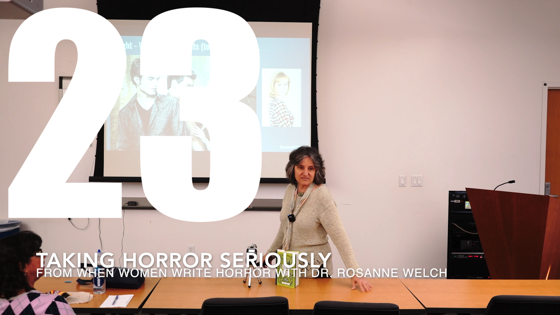
20 Even More On Buffy from When Women Write Horror with Dr. Rosanne Welch [Video] (1 minute 16 seconds)

Watch this entire presentation

20 Even More On Buffy from When Women Write Horror with Dr. Rosanne Welch

Subscribe to Rosanne’s Channel and receive notice of each new video!


In honor of Halloween – and in service to my teaching philosophy —

“Words Matter. Writers Matter. Women Writers Matter.”

I presented this holiday lecture “When Women Write Horror” on Tuesday, October 29th, 2019. Researching the many, many women who have written horror stories – in novels, films and television – brought new names to my attention who I am excited to start reading. I hope you will be, too!

Transcript:

The other thing that’s important about Buffy is that we’re going to blend in some LGBTQ stories in the course of time. We’re going to blend in the fact that these men in her life help but never save the day. In any other story, it’s the men who come along and save the damsel in distress. In this case, it’s the chick who saves the dudes in distress or through sharing the work they make the solution happen. One of the special things about Buffy was it is about how a woman masters a problem in a feminine way right? Sadly we tend to think that when boys learn how to save the day they learn how to master a weapon and go one on one with the bad guy. That’s what they’ve seen in a million movies — many movies that i enjoy myself. The way women do it is they gather a group around them and they empower that group to be as good as they can be together and then as a group they go forward and they save the day and that’s a feminine way of doing things that’s a very that’s a very teacherly way of doing things. Together we will learn this and we will master this thing and move on in the world and succeed. So i think the show did so many things from a feminine perspective and i think it’s because of those two ladies. That makes a big difference.

From The Journal Of Screenwriting V1 Issue 2: Who Writes British Films: A Summary on the UKFC Report and a Call for Further Research by Susan Rogers

Highlighting the articles in the past editions of the Journal of Screenwriting, of which I am the Book Reviews Editor. Hopefully these abstracts will entice you to did a little deeper into the history and future of screenwriting. — Rosanne


Who Writes British Films: A Summary on the UKFC Report and a Call for Further Research by Susan Rogers

In 2007 I was commissioned by the UK Film Council to investigate the background and employment experience of screenwriters credited on a random selection of recent UK films. The resulting report, Writing British Films Who Writes British Films and How They are Recruited, confirmed some widely-held views and uncovered much new information. The UK Film Council’s first studies had revealed that many of the beliefs about screenwriting, expressed in interviews within the British film industry, to be anecdotal or based on unsubstantiated fact and to an extent, myth, confirming the scarcity of research in this field. The following is a summary and a reflection on the findings revealed in the report.


The Journal of Screenwriting is an international double-blind peer-reviewed journal that is published three times a year. The journal highlights current academic and professional thinking about the screenplay and intends to promote, stimulate and bring together current research and contemporary debates around the screenplay whilst encouraging groundbreaking research in an international arena. The journal is discursive, critical, rigorous and engages with issues in a dynamic and developing field, linking academic theory to screenwriting practice. 

Get your copy and subscription to the Journal of Screenwriting Today!


* A portion of each sale from Amazon.com directly supports our blogs
** Many of these books may be available from your local library. Check it out!

From The Journal Of Screenwriting V1 Issue 2: From three acts to three screens: the significance of the role of writing in a new media film project by Jeremy Bubb

Highlighting the articles in the past editions of the Journal of Screenwriting, of which I am the Book Reviews Editor. Hopefully these abstracts will entice you to did a little deeper into the history and future of screenwriting. — Rosanne


From three acts to three screens: the significance of the role of writing in a new media film project by Jeremy Bubb
  
This article will discuss the writing and editing of a short film called Writ in Water, a project specifically designed for three-screen projection. I will explore the influences of the process of writing for multi-image drama by considering Lev Manovich’s notion of narrative as database, Gene Youngblood’s view of syncretism and synaesthetics and Robert McKee’s approach to three-act structure in relation to story, inciting incident, character development and narrative timeline. I will also outline the influence of Aristotle on this new media drama triptych and, finally, discuss scriptwriting as a changing component in relation to digital technology. The continuing significance of the script as blueprint will be explored and how classic story structure and use of new technology work together to inform the final work. This article aims to reflect on the acts and the actions of narrative creation using the classic tropes of screenwriting and its influences, and also recognize the importance of process in contributing to new knowledge in the area of multi-image screen narrative. A full appreciation of an artwork includes an understanding of the extent to which it is a product and reflection of the technologies used in its making (Shaw and Weibel 2003: 198).


The Journal of Screenwriting is an international double-blind peer-reviewed journal that is published three times a year. The journal highlights current academic and professional thinking about the screenplay and intends to promote, stimulate and bring together current research and contemporary debates around the screenplay whilst encouraging groundbreaking research in an international arena. The journal is discursive, critical, rigorous and engages with issues in a dynamic and developing field, linking academic theory to screenwriting practice. 

Get your copy and subscription to the Journal of Screenwriting Today!


* A portion of each sale from Amazon.com directly supports our blogs
** Many of these books may be available from your local library. Check it out!