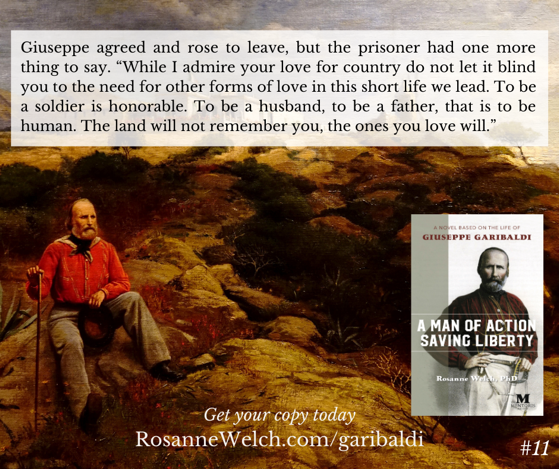
Giuseppe agreed and rose to leave, but the prisoner had one more thing to say. “While I admire your love for country do not let it blind you to the need for other forms of love in this short life we lead. To be a soldier is honorable. To be a husband, to be a father, that is to be human. The land will not remember you, the ones you love will.”
Join our program director, Dr. Rosanne Welch, for a virtual open house to learn more about our Master of Fine Arts in TV and Screenwriting. As we prepare to welcome the 2021 cohort in fall 2021, we invite you to learn about the program, hear how the admissions process works, and an open Q&A to get all your questions answered.
Write Reach Represent
Online Open House with Program Executive Director Dr. Rosanne Welch and Director of Admissions Alexandra Miller
New York, USA Wed, Nov 18, 2020 at 7:00 pm EST Columbia, USA Wed, Nov 18, 2020 at 6:00 pm CST Denver, USA Wed, Nov 18, 2020 at 5:00 pm MST Los Angeles, USA Wed, Nov 18, 2020 at 4:00 pm PST
Highlighting the articles in the past editions of the Journal of Screenwriting, of which I am the Book Reviews Editor. Hopefully these abstracts will entice you to did a little deeper into the history and future of screenwriting. — Rosanne
This exploration is a continuation of my work on the ‘mental space of film genre’, a term I have coined to introduce a terminology to investigate the use of film genre for the screenwriter as he or she constructs a screenplay. Understanding this use of film genre may add to the screenwriter’s other technical skills such as knowledge of story structure and character construction. I have previously delineated the first two elements of the mental space of film genre in the second issue of the Journal of Screenwriting – schematic knowledge (the use of film genre as a framing device) and specific knowledge (the understanding of film genre the audience brings to the viewing of filmic narratives). This work will then focus on what I believe to be the important third element of the mental space of film genre – relevant knowledge.
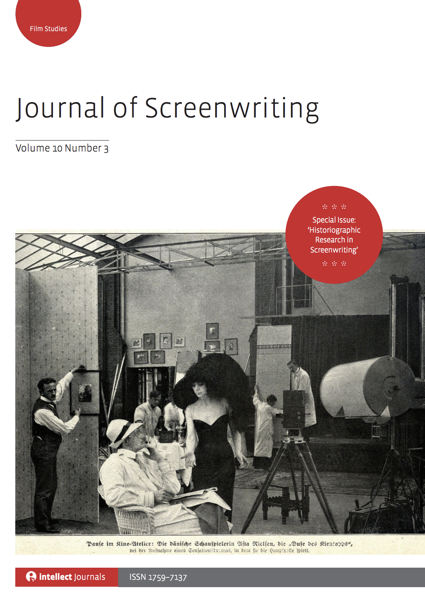
The Journal of Screenwriting is an international double-blind peer-reviewed journal that is published three times a year. The journal highlights current academic and professional thinking about the screenplay and intends to promote, stimulate and bring together current research and contemporary debates around the screenplay whilst encouraging groundbreaking research in an international arena. The journal is discursive, critical, rigorous and engages with issues in a dynamic and developing field, linking academic theory to screenwriting practice.
While any past event is vulnerable to the mythmaking of film, the Civil War might be the most contested event in American History. No national historical moment has been more written about (except perhaps World War II), argued over and romanticized than the so-called Irrepressible Conflict.
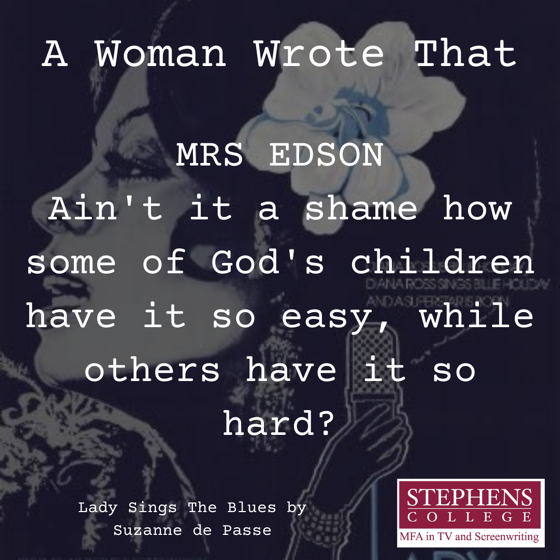
This new “A Woman Wrote That” post is an echo of the Writers Guild campaign of a few years ago (“A Writer Wrote That”) where they noted famous movie quotes and credited the screenwriter rather than the director. The difference here being that we will be posting lines from films written by female screenwriters. Feel free to share! — Rosanne
Subscribe to Rosanne’s Channel and receive notice of each new video!
Transcript:
That’s why these services are so important to what we’re going to be able to do in the future because so many films are now co-productions with Netflix and they know they want to keep this worldwide audience because soon we’ll have the Disney streaming channel and we’re going to have an NBC streaming channel. There will be too many of those to pick from. The one thing Netflix has going for it is it’s done co-productions with so many countries. So people can have an interest in seeing their stories more than repetitive Disney stories, as much as I like Disney after a while I don’t need to see Aladdin filmed by 47 different actors again and again and again. So I think it’s really important and so even when I was preparing and thinking about doing this I watched some Brazilian television. I was able on my own television to simply dial up these programs and see what they were all about and because of that, I can then share them with my students who are very interested in finding out because my students come from many, many different backgrounds — many many different heritages and they don’t always see themselves represented on film. So the idea of seeing television shows and movies from their families home culture is a beautiful way for them to keep that culture even in a world where assimilation is the thing that more people are respecting, and they feel they lose their culture.
Watch this entire presentation
A Note About This Presentation
A clip from my keynote speech at the 10th Screenwriters´(hi)Stories Seminar for the interdisciplinary Graduation Program in “Education, Art, and History of Culture”, in Mackenzie Presbyterian University, at São Paulo, SP, Brazil, focused on the topic “Why Researching Screenwriters (has Always) Mattered.” I was especially pleased with the passion these young scholars have toward screenwriting and it’s importance in transmitting culture across the man-made borders of our world.
To understand the world we have to understand its stories and to understand the world’s stories we must understand the world’s storytellers. A century ago and longer those people would have been the novelists of any particular country but since the invention of film, the storytellers who reach the most people with their ideas and their lessons have been the screenwriters. My teaching philosophy is that: Words matter, Writers matter, and Women writers matte, r so women writers are my focus because they have been the far less researched and yet they are over half the population. We cannot tell the stories of the people until we know what stories the mothers have passed down to their children. Those are the stories that last. Now is the time to research screenwriters of all cultures and the stories they tell because people are finally recognizing the work of writers and appreciating how their favorite stories took shape on the page long before they were cast, or filmed, or edited. But also because streaming services make the stories of many cultures now available to a much wider world than ever before.
Many thanks to Glaucia Davino for the invitation.
* A portion of each sale from Amazon.com directly supports our blogs ** Many of these books may be available from your local library. Check it out! † Available from the LA Public Library
For the love of country. For the love of freedom. For the love of a woman. He fought.
Giuseppe Garibaldi yearned for a world of equality, liberty, and freedom for all nations, races, and genders. America had long claimed her independence from England, yet his beloved Italian peninsula was in a never-ending state of instability and war as the Austrian Empire, French, Church, and regional kingdoms wrestled for power.
Forced into exile, Garibaldi’s resolve to unify his homeland into the sovereign nation of Italy led him on adventures that spanned the continents. On sea, horseback, and foot, he confronted pirates, clashed with South American gauchos, and commanded his loyal volunteer army of thousands—the “Redshirts”—with dignity, clarity, and courage.
But one of the most revered generals in history was as vulnerable to loss, failure, and heartache as any man. Perhaps Garibaldi’s greatest battle was the one in his heart as he struggled to hold onto the love of his life—the revolutionary woman always by his side, both on and off the battlefield.
As they could not yet return to Italy, the two became embroiled in the cause of creating the Republic of Rio Grande do Sul, a region of Brazil which wanted to separate from Brazil in 1835. Named the Ragamuffin War for the the fringed leather worn by the gaucho farmers who began it, the war became a cause close to Giuseppe’s heart.
Part of the problem was and is that civil wars create particular problems that World War II does not. In our Civil War we didn’t fight outsiders such as the Germans or the Japanese, we fought ourselves. In this way a civil war is a family fight and afterward we are forced to live with our family.
Highlighting the articles in the past editions of the Journal of Screenwriting, of which I am the Book Reviews Editor. Hopefully these abstracts will entice you to did a little deeper into the history and future of screenwriting. — Rosanne
This article aims to define certain characteristics of so-called poetic dramaturgy by analysing sequences from Andrey Tarkovsky’s first feature film Ivan’s Childhood (1962). The essential elements of classical dramaturgy as proposed by Aristotle are problem (conflict), cause and effect, turning points and a closed ending, and writerscontinue to use such elements in their writing. I am interested in whether or not it is possible to define the features of poetic dramaturgy in a similar way so that they too are incorporated into the writer’s craft. In this article, I will focus on one frequently occurring expressive cinematic element in Ivan’s Childhood – upward–downward movement. Through dramaturgical analysis, my aim is to reveal the dramaturgical system associated with this movement. The deviations from classical dramaturgy are of interest to me, and I will consider them as evidence of poetic dramaturgy. My contention is that there is an immanent system in Tarkovsky’s film that clearly differs from classical dramaturgy and which we can define as poetic. In addition, this article aims to analyse the nexus between word and image in the screenplay and film, with the intention of understanding whether the poetic dramaturgy has been defined in (written into) this particular screenplay or whether it is something that the director has introduced into the film.
The Journal of Screenwriting is an international double-blind peer-reviewed journal that is published three times a year. The journal highlights current academic and professional thinking about the screenplay and intends to promote, stimulate and bring together current research and contemporary debates around the screenplay whilst encouraging groundbreaking research in an international arena. The journal is discursive, critical, rigorous and engages with issues in a dynamic and developing field, linking academic theory to screenwriting practice.



![36 Streaming Companies and World Culture from Why Researching Screenwriters Has Always Mattered [Video] (1 minute 19 seconds)](https://rosannewelch.com/wp-content/uploads/2020/11/rmw-sao-paolo-36.png)
![Mentoris Project Podcast: A Man Of Action Saving Liberty: A Novel Based On The Life Of Giuseppe Garibaldi with Author, Dr. Rosanne Welch [Audio]](https://rosannewelch.com/wp-content/uploads/2020/11/mentoris-rmw.png)


