17 Margaret Atwood from When Women Write Horror with Dr. Rosanne Welch [Video] (58 seconds)

Watch this entire presentation
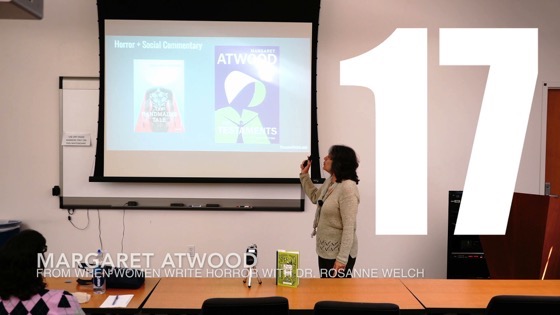
17 Margaret Atwood from When Women Write Horror with Dr. Rosanne Welch

Subscribe to Rosanne’s Channel and receive notice of each new video!


In honor of Halloween – and in service to my teaching philosophy —

“Words Matter. Writers Matter. Women Writers Matter.”

I presented this holiday lecture “When Women Write Horror” on Tuesday, October 29th, 2019. Researching the many, many women who have written horror stories – in novels, films and television – brought new names to my attention who I am excited to start reading. I hope you will be, too!

Transcript:

What works I think best is when you blend horror and social commentary. As I’ve sort of been examining as we go through. Obviously, The Handmaid’s Tale and Margaret Atwood also falls into that world looking at a future that is horrific for one particular gender, which happens to be chicks right? This is not a great world to grow up in and she just, some 25 years later, came up with the sequel, Testaments, which is different from the television show. The TV show stopped –the first season stopped at the end of the book and then the people on the show had to create the rest of that. She’s like “No no no. This is where I thought the story was going.” So, as an author, she has the power to say “No this is where I wanted those characters to be not whatever you guys are doing on a weekly basis. So I think it’s really interesting to compare that to the later seasons of the show. I love her early picture and then her current while the CBS while the Emmys are going on. So Margaret’s been writing for a long time. It’s a very long illustrious career writing horror.

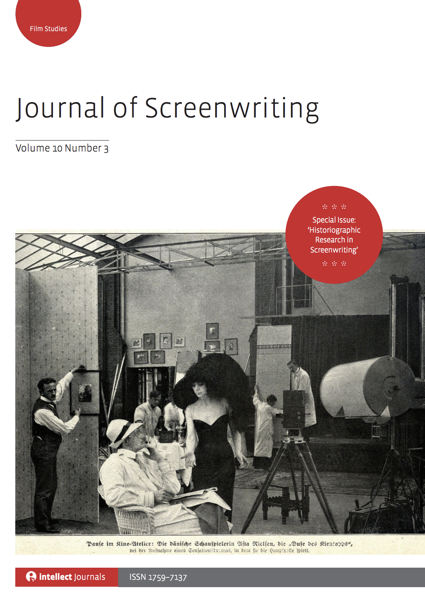
From The Journal Of Screenwriting V1 Issue 2: The hero and heroine’s journey and the writing of Loy by Helen Jacey

Highlighting the articles in the past editions of the Journal of Screenwriting, of which I am the Book Reviews Editor. Hopefully these abstracts will entice you to did a little deeper into the history and future of screenwriting. — Rosanne


The hero and heroine’s journey and the writing of Loy by Helen Jacey

Christopher Vogler suggests an essential humanity beyond gender and sexual difference lies at the heart of the Hero’s Journey archetypal paradigm which he presents in The Writers Journey (2007), yet he still advises readers to go elsewhere for alternative theories on the woman’s journey, recommending key Jungian feminist theories including Maureen Murdock’s The Heroine’s Journey (1990), and Clarissa Pinkola Estes’s Women Who Run With The Wolves (1992). Through the practice of writing a screenplay Loy, a biopic based on the life of modernist poet and artist Mina Loy (18821966), I questioned to what extent is the Hero’s Journey useful as a metaphoric aid in supporting the development of a screenplay with two female protagonists, and to what extent does the paradigm have a masculine bias? This article first sets out the principles of Vogler’s Hero’s Journey and Murdock’s Heroine’s Journey cycle. I then explore the strengths and weaknesses of both models as creative aids during the development of my screenplay, with particular reference to the development of character, structure and theme. Turning to the notion of archetypes as a creative system for characterization, I discuss how I used archetypes in the development of Loy’s protagonists. Finally, I draw on Clarissa Pinkola Estes’s myth of the Skeleton Woman as an effective metaphoric aid for the development of narratives where relationships are central. I conclude that while the Hero’s Journey has key strengths, models from Jungian feminism are particularly rich for screenwriters developing female-led stories.


The Journal of Screenwriting is an international double-blind peer-reviewed journal that is published three times a year. The journal highlights current academic and professional thinking about the screenplay and intends to promote, stimulate and bring together current research and contemporary debates around the screenplay whilst encouraging groundbreaking research in an international arena. The journal is discursive, critical, rigorous and engages with issues in a dynamic and developing field, linking academic theory to screenwriting practice. 

Get your copy and subscription to the Journal of Screenwriting Today!


* A portion of each sale from Amazon.com directly supports our blogs
** Many of these books may be available from your local library. Check it out!

15 More On Charlie Brackett from Why Researching Screenwriters (has Always) Mattered [Video] (57 seconds)

Watch this entire presentation

15 More On Charlie Brackett from Why Researching Screenwriters (has Always) Mattered

Subscribe to Rosanne’s Channel and receive notice of each new video!


Transcript:

This is the two men. Also now Charlie Brackett working with Billy Wilder. Also a man who’s more famous because he became a director as well. Together they wrote Sunset Boulevard. If you look at this poster, you can see Billy Wilder’s name on the bottom in the middle — very big letters. You can’t see Charles Brackett’s name. He’s not part of that poster, even though he co-wrote this very important film and then also in his diary he had this funny line about how he noticed when his own daughter eloped, he thought the trade papers would say that Billy Wilder was upset because his collaborator’s daughter had disappeared. He already knew that they weren’t going to remember his name. Which is terrible because he had an Oscar for writing the very first version of Titanic. Not the James Cameron one that most people know of today, but the very first. So the man was an Oscar-winning screenplay writer and yet does not appear in too many histories because the directors he co-wrote with overtook that fame.

A Note About This Presentation

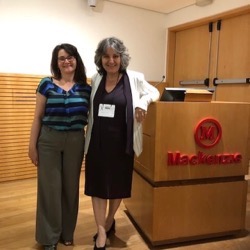
A clip from my keynote speech at the 10th Screenwriters´(hi)Stories Seminar for the interdisciplinary Graduation Program in “Education, Art, and History of Culture”, in Mackenzie Presbyterian University, at São Paulo, SP, Brazil, focused on the topic “Why Researching Screenwriters (has Always) Mattered.” I was especially pleased with the passion these young scholars have toward screenwriting and it’s importance in transmitting culture across the man-made borders of our world.

To understand the world we have to understand its stories and to understand the world’s stories we must understand the world’s storytellers. A century ago and longer those people would have been the novelists of any particular country but since the invention of film, the storytellers who reach the most people with their ideas and their lessons have been the screenwriters. My teaching philosophy is that: Words matter, Writers matter, and Women writers matte, r so women writers are my focus because they have been the far less researched and yet they are over half the population. We cannot tell the stories of the people until we know what stories the mothers have passed down to their children. Those are the stories that last. Now is the time to research screenwriters of all cultures and the stories they tell because people are finally recognizing the work of writers and appreciating how their favorite stories took shape on the page long before they were cast, or filmed, or edited. But also because streaming services make the stories of many cultures now available to a much wider world than ever before.

Many thanks to Glaucia Davino for the invitation.


* A portion of each sale from Amazon.com directly supports our blogs
** Many of these books may be available from your local library. Check it out!
† Available from the LA Public Library

Listen to the latest “How I Wrote That” Podcast with Screenwriter Laura Brennan from Most Likely to Die, and Faux Baby. [Audio]

Listen to the latest How I Wrote That Podcast with Tera Hernandez of The Big Bang Theory [Audio]

Listen to the latest

Subscribe to the Podcast with iTunes | TuneIn

Listen to this episode

Laura Brennan’s eclectic writing career includes television, film, theater, web series, fiction and news. Behind the scenes, she has helped production companies develop movies, TV pilots and limited series. She has taught pitching workshops to executives at Netflix and Film Victoria, as well as MFA programs and undergraduate classes at universities including Stephens College, University of California, Los Angeles, University of Southern California, Boston University and National University.A graduate of Yale University, Brennan has won awards for journalism, television writing and fiction. Her children’s book, Nana Speaks Nanese, tackles the confusing changes brought on by dementia in a reassuring and straightforward way. She hopes it will help families facing a diagnosis of dementia open up a conversation with their young children. Her web series Faux Baby is also for parents, but it is definitely not for children—or even safe for work.

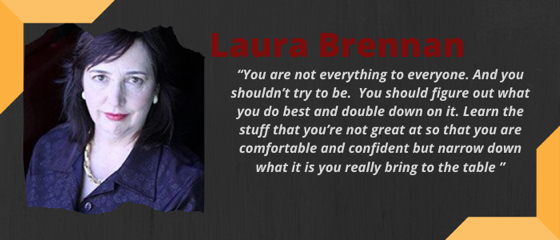
“You are not everything to everyone. And you shouldn’t try to be.  You should figure out what you do best and double down on it. Learn the stuff that you’re not great at so that you are comfortable and confident but narrow down what it is you really bring to the table ” -Laura Brennan

Presented by Stephens College MFA in TV and Screenwriting


Visit the Stephens College MFA in TV and Screenwriting for more information.

Follow @StephensMFA on Instagram

Follow and Like the Stephens College MFA in TV and Screenwriting

#MentorMonday 8 - Dawn Comer Jefferson - Stephens College MFA in TV and Screenwriting

2020 Jan Marino Scholarship to Stephens MFA in TV and Screenwriting Announced at SeriesFest [Video]

2020 Jan Marino Scholarship to Stephens MFA in TV and Screenwriting Announced at SeriesFest [Video]

It was a pleasure to take part in announcing our Class of 2022 Jan Marino Scholarship winner at this year’s (online of course) SeriesFest.

Betsy Leighton, the founder of the scholarship, and I each recorded short videos to be played before one of the major panels of the festival.

I wanted to share the videos here so everyone can join me in welcoming Jen Bosworth-Ramirez to the Stephens College MFA in TV and Screenwriting.

Stephens College MFA in TV and Screenwriting Alumna Sarah Phillips Batchelder (Class of 2017) in Drama Series Comeptition at SeriesFest

SeriesFest 2020

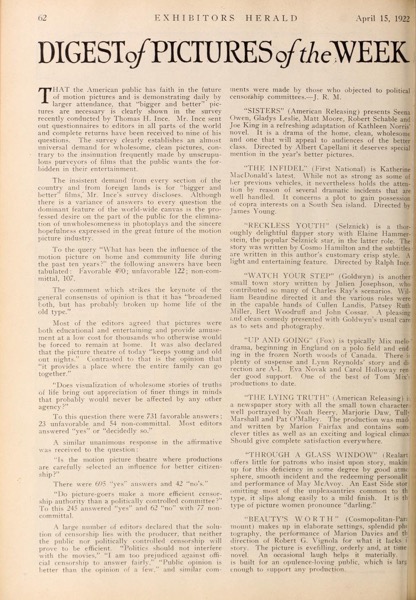
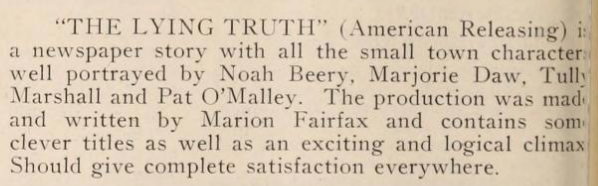
From The “When Women Wrote Hollywood Archives 31: Marion Fairfax, Exhibitors Herald, 17 April 1922.

Months of research went into the creation of the essays in “When Women Wrote Hollywood.” Here are some of the resources used to enlighten today’s film lovers to the female pioneers who helped create it.

From The “When Women Wrote Hollywood Archives 31: Marion Fairfax, Exhibitor’s Herald. Exhibitors Herald, 15 April 1922.

From The

From The

From The


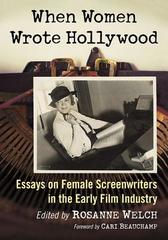
Buy “When Women Wrote Hollywood” Today!


When Women Wrote Hollywood: Essays on Female Screenwriters in the Early Film Industry

Paperback Edition | Kindle Edition | Google Play Edition

Help Support Local Bookstores — Buy at Bookshop.org

* A portion of each sale from Amazon.com directly supports our blogs
** Many of these books may be available from your local library. Check it out!
† Available from the LA Public Library

16 More On Toni Morrison and Beloved from When Women Write Horror with Dr. Rosanne Welch [Video] (31 seconds)

Watch this entire presentation

16 More On Toni Morrison and Beloved from When Women Write Horror with Dr. Rosanne Welch [Video] (31 seconds)

Subscribe to Rosanne’s Channel and receive notice of each new video!


In honor of Halloween – and in service to my teaching philosophy —

“Words Matter. Writers Matter. Women Writers Matter.”

I presented this holiday lecture “When Women Write Horror” on Tuesday, October 29th, 2019. Researching the many, many women who have written horror stories – in novels, films and television – brought new names to my attention who I am excited to start reading. I hope you will be, too!

Transcript:

This ghost comes back into her life after the Civil War is over, because what an awful thing — I didn’t want my children to live as slaves, so I killed her and then the war ended and then there was no slavery anymore and she could have lived and now that guilt is the haunting that’s in her mind forever. So it a really, really, powerful story. Taking the haunted house from kind of pop culture-y goofy to Oh My God, serious literature. That, as well, won a Pulitzer Prize — which is pretty huge.

Text of Rosanne’s Keynote at 10th Screenwriter Stories Seminar: Screenplay-X at the Université Presbytériènne Mackenzie in São Paulo, Brazil.

I’m happy to post this ebook of papers presented at the10th Screenwriter Stories Seminar: Screenplay-X at the Université Presbytériènne Mackenzie in São Paulo, Brazil

Screenplay-X at the Université Presbytériènne Mackenzie in São Paulo, Brazil.

I gave the opening lecture entitled, “Why Researching Screenwriters (has Always) Mattered” which appears here in English, though the rest of the papers (naturally) are in Portuguese.  It was an honor to be asked to do the lecture and privilege to spend time with Professor Glaucia Davino and her students who made me feel very welcome in their city.

Words matter. Writers matter and women writers matter in this world. It is important to consider writers because the word writer comes before the word director when you describe a filmmaker who can do two things. They are writer-directors, they are not director-writers. That tells us something. The vision of a movie cannot exist without the screenplay. A director cannot direct nothing. There must be an idea. There must be a philosophy. There must be a theme. There must be a story. This proves that the writer is of equal importance. We must remember writers have to be equal partners and I think we realize that without realizing it. When people talk about movies to their friends they don’t say “I loved the camera angle in scene 7.” They quote dialogue from their favorite movies whether they are from a Pixar film or a Disney one, they quote the dialogue and that is the work of the writer. That’s the person who should be given credit, yet often at the start a class I ask students to list their two or three favorite films, who directed those films and who wrote that film. They very often cannot name the person who wrote the film they claim to adore. How can you study to be a writer if you don’t remember writers yourself? Hence the reason to study Screenwriting. Hence researching screenwriters has always mattered.

When actors Frances McDormand won her Oscar for Three Billboards Outside Ebbing Missouri she said of the screenwriter Martin McDonagh, “He did not sketch a blueprint. That’s an insult to a screenplay. He didn’t string together a few words. He wrote, meticulously crafted, a tsunami, and then he allowed his troupe of actors to surf it into the shore.” (https://www.hollywoodreporter.com/news/sag-awards-three-billboards-takes-top-honors-at-a-show-women-took-center-stage-1076726) She credited the writer in a way that many people do not.

Stories – and therefore screenplays and therefore screenwriters — are important because they transmit culture around the world. The United States has had a corner on that market for far too many years but now we’re beginning to see other stories permeate our culture, a good and beneficial thing for a country made of immigrants and the ancestors of immigrants. Stories have always transmitted culture far back to the cave paintings of many ancient cultures, through Gilgamesh, and the griots of Africa. Humans have used stories to move culture forward. Movies are the most current version of doing that so why do we forget to study the storytellers? Now is the time to fix this glaring omission both in casual discussions of films and in academia.

Read More

Read and Download The Entire Why Researching Screenwriters (has Always) Mattered Presentation in PDF Format

Text of Rosanne's Keynote at 10th Screenwriter Stories Seminar: Screenplay-X at the Université Presbytériènne Mackenzie in São Paulo, Brazil.
Download the Portuguese PDF 

Watch the the entire presentation here

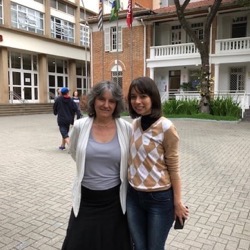
Photos from the event

Screenplay-X at the Université Presbytériènne Mackenzie in São Paulo, Brazil. Screenplay-X at the Université Presbytériènne Mackenzie in São Paulo, Brazil.

Screenplay-X at the Université Presbytériènne Mackenzie in São Paulo, Brazil. Screenplay-X at the Université Presbytériènne Mackenzie in São Paulo, Brazil.

From The Journal Of Screenwriting V1 Issue 2: The physical and emotional threads of the archetypal hero’s journey: proposing common terminology and re-examining the narrative model by Craig Batty

Highlighting the articles in the past editions of the Journal of Screenwriting, of which I am the Book Reviews Editor. Hopefully these abstracts will entice you to did a little deeper into the history and future of screenwriting. — Rosanne


The physical and emotional threads of the archetypal hero’s journey: proposing common terminology and re-examining the narrative model by Craig Batty

This article will discuss how, in mainstream film screenplays, the protagonist undergoes both an actual, physical journey and an internal, emotional journey, pulled together by the invisible hand of the screenwriter in order to create the complete narrative experience. Central to the article is an evaluation of how character transformation (arc) is positioned against physical action (plot), arguing that the two can be mapped out as individual yet symbiotic threads of a narrative: the physical and the emotional journeys.After mapping the territory of what is already written on this subject, the works of Joseph Campbell and his protg Christopher Vogler (Clayton 2007: 210) will be drawn together to offer a re-examination of the model of the Hero’s Journey. Assessing these two narrative threads (physical and emotional) as both distinct and symbiotic, it will be clear that a special relationship exists between plot and character, where character transformation is encouraged to take place within the frame of the physical action of the plot. The substance of such a transformation, the emotional core of the narrative experience, is what lives on in the audience, post-text; the physical action of a film story may frame emotion, but emotion has the power to break the frame and take on a life of its own.


The Journal of Screenwriting is an international double-blind peer-reviewed journal that is published three times a year. The journal highlights current academic and professional thinking about the screenplay and intends to promote, stimulate and bring together current research and contemporary debates around the screenplay whilst encouraging groundbreaking research in an international arena. The journal is discursive, critical, rigorous and engages with issues in a dynamic and developing field, linking academic theory to screenwriting practice. 

Get your copy and subscription to the Journal of Screenwriting Today!


* A portion of each sale from Amazon.com directly supports our blogs
** Many of these books may be available from your local library. Check it out!

14 Charlie Brackett from Why Researching Screenwriters (has Always) Mattered [Video] (54 seconds)

Watch this entire presentation

14 Charlie Brackett from Why Researching Screenwriters (has Always) Mattered

Subscribe to Rosanne’s Channel and receive notice of each new video!


Transcript:

Another answer for why we don’t credit writers is that we never really credited them equally. In the very early days of Hollywood, you can see on the bottom of this poster, it says it was written and directed by Preston Sturgis, a very famous director of the 30s and 40s and 50s however, it was co-written by two men. The other man’s name doesn’t appear on the poster because he didn’t also direct it yet he co-wrote the movie and in fact his name was Charlie Brackett and he put out – his family put – out his diary the diaries he kept. They published a couple of years ago and in those diaries he wrote things about how he saw himself being written out of Hollywood and he didn’t know what to do about it right? So, in this case, he’s talking about the poster I just had where it says it’s written and directed by Preston Sturgis and he says “evidently he took out every comma as I expected he would do”, right? So he knew he was being erased.

A Note About This Presentation

A clip from my keynote speech at the 10th Screenwriters´(hi)Stories Seminar for the interdisciplinary Graduation Program in “Education, Art, and History of Culture”, in Mackenzie Presbyterian University, at São Paulo, SP, Brazil, focused on the topic “Why Researching Screenwriters (has Always) Mattered.” I was especially pleased with the passion these young scholars have toward screenwriting and it’s importance in transmitting culture across the man-made borders of our world.

To understand the world we have to understand its stories and to understand the world’s stories we must understand the world’s storytellers. A century ago and longer those people would have been the novelists of any particular country but since the invention of film, the storytellers who reach the most people with their ideas and their lessons have been the screenwriters. My teaching philosophy is that: Words matter, Writers matter, and Women writers matte, r so women writers are my focus because they have been the far less researched and yet they are over half the population. We cannot tell the stories of the people until we know what stories the mothers have passed down to their children. Those are the stories that last. Now is the time to research screenwriters of all cultures and the stories they tell because people are finally recognizing the work of writers and appreciating how their favorite stories took shape on the page long before they were cast, or filmed, or edited. But also because streaming services make the stories of many cultures now available to a much wider world than ever before.

Many thanks to Glaucia Davino for the invitation.


* A portion of each sale from Amazon.com directly supports our blogs
** Many of these books may be available from your local library. Check it out!
† Available from the LA Public Library