Born in Chicago in 1888 (or thereabouts, different sites report different dates), writer-producer Eve Unsell grew up in Caldwell, Kansas. After earning her undergraduate degree and working as a journalist for the Kansas City Post, she attended graduate school at Boston’s Emerson College for a year. There she studied drama and literature before heading to New York. After reading one of her short stories, theatrical agent Beatrice deMille (mother of Cecil and William) hired to work as what was then called a play reader and constructionist. During her career, Unsell accumulated nearly 100 credits as a screenwriter while writing for notable stars including Mary Pickford, Lon Chaney, Clara Bow, Baby Peggy and Jack Benny.
In researching and writing my book on Giuseppe and Anita Garibaldi and the unification of Italy (A Man Of Action Saving Liberty: A Novel Based On The Life Of Giuseppe Garibaldi) I re-discovered the first American female war correspondent – Margaret Fuller — who I had first met in a college course on the Transcendentalists. I was once again fascinated by a life lived purposefully.
Concord Days sends love to Margaret Fuller on the anniversary of her death in 1850.
The conversation focuses on Margaret’s exciting days in ITALY!
Dr. Rosanne Welch takes us through her adventures and enthusiastically reminds us what she was like when she was living her best life!
Transcript:
Tammy: So talk about him (Giovanni Angelo) a little bit more because I feel like he’s sort of this figure and you know I want to imagine him in my mind as sort of like this you know super handsome — maybe not the rich guy but you know definitely — the man of quality that we all aspire to meet.
Rosanne: Well he went against his family as well because they were not for the united unification of Italy. So he lost his he — they wrote him off if you will. So that’s why it doesn’t have any money. He’s not going to inherit any and the family does have lands and all that stuff but they were against the unification and many people were because they were happy with whichever country was running their section of Italy or they didn’t appreciate the king and they didn’t want the king to be king over all of Italy or lots of different reasons that they were against it and so yeah they write him off and because he married her and she wasn’t Catholic and this is huge obviously back in the day.
I actually tell the story. My mom put together her brother — three children of Sicilian immigrants — only one son — my mother put her brother together with a woman who wasn’t Catholic and they fell in love and they got married. She did become Catholic because you know she converted because she knew she had to but on the day of the wedding my mother was a maid of honor. My grandmother was tying the bow on her dress and as she walked out into the church the last thing her mother said to her was I’ll never forgive you for this. That was 1950 in America. That was like you this is a mismatched marriage.
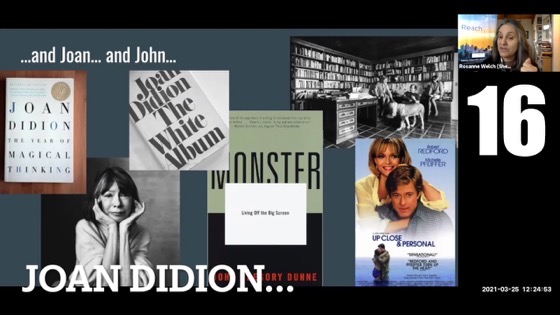
We bring in Joan and John. So in this third version, we’re going to have another female writer with her imprint on this movie. She’s going to change a few things. She is a journalist. She’s worked in New York. She’s worked out of Sacramento. She’s covered the hippie generation. She particularly wrote this lovely piece — a book called The White Album where she looked at the culture of her day and she studied The Doors. She was fascinated by The Doors and their popularity and the way that Jim Morrison just blew up in American culture right? She in fact called them the missionaries of apocalyptic sex right? Look at this beautiful picture of this young man right? Sadly he’s going to be one of the guys who dies young right. He’s going to join the Jimi Hendrix and you know that whole team of people that we’ve lost too young in life but now Joan is writing this new version and she’s going to make the new people rock and roll stars. So we’re going to move out of acting — move out of musical theater — we’re going to move into the rock world. So right away she’s patterning things on Jim Morrison. Look at this picture of Kris Kristofferson. This is Kris Kristofferson young. This is Jim Morrison. Look how close they are. You could almost mix them up right? So Joan immediately is having this vision of who is this new Norman Maine and because Norman is not such a cool name in the 70s, he’s John Norman Maine, right? So we’re going to make a little change.
Watch this entire presentation
Connections at conferences matter! Through the most recent SCMS, I met Vicki Callahan, whose film history focus right now is on Mabel Normand. When she learned I could put together a lecture on the importance of the female voice in the A Star is Born franchise she asked me to give that lecture to her master students.
It made for a great opportunity for me to hone the ideas I’m working on for a chapter on that franchise that I’m writing for a new book from Bloomsbury: The Bloomsbury Handbook Of International Screenplay Theory. It’s always nice when one piece of research can be purposed in other ways – and it’s always fun revisiting such a female-centric film franchise – one that drew the talents of such powerful performers as Janet Gaynor, Judy Garland, Barbara Streisand, and Lady Gaga.
I enjoyed sharing the names and careers of women like Peg Lynch, Gerturde Berg, Selma Diamond and D.C. Fontana to the members who gathered on Zoom last Wednesday morning. There are so many more I could have talked about whose names don’t appear in mainstream books about the history of television so we have to learn who they are and carry those names forward ourselves. It’s one of the missions of the Stephens College MFA in TV and Screenwriting – and has been one of my missions all my life.
Transcript:
My teaching philosophy is that Words matter, Writers matter,. and Women Writers matter and they are far too often left out of the history books that we use to teach our incoming students. My school is Stephens College as Jen has so nicely told you and we teach a program in TV and Screenwriting — a master’s program — and I’m excited to say that we are all about representation on television and we’re going to see a little example of that in my presentation today. So let’s get to it. One of the first women — we credit her with inventing the sitcom which is a money maker for television for all these many, many years. Peg Lynch. She began in radio, as many of these women did, and she was writing short sketches — 10 and 15 minute sketches — called the Ethel and Albert Comedies and this is the first time she took sort of domestic life and made jokes out of it and put that on the media right? In this case, radio shows and eventually they became television shows and to her credit, she has 11,000 scripts. So think about that as if she was writing for a variety show if you will. It went on for many years. There were many many episodes. So she’s the first person who really got into the husband and wife having a chat and let’s make some jokes about how tough real-life can be. Often with the wife being a little smarter than the husband right? Being a step ahead of him but society allowed him to move forward and of course, that’s a pattern we’re gonna see repeated naturally in I Love Lucy.
Many thanks to Janice Law of the American Women Writers National Museum who invited me to give a short talk on The Women of Early TV.
I enjoyed sharing the names and careers of women like Peg Lynch, Gerturde Berg, Selma Diamond and D.C. Fontana to the members who gathered on Zoom last Wednesday morning. There are so many more I could have talked about whose names don’t appear in mainstream books about the history of television so we have to learn who they are and carry those names forward ourselves. It’s one of the missions of the Stephens College MFA in TV and Screenwriting – and has been one of my missions all my life.
Watch this entire presentation
Women pioneers who created, produced or shepherded many of America’s most wildly popular, early television programs will be profiled by Dr. Rosanne Welch.
Facebook is fleeting so when I heard that Mike Nesmith of The Monkees had passed away this morning I posted this short tribute along with the link to his audition for the show:
This is how I will remember Mike, another hopeful young performer who came to Hollywood, hit the heights so many others only dream of, and became the ‘father’ figure on a show that eschewed authority figures. RIP Mike Nesmith.
But there is more to say (heck, I discovered there was a whole book’s worth). In Monkees fan circles I call myself a Mickey girl as Dolenz was my major childhood crush from the show. What I recognized in the character of Mike (all the actors used their real names on the show which proved to make their career lives post the show a bit more difficult) was the strength and balance he brought to the show. Part of that came from being among the older (and taller) of the 4 actors and part from his having been in the military for a short time – and he was the only then-married member of the band.
Just as Davy Jones brought his bit of vaudevillian Broadway to the show, Peter Tork brought a bit of peace-loving hippie and Mickey Dolenz brought his Marx Brothers madcap-ed-ness, Mike brought what one producer defined as a “Will Rogers kind of country and western figure” to the show – and to their concerts through his songwriting. I wonder what would have happened if back then actors also contributed writing to their TV shows as some do today… What sort of adventures would Mike have added to the story of those 4 fictional boys who dreamed of being famous when he lived that dream…?
Queen Charlotte was so popular they’re doing a prequel about queen charlotte’s life because she is reportedly to be the first queen who was a woman of color in England but it wasn’t widely known right? So that’s the piece that you can go back into and really dig through and we’ll see where that goes. I don’t know. I just read this the other day but that’s another example of wow that was so popular now the Netflix is like how can I mine this more. They already know they’re going to do seven more limited series because each of the children in the Bridgeton family is going to have their own six-hour love story right? Those are what all the books are. So each book is going to have its own limited series and they’re like but how else can we mine this intellectual property. Oh, let’s go backwards and do a prequel on this character who’s not part of the other books but we’ll do you know so that’ll be whatever they discover both historically and then whatever fictional thing they lay on top of that.
It’s always fun to sit down with students and share stories about entering the television industry and how things work at all stages and I had that opportunity the other day.
Daniela Torres, a just-graduated (Congratulations!) student of the Columbia College Semester in LA program asked me to guest on a podcast she had recently begun hosting with another college student she met during her internship (good example of networking in action!).
We could have talked all morning (the benefit of a 3 hour class session) but we held it to about an hour and fifteen minutes or so. Hopefully, along the way I answered some questions you might have about how the business works. So often it amounts to working hard at being a better writer and gathering a group of other talented, hard-working people around you so you can all rise together.
Dr. Rosanne Welch is a television writer with credits that include Beverly Hills 90210, Picket Fences, ABCNEWS: Nightline and Touched by an Angel. She also teaches Television Writing and the Art of Film at San Jose State University.
Rosanne discusses what made shows like Beverly Hills 90210 compelling, what to do and not to do when attempting to pitch a show to broadcast or streaming, what most young writers neglect in their writing process, and much more!
The Courier Thirteen Podcast is available on YouTube, Spotify, Apple Podcasts, SoundCloud, and Audible.
In researching and writing my book on Giuseppe and Anita Garibaldi and the unification of Italy (A Man Of Action Saving Liberty: A Novel Based On The Life Of Giuseppe Garibaldi) I re-discovered the first American female war correspondent – Margaret Fuller — who I had first met in a college course on the Transcendentalists. I was once again fascinated by a life lived purposefully.
Concord Days sends love to Margaret Fuller on the anniversary of her death in 1850.
The conversation focuses on Margaret’s exciting days in ITALY!
Dr. Rosanne Welch takes us through her adventures and enthusiastically reminds us what she was like when she was living her best life!
Transcript:
…But she (Anita Garibaldi) knew that she had created her children and that she lived a life of love. Which is true of Margaret as well. She found a man, as you said earlier, that she could love who loved her for who she was and didn’t expect her to give that up in order to be his wife, and that had to be crazy because he was an Italian, right? He’s from an earlier era. We’re not even talking about feminism in Italy at the time. So that fact that he was open to that..he is a fascinating character that we, of course, lost any chance to understand more deeply through her.
Highlighting the articles in the past editions of the Journal of Screenwriting, of which I am the Book Reviews Editor. Hopefully these abstracts will entice you to did a little deeper into the history and future of screenwriting. — Rosanne
The British original Life on Mars, the spin-off Ashes to Ashes, and the American remake of Life on Mars offered divergent endings to the same premise, and each series finale divided viewer opinion to varying degrees. This article discusses these three different endings and considers how the writers of each series framed explanations for their creative decisions in discourse surrounding the finales. The article’s analysis illustrates that the series writers strove to justify their narrative resolutions strategically at various points in each series run to account for potential public reaction and to frame their writing decisions as driven primarily by creative motivations, not industrial ones. As such, the article suggests that writers of television finales, particularly those that close off serialized shows, have more opportunity and pressure than ever before to enter into dialogue with emboldened audiences about the production process.
The Journal of Screenwriting is an international double-blind peer-reviewed journal that is published three times a year. The journal highlights current academic and professional thinking about the screenplay and intends to promote, stimulate and bring together current research and contemporary debates around the screenplay whilst encouraging groundbreaking research in an international arena. The journal is discursive, critical, rigorous and engages with issues in a dynamic and developing field, linking academic theory to screenwriting practice.
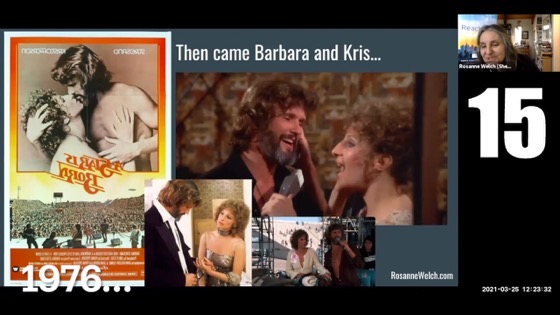
1976 comes along and this is Barbra Streisand and Kris Kristofferson. So 54 or jump into 76. It’s kind of like once every generation there’s an interest and a need for this movie. Partially because female creatives, whether they be writers or actresses, see this as a great piece to work from and a great way to reflect on their moment in culture right? So this is a big fancy deal. Look at these great photographs. Let me tell you, this is going to be written by Joan Didion and John Gregory Dunn. They are a married couple who write their own novels as you see here and work out of New York. They get hired to do this and Joan is going to have her own imprint on it. We’re going to see that in a second. I also want to highlight the fact that John Gregory Dunn wrote this marvelous book if you’ve never read it called Monster: Living Life Off the Big Screen. It’s about the writing of this film Up Close and Personal, which was meant to be the story of Jessica Savitch, an anchorwoman who died when she was high on cocaine and drove her car into a lake and drown and by the time they were done it had nothing to do with her at all and so this tells you the eight-year struggle to get the movie made out of the Disney company. It’s a really a good inside look at how writers and producers work with studios.
Watch this entire presentation
Connections at conferences matter! Through the most recent SCMS, I met Vicki Callahan, whose film history focus right now is on Mabel Normand. When she learned I could put together a lecture on the importance of the female voice in the A Star is Born franchise she asked me to give that lecture to her master students.
It made for a great opportunity for me to hone the ideas I’m working on for a chapter on that franchise that I’m writing for a new book from Bloomsbury: The Bloomsbury Handbook Of International Screenplay Theory. It’s always nice when one piece of research can be purposed in other ways – and it’s always fun revisiting such a female-centric film franchise – one that drew the talents of such powerful performers as Janet Gaynor, Judy Garland, Barbara Streisand, and Lady Gaga.
I enjoyed sharing the names and careers of women like Peg Lynch, Gerturde Berg, Selma Diamond and D.C. Fontana to the members who gathered on Zoom last Wednesday morning. There are so many more I could have talked about whose names don’t appear in mainstream books about the history of television so we have to learn who they are and carry those names forward ourselves. It’s one of the missions of the Stephens College MFA in TV and Screenwriting – and has been one of my missions all my life.
Transcript:
Well good morning everybody. I am going to dive right in so that we have a chance to get started. So I’m going to share my screen and you’re going to be able to see some photographs of some of these most wonderful women who are part of early Hollywood and early television and to me, they’re the people that we’re here to talk about right? So one of the beautiful things we have to do is look at who came before us. I teach a class in tv and screenwriting and I want people to recognize the people on whose shoulders we stand. So today we’re going to talk about the women of early tv. There are many more women to love than just Lucy. She’s the only one we hear about. She’s done some good work and we want to talk about that but we want to speak to all these other women who are so important. A little background on me very quickly. I’m a television writer. I worked on these programs. Touched by an Angel. Beverly Hills 90210 and Picket Fences which was a marvelous show and I also did a little documentary work with ABC News Nightline. So very excited about that. I’m also very happy with the fact that these are books that I have written. Particularly this one is about women in early Hollywood screenwriters and that interests me very much. So of course this is also an Encyclopedia on Women in American History and the Arts. It’s a four-volume set we put out a couple of years ago and we won a couple of awards from National Library Associations so we’re happy about that. I’m also on the board — the editorial board — for the Journal of Screenwriting and Written By magazine which is the magazine of the Writers Guild where we interview certain tv writers every week and also movie writers and it is free online at writtenby.org, if you’re interested in reading about people in the arts these days in the media arts.
Many thanks to Janice Law of the American Women Writers National Museum who invited me to give a short talk on The Women of Early TV.
I enjoyed sharing the names and careers of women like Peg Lynch, Gerturde Berg, Selma Diamond and D.C. Fontana to the members who gathered on Zoom last Wednesday morning. There are so many more I could have talked about whose names don’t appear in mainstream books about the history of television so we have to learn who they are and carry those names forward ourselves. It’s one of the missions of the Stephens College MFA in TV and Screenwriting – and has been one of my missions all my life.
Watch this entire presentation
Women pioneers who created, produced or shepherded many of America’s most wildly popular, early television programs will be profiled by Dr. Rosanne Welch.

![21 The Husband from Concord Days: Margaret Fuller in Italy [Video]](https://rosannewelch.com/wp-content/uploads/2021/12/rmw-concord-day-2021-fuller-rome-21.jpg)

![02 Peg Lynch from “VISIBLE STARS: Women in Early TV” for the American Women Writers National Museum [Video]](https://rosannewelch.com/wp-content/uploads/2021/12/rmw-visible-stars-early-tv-02-1200x675.jpg)


![27 Queen Charlotte from Worry and Wonder | The Courier Thirteen Podcast [Video]](https://rosannewelch.com/wp-content/uploads/2021/12/rmw-courier-13-27.jpg)