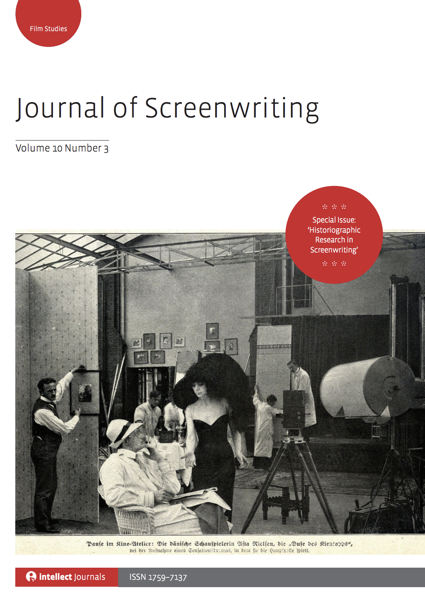
Announcing the Journal of Screenwriting Special Issue: Women in Screenwriting with Editors, Dr. Rosanne Welch and Dr. Rose Ferrell

I’m happy to announce the publication of a special issue of the Journal of Screenwriting focused on “Women in Screenwriting” that I co-edited with my SRN colleague Rose Ferrell, lecturer at the Western Australian Academy of Performing Arts, at Edith Cowan University. 

While focusing on females was our first mandate, our second mandate was to be as international as possible.  This issue, then, includes articles about women in screenwriting covering five continents including countries such as Japan, China, Syria, Argentina, Brazil, Peru, Zimbabwe and Canada. — Rosanne

Announcing the Journal of Screenwriting Special Issue: Women in Screenwriting with Editors, Dr. Rosanne Welch and Dr.  Rose Ferrell


Contents
Volume (11): Issue (3)
Cover date: 2020

  • Editorial introduction by Rose Ferrell, Rosanne Welch
  • Tang Cheng: The first female animation screenwriter and director in the People’s Republic of China by Shaopeng Chen
  • Scouting for scripts: Mizuki Yōko and social issue film in post-war Japan by Lauri Kitsnik
  • Who is the author of Neria (1992) – and is it a Zimbabwean masterpiece or a neo-colonial enterprise? by Agnieszka Piotrowska
  • The Hakawati’s Daughter: How the Syrian revolution inspired a rewrite by Rana Kazkaz
  • The silent women: The representation of Israeli female soldiers in Israeli women’s films by Mira Moshe, Matan Aharoni
  • How the scripts of Latin American screenwriters Lucrecia Martel (Argentina), Anna Muylaert (Brazil) and Claudia Llosa (Peru) have made a mark on the world stage by Margaret McVeigh, Clarissa Mazon Miranda
  • ‘Polite, no chill’ for the win: How Emily Andras engaged fans and overcame problematic tropes in Wynonna Earp by Tanya N. Cook
  • Battle of the sketches: Short form and feminism in the comedy mode by Stayci Taylor
  • Anita Loos Rediscovered: Film Treatments and Fiction, Cari Beauchamp and Mary Anita Loos (eds) (2003) by Cierra Winkler
  • Modern Film Dramaturgy: An Introduction, Kristen Stutterheim (2019) by Andrew Wickwire
  • Nobody’s Girl Friday: The Women Who Ran Hollywood, J. E. Smyth (2018) by Toni Anita Hull
  • How to Write for Moving Pictures: A Manual of Instruction and Information, Marguerite Bertsch (1917) by Diane Barley

Read article abstracts


Journal of screenwriting 94737 800x600

The Journal of Screenwriting is an international double-blind peer-reviewed journal that is published three times a year. The journal highlights current academic and professional thinking about the screenplay and intends to promote, stimulate and bring together current research and contemporary debates around the screenplay whilst encouraging groundbreaking research in an international arena. The journal is discursive, critical, rigorous and engages with issues in a dynamic and developing field, linking academic theory to screenwriting practice. 

Get your copy and subscription to the Journal of Screenwriting Today!


* A portion of each sale from Amazon.com directly supports our blogs
** Many of these books may be available from your local library. Check it out!

Learn more about the Stephens College MFA in TV and Screenwriting in this Q&A with Executive Director, Dr. Rosanne Welch

I had the pleasure of sitting down with Alex Miller, the Senior Director of Admissions at Stephens College the other day to talk about our MFA in TV and Screenwriting.

Alex had collected some of the basic questions asked by applicants so we answered them over this short 10 minute video. 

If you’d like to know what sort of activities fill the days during our 10 day residency intensive or wonder about the composition of our cohorts, or what type of classes we offer that are unique to our program — here’s the place to find out. — Rosanne

Learn more about the Stephens College MFA in TV and Screenwriting in this Q&A with Executive Director, Dr, Rosanne Welch

Learn more about the Stephens College MFA in TV and Screenwriting in this Q&A with Executive Director, Dr, Rosanne Welch

Learn more about the Stephens College MFA in TV and Screenwriting

and

Apply Today!

“Words Matter. Writers Matter. Women Writers Matter.” via Instagram

Words Matter. Writers Matter. Women Writers Matter

My simple philosophy…

Words Matter.

Writers Matter.

Women Writers Matter.

Follow me on Instagram

02 Writers Matter from There And Back Again: Writing and Developing for American TV [Video] (1 minute 3 seconds)

02 Writers Matter from There And Back Again: Writing and Developing for American TV [Video] (1 minute 3 seconds);

Thanks to the gracious invitation from my Screenwriting Research Network colleague Paolo Russo – and a grant he was able to procure (and in the before-Covid time) I was able to spend a week at Oxford Brookes University working with the screenwriting masters students in Paolo’s course. At the culmination of the week, I gave this lecture on how writers rooms worked in the States.

Transcript:

I do teach at Stephens College which is located in Missouri but we teach low-residency so they do everything online but they come to Hollywood — which is where I live — for 10 days twice a year and that’s a lovely thing. It’s at the Jim Henson Studios so there’s Kermit saying hi to you when you come in. Very lovely and very welcoming to see Kermit every morning. I have a teaching philosophy which is pretty simple. Words matter. Writers matter. Women writers matter. Thank you very much. Yes Indeed. We haven’t thought about women a lot over the years and I do. One of the things I think we need to think about — this is a Facebook post that I saw the other day and – how words can be misused. So I don’t want to get too political on you. I’m coming from a place where there’s a lot of politics going on, as you can imagine, but think about how these words were misused right? Take a little second. Your brain will wrap around the mistake in these words. Think about it you could have written that a different way but they had an opinion they wanted to put out, right, so words are important.

Watch this entire presentation

Subscribe to Rosanne’s Channel and receive notice of each new video!


* A portion of each sale from Amazon.com directly supports our blogs
** Many of these books may be available from your local library. Check it out!
† Available from the LA Public Library

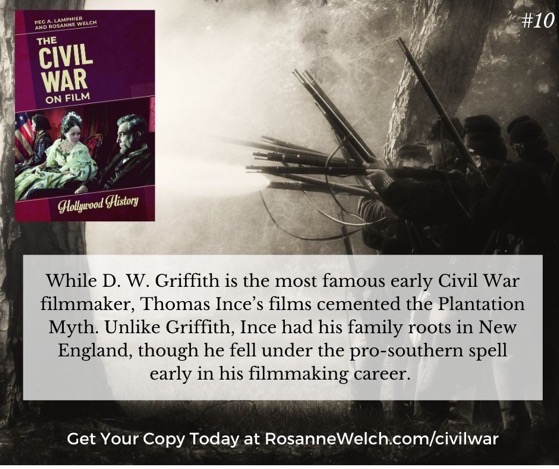
The Civil War On Film – 10 in a series – …Thomas Ince’s films cemented the Plantation Myth.

The Civil War On Film - 10  in a series - ...Thomas Ince’s films cemented the Plantation Myth.

While D. W. Griffith is the most famous early Civil War filmmaker, Thomas Ince’s films cemented the Plantation Myth. Unlike Griffith, Ince had his family roots in New England, though he fell under the pro-southern spell early in his filmmaking career.

Movies profiled in this book:

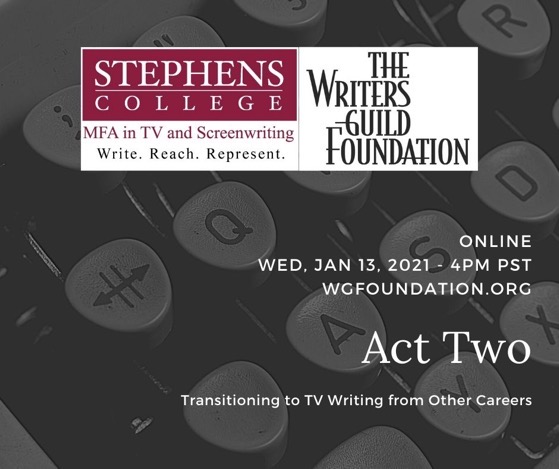
Panel Discussion: Act Two: Transitioning to TV Writing from Other Careers – Wed, January 13, 2021 – 4pm PST – RSVP Today!

I’m proud to announce the next panel I’m moderating with the Writers Guild Foundation for our Stephens College MFA in TV and ScreenwritingAct Two: Transitioning to TV Writing from Other Careers

Panel Discussion: Act Two: Transitioning to TV Writing from Other Careers - Wed, January 13, 2021 - 4pm PST - RSVP Today!

The WGF may have hit a pause on our live events, but thanks to technology, we’re aiming to provide more access to advice and knowledge from film and TV writers while we’re all social distancing. Over the last few months, we’ve been hosting free Zoom panels about craft and all things relevant to writers.

For this session, we team up with Stephens College MFA in TV and Screenwriting for a discussion on transitioning to TV writing from other careers. Learn how our panel of TV writers and producers made the jump to television, how their previous experiences inform their writing, and how that lens impacts their approach in the writers room.

Panelists:

  • Zoanne Clack, M.D., MPH – Executive Producer, Grey’s Anatomy. Former career: Emergency room physician
  • Rashaan Dozier-Escalante – Staff Writer, SEAL Team. Former career: Senior Physical Security Analyst for federal agencies, U.S. Army Reserve veteran
  • Calaya Michelle Stallworth, Ph.D – Executive Story Editor, Fear of the Walking Dead. Former career: English professor at Spelman College, publishing
  • Moderated by Dr. Rosanne Welch, Director of Stephens College MFA in TV and Screenwriting.

Panel starts at 4:00pm Pacific time.

Space is limited so RSVP now. After signing up, you’ll receive information on how to access the Zoom panel.

If you have any questions, please feel free to reach out to us at events@wgfoundation.org.

For anyone who was unable to RSVP for the panel, we will record and post it at a later date.

From The Journal Of Screenwriting V3 Issue 1: Imitation and adaptation: A screenwriting pedagogy by Debbie Danielpour

Highlighting the articles in the past editions of the Journal of Screenwriting, of which I am the Book Reviews Editor. Hopefully these abstracts will entice you to did a little deeper into the history and future of screenwriting. — Rosanne


Imitation and adaptation: A screenwriting pedagogy by Debbie Danielpour

Because originality is highly valued in all the arts, it initially appears counterproductive to teach screenwriting students the craft by encouraging them to imitate established genres or to adapt literature. This pedagogical method, however, teaches students genre-specific narrative structure and conventions, avoids the paralysis that sometimes comes with ‘complete’ artistic freedom and ultimately allows students to discern the qualities of their unique ‘voice’. Countless contemporary American films are adaptations, sequels, parodies or mashups, yet many fear that learning via imitation will cause students to write derivative or cliché scripts. By exploring the history of emulation in art and the fact that the value placed on originality is relatively new, the pedagogic push for originality starts to appear short-sighted. Further analysis reveals how reaching for ‘highly original’ may produce innovation but few screenplays of critical value. Identifying an example of ‘original’ within the genre boundaries of the horror screenplay demonstrates how a screenwriter can break new ground while still writing within the conventions of the genre. Fiction to Film Adaptations also prove to be highly innovative and original works, ultimately refining the definition of creativity, innovation and originality in screenplay writing.


The Journal of Screenwriting is an international double-blind peer-reviewed journal that is published three times a year. The journal highlights current academic and professional thinking about the screenplay and intends to promote, stimulate and bring together current research and contemporary debates around the screenplay whilst encouraging groundbreaking research in an international arena. The journal is discursive, critical, rigorous and engages with issues in a dynamic and developing field, linking academic theory to screenwriting practice. 

Get your copy and subscription to the Journal of Screenwriting Today!


* A portion of each sale from Amazon.com directly supports our blogs
** Many of these books may be available from your local library. Check it out!

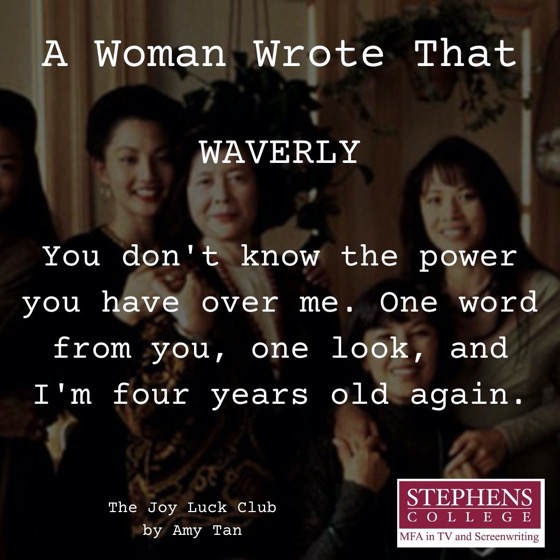
A Woman Wrote That – 6 in a series – The Joy Luck Club by Amy Tan

This new “A Woman Wrote That” post is an echo of the Writers Guild campaign of a few years ago (“A Writer Wrote That”) where they noted famous movie quotes and credited the screenwriter rather than the director.  The difference here being that we will be posting lines from films written by female screenwriters.  Feel free to share! — Rosanne

A Woman Wrote That - 6 in a series - The Joy Luck Club by AmyTan

WAVERLY: “You don’t know the power you have over me. One word from you, one look, and I’m four years old again.”

Where’s Her Movie? Astronomer, Margaret Harwood – 4 in a series

“Where’s HER Movie” posts will highlight interesting and accomplished women from a variety of professional backgrounds who deserve to have movies written about them as much as all the male scientists, authors, performers, and geniuses have had written about them across the over 100 years of film.  This is our attempt to help write these women back into mainstream history.  — Rosanne

Where's Her Movie? Astronomer, Margaret Harwood - 4 in a series

Observatory Photo By Versageek – Own work, CC BY-SA 3.0

from Wikipedia…

After graduating college, she worked at the Harvard Observatory and taught in private schools in the Boston area. In 1912, an astronomical fellowship was created for women to work at Maria Mitchell Observatory; Harwood was the first recipient of the fellowship, receiving $1,000.[2][3] In 1916, at 30 years old, Harwood was named director of Mitchell Observatory, and worked there from 1916 until her retirement in 1957.[2] Her specialty, photometry, involved measuring variation in the light of stars and asteroids, particularly that of the small planet Eros. A member of the American Astronomical Society and Fellow of the Royal Astronomical Society, she traveled widely in Europe and the United States. She was the first woman to gain access to the Mount Wilson Observatory, the world’s largest observatory at the time.[4]

In 1917, she discovered the asteroid 886 Washingtonia four days before its formal recognition by George Peters.[5] At the time, “senior people around her advised her not to report it as a new discovery because it was inappropriate that a woman should be thrust into the limelight with such a claim”.[6][7] However, Harwood did send her photographs of her discovery to Peters for him to include in his study of the asteroid’s orbit.[6] In 1960, an asteroid discovered at Palomar, was named in her honor, 7040 Harwood.[6][3]

01 Introduction from There And Back Again: Writing and Developing for American Television]: from Freelancing to Writers Rooms [Video] (1 minute)

01 Introduction from There And Back Again: Writing and Developing for American Television]: from Freelancing to Writers Rooms [Video] (1 minute)

Thanks to the gracious invitation from my Screenwriting Research Network colleague Paolo Russo – and a grant he was able to procure (and in the before-Covid time) I was able to spend a week at Oxford Brookes University working with the screenwriting masters students in Paolo’s course. At the culmination of the week, I gave this lecture on how writers rooms worked in the States.

Transcript:

As Paolo said — so I won’t spend a lot of time on it — these are the shows –these are the books I’ve done. Sorry. Largely a big Doctor Who fan. Any Doctor Who fans in the house. Really we’ll talk a little bit about the writing of that. It’s quite a brilliant show, I think. These are most of the things I’ve done. Also, love Torchwood has also been quite well done. I am the book review editor, so if you’re Masters students — when you graduate — you can email me, and if there’s a book you’d like to have for free — because they don’t pay you to write in journals — you can review the book and I’ll have it sent to you so you can do that and it’s a credit for you so it’s a lovely thing and Written By Magazine is the magazine of the Writers Guild. You can read this online for free if you go to writtenby.com. You go to WGA, which is our website for the Writer’s Guild, and every two months or so it comes out. Always interviews with writers and showrunners, movie film writers, people like that, so it’s really I think an excellent thing it’s like having a guest speaker come to you and very in-depth interviews, right? We’ll talk about some of them that I’ve done over time.

Watch this entire presentation

Subscribe to Rosanne’s Channel and receive notice of each new video!


* A portion of each sale from Amazon.com directly supports our blogs
** Many of these books may be available from your local library. Check it out!
† Available from the LA Public Library