
Join our low-residency MFA in TV and Screenwriting to share in our mission of bringing more female and underrepresented voices into mainstream media.
On Screenwriting and Media with Dr. Rosanne Welch
Writing, Film, Television and More!
Join our low-residency MFA in TV and Screenwriting to share in our mission of bringing more female and underrepresented voices into mainstream media.
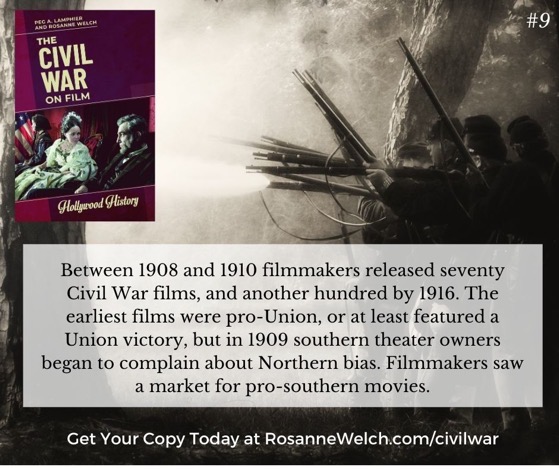
Between 1908 and 1910 filmmakers released seventy Civil War films, and another hundred by 1916. The earliest films were pro-Union, or at least featured a Union victory, but in 1909 southern theater owners began to complain about Northern bias. Filmmakers saw a market for pro-southern movies.
Movies profiled in this book:
Highlighting the articles in the past editions of the Journal of Screenwriting, of which I am the Book Reviews Editor. Hopefully these abstracts will entice you to did a little deeper into the history and future of screenwriting. — Rosanne
My investigations into transmedia and multi-platform production practices reveal that writers for film and TV could soon need to become content creators (directors or producers or craftspeople in addition to being writers), blurring the distinctions between concept, creation, production and post-production. This article explores this phenomenon of multi-platform/transmedia production, mostly in the United Kingdom, and in particular its storytelling processes through a study of a small but successful company, Bellyfeel, based in Manchester, United Kingdom. Bellyfeel have given me complete access to their work and established an online environment where I can study their practice/writing. I will contextualize the creative practice of the company with the work of Henry Jenkins, and suggest that, in the contemporary marketplace, it may be necessary for the writer to be focused on the production process and the technological aspects of this process in order to understand how product is created and functions in this new environment.
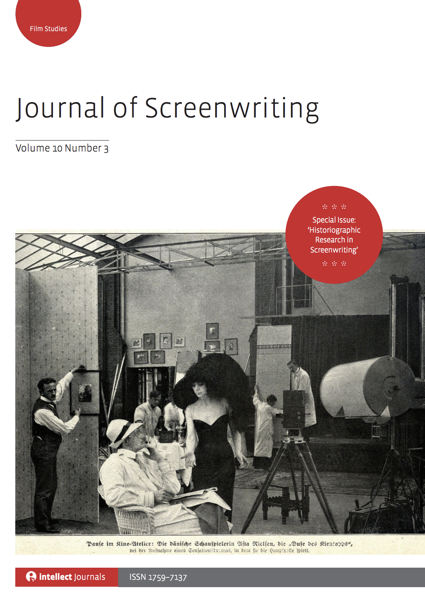
The Journal of Screenwriting is an international double-blind peer-reviewed journal that is published three times a year. The journal highlights current academic and professional thinking about the screenplay and intends to promote, stimulate and bring together current research and contemporary debates around the screenplay whilst encouraging groundbreaking research in an international arena. The journal is discursive, critical, rigorous and engages with issues in a dynamic and developing field, linking academic theory to screenwriting practice.
Get your copy and subscription to the Journal of Screenwriting Today!
* A portion of each sale from Amazon.com directly supports our blogs
** Many of these books may be available from your local library. Check it out!
“Where’s HER Movie” posts will highlight interesting and accomplished women from a variety of professional backgrounds who deserve to have movies written about them as much as all the male scientists, authors, performers, and geniuses have had written about them across the over 100 years of film. This is our attempt to help write these women back into mainstream history. — Rosanne
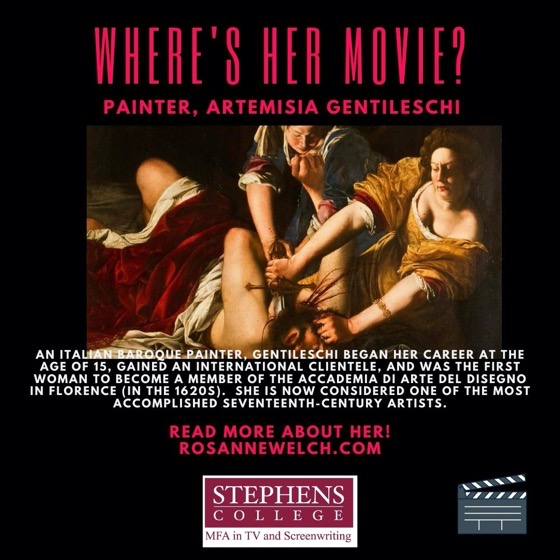
An Italian Baroque painter, Gentileschi began her careet at the age of 15, gained an international clientele, and was the first woman to become a member of the Accademia di Arte del Disegno in Florence (in the 1620s).
She is now considered one of the most accomplished seventeenth-century artists.
Read more about Artemisia Gentileschi
from Wikipedia…
Artemisia Lomi or Artemisia Gentileschi (US: /ˌdʒɛntiˈlɛski/,[1][2] Italian: [arteˈmiːzja dʒentiˈleski]; July 8, 1593 – c. 1656) was an Italian Baroque painter, now considered one of the most accomplished seventeenth-century artists, initially working in the style of Caravaggio. She was producing professional work by the age of fifteen.[3] In an era when women had few opportunities to pursue artistic training or work as professional artists, Artemisia was the first woman to become a member of the Accademia di Arte del Disegno in Florence and she had an international clientele.[4][5]
Many of Artemisia’s paintings feature women from myths, allegories, and the Bible, including victims, suicides, and warriors.[6] Some of her best known subjects are Susanna and the Elders (particularly the 1610 version in Pommersfelden), Judith Slaying Holofernes (her 1614–1620 version is in the Uffizi gallery), and Judith and Her Maidservant (her version of 1625 is in the Detroit Institute of Arts).
Artemisia was known for being able to depict the female figure with great naturalism,[7][8] and for her skill in handling color to express dimension and drama.[9][10]
This new “A Woman Wrote That” post is an echo of the Writers Guild campaign of a few years ago (“A Writer Wrote That”) where they noted famous movie quotes and credited the screenwriter rather than the director. The difference here being that we will be posting lines from films written by female screenwriters. Feel free to share! — Rosanne
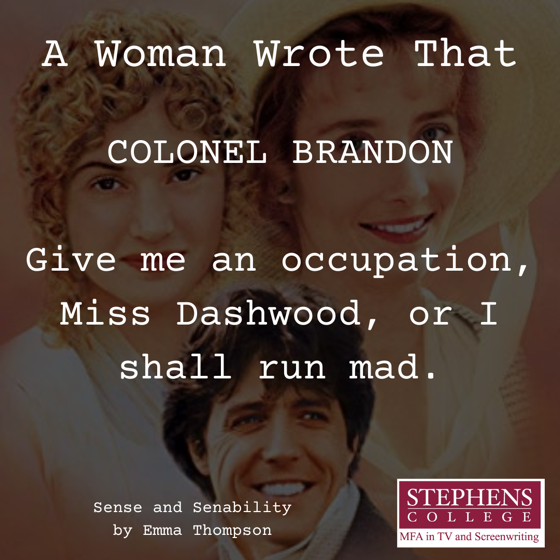
COLONEL BRANDON: “Give me an occupation, Miss Dashwood, or I shall run mad.”

Thanks to the gracious invitation from my Screenwriting Research Network colleague Paolo Russo – and a grant he was able to procure (and in the before-Covid time) I was able to spend a week at Oxford Brookes University working with the screenwriting masters students in Paolo’s course. At the culmination of the week, I gave this lecture on how writers rooms worked in the States.
Subscribe to Rosanne’s Channel and receive notice of each new video!
* A portion of each sale from Amazon.com directly supports our blogs
** Many of these books may be available from your local library. Check it out!
† Available from the LA Public Library

The last component of the Lost Cause, and perhaps the key component, is the cherished belief in happy slaves and sub-human African Americans in need of civilization and Christianity. Lost Cause adherents deny the immorality and cruelty of slavery and insist slavery was a benign and misunderstood institution.
Movies profiled in this book:
Highlighting the articles in the past editions of the Journal of Screenwriting, of which I am the Book Reviews Editor. Hopefully these abstracts will entice you to did a little deeper into the history and future of screenwriting. — Rosanne
Television and film screenwriters: How to reach a global audience by Philippe Perebinossoff
The focus of this article will be on an examination of American television and film projects and their inceptions and/or receptions in various marketplaces. In addition, the article will explore some of the specific cultural differences around the world that may be of importance to screenwriters.
The Journal of Screenwriting is an international double-blind peer-reviewed journal that is published three times a year. The journal highlights current academic and professional thinking about the screenplay and intends to promote, stimulate and bring together current research and contemporary debates around the screenplay whilst encouraging groundbreaking research in an international arena. The journal is discursive, critical, rigorous and engages with issues in a dynamic and developing field, linking academic theory to screenwriting practice.
Get your copy and subscription to the Journal of Screenwriting Today!
* A portion of each sale from Amazon.com directly supports our blogs
** Many of these books may be available from your local library. Check it out!
This new “A Woman Wrote That” post is an echo of the Writers Guild campaign of a few years ago (“A Writer Wrote That”) where they noted famous movie quotes and credited the screenwriter rather than the director. The difference here being that we will be posting lines from films written by female screenwriters. Feel free to share! — Rosanne

Louise: “You get what you settle for.”
Thelma and Louise Script (PDF)

In keeping with the binary nature of ideologies, the honorable Southern generals stand in contrast to venal, uncouth Northerners. The Lost Cause insists upon the illegitimacy of Abraham Lincoln’s election and his personal villainy as a backwoods barbarian, miscegenationist and all-purpose bad dude.
Movies profiled in this book: