People are beginning to read screenplays as literature…

People are beginning to read screenplays as literature...


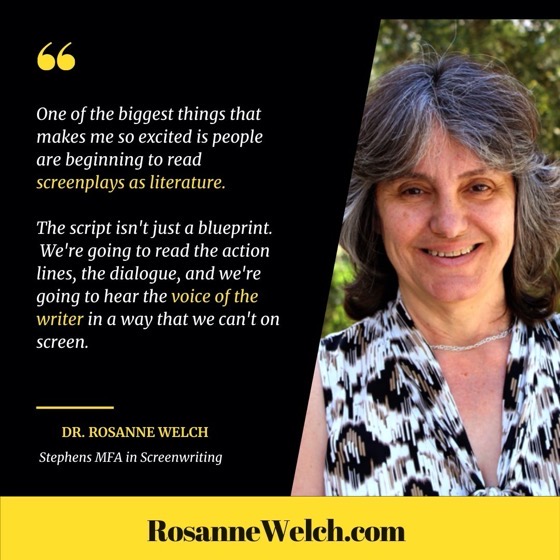
One of the biggest things that makes me so excited is people are beginning to read screenplays as literature.

The script isn’t just a blueprint. We’re going to read the action lines, the dialogue, and we’re going to hear the voice of the writer in a way that we can’t on screen.


Follow me on Instagram


08 Monkees Writers and History from There And Back Again: Writing and Developing for American TV [Video] (1 minute)

08 Monkees Writers and History from There And Back Again: Writing and Developing for American TV [Video] (1 minute)

Thanks to the gracious invitation from my Screenwriting Research Network colleague Paolo Russo – and a grant he was able to procure (and in the before-Covid time) I was able to spend a week at Oxford Brookes University working with the screenwriting masters students in Paolo’s course. At the culmination of the week, I gave this lecture on how writers rooms worked in the States.

Transcript:

I wrote this article for Written By which is about these writers and it was very interesting to go back and speak to them in their 80s about what their experience had been to write hippie characters in the 60s and it was all about how they shared stories. Some of them were more conservative. Some of them were already becoming hippies. Treva tells a funny story about her mother not understanding what it meant when she said she smoked pot. Her mother thought she was doing something in the kitchen. She didn’t divest her of that opinion right? So they all had a different attitude toward how they wrote but in one-hour dramas, things were done differently back in the day as everyone is fond of saying. They used writer pools. They would simply hire you under contract at a studio — Universal, Warner Brothers, Disney, whatever it was — and you literally sat on the line now that’s a that’s a pool of women typing. That’s how scripts were done before there were computers right? They had a bunch of women in a room. They had that ditto paper and you type and you get three copies with the little purple stuff and think about that. You’re doing that 24/7. If you’re doing Gone with the Wind, how many copies of that script do you have to consistently keep typing so that it’s ready.

Watch this entire presentation

Subscribe to Rosanne’s Channel and receive notice of each new video!


* A portion of each sale from Amazon.com directly supports our blogs
** Many of these books may be available from your local library. Check it out!
† Available from the LA Public Library

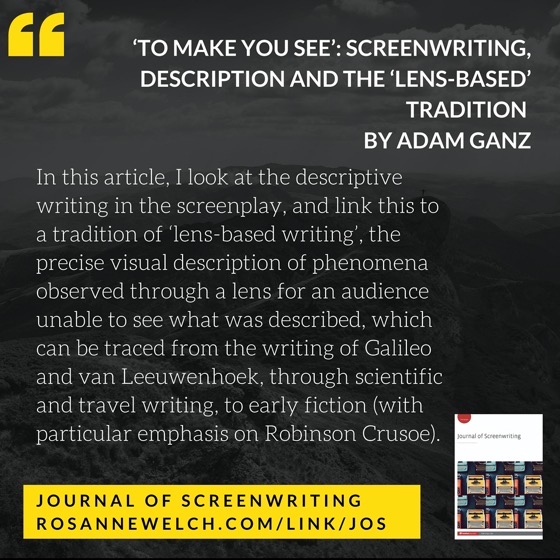
From The Journal Of Screenwriting V4 Issue 1: ‘To make you see’: Screenwriting, description and the ‘lens-based’tradition by Adam Ganz

Highlighting the articles in the past editions of the Journal of Screenwriting, of which I am the Book Reviews Editor. Hopefully these abstracts will entice you to did a little deeper into the history and future of screenwriting. — Rosanne


‘To make you see’: Screenwriting, description and the ‘lens-based’tradition by Adam Ganz
  
In this article I look at the descriptive writing in the screenplay, and link this to a tradition of ‘lens-based writing’, the precise visual description of phenomena observed through a lens for an audience unable to see what was described, which can be traced from the writing of Galileo and van Leeuwenhoek, through scientific and travel writing, to early fiction (with particular emphasis on Robinson Crusoe). I identify the most significant features of lens-based writing – the use of simple language and the separation of observation and deduction to communicate what has been seen through a simultaneous act of looking and framing, and show the similarities between this and screenwriting practice. I also make some observations about what this model can offer screenwriting research.

In this article I look at the descriptive writing in the screenplay, and link this to a tradition of ‘lens-based writing’, the precise visual description of phenomena observed through a lens for an audience unable to see what was described, which can be traced from the writing of Galileo and van Leeuwenhoek, through scientific and travel writing, to early fiction (with particular emphasis on Robinson Crusoe). I identify the most significant features of lens-based writing – the use of simple language and the separation of observation and deduction to communicate what has been seen through a simultaneous act of looking and framing, and show the similarities between this and screenwriting practice. I also make some observations about what this model can offer screenwriting research.


Journal of Screenwriting Cover

The Journal of Screenwriting is an international double-blind peer-reviewed journal that is published three times a year. The journal highlights current academic and professional thinking about the screenplay and intends to promote, stimulate and bring together current research and contemporary debates around the screenplay whilst encouraging groundbreaking research in an international arena. The journal is discursive, critical, rigorous and engages with issues in a dynamic and developing field, linking academic theory to screenwriting practice. 

Get your copy and subscription to the Journal of Screenwriting Today!


* A portion of each sale from Amazon.com directly supports our blogs
** Many of these books may be available from your local library. Check it out!

Watch Dr. Rosanne Welch on What Is a Western? Interview Series: When Women Wrote Westerns from the Autry Museum of the American West [Video] (27 minutes)

The Stephens College MFA in TV and Screenwriting is building a relationship with the Autry Museum of the American West since both organizations are devoted to bringing out more diverse and untold stories.  Last year we were able to take our cohort of graduating MFA candidates to the museum’s theatre for a showing of Michael Wilson’s Salt of the Earth and we had plans to present a film of our choice this year – but of course the pandemic changed all that.  Instead, Autry Curator Josh Garrett-Davis asked me if I would sit for an interview about female screenwriters in the western genre and so “When Women Wrote Westerns” came to be a part of their “What Is a Western? Interview Series”

I had a great time discussing so many wonderful women writers – from Jeanne MacPherson to D.C. Fontana to Edna Ferber to Emily Andras.  If you love westerns I suggest you watch Josh’s other interviews covering everything from the work of Native Americans in Western movies to films in the western-horror hybrid. — RMW Rosanne Signature for Web


Watch Dr. Rosanne Welch on What Is a Western? Interview Series: When Women Wrote Westerns from the Autry Museum of the American West [Video] (27 minutes)

As part of a series exploring the significance of the Western genre and the ways in which the movies shape our understanding of the American West, Autry Curator Josh Garrett-Davis interviews Professor Rosanne Welch about the women screenwriters of Hollywood and their contributions to the Western genre.

Find more information at the Autry Museum of the American West

07 The Monkees Writers Room from There And Back Again: Writing and Developing for American TV [Video] (44 seconds)

07 The Monkees Writers Room from There And Back Again: Writing and Developing for American TV [Video] (44 seconds)

Thanks to the gracious invitation from my Screenwriting Research Network colleague Paolo Russo – and a grant he was able to procure (and in the before-Covid time) I was able to spend a week at Oxford Brookes University working with the screenwriting masters students in Paolo’s course. At the culmination of the week, I gave this lecture on how writers rooms worked in the States.

Transcript:

Neil Simon actually wrote about writing for Sid Caesar in a play and that was all about glorifying what happened in the writer’s room. So it’s really a fun kind of play if you see it. I did some work on this tv show which is from the 60s. It’s also all on YouTube if you care to see it. It was a comedy about four guys who ran a rock and roll band. They’re literally still around and still touring. They’re in New Zealand right now. That’s how long-lasting the effect of the show was but these folks were all the writers of it including Treva Silverman — the woman up in the corner. She was the first woman to write alone on a series without a male partner — a husband or a guy who happened to work with her. That’s a big move. It seems ridiculous but that was a big moment in TV history.

Watch this entire presentation

Subscribe to Rosanne’s Channel and receive notice of each new video!


* A portion of each sale from Amazon.com directly supports our blogs
** Many of these books may be available from your local library. Check it out!
† Available from the LA Public Library

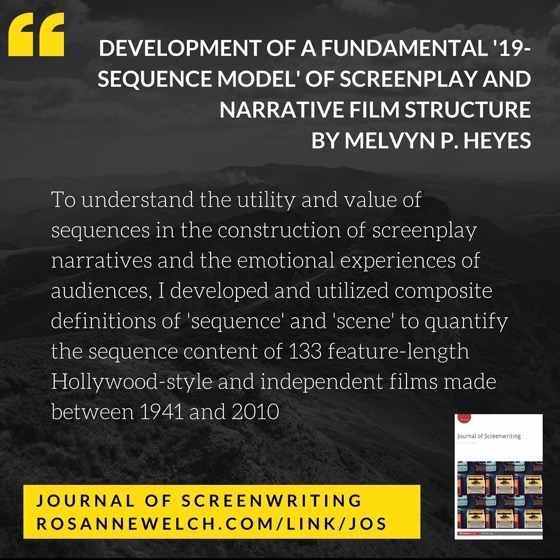
From The Journal Of Screenwriting V3 Issue 2: Development of a fundamental ’19-Sequence Model’ of screenplay and narrative film structure by Melvyn P. Heyes

Highlighting the articles in the past editions of the Journal of Screenwriting, of which I am the Book Reviews Editor. Hopefully these abstracts will entice you to did a little deeper into the history and future of screenwriting. — Rosanne


Development of a fundamental ’19-Sequence Model’ of screenplay and narrative film structure by Melvyn P. Heyes

To understand the utility and value of sequences in the construction of screenplay narratives and the emotional experiences of audiences, I developed and utilized composite definitions of ‘sequence’ and ‘scene’ to quantify the sequence content of 133 feature-length Hollywood-style and independent films made between 1941 and 2010 that were produced in the United States, Great Britain, Russia, Germany and Japan. The 3-Act Model was used as familiar reference points. I also contrasted the results to Frank Daniels’ 8-Sequence Model as described by Gulino. I argue the results directly support a fundamental 19-Sequence Model of screenplay and film narrative structure. I propose that sequences expand vicarious and empathic emotional experiences of audiences into ‘contextual emotional meaning’, where significant autonomous emotions are generated that create the enjoyable and satisfying experience of what the story means to both the characters and viewer.

From The Journal Of Screenwriting V3 Issue 2: Development of a fundamental '19-Sequence Model' of screenplay and narrative film structure by Melvyn P. Heyes


Journal of Screenwriting Cover

The Journal of Screenwriting is an international double-blind peer-reviewed journal that is published three times a year. The journal highlights current academic and professional thinking about the screenplay and intends to promote, stimulate and bring together current research and contemporary debates around the screenplay whilst encouraging groundbreaking research in an international arena. The journal is discursive, critical, rigorous and engages with issues in a dynamic and developing field, linking academic theory to screenwriting practice. 

Get your copy and subscription to the Journal of Screenwriting Today!


* A portion of each sale from Amazon.com directly supports our blogs
** Many of these books may be available from your local library. Check it out!

06 Inside The Writers Room from There And Back Again: Writing and Developing for American TV [Video] (43 seconds)

06 Inside The Writers Room from There And Back Again: Writing and Developing for American TV

Thanks to the gracious invitation from my Screenwriting Research Network colleague Paolo Russo – and a grant he was able to procure (and in the before-Covid time) I was able to spend a week at Oxford Brookes University working with the screenwriting masters students in Paolo’s course. At the culmination of the week, I gave this lecture on how writers rooms worked in the States.

Transcript:

What happens with writers rooms because this is the place where work gets done. Where stories get told, created, honed, in a particular way. The very beginning, this is what everybody thought. This is a writer’s room because comedies did use them. Comedians, we’re used to having three or four guys — generally, always guys — who travel with them and help them make funnier jokes. In America that was best seen in the Dick Van Dyke Show which you can see on youtube in a million different ways and Sally Rogers was the only woman anybody ever saw who wrote television which was kind of shocking but many women who came later defined her as a role model because that told them they could get in a room someday right? If they found the right kind of guys who would let them in.

Watch this entire presentation

Subscribe to Rosanne’s Channel and receive notice of each new video!


* A portion of each sale from Amazon.com directly supports our blogs
** Many of these books may be available from your local library. Check it out!
† Available from the LA Public Library

We need this message… via Instagram

We need this message... via Instagram

Great TV and Movies are built around the theme, you have to have friends. You have to have friends you can trust.

Look how powerful that has been. We need that message.

We go to movies and television shows – we go to stories – to learn that message.

Follow me on Instagram


From The Journal Of Screenwriting V3 Issue 2: Storytelling in Bhutanese cinema: Research context and case study of a film in development by Shohini Chaudhuri, Sue Clayton

Highlighting the articles in the past editions of the Journal of Screenwriting, of which I am the Book Reviews Editor. Hopefully these abstracts will entice you to did a little deeper into the history and future of screenwriting. — Rosanne


Storytelling in Bhutanese cinema: Research context and case study of a film in development by Shohini Chaudhuri, Sue Clayton

Screenwriter and director Sue Clayton and academic Shohini Chaudhuri consider storytelling structures in Bhutan, a country that has, until recently, been relatively culturally isolated but is now moving towards entering the global stage. As in the rest of South Asia, the dominant cinematic model in Bhutan is that of Bollywood, yet Buddhism, the oral tradition and supernatural beliefs form a rich repertoire of stories that screenwriters of the emerging film industry are increasingly attempting to mine. In this article, we show how cinematic storytelling in Bhutan functions as a kind of ‘secondary orality’ through our analyses of an earlier international co-production Travellers and Magicians (2003), two local DV films, and the film project that Clayton is developing in dialogue with Bhutanese writers, Jumolhari. We argue that Bhutan’s Buddhist, animist and oral traditions challenge and transform classically established cinema conventions of story structure, decentring individual human subjectivity as the controlling force and producing an altogether different kind of hero’s journey.


Journal of Screenwriting Cover

The Journal of Screenwriting is an international double-blind peer-reviewed journal that is published three times a year. The journal highlights current academic and professional thinking about the screenplay and intends to promote, stimulate and bring together current research and contemporary debates around the screenplay whilst encouraging groundbreaking research in an international arena. The journal is discursive, critical, rigorous and engages with issues in a dynamic and developing field, linking academic theory to screenwriting practice. 

Get your copy and subscription to the Journal of Screenwriting Today!


* A portion of each sale from Amazon.com directly supports our blogs
** Many of these books may be available from your local library. Check it out!
Drs. Rosanne Welch and Sarah Clark discuss The Monkees “Here Come the Monkees (Pilot)” episode on the Zilch Podcast’s Monkees 101 Series [Audio]

When I finished writing the book and going to book signings or conferences where I could keep talking about The Monkees I thought I was done.  Then Sarah Clark, PhD emailed and asked me if I’d like to do a segment called “Monkees 101” where we both put our PhD hats and talked about each episode in terms of how it fit into the world in which it aired – sociologically, ideologically and even sometimes politically – covering what was going on in the news the week the show aired and covering the lives of the crafts people who came together to make the show.  How could I say no?  Here’s our latest installment, “Here Come the Monkees (Pilot)”.

Drs. Rosanne Welch and Sarah Clark discuss The Monkees “Here Come the Monkees (Pilot)” episode on the Zilch Podcast's Monkees 101 Series [Audio]

Zilch #161 Monkees 101-10 “Here Come the Monkees (Pilot)” Zilch talks The Monkees TV show, Season 1 Episode 10 In the series pilot which aired November 14, 1966. “The group auditions for the Sweet Sixteen Party, and Davy falls for a sweet 16-year-old.” Aired 1/7/21

Listen Now