From The Journal Of Screenwriting V4 Issue 1: The unseen collaborator: Breaking down art to create modern narratives by Marie Regan

Highlighting the articles in the past editions of the Journal of Screenwriting, of which I am the Book Reviews Editor. Hopefully these abstracts will entice you to did a little deeper into the history and future of screenwriting. — Rosanne


The unseen collaborator: Breaking down art to create modern narratives by Marie Regan

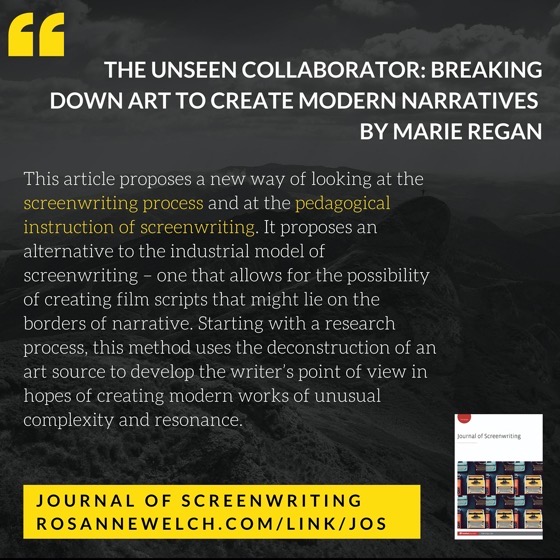
This article proposes a new way of looking at the screenwriting process and at the pedagogical instruction of screenwriting. It proposes an alternative to the industrial model of screenwriting – one that allows for the possibility of creating film scripts that might lie on the borders of narrative. Starting with a research process, this method uses the deconstruction of an art source to develop the writer’s point of view in hopes of creating modern works of unusual complexity and resonance. Citing examples from Bach, Munch and Melville, and films by Francois Girard, Peter Watkins and Claire Denis, the article suggests a method for screenwriters using the limit of an original artwork’s form to generate a unique narrative structure, and building on that structure by bringing the writer’s own contemporary perspective to the content concerns. It contends that this process works to renew the writer’s connection to form and, by working with an artwork the writer admires, pushes the writer into deeper engagement with her own point of view.
From The Journal Of Screenwriting V4 Issue 1: The unseen collaborator: Breaking down art to create modern narratives by Marie Regan


Journal of Screenwriting Cover

The Journal of Screenwriting is an international double-blind peer-reviewed journal that is published three times a year. The journal highlights current academic and professional thinking about the screenplay and intends to promote, stimulate and bring together current research and contemporary debates around the screenplay whilst encouraging groundbreaking research in an international arena. The journal is discursive, critical, rigorous and engages with issues in a dynamic and developing field, linking academic theory to screenwriting practice. 

Get your copy and subscription to the Journal of Screenwriting Today!


* A portion of each sale from Amazon.com directly supports our blogs
** Many of these books may be available from your local library. Check it out!

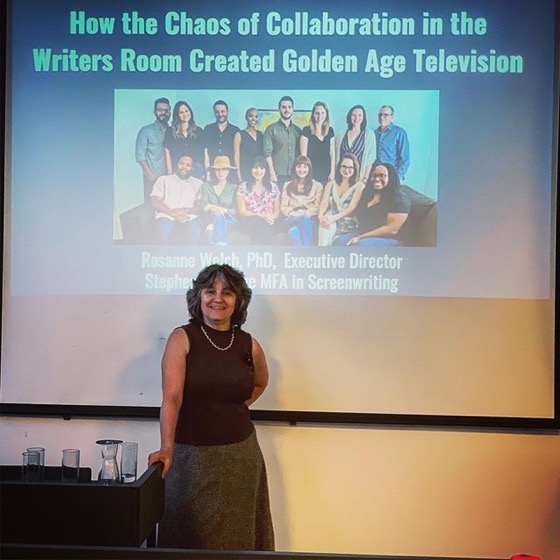
01 Introduction from How The Chaos Of Collaboration in the Writers Room Created Golden Age Television [Video]

With the full recording of “How The Chaos Of Collaboration in the Writers Room Created Golden Age Television”

01  Introduction from How The Chaos Of Collaboration in the Writers Room Created Golden Age Television [Video]

Subscribe to Rosanne’s Channel and receive notice of each new video!


When the folks hosting the conference announced their theme as “Screen Narratives: Chaos and Order” the word ‘chaos’ immediately brought to mind writers rooms. I offered a quick history of writers rooms (the presentations are only 20 minutes long) and then quoted several current showrunners on how they compose their rooms and how they run them.

Transcript

Always good to see everybody here. We’re all like on different time schedules so I’m still — I think it’s three in the morning in Los Angeles but that’s okay. Yes, we’re going to talk about this concept of chaos in writers’ rooms, which are really run in chaos, at least the ones in the United States. Just a quick background on who I am. I was in the business for several years. I wrote Picket Fences, Beverly Hills 90210 — which is a show that won’t die because they just did a live show or is just a little crazy and Touched By An Angel for a long time. So this is where I came from in television. This is what I’ve done in academia and writing. My favorite new book is a collection of essays written by many of my students about female screenwriters from the early days and giving us their backgrounds so I’m all about finding more women that we can write about and talk about in our classes. I think that’s important. I’m also the book review editor of the Journal of Screenwriting so if you have any books you’d like to review please let me know. I’d love to get you a free copy and get your review in the journal and also I’m on the editorial board for the Written By Magazine, which is the magazine of the Writers Guild of America. You can access that for free digitally online if you go to writtenby.com or go to wga.org and they’ll have a link to it, but every month we do interviews with either a film person or a television person or whole writer’s room from a show and I think it’s a great way to bring guest stars into a classroom from all over the world. Again, they’re obviously Americans although I interviewed Russell Davies several years ago so we do have some other folks come on into the magazine but it’s pretty cool.

For more information on the Screenwriting Research Network, visit

Screenwriting Research Network Conference, Porto, Portugal, All Sessions


Ready to present my talk yesterday at the Screenwriting Research Conference here in Porto, Portugal via Instagram

Follow me on Instagram


* A portion of each sale from Amazon.com directly supports our blogs
** Many of these books may be available from your local library. Check it out!

A Woman Wrote That – 16 in a series – Gilmore Girls, Wr: Amy Sherman-Palladino

This new “A Woman Wrote That” post is an echo of the Writers Guild campaign of a few years ago (“A Writer Wrote That”) where they noted famous movie quotes and credited the screenwriter rather than the director.  The difference here being that we will be posting lines from films written by female screenwriters.  Feel free to share! — Rosanne

A Woman Wrote That - 16 in a series - Gilmore Girls, Wr: Amy Sherman-Palladino

MICHEL

People are particularly stupid today. I can’t talk to any more of them.

Where’s Her Movie? Computer Scientist, Margaret Hamilton – 9 in a series

“Where’s HER Movie” posts will highlight interesting and accomplished women from a variety of professional backgrounds who deserve to have movies written about them as much as all the male scientists, authors, performers, and geniuses have had written about them across the over 100 years of film.  This is our attempt to help write these women back into mainstream history.  — Rosanne

Where's Her Movie? Computer Scientist, Margaret Hamilton - 9 in a series

Margaret Heafield Hamilton (born August 17, 1936) is an American computer scientist, systems engineer, and business owner. She was director of the Software Engineering Division of the MIT Instrumentation Laboratory, which developed on-board flight software for NASA’s Apollo program. She later founded two software companies—Higher Order Software in 1976 and Hamilton Technologies in 1986, both in Cambridge, Massachusetts.

Hamilton has published more than 130 papers, proceedings and reports about sixty projects and six major programs. She is one of the people credited with coining the term “software engineering”.[1]

On November 22, 2016, Hamilton received the Presidential Medal of Freedom from president Barack Obama for her work leading to the development of on-board flight software for NASA’s Apollo Moon missions. — Wikipedia

Dr. Rosanne Welch Joins Panel on Monkees Books with Plastic EP Live [Video] (54 minutes)

Many thanks to Fred Velez for telling me about Daniel Sam and his fun internet Monkees talk show — followed by thanks to Dan for inviting me onto  this discussion of all the great Monkees books out there. I enter the chat at the 15 minute mark in the video. — Rosanne

Plastic ep monkees 20210216

On Tuesday February 16th, 2021, the Plastic EP TV Facebook Live Monkees Discussion Panel  held a literary discussion on Monkees Books.

Participants included:

  • Fred Velez
  • Charles Rosenay
  • Ed Reilly
  • Michael A Ventrella
  • Mark Arnold
  • Natalie A Palumbo 
  • Special Guest, Dr. Rosanne Welch, Author of Why The Monkees Matter

Get your copy today!

From The Journal Of Screenwriting V4 Issue 1: expensive words, cheap images: ‘Scripting’ the adapted screenplay by Alex Munt

Highlighting the articles in the past editions of the Journal of Screenwriting, of which I am the Book Reviews Editor. Hopefully these abstracts will entice you to did a little deeper into the history and future of screenwriting. — Rosanne


expensive words, cheap images: ‘Scripting’ the adapted screenplay by Alex Munt

This article explores ‘scripting’ the adapted screenplay for budget film models, including microbudget features, DIY film-making and creative practice-led research. It highlights the lack of attention given to the adapted screenplay in the field of adaptation studies, and works with notions of intermediality, and transmediality, to privilege the screenplay as the primary site for creative interaction in the adaptation process. In the context of small-scale, budget film-making practices the focus is towards modes of scripting that rely on working with images, both as part of the screenplay form/format and more directly, in ‘writing’ with moving images, with the screenplay situated within production. This article argues that in consideration of the adapted screenplay, for budget film-making, the relationship between words and images is realigned. The impact of digital media culture together with the advance of digital film-making will accelerate this. Two case studies are presented. The first is Mala No he (1985), the debut feature film of Gus Van Sant, based on the novella by Walt Curtis. The second is LBF (2011), the author’s own debut feature film, based on the novel Living Between Fucks (2006) by Cry Bloxsome. This article aims to engage screenwriting researchers, independent/budget film-makers and creative arts practitioners.

From The Journal Of Screenwriting V4 Issue 1: expensive words, cheap images: ‘Scripting’ the adapted screenplay by Alex Munt


Journal of Screenwriting Cover

The Journal of Screenwriting is an international double-blind peer-reviewed journal that is published three times a year. The journal highlights current academic and professional thinking about the screenplay and intends to promote, stimulate and bring together current research and contemporary debates around the screenplay whilst encouraging groundbreaking research in an international arena. The journal is discursive, critical, rigorous and engages with issues in a dynamic and developing field, linking academic theory to screenwriting practice. 

Get your copy and subscription to the Journal of Screenwriting Today!


* A portion of each sale from Amazon.com directly supports our blogs
** Many of these books may be available from your local library. Check it out!

The Civil War On Film – 19 in a series – …so many white Americans have wished to live in a world in which African Americans are not angry over past and present injustices…

The Civil War On Film - 19 in a series - ...so many white Americans have wished to live in a world in which African Americans are not angry over past and present injustices...

This fictional vision of slavery was pervasive many years after the war, up to and including GWTW. In her book Clinging to Mammy (2007), Micki McElya posits the idea that “the myth of the faithful slave lingers because so many white Americans have wished to live in a world in which African Americans are not angry over past and present injustices, a world in which white people were and are not complicit, in which the injustices themselves—of slavery, Jim Crow, and ongoing structural racism—seem not to exist at all.”.

Movies profiled in this book:

Dr. Rosanne Welch Joins Panel on Monkees Books with Plastic EP Live – Tuesday February 16th, 2021, 8pm EST/5pm PST

Dr. Rosanne Welch Joins Panel on Monkees Books with Plastic LP Live - Tuesday February 16th, 2021, 8pm EST/5pm PST

Tuesday February 16th, 2021, the Plastic EP TV Facebook Live Monkees Discussion Panel will present a literary discussion on Monkees Books.

Tuesday February 16th, 2021, 8pm EST/5pm PST

Watch Live

Join Plastic EP and his distinguished, literary panel for a spirited discussion on Monkees Literature.

Participants:

  • Fred Velez
  • Charles Rosenay
  • Ed Reilly
  • Michael A Ventrella
  • Mark Arnold
  • Natalie A Palumbo 
  • Special Guest, Dr. Rosanne Welch, Author of Why The Monkees Matter

A Woman Wrote That – 15 in a series – Clueless – Wr: Amy Heckerling

This new “A Woman Wrote That” post is an echo of the Writers Guild campaign of a few years ago (“A Writer Wrote That”) where they noted famous movie quotes and credited the screenwriter rather than the director.  The difference here being that we will be posting lines from films written by female screenwriters.  Feel free to share! — Rosanne

A Woman Wrote That - 15 in a series - Clueless - Wr: Amy Heckerling

AMBER

Ms. Stoeger, my plastic surgeon doesn’t want me doing any activity where balls fly at my nose.

10 The Writer’s Voice from There And Back Again: Writing and Developing for American TV [Video] (1 minute 3 seconds)

10 The Writer's Voice from There And Back Again: Writing and Developing for American TV

Thanks to the gracious invitation from my Screenwriting Research Network colleague Paolo Russo – and a grant he was able to procure (and in the before-Covid time) I was able to spend a week at Oxford Brookes University working with the screenwriting masters students in Paolo’s course. At the culmination of the week, I gave this lecture on how writers rooms worked in the States.

Transcript:

Stephen Cannell — who I’m going to talk about briefly in a second — he was in a writer’s pool and he was asked to write an episode of this one day and the reason he stood out and became then his own showrunner was because he had the craziest little idea. Rather than worry about what’s the crime this week and what’s the problem the cops are involved with, he just thought what would happen if the police were assigned to work in a police car which kept breaking down all day. Just a funny little idea which then was the theme of the whole episode. How do you do your job when you’re not providing the proper equipment and that made other people in Universal buzz about this new cool writer and they pretty much thought he had a particular voice and to me that’s the most important thing and you hear this word a thousand times. What does it mean? How do you do it? What does it prove? I’m gonna make you do a little exercise practicing that because writer’s voice is style plus opinion. You have a style of writing and you have something to say, right? That’s the theme. If you don’t have a theme you have no reason to write anything.

Watch this entire presentation

Subscribe to Rosanne’s Channel and receive notice of each new video!


* A portion of each sale from Amazon.com directly supports our blogs
** Many of these books may be available from your local library. Check it out!
† Available from the LA Public Library