Event: ScriptChat with Dr. Rosanne Welch – Sunday, February 14, 2021 – 4PM PDT

I’m pleased to have been invited to be the guest on the weekly Twitter show #Scriptchat, hosted by editor Jeanne Veillette Bowerman.

On Sunday Februrary 14th at 4pm PDT we’ll be talking about behavior in a writers room, and the benefits of having an MFA in TV and Screenwriting.

If you haven’t checked in with their shows you should know that #Scriptchat brings the guests to the party so you can learn in a free, unbiased and respectful platform. Their #1 goal is to thoroughly enjoy spending an hour together every Sunday with writers working hard to improve and succeed, and they’re proud to have accomplished that time and time again, since 2009! – Rosanne

Event: ScriptChat with Dr. Rosanne Welch – Sunday, February 14, 2021 - 4PM PDT

ScriptChat with Dr. Rosanne Welch – Sunday, February 14, 2021

Wednesday, February 10, 2021
At 4 PM PDT – 5 PM PDT
TOPIC: Working in / behavior in a writers room, & benefits of having an MFA #WritingCommunity

@RosanneWelch – ##screenwriter, TV writer, novelist & Exec Dir, @stephenscollege MFA In TV & #Screenwriting

Engage via TwChat

Engage via TChat.io

Event: Stephens College MFA in TV and Screenwriting Open House – Wednesday, February 10, 2021

Wednesday, February 10, 2021

Wednesday, February 10, 2021
At 4 PM PDT – 5 PM PDT
 
Register Now

Explore the low-residency MFA in TV + Screenwriting with Executive Director Dr. Rosanne Welch. Our mission is to increase the impact of women and other under-represented voices in television and film. Our faculty and mentors include some of the best working writers in Hollywood, and our curriculum includes an in-depth look at the business side of TV and screenwriting.

Register Now

A Woman Wrote That – 13 in a series – Star Wars: The Empire Strikes Back (1980)

This new “A Woman Wrote That” post is an echo of the Writers Guild campaign of a few years ago (“A Writer Wrote That”) where they noted famous movie quotes and credited the screenwriter rather than the director.  The difference here being that we will be posting lines from films written by female screenwriters.  Feel free to share! — Rosanne

A Woman Wrote That - 13 in a series - Star Wars: The Empire Strikes Back (1980)

PRINCESS LEIA

Why, you stuck up, half-witted, scruffy-looking… nerf-herder.

People are beginning to read screenplays as literature…

People are beginning to read screenplays as literature...


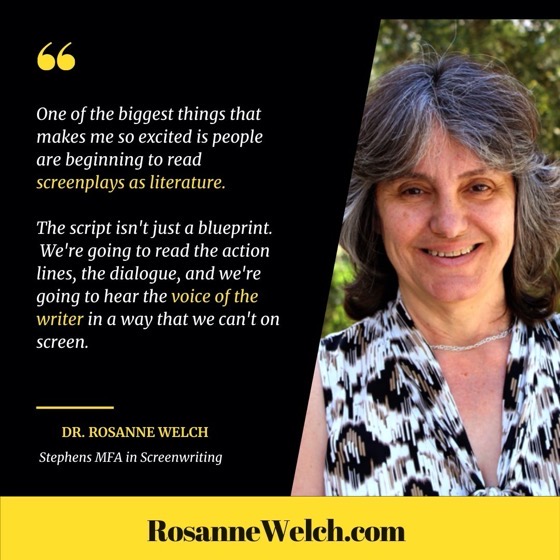
One of the biggest things that makes me so excited is people are beginning to read screenplays as literature.

The script isn’t just a blueprint. We’re going to read the action lines, the dialogue, and we’re going to hear the voice of the writer in a way that we can’t on screen.


Follow me on Instagram


The Civil War On Film – 16 in a series – As a producer interested in maximizing his profits, Selznick worked hard to head off any possible protest.

The Civil War On Film - 16 in a series - As a producer interested in maximizing his profits, Selznick worked hard to head off any possible protest.

As a producer interested in maximizing his profits, Selznick worked hard to head off any possible protest. The NAACP took issue with the use of the n-word in the book, so the script used the word “freedmen” instead. Selznick also conceded to veterans of the Union army. In the book, Scarlett shoots one of Sherman’s soldiers after he menaces her with rape. In the film the soldier becomes a deserter who was going against Sherman’s orders to not harm citizens on the March to the Sea.

Movies profiled in this book:

A Woman Wrote That – 12 in a series – Private Benjamin (1980) by Nancy Meyers

This new “A Woman Wrote That” post is an echo of the Writers Guild campaign of a few years ago (“A Writer Wrote That”) where they noted famous movie quotes and credited the screenwriter rather than the director.  The difference here being that we will be posting lines from films written by female screenwriters.  Feel free to share! — Rosanne

A Woman Wrote That - 12 in a series - Private Benjamin (1980) by Nancy Meyers

JUDY

Look at this place. The army couldn’t afford drapes?

Dr. Rosanne Welch Speaks On “An Introduction to the Women of Early TV: There are More Women than Lucy to Love“ for the American Women Writers National Museum [Virtual via Zoom]

I’m thrilled to have been asked to make a presentation for the American Women Writers National Museum (AWWNM) on the topic of “An Introduction to the Women of Early TV: There are More Women than Lucy to Love“.  I’ll be discussing the groundbreaking work of women from Gertrude Berg (one of the first women to create, write, produce and star in a long-running hit — The Goldbergs) to D.C. Fontana (Star Trek).    — RMW Rosanne Signature for Web


BannerTextRevFeb2011b<
State Meant 50 5 U NBannerArtRevFeb2011b2

RSVP Today! 
Email AWWNM1@gmail.com

Wed Feb 10, 2021 noon-12:45 EDT

“An Introduction to the Women of Early TV: There are More Women than Lucy to Love“

Sponsored by: American Women Writers National Museum

Time & Place: noon-12:45 p.m. EDT / 9 AM PDT via Zoom

All AWWNM programs are now via Zoom until further notice. Invitations are sent via email to AWWNM’s mailing list. RSVPS are REQUIRED in order to receive a link to a specific program. If you would like an invitation, email request to AWWNM1@gmail.com.

Dr. Rosanne Welch, Executive Director of the Stephens College MFA in TV and Screenwriting, Author, Historian and Book Reviews editor of the Journal of Screenwriting will profile pioneer women who created, produced and worked on many of America’s most wildly popular early TV Programs. 

“My goal is to rescue these talented women from historical oblivion”, she said.

Some of the women writers she will discuss are:

  • Lucille Ball (1911-1989) of “I Love Lucy” fame, who also ran Desilu production company and greenlighted the blockbuster Star Trek productions.
  • Treva Silverman (1936- ) winner of two Emmy awards for the brilliant comedy The Mary Tyler Moore Show.
  • D.C. Fontana (Dorothy Catherine) Fontana (1939-2019) a story editor of Star Trek
  • Leigh Brackett (1915-1878) known as “Queen of the Space Opera” who wrote on or worked on timeless films: The Big Sleep (1946), Rio Bravo (1959), The Long Goodbye (1973) and The Empire Strike Back (1980).
  • Peg Lynch (1915-2015) She wrote about 11,000 scripts for radio and TV

Watch Dr. Rosanne Welch on What Is a Western? Interview Series: When Women Wrote Westerns from the Autry Museum of the American West [Video] (27 minutes)

The Stephens College MFA in TV and Screenwriting is building a relationship with the Autry Museum of the American West since both organizations are devoted to bringing out more diverse and untold stories.  Last year we were able to take our cohort of graduating MFA candidates to the museum’s theatre for a showing of Michael Wilson’s Salt of the Earth and we had plans to present a film of our choice this year – but of course the pandemic changed all that.  Instead, Autry Curator Josh Garrett-Davis asked me if I would sit for an interview about female screenwriters in the western genre and so “When Women Wrote Westerns” came to be a part of their “What Is a Western? Interview Series”

I had a great time discussing so many wonderful women writers – from Jeanne MacPherson to D.C. Fontana to Edna Ferber to Emily Andras.  If you love westerns I suggest you watch Josh’s other interviews covering everything from the work of Native Americans in Western movies to films in the western-horror hybrid. — RMW Rosanne Signature for Web


Watch Dr. Rosanne Welch on What Is a Western? Interview Series: When Women Wrote Westerns from the Autry Museum of the American West [Video] (27 minutes)

As part of a series exploring the significance of the Western genre and the ways in which the movies shape our understanding of the American West, Autry Curator Josh Garrett-Davis interviews Professor Rosanne Welch about the women screenwriters of Hollywood and their contributions to the Western genre.

Find more information at the Autry Museum of the American West

New Book by IGE Lecturers Critique the Civil War in Films via PolyCentric [News]

New Book by IGE Lecturers Critique the Civil War in Films via PolyCentric [News]

Recently my co-author Peg Lamphier and I sat for an interview about our Civil War on Film book to discuss the American film industry’s depiction of the American Civil War and the mythologies and ideologies surrounding the experience of that war. 

We completely destroy any idea that there is something noble and admirable about the Confederacy. There is not. They fought to preserve human bondage. That should be morally revolting to all twenty-first century Americans and the fact that it is not is a testament to how far we still have to go to heal the wounds of our nation’s history of slavery.

Suddenly, the book seems even more timely than when we began writing it 2 years ago. — Rosanne


New Book by IGE Lecturers Critique the Civil War in Films 

For their third book project, lecturers Peg Lamphier and Roseanne Welch, in the Department of Interdisciplinary General Education, decided to write a book examining the American film industry’s depiction of the American Civil War. In their book, “The Civil War on Film,” the authors contend that American films are filled with mythologies and ideologies surrounding the experience of the war and further research is required to uncover the full, real history.

New Book by IGE Lecturers Critique the Civil War in Films via PolyCentric [News]

Peg Lamphier and Roseanne Welch, lecturers in the Department of Interdisciplinary General Education, team up on their third book, which examines the American film industry’s depiction of the American Civil War.

According to the authors, the Civil War, which occurred from 1861-1865, is contested ground both among historians and the general public. They argue that most are clear about the anti-slavery aims of the war, as well as the fundamentally treasonous nature of succession, but neo-Confederates cast the war in terms favorable to their white supremacist agenda.

In a joint statement, Lamphier and Welch wrote, “Our book is entirely unsympathetic to the Neo-Con/Lost Cause agenda and so we’re engaged in a vigorous refutation of a number of pro-Confederate myths that serve to hamper racial equality in modern America. We hope readers will better understand the nature of the war and the troubled way it’s been filmed as they work through our book. We also hope it shows readers that films always engage in a bit of fictionalization in order to heighten the drama.”

Read this entire article

Other Welch/Lamphier Books

The Civil War On Film – 15 in a series – “…a Civilization gone with the wind.”

The Civil War On Film - 15  in a series -

Then the scrolling text promises the audience a story about “a land of Cavaliers and Cotton Fields called the Old South. Here in this pretty world, Gallantry took its last bow. Here was the last ever to be seen of Knights and their Ladies Fair, of Master and of Slave. Look for it only in books, for it is no more than a dream remembered, a Civilization gone with the wind.”

Movies profiled in this book: