From The Journal Of Screenwriting V3 Issue 2: Frances Marion: Censorship and the Screenwriter in Hollywood, 1929-1931 by Leslie Kreiner Wilson

Highlighting the articles in the past editions of the Journal of Screenwriting, of which I am the Book Reviews Editor. Hopefully these abstracts will entice you to did a little deeper into the history and future of screenwriting. — Rosanne


Frances Marion: Censorship and the Screenwriter in Hollywood, 1929-1931 by Leslie Kreiner Wilson

The careful study of the screenplay – including archival study – can clarify our view of film history. While some film historians argue studios and studio bosses disregarded censors in the early 1930s before the Production Code Administration (PCA) was formed, archival research reveals screenwriter Frances Marion faced escalating censorship pressure at MGM in 1929 and 1930 as she moved through several drafts for Anna Christie (1930), The Big House (1930) and The Secret Six (1931). This research provides insight into the nature of the problems Marion faced and exposes the day-to-day frustrations and complications in the life of one screenwriter struggling to create art within a convoluted matrix of censorship negotiations as the Production Code was being drafted and ratified.

Journal of Screenwriting Cover

The Journal of Screenwriting is an international double-blind peer-reviewed journal that is published three times a year. The journal highlights current academic and professional thinking about the screenplay and intends to promote, stimulate and bring together current research and contemporary debates around the screenplay whilst encouraging groundbreaking research in an international arena. The journal is discursive, critical, rigorous and engages with issues in a dynamic and developing field, linking academic theory to screenwriting practice. 

Get your copy and subscription to the Journal of Screenwriting Today!


* A portion of each sale from Amazon.com directly supports our blogs
** Many of these books may be available from your local library. Check it out!

A Woman Wrote That – 7 in a series – Love & Basketball by Gina Prince-Bythewood

This new “A Woman Wrote That” post is an echo of the Writers Guild campaign of a few years ago (“A Writer Wrote That”) where they noted famous movie quotes and credited the screenwriter rather than the director.  The difference here being that we will be posting lines from films written by female screenwriters.  Feel free to share! — Rosanne

A Woman Wrote That - 7 in a series - Love & Basketball by Gina Prince-Bythewood

MONICA

When you’re a kid, you see the life you want, and it never crosses your mind that it’s not gonna turn out that way.

Announcing the Journal of Screenwriting Special Issue: Women in Screenwriting with Editors, Dr. Rosanne Welch and Dr. Rose Ferrell

I’m happy to announce the publication of a special issue of the Journal of Screenwriting focused on “Women in Screenwriting” that I co-edited with my SRN colleague Rose Ferrell, lecturer at the Western Australian Academy of Performing Arts, at Edith Cowan University. 

While focusing on females was our first mandate, our second mandate was to be as international as possible.  This issue, then, includes articles about women in screenwriting covering five continents including countries such as Japan, China, Syria, Argentina, Brazil, Peru, Zimbabwe and Canada. — Rosanne

Announcing the Journal of Screenwriting Special Issue: Women in Screenwriting with Editors, Dr. Rosanne Welch and Dr.  Rose Ferrell


Contents
Volume (11): Issue (3)
Cover date: 2020

  • Editorial introduction by Rose Ferrell, Rosanne Welch
  • Tang Cheng: The first female animation screenwriter and director in the People’s Republic of China by Shaopeng Chen
  • Scouting for scripts: Mizuki Yōko and social issue film in post-war Japan by Lauri Kitsnik
  • Who is the author of Neria (1992) – and is it a Zimbabwean masterpiece or a neo-colonial enterprise? by Agnieszka Piotrowska
  • The Hakawati’s Daughter: How the Syrian revolution inspired a rewrite by Rana Kazkaz
  • The silent women: The representation of Israeli female soldiers in Israeli women’s films by Mira Moshe, Matan Aharoni
  • How the scripts of Latin American screenwriters Lucrecia Martel (Argentina), Anna Muylaert (Brazil) and Claudia Llosa (Peru) have made a mark on the world stage by Margaret McVeigh, Clarissa Mazon Miranda
  • ‘Polite, no chill’ for the win: How Emily Andras engaged fans and overcame problematic tropes in Wynonna Earp by Tanya N. Cook
  • Battle of the sketches: Short form and feminism in the comedy mode by Stayci Taylor
  • Anita Loos Rediscovered: Film Treatments and Fiction, Cari Beauchamp and Mary Anita Loos (eds) (2003) by Cierra Winkler
  • Modern Film Dramaturgy: An Introduction, Kristen Stutterheim (2019) by Andrew Wickwire
  • Nobody’s Girl Friday: The Women Who Ran Hollywood, J. E. Smyth (2018) by Toni Anita Hull
  • How to Write for Moving Pictures: A Manual of Instruction and Information, Marguerite Bertsch (1917) by Diane Barley

Read article abstracts


Journal of screenwriting 94737 800x600

The Journal of Screenwriting is an international double-blind peer-reviewed journal that is published three times a year. The journal highlights current academic and professional thinking about the screenplay and intends to promote, stimulate and bring together current research and contemporary debates around the screenplay whilst encouraging groundbreaking research in an international arena. The journal is discursive, critical, rigorous and engages with issues in a dynamic and developing field, linking academic theory to screenwriting practice. 

Get your copy and subscription to the Journal of Screenwriting Today!


* A portion of each sale from Amazon.com directly supports our blogs
** Many of these books may be available from your local library. Check it out!

41 UK TV In The US from Why Researching Screenwriters Has Always Mattered [Video] (39 seconds)

Watch this entire presentation

41 UK TV In The US from Why Researching Screenwriters Has Always Mattered [Video] (39 seconds)

Subscribe to Rosanne’s Channel and receive notice of each new video!


Transcript:

Just in the United States, this show finished a six-season run. It’s from England and we’d always had programming from England because we had that in our national channel always brought in stuff from England because in the United States we think the English folks are smarter and more intellectual than we are right? We think that they’re just better because they have Shakespeare and we don’t. So we like English programming but what I liked was it taught me about a book series I had never heard of right? So I was exposed to some literature from another country that way. likewise, this is from years ago but this book series was a tv show in England that aired in the United States which I liked a lot.

Watch this entire presentation

A Note About This Presentation

A clip from my keynote speech at the 10th Screenwriters´(hi)Stories Seminar for the interdisciplinary Graduation Program in “Education, Art, and History of Culture”, in Mackenzie Presbyterian University, at São Paulo, SP, Brazil, focused on the topic “Why Researching Screenwriters (has Always) Mattered.” I was especially pleased with the passion these young scholars have toward screenwriting and it’s importance in transmitting culture across the man-made borders of our world.

To understand the world we have to understand its stories and to understand the world’s stories we must understand the world’s storytellers. A century ago and longer those people would have been the novelists of any particular country but since the invention of film, the storytellers who reach the most people with their ideas and their lessons have been the screenwriters. My teaching philosophy is that: Words matter, Writers matter, and Women writers matte, r so women writers are my focus because they have been the far less researched and yet they are over half the population. We cannot tell the stories of the people until we know what stories the mothers have passed down to their children. Those are the stories that last. Now is the time to research screenwriters of all cultures and the stories they tell because people are finally recognizing the work of writers and appreciating how their favorite stories took shape on the page long before they were cast, or filmed, or edited. But also because streaming services make the stories of many cultures now available to a much wider world than ever before.

Many thanks to Glaucia Davino for the invitation.


* A portion of each sale from Amazon.com directly supports our blogs
** Many of these books may be available from your local library. Check it out!
† Available from the LA Public Library

“Words Matter. Writers Matter. Women Writers Matter.” via Instagram

Words Matter. Writers Matter. Women Writers Matter

My simple philosophy…

Words Matter.

Writers Matter.

Women Writers Matter.

Follow me on Instagram

“A Man Of Action Saving Liberty: A Novel Based On The Life Of Giuseppe Garibaldi” – 15 in a series

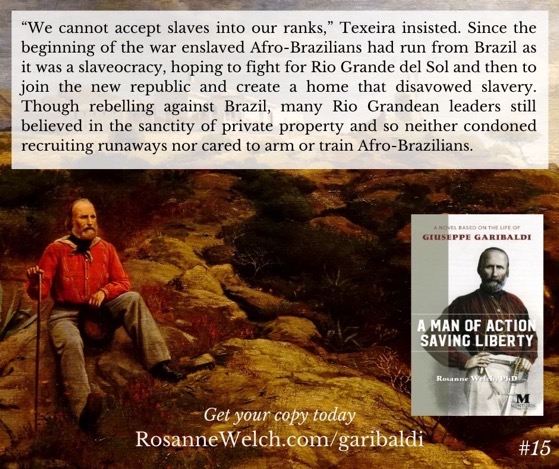
“We cannot accept slaves into our ranks,” Texeira insisted. Since the beginning of the war enslaved Afro-Brazilians had run from Brazil as it was a slaveocracy, hoping to fight for Rio Grande del Sol and then to join the new republic and create a home that disavowed slavery. Though rebelling against Brazil, many Rio Grandean leaders still believed in the sanctity of private property and so neither condoned recruiting runaways nor cared to arm or train Afro-Brazilians.

Get your copy of A Man Of Action Saving Liberty Today!

The Civil War On Film – 10 in a series – …Thomas Ince’s films cemented the Plantation Myth.

The Civil War On Film - 10  in a series - ...Thomas Ince’s films cemented the Plantation Myth.

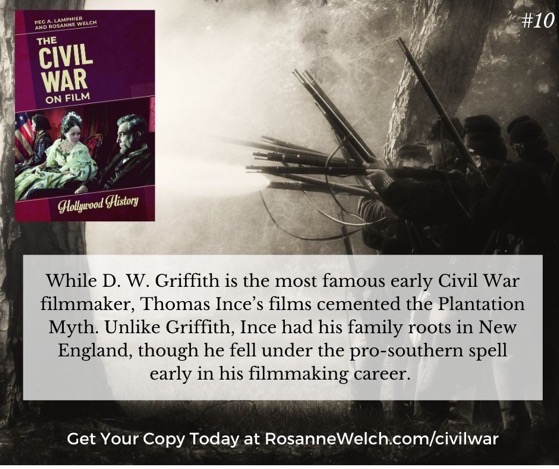
While D. W. Griffith is the most famous early Civil War filmmaker, Thomas Ince’s films cemented the Plantation Myth. Unlike Griffith, Ince had his family roots in New England, though he fell under the pro-southern spell early in his filmmaking career.

Movies profiled in this book:

A Woman Wrote That – 6 in a series – The Joy Luck Club by Amy Tan

This new “A Woman Wrote That” post is an echo of the Writers Guild campaign of a few years ago (“A Writer Wrote That”) where they noted famous movie quotes and credited the screenwriter rather than the director.  The difference here being that we will be posting lines from films written by female screenwriters.  Feel free to share! — Rosanne

A Woman Wrote That - 6 in a series - The Joy Luck Club by AmyTan

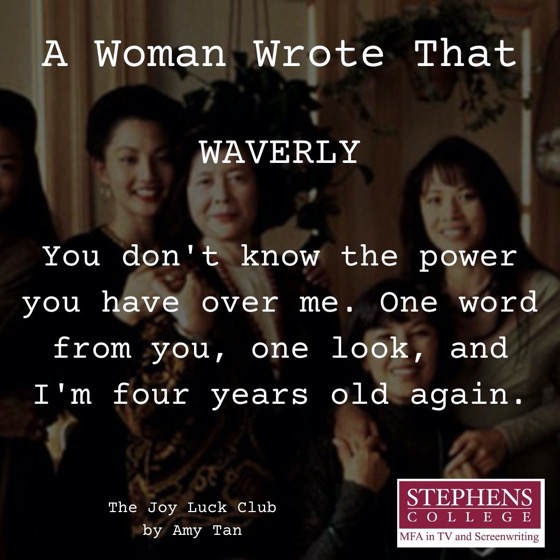
WAVERLY: “You don’t know the power you have over me. One word from you, one look, and I’m four years old again.”

40 The Almighty Johnsons from New Zealand from Why Researching Screenwriters Has Always Mattered [Video] (1 minute 12 seconds)

Watch this entire presentation

40 The Almighty Johnsons from New Zealand from Why Researching Screenwriters Has Always Mattered [Video] (1 minute 12 seconds)

Subscribe to Rosanne’s Channel and receive notice of each new video!


Transcript:

This is actually a program from New Zealand. Who knew New Zealand made television, but I have my students write spec scripts — speculative scripts — which are their own versions of a show that already exists to teach the art of copying, because if you’re going to write television you have to copy what exists and then you make your own story, but you have to know how the characters sound. So, I have them pitch ideas from programs they are watching, but they have to write a United States show because that’s what the people are going to read in the United States. This young man pitched an episode of this show because he saw it on Netflix and he didn’t even realize it wasn’t from the United States. he didn’t even notice that they were using city names from New — he didn’t know what New Zealand was really, but the TV showed him and I stay that we learn the mythology of other cultures. This is a show about Norse mythology. the young boys on the program discover that they are the re-born versions of Norse gods and their goal is to get together with the other Norse gods and eventually go back to heaven together and rule the world. It’s adorable and I wouldn’t have heard about it except for Netflix.

Watch this entire presentation

A Note About This Presentation

A clip from my keynote speech at the 10th Screenwriters´(hi)Stories Seminar for the interdisciplinary Graduation Program in “Education, Art, and History of Culture”, in Mackenzie Presbyterian University, at São Paulo, SP, Brazil, focused on the topic “Why Researching Screenwriters (has Always) Mattered.” I was especially pleased with the passion these young scholars have toward screenwriting and it’s importance in transmitting culture across the man-made borders of our world.

To understand the world we have to understand its stories and to understand the world’s stories we must understand the world’s storytellers. A century ago and longer those people would have been the novelists of any particular country but since the invention of film, the storytellers who reach the most people with their ideas and their lessons have been the screenwriters. My teaching philosophy is that: Words matter, Writers matter, and Women writers matte, r so women writers are my focus because they have been the far less researched and yet they are over half the population. We cannot tell the stories of the people until we know what stories the mothers have passed down to their children. Those are the stories that last. Now is the time to research screenwriters of all cultures and the stories they tell because people are finally recognizing the work of writers and appreciating how their favorite stories took shape on the page long before they were cast, or filmed, or edited. But also because streaming services make the stories of many cultures now available to a much wider world than ever before.

Many thanks to Glaucia Davino for the invitation.


* A portion of each sale from Amazon.com directly supports our blogs
** Many of these books may be available from your local library. Check it out!
† Available from the LA Public Library

Where’s Her Movie? Astronomer, Margaret Harwood – 4 in a series

“Where’s HER Movie” posts will highlight interesting and accomplished women from a variety of professional backgrounds who deserve to have movies written about them as much as all the male scientists, authors, performers, and geniuses have had written about them across the over 100 years of film.  This is our attempt to help write these women back into mainstream history.  — Rosanne

Where's Her Movie? Astronomer, Margaret Harwood - 4 in a series

Observatory Photo By Versageek – Own work, CC BY-SA 3.0

from Wikipedia…

After graduating college, she worked at the Harvard Observatory and taught in private schools in the Boston area. In 1912, an astronomical fellowship was created for women to work at Maria Mitchell Observatory; Harwood was the first recipient of the fellowship, receiving $1,000.[2][3] In 1916, at 30 years old, Harwood was named director of Mitchell Observatory, and worked there from 1916 until her retirement in 1957.[2] Her specialty, photometry, involved measuring variation in the light of stars and asteroids, particularly that of the small planet Eros. A member of the American Astronomical Society and Fellow of the Royal Astronomical Society, she traveled widely in Europe and the United States. She was the first woman to gain access to the Mount Wilson Observatory, the world’s largest observatory at the time.[4]

In 1917, she discovered the asteroid 886 Washingtonia four days before its formal recognition by George Peters.[5] At the time, “senior people around her advised her not to report it as a new discovery because it was inappropriate that a woman should be thrust into the limelight with such a claim”.[6][7] However, Harwood did send her photographs of her discovery to Peters for him to include in his study of the asteroid’s orbit.[6] In 1960, an asteroid discovered at Palomar, was named in her honor, 7040 Harwood.[6][3]