The Civil War On Film – 7 in a series – “…honorable Southern generals stand in contrast to venal, uncouth Northerners.”

The Civil War On Film - 6  in a series -

In keeping with the binary nature of ideologies, the honorable Southern generals stand in contrast to venal, uncouth Northerners. The Lost Cause insists upon the illegitimacy of Abraham Lincoln’s election and his personal villainy as a backwoods barbarian, miscegenationist and all-purpose bad dude.

Movies profiled in this book:

From The Journal Of Screenwriting V3 Issue 1: Irish cinema 1994–2009: The trajectory of script development policy at the Irish Film Board by Díóg O’Connell

Highlighting the articles in the past editions of the Journal of Screenwriting, of which I am the Book Reviews Editor. Hopefully these abstracts will entice you to did a little deeper into the history and future of screenwriting. — Rosanne


Irish cinema 1994–2009: The trajectory of script development policy at the Irish Film Board by Díóg O’Connell

This article explores the changing nature of public policy in Ireland, 1994–2009, as it relates to film and scriptwriting practice. The dominant discourse in Irish cinema studies has centred around ideas of identity, national identity in particular with more recent studies branching off in the direction of genre studies, political economy and narrative studies. This article is framed, broadly speaking, within a political economy discourse, by way of exploring how Irish Film Board policy changed over a specific period as a result of internal and external factors, shaping a structure that would determine how Irish scriptwriters related to the wider field of film production. Through a survey of Irish Film Board policies, newspaper articles and annual reports, this article presents a general historical overview of an evolving film policy as it related directly to scriptwriting and script development. Against this backdrop, other questions surface about Irish cinema and scriptwriting practice, particularly questions centred on local/global issues.


The Journal of Screenwriting is an international double-blind peer-reviewed journal that is published three times a year. The journal highlights current academic and professional thinking about the screenplay and intends to promote, stimulate and bring together current research and contemporary debates around the screenplay whilst encouraging groundbreaking research in an international arena. The journal is discursive, critical, rigorous and engages with issues in a dynamic and developing field, linking academic theory to screenwriting practice. 

Get your copy and subscription to the Journal of Screenwriting Today!


* A portion of each sale from Amazon.com directly supports our blogs
** Many of these books may be available from your local library. Check it out!

Kirkus Review of A Man Of Action Saving Liberty: A Novel Based On The Life Of Giuseppe Garibaldi by Dr. Rosanne Welch

It’s always nice to read a positive review of a newly published book so when the Kirkus Review of my new book on the life of Giuseppe Garibaldi said it was “A wonderfully researched and dramatically gripping work of historical fiction” I smiled.

Research IS my middle name these days and ‘gripping’ is what’s needed for the pace when one is documenting such an epic life so that it doesn’t feel like it is just meandering from battle to battle with no story growth. 

The book gave me the chance to finally delve deeply into Garibaldi and Anita’s lives and come to a deeper understanding of the revolution that united Italy. — Rosanne

Kirkus Review of A Man Of Action Saving Liberty: A Novel Based On The Life Of Giuseppe Garibaldi by Dr. Rosanne Welch

“A novelistic biography of the 19th-century Italian general who devoted his life to the unification of Italy. 

Giuseppe Garibaldi was raised in Nice, an Italian territory in Piedmont held by the French. His mother nevertheless insisted, against convention, that he learn to read Italian and to zealously assert his independence. After an aborted attempt to follow in his father’s footsteps and become a sailor, Garibaldi joined the Young Italy movement under the direction of Giuseppe Mazzini and agitated for Italian independence. As a result, he was sentenced to death and was forced to flee to South America, an exile that lasted more than a decade. 

While in Brazil, he discovered thousands of misplaced Italians, and he recruited them to participate in the Ragamuffin War to establish a republican experience that prepared him for the wars of independence in Italy later. Also, he fought in the Uruguayan civil war before finally returning to Italy intoxicated by the dream of Italian independence and unification—a devotion stirringly portrayed by Welch. 

He formed a group of volunteers, called the Hunters of the Alps, to fight in the Second Italian War for Independence and later participated in the Expedition of the Thousand in Sicily, successfully establishing Victor Emmanuel II as king. 

Welch’sresearch is impeccably rigorous. She captures the minute details of Garibaldi’s life, the machinations of military strategy of the period, and the atmosphere of both 19th-century Italy and South America. One could quibble that the accumulating, granular detail finally becomes daunting to digest. However, her prose is reliably lucid and sometimes achieves genuine poignancy, particularly in the representation of Garibaldi’s indefatigable fervor: “Italy will not truly exist as a nation until her flag, symbolizing the unity and freedom of the former Roman Empire, flies from the Capitol in Rome.

”A wonderfully researched and dramatically gripping work of historical fiction.” – Kirkus Reviews

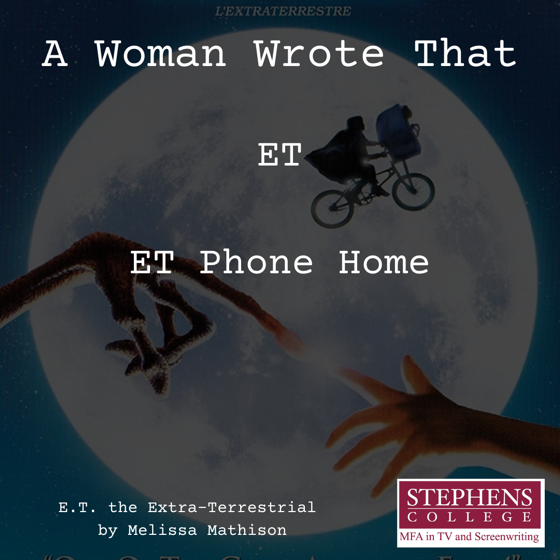
A Woman Wrote That – 3 in a series – E.T. the Extra-Terrestrial

This new “A Woman Wrote That” post is an echo of the Writers Guild campaign of a few years ago (“A Writer Wrote That”) where they noted famous movie quotes and credited the screenwriter rather than the director.  The difference here being that we will be posting lines from films written by female screenwriters.  Feel free to share! — Rosanne

A Woman Wrote That - 2 in a series - E.T. the Extra-Terrestrial

“ET Phone Home”

E.T. the Extra-Terrestrial Shooting Script (PDF)

E.T. the Extra-Terrestrial on IMDB

37 International TV Shows and the US from Why Researching Screenwriters Has Always Mattered [Video] (41 seconds)

Watch this entire presentation

37 International TV Shows and the US from Why Researching Screenwriters Has Always Mattered [Video] (41 seconds)

Subscribe to Rosanne’s Channel and receive notice of each new video!


Transcript:

This is a film — excuse me — a tv show that started in Europe. I learned about it through an Italian screenwriting colleague — Braccialetti Rossi and it’s about a group of young children in a hospital and they wear red bands because they have terminal illnesses and it’s about them banding together and being friends, One of the things that’s good or maybe bad about what’s going on with international television is that I believe we could air the original version in the United States and that enough people would watch it but the networks still believe they need to have an American version — a United States version. I had to learn to stop saying that this week right because I’m in America right now.

Watch this entire presentation

A Note About This Presentation

A clip from my keynote speech at the 10th Screenwriters´(hi)Stories Seminar for the interdisciplinary Graduation Program in “Education, Art, and History of Culture”, in Mackenzie Presbyterian University, at São Paulo, SP, Brazil, focused on the topic “Why Researching Screenwriters (has Always) Mattered.” I was especially pleased with the passion these young scholars have toward screenwriting and it’s importance in transmitting culture across the man-made borders of our world.

To understand the world we have to understand its stories and to understand the world’s stories we must understand the world’s storytellers. A century ago and longer those people would have been the novelists of any particular country but since the invention of film, the storytellers who reach the most people with their ideas and their lessons have been the screenwriters. My teaching philosophy is that: Words matter, Writers matter, and Women writers matte, r so women writers are my focus because they have been the far less researched and yet they are over half the population. We cannot tell the stories of the people until we know what stories the mothers have passed down to their children. Those are the stories that last. Now is the time to research screenwriters of all cultures and the stories they tell because people are finally recognizing the work of writers and appreciating how their favorite stories took shape on the page long before they were cast, or filmed, or edited. But also because streaming services make the stories of many cultures now available to a much wider world than ever before.

Many thanks to Glaucia Davino for the invitation.


* A portion of each sale from Amazon.com directly supports our blogs
** Many of these books may be available from your local library. Check it out!
† Available from the LA Public Library

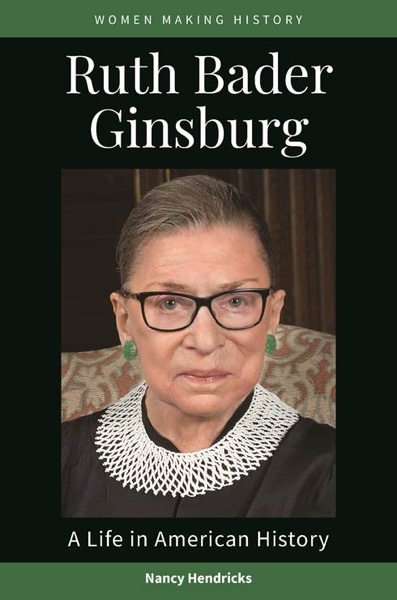
Our New Book: Women Making History: Ruth Bader Ginsburg by Nancy Hendriks – Part of new series from ABC-Clio Edited by Dr. Rosanne Welch and Dr. Peg Lamphier

Our New Book: Women Making History: Ruth Bader Ginsburg - Part of new series from ABC-CLIO Edited by Dr. Rosanne Welch and Dr. Peg Lamphier

I’m so proud to present the first book in the 8 book Women Making History series I co-edited with my good friend and colleague Peg Lamphier.

This first book, written by Nancy Hendricks, covers the life of the beloved and brilliant Ruth Bader Ginsburg, the second woman on the Supreme Court whose life inspired the film On the Basis of Sex (produced by my good friend Karen Loop).

What makes books published by ABC-Clio so special is that they include a collection of primary documents, allowing the subject of the biography to speak for themselves.  In this case Nancy has chosen to include text from the Notorious RBG’s Congressional Hearing for her nomination alongside her dissent in the case of Shelby County v. Holder in 2013 where she eloquently argued that breaking off pieces of the Voting Rights Act of 1965 because it seemed outdated was like “throwing away you umbrella in a rainstorm because you are not getting wet.”

In Nancy’s book you will read about Ruth’s happy marriage to Martin Ginsburg (one of the most renowned tax attorneys in the country) which you have probably read about, and her year of work in Sweden with the Project on International Civic Procedure, which you probably haven’t heard of yet but which turns out to be a fascinating look at this fascinating woman. Most male lawyers had turned down the job because it meant learning Scandinavian but being RBG she mastered that lickety split.

Many thanks to Nancy for her beautifully poetic writing, to Peg for being a brilliant co-editor – and to RBG for paving the way for women for so, so long. I’ve scanned the inner front page of the book since it’s the page with my and Peg’s series editor credit.  What an honor to be asked to oversee this set – and to dwell so long in the lives of these amazing women.

Look out for the rest of the series which will include biographies on the lives of Hillary Clinton, Gloria Steinem, Ida B. Wells, Helen Keller, Delores Huerta, Eleanor Roosevelt, Wilma Mankiller and Sally Ride.
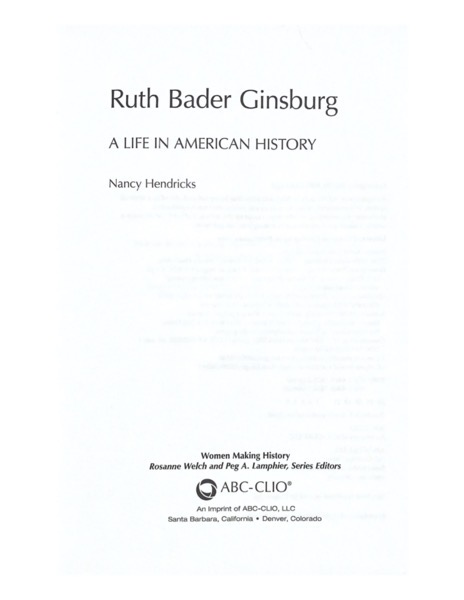
Our New Book: Women Making History: Ruth Bader Ginsburg by Nancy Hendriks - Part of new series from ABC-Clio Edited by Dr. Rosanne Welch and Dr. Peg Lamphier

Description

This book offers both a biography of Ruth Bader Ginsburg, only the second-ever woman appointed to the Supreme Court, and a historical analysis of her impact in her role.

Ruth Bader Ginsburg: A Life in American History explores Ginsburg’s path to holding the highest position in the judicial branch of U.S. government as a Supreme Court justice for almost three decades. Readers will learn about the choices, challenges, and triumphs that this remarkable American has lived through, and about the values that shape the United States.

Ginsburg, sometimes referred to as “The Notorious RBG” or “RBG” was a professor of law, a member of the American Civil Liberties Union, an advocate for women’s rights, and more, before her tenure as Supreme Court justice. She has weighed in on decisions, such as Bush v. Gore (2000); King v. Burwell (2015); and Masterpiece Cakeshop v. Colorado Civil Rights Commission (2018), that continue to guide lawmaking and politics. Ginsburg’s crossover to stardom was unprecedented, though perhaps not surprising. Where some Americans see the Supreme Court as a decrepit institution, others see Ginsburg as an embodiment of the timeless principles on which America was founded.

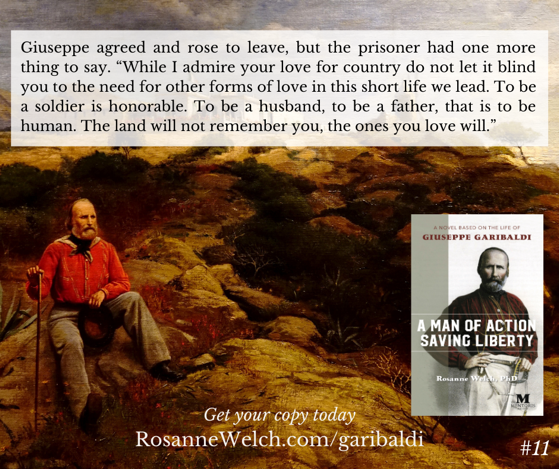
“A Man Of Action Saving Liberty: A Novel Based On The Life Of Giuseppe Garibaldi” – 11 in a series

Giuseppe agreed and rose to leave, but the prisoner had one more thing to say. “While I admire your love for country do not let it blind you to the need for other forms of love in this short life we lead. To be a soldier is honorable. To be a husband, to be a father, that is to be human. The land will not remember you, the ones you love will.”

Get your copy of A Man Of Action Saving Liberty Today!

From The Journal Of Screenwriting V3 Issue 1: The constructive use of film genre for the screenwriter: The relevant knowledge component of the mental space of film genre by Jule Selbo

Highlighting the articles in the past editions of the Journal of Screenwriting, of which I am the Book Reviews Editor. Hopefully these abstracts will entice you to did a little deeper into the history and future of screenwriting. — Rosanne


The constructive use of film genre for the screenwriter: The relevant knowledge component of the mental space of film genre by Jule Selbo

This exploration is a continuation of my work on the ‘mental space of film genre’, a term I have coined to introduce a terminology to investigate the use of film genre for the screenwriter as he or she constructs a screenplay. Understanding this use of film genre may add to the screenwriter’s other technical skills such as knowledge of story structure and character construction. I have previously delineated the first two elements of the mental space of film genre in the second issue of the Journal of Screenwriting – schematic knowledge (the use of film genre as a framing device) and specific knowledge (the understanding of film genre the audience brings to the viewing of filmic narratives). This work will then focus on what I believe to be the important third element of the mental space of film genre – relevant knowledge.


The Journal of Screenwriting is an international double-blind peer-reviewed journal that is published three times a year. The journal highlights current academic and professional thinking about the screenplay and intends to promote, stimulate and bring together current research and contemporary debates around the screenplay whilst encouraging groundbreaking research in an international arena. The journal is discursive, critical, rigorous and engages with issues in a dynamic and developing field, linking academic theory to screenwriting practice. 

Get your copy and subscription to the Journal of Screenwriting Today!


* A portion of each sale from Amazon.com directly supports our blogs
** Many of these books may be available from your local library. Check it out!

The Civil War On Film – 6 in a series – “…the so-called Irrepressible Conflict.”

The Civil War On Film - 6  in a series -

While any past event is vulnerable to the mythmaking of film, the Civil War might be the most contested event in American History. No national historical moment has been more written about (except perhaps World War II), argued over and romanticized than the so-called Irrepressible Conflict.

Movies profiled in this book:

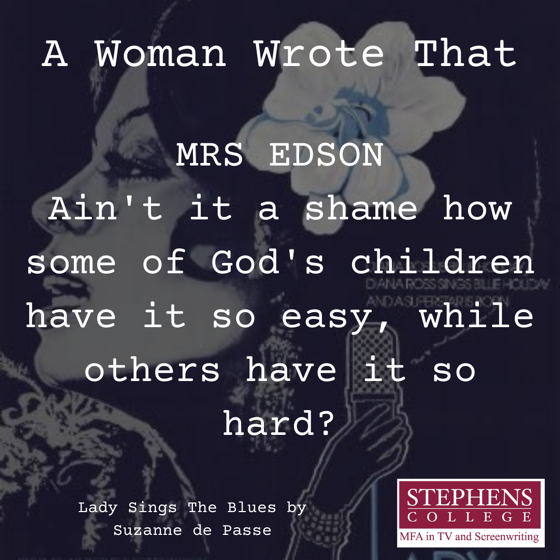
A Woman Wrote That – 2 in a series – Lady Sings The Blues, Screenplay by Suzanne De Passe, Chris Clark, and Terence McCloy

This new “A Woman Wrote That” post is an echo of the Writers Guild campaign of a few years ago (“A Writer Wrote That”) where they noted famous movie quotes and credited the screenwriter rather than the director.  The difference here being that we will be posting lines from films written by female screenwriters.  Feel free to share! — Rosanne

A Woman Wrote That - 2 in a series - Lady Sings The Blues, Screenplay by Suzanne De Passe, Chris Clark, and Terence McCloy

“Lady Sings The Blues” on IMDB