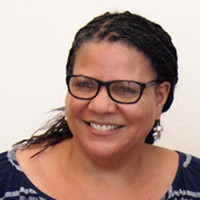
As the Stephens College MFA in TV and Screenwriting is one of the sponsors of the Reel Sisters of the Diaspora Film Festival I’ll be hosting (along with MFA mentor Dawn Comer Jefferson) a free script breakdown and Q & A with Nicole Ballivian (writer-director) for her 10 minute short Joe and the Shawl described as the story of “an adorable tow truck driver who really digs Kelli, a fellow North Carolinian, when he meets her as he changes her dead car battery. But Joe’s interest takes a sharp right turn when he learns that Kelli is a Muslim.”
If you’d like to virtually attend the event, register and join us
Sunday, October 25th 1pm-2:30pm (Pacific Time) FREE Register Here
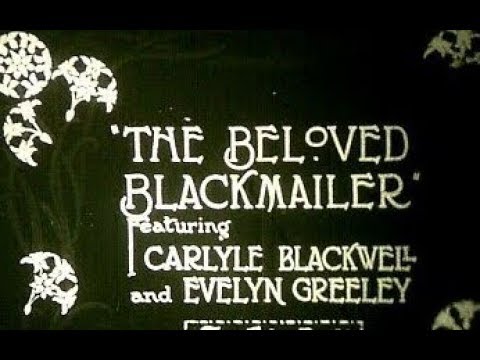
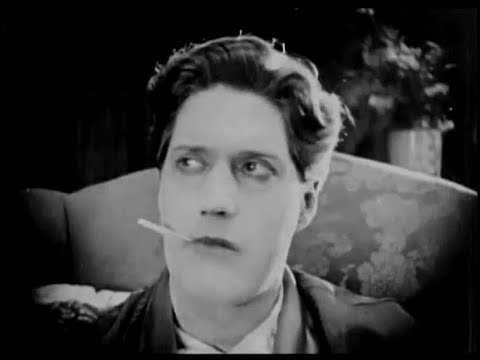
The spoiled, somewhat “mama’s boy” young son of a railroad magnate and the pretty young daughter of the magnate’s partner set out to stop their respective fathers from their constant quarreling. In the process they find themselves falling for each other. – IMDB
* A portion of each sale from Amazon.com directly supports our blogs
** Many of these books may be available from your local library. Check it out!
† Available from the LA Public Library
Subscribe to Rosanne’s Channel and receive notice of each new video!
Transcript:
Now we’ve had a ton of final girls in movies. There was actually a final girl movie because of that trope right? So i think that’s kind of interesting, but what’s great is that after 11 Halloween sequels, they came back to Jamie Lee Curtis and said will you do another one of these movies and she said “Now I will only do it if we flip the whole damn thing and from now on I’m the survivor. She’s the survivor. She gets back at the guy who did that to them. That’s why she agreed to the movie to flip that trope over in her adulthood. She’s like why don’t we call women survivors? Why are they girls? They’re survivors. Let’s think about the language and how it’s used.
A Note About This Presentation
A clip from my keynote speech at the 10th Screenwriters´(hi)Stories Seminar for the interdisciplinary Graduation Program in “Education, Art, and History of Culture”, in Mackenzie Presbyterian University, at São Paulo, SP, Brazil, focused on the topic “Why Researching Screenwriters (has Always) Mattered.” I was especially pleased with the passion these young scholars have toward screenwriting and it’s importance in transmitting culture across the man-made borders of our world.
To understand the world we have to understand its stories and to understand the world’s stories we must understand the world’s storytellers. A century ago and longer those people would have been the novelists of any particular country but since the invention of film, the storytellers who reach the most people with their ideas and their lessons have been the screenwriters. My teaching philosophy is that: Words matter, Writers matter, and Women writers matte, r so women writers are my focus because they have been the far less researched and yet they are over half the population. We cannot tell the stories of the people until we know what stories the mothers have passed down to their children. Those are the stories that last. Now is the time to research screenwriters of all cultures and the stories they tell because people are finally recognizing the work of writers and appreciating how their favorite stories took shape on the page long before they were cast, or filmed, or edited. But also because streaming services make the stories of many cultures now available to a much wider world than ever before.
Many thanks to Glaucia Davino for the invitation.
* A portion of each sale from Amazon.com directly supports our blogs ** Many of these books may be available from your local library. Check it out! † Available from the LA Public Library
Our culture’s most powerful ideas about the past come, not from books written by professional historians, but from popular images and mythologies, including those that come from films written by screenwriters. Screenwriters write Civil War movies for mass audiences, who tend to believe what they see. And films, unlike books, don’t get relegated to the back shelves of libraries.
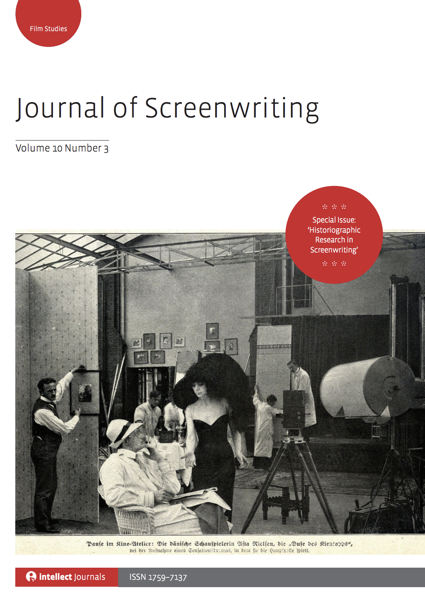
Highlighting the articles in the past editions of the Journal of Screenwriting, of which I am the Book Reviews Editor. Hopefully these abstracts will entice you to did a little deeper into the history and future of screenwriting. — Rosanne
This article centres on a drama-documentary developed by the author, an experienced screenwriter, producer and academic. The project in question was a major featurelength film for the BBC about the first suicide attack carried out by UK citizens. Aside from the significant difficulties posed by the subject matter, the mixed-genre nature of the film made its development problematic, falling between two distinct and contrasting traditions of programme-making. This case study locates the project in the context of a rising fashion for dramadoc within the BBC post 2000, identifies unforeseen difficulties with screenwriting that arose with the use of the form, and illustrates how those difficulties became amplified in this particular production. The analysis deals with the status of the screenwriter in a process where the script is no longer sovereign, raising questions of authorship, division of labour and collaborative exchange. It contributes to the ongoing debate between documentary values of sobriety and objectivity as opposed to dramatic ones of inner truth and emotional understanding, and makes the case for an ‘accumulation of voices’ as a justifiable representation of reality in contrast to a linear expository narrative. Finally, it commends further study of mixed genre drama/ documentary as a way of reappraising orthodox screenwriting theory, offering as it does production methodologies that frequently dispense with the formal screenplay.
The Journal of Screenwriting is an international double-blind peer-reviewed journal that is published three times a year. The journal highlights current academic and professional thinking about the screenplay and intends to promote, stimulate and bring together current research and contemporary debates around the screenplay whilst encouraging groundbreaking research in an international arena. The journal is discursive, critical, rigorous and engages with issues in a dynamic and developing field, linking academic theory to screenwriting practice.
Subscribe to Rosanne’s Channel and receive notice of each new video!
Transcript:
If you censor the storytellers you’re going to censor the stories and that’s why we get such a small block of stories that are repeated over and over and over again, right, and this makes me crazy. Stories equal culture. So if we censor the stories, we are censoring these moments of culture. We’re not allowing people to learn about these other people and their struggles, which is what art has always been about, right, about highlighting these ideas. Now, this is where we come to streaming because streaming services are finally our chance to show all the many cultures of the world to each other, right? You can’t really block them, which I think is fascinating.
Watch this entire presentation
A Note About This Presentation
A clip from my keynote speech at the 10th Screenwriters´(hi)Stories Seminar for the interdisciplinary Graduation Program in “Education, Art, and History of Culture”, in Mackenzie Presbyterian University, at São Paulo, SP, Brazil, focused on the topic “Why Researching Screenwriters (has Always) Mattered.” I was especially pleased with the passion these young scholars have toward screenwriting and it’s importance in transmitting culture across the man-made borders of our world.
To understand the world we have to understand its stories and to understand the world’s stories we must understand the world’s storytellers. A century ago and longer those people would have been the novelists of any particular country but since the invention of film, the storytellers who reach the most people with their ideas and their lessons have been the screenwriters. My teaching philosophy is that: Words matter, Writers matter, and Women writers matte, r so women writers are my focus because they have been the far less researched and yet they are over half the population. We cannot tell the stories of the people until we know what stories the mothers have passed down to their children. Those are the stories that last. Now is the time to research screenwriters of all cultures and the stories they tell because people are finally recognizing the work of writers and appreciating how their favorite stories took shape on the page long before they were cast, or filmed, or edited. But also because streaming services make the stories of many cultures now available to a much wider world than ever before.
Many thanks to Glaucia Davino for the invitation.
* A portion of each sale from Amazon.com directly supports our blogs ** Many of these books may be available from your local library. Check it out! † Available from the LA Public Library
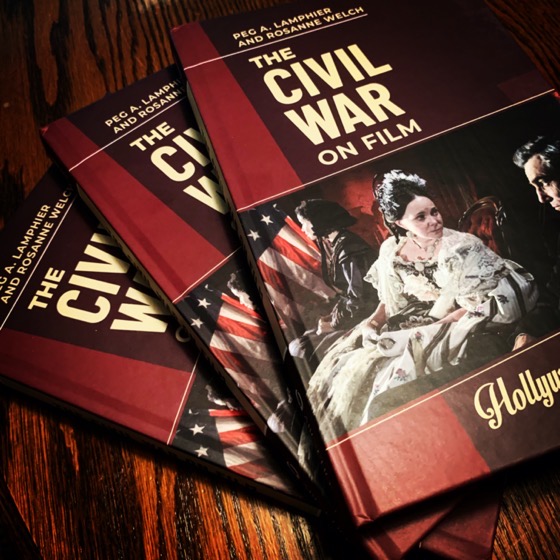
My newest book The Civil War on Film (co-written with my colleague Peg Lamphier as part of ABC-Clio’s Hollywood History series) was published today.
Peg and I discuss 10 Civil War films based on their accuracy and cultural context. It is no surprise that we agree with a collection of historians that the most accurate of all the films of the Civil War is Glory (written by Kevin Jarre), though even that film makes the ‘mistake’ of omitting the fact that Harriet Tubman served as a spy for the 54th Massachusetts Infantry Regiment.
As we say about many of the films, one film can’t encapsulate the entirety of a historical event (though Free State of Jones (written by Gary Ross) does try, and here we admit that that attempt to do it all makes for a long and plodding film, which is sad since it is a thorough portrait of Reconstruction, which is nearly never covered in films as they all prefer ending when the war ends).
As always it was a pleasure to work with Peg. We’re in the middle of our second book for this series – chronicling how Women’s History is covered in films coming sometime in 2021.
* A portion of each sale from Amazon.com directly supports our blogs ** Many of these books may be available from your local library. Check it out!
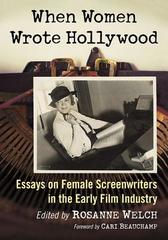
Months of research went into the creation of the essays in “When Women Wrote Hollywood.” Here are some of the resources used to enlighten today’s film lovers to the female pioneers who helped create it.
†
†
* A portion of each sale from Amazon.com directly supports our blogs ** Many of these books may be available from your local library. Check it out! † Available from the LA Public Library
During the ’30s and ’40s, Hollywood produced a genre of madcap comedies that emphasized reuniting the central couple after divorce or separation. Their female protagonists were strong, independent, and sophisticated. Here, Stanley Cavell names this new genre of American film―“the comedy of remarriage”―and examines seven classic movies for their cinematic techniques and for such varied themes as feminism, liberty, and interdependence.
Included are Adam’s Rib, The Awful Truth, Bringing Up Baby, His Girl Friday, It Happened One Night, The Lady Eve, and The Philadelphia Story. – Amazon
* A portion of each sale from Amazon.com directly supports our blogs
** Many of these books may be available from your local library. Check it out!
† Available from the LA Public Library
Min and Bill is a 1930 American Pre-Code comedy-drama film starring Marie Dressler and Wallace Beery, and based on Lorna Moon’s 1929 novel Dark Star, adapted by Frances Marion and Marion Jackson. The film tells the story of dockside innkeeper Min’s tribulations as she tries to protect the innocence of her adopted daughter Nancy, all while loving and fighting with boozy fisherman Bill, who resides at the inn.
Min and Bill stars Marie Dressler (Min), Wallace Beery (Bill), Dorothy Jordan (Nancy), and Marjorie Rambeau (Bella, Nancy’s ill-reputed mother), and was directed by George W. Hill. Dressler won the Academy Award for Best Actress in 1931 for her performance in this film.[2]
This film was such a runaway hit that it and its near-sequel Tugboat Annie, which re-teamed Dressler and Beery in similar roles, boosted both to superstar status. Dressler topped Quigley Publications’ annual Top Ten Money Making Stars Poll of movie exhibitors in 1933, and the two pairings with Dressler were primarily responsible for Beery becoming MGM’s highest-paid actor in the early 1930s, before Clark Gable took over that crown; — Wikipedia
* A portion of each sale from Amazon.com directly supports our blogs
** Many of these books may be available from your local library. Check it out!
† Available from the LA Public Library
Subscribe to Rosanne’s Channel and receive notice of each new video!
Transcript:
Also, think about how important names are with your characters. You all know from your childhood Cruella de Ville. Y’all knew what that was really, of course, maybe not when you were five but eventually you caught on. She was the devil, right? Think about all the movie characters Luke Skywalker walks through the sky right? Han Solo flies alone. I guess you forget about Chewbacca and that right? Names mean something. Ginny Fields. Ginny is the nickname for Virginia which means her name is Virgin Fields. She’s never had sex. (Audience) She’s never been plowed. She has never been plowed. Seriously. That is literally what her name is telling you. Is that not crazy? That.. is it’s wonderful. She’s right. I love that. So you really have to think about, my gosh, what was that message telling young girls right and who decided that was the message they needed.
A Note About This Presentation
A clip from my keynote speech at the 10th Screenwriters´(hi)Stories Seminar for the interdisciplinary Graduation Program in “Education, Art, and History of Culture”, in Mackenzie Presbyterian University, at São Paulo, SP, Brazil, focused on the topic “Why Researching Screenwriters (has Always) Mattered.” I was especially pleased with the passion these young scholars have toward screenwriting and it’s importance in transmitting culture across the man-made borders of our world.
To understand the world we have to understand its stories and to understand the world’s stories we must understand the world’s storytellers. A century ago and longer those people would have been the novelists of any particular country but since the invention of film, the storytellers who reach the most people with their ideas and their lessons have been the screenwriters. My teaching philosophy is that: Words matter, Writers matter, and Women writers matte, r so women writers are my focus because they have been the far less researched and yet they are over half the population. We cannot tell the stories of the people until we know what stories the mothers have passed down to their children. Those are the stories that last. Now is the time to research screenwriters of all cultures and the stories they tell because people are finally recognizing the work of writers and appreciating how their favorite stories took shape on the page long before they were cast, or filmed, or edited. But also because streaming services make the stories of many cultures now available to a much wider world than ever before.
Many thanks to Glaucia Davino for the invitation.
* A portion of each sale from Amazon.com directly supports our blogs ** Many of these books may be available from your local library. Check it out! † Available from the LA Public Library