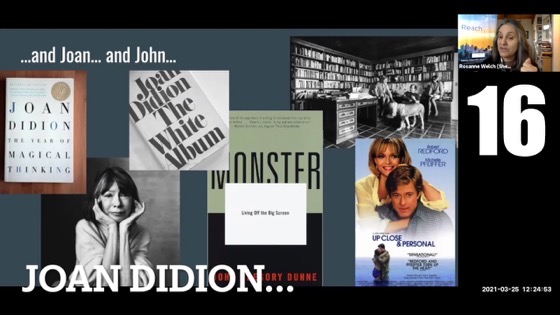
We bring in Joan and John. So in this third version, we’re going to have another female writer with her imprint on this movie. She’s going to change a few things. She is a journalist. She’s worked in New York. She’s worked out of Sacramento. She’s covered the hippie generation. She particularly wrote this lovely piece — a book called The White Album where she looked at the culture of her day and she studied The Doors. She was fascinated by The Doors and their popularity and the way that Jim Morrison just blew up in American culture right? She in fact called them the missionaries of apocalyptic sex right? Look at this beautiful picture of this young man right? Sadly he’s going to be one of the guys who dies young right. He’s going to join the Jimi Hendrix and you know that whole team of people that we’ve lost too young in life but now Joan is writing this new version and she’s going to make the new people rock and roll stars. So we’re going to move out of acting — move out of musical theater — we’re going to move into the rock world. So right away she’s patterning things on Jim Morrison. Look at this picture of Kris Kristofferson. This is Kris Kristofferson young. This is Jim Morrison. Look how close they are. You could almost mix them up right? So Joan immediately is having this vision of who is this new Norman Maine and because Norman is not such a cool name in the 70s, he’s John Norman Maine, right? So we’re going to make a little change.
Watch this entire presentation
Connections at conferences matter! Through the most recent SCMS, I met Vicki Callahan, whose film history focus right now is on Mabel Normand. When she learned I could put together a lecture on the importance of the female voice in the A Star is Born franchise she asked me to give that lecture to her master students.
It made for a great opportunity for me to hone the ideas I’m working on for a chapter on that franchise that I’m writing for a new book from Bloomsbury: The Bloomsbury Handbook Of International Screenplay Theory. It’s always nice when one piece of research can be purposed in other ways – and it’s always fun revisiting such a female-centric film franchise – one that drew the talents of such powerful performers as Janet Gaynor, Judy Garland, Barbara Streisand, and Lady Gaga.
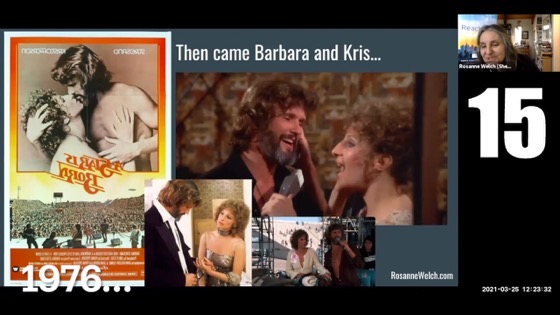
1976 comes along and this is Barbra Streisand and Kris Kristofferson. So 54 or jump into 76. It’s kind of like once every generation there’s an interest and a need for this movie. Partially because female creatives, whether they be writers or actresses, see this as a great piece to work from and a great way to reflect on their moment in culture right? So this is a big fancy deal. Look at these great photographs. Let me tell you, this is going to be written by Joan Didion and John Gregory Dunn. They are a married couple who write their own novels as you see here and work out of New York. They get hired to do this and Joan is going to have her own imprint on it. We’re going to see that in a second. I also want to highlight the fact that John Gregory Dunn wrote this marvelous book if you’ve never read it called Monster: Living Life Off the Big Screen. It’s about the writing of this film Up Close and Personal, which was meant to be the story of Jessica Savitch, an anchorwoman who died when she was high on cocaine and drove her car into a lake and drown and by the time they were done it had nothing to do with her at all and so this tells you the eight-year struggle to get the movie made out of the Disney company. It’s a really a good inside look at how writers and producers work with studios.
Watch this entire presentation
Connections at conferences matter! Through the most recent SCMS, I met Vicki Callahan, whose film history focus right now is on Mabel Normand. When she learned I could put together a lecture on the importance of the female voice in the A Star is Born franchise she asked me to give that lecture to her master students.
It made for a great opportunity for me to hone the ideas I’m working on for a chapter on that franchise that I’m writing for a new book from Bloomsbury: The Bloomsbury Handbook Of International Screenplay Theory. It’s always nice when one piece of research can be purposed in other ways – and it’s always fun revisiting such a female-centric film franchise – one that drew the talents of such powerful performers as Janet Gaynor, Judy Garland, Barbara Streisand, and Lady Gaga.
Thanks to the gracious invitation from my Screenwriting Research Network colleague Paolo Russo – and a grant he was able to procure (and in the before-Covid time) I was able to spend a week at Oxford Brookes University working with the screenwriting masters students in Paolo’s course. At the culmination of the week, I gave this lecture on how writers rooms worked in the States.
Transcript:
…and if you don’t think novelists are writers who collaborate think about the fact that all these guys hung around with each other in a writer’s group and read stuff to each other and took notes from each other and made changes based on those notes. Those were writer’s rooms. The Eagle and whatever that pub is called I haven’t gotten to yet …that was a writer’s room right and from that room not only did we get those books. We got this collaboration. Phil Jackson is great. I love him. He’s brilliant. He does great stuff. He doesn’t do it alone. He’s just the guy who’s willing to do the interviews. His wife doesn’t care to do interviews. I don’t know what’s wrong with her but she’s making me crazy right because we’re forgetting that two women co-wrote this movie. That’s what makes it so much better for our times right? They got the best-adapted screenplay award. Two women and a guy made The Lord of the Rings into what it is. I think that’s really important. So who remembers what I said my teaching philosophy was
three things matter
Words matter, Writers matter, and Women Writers matter.
Thank you very much. You’re listening. This thing is good. All right and this is important to me. It’s not just what I know. It’s spreading that around this is my first graduating classroom at Stephen’s MFA. As I said it was an all-female college. So it’s about spreading the word. Writers are teachers with a giant podium. What’s your opinion of how this world should work? Put it out there and the bigger audience you get the more influence you get. Forget YoutTube and who does makeup well. Those aren’t influencers. People who tell stories — I seriously — they’re not — people who tell stories are influencers because stories teach us to feel and that’s what you get paid to do which I love. So again these are a bunch of books I use when I’m just thinking about putting this together. So if you’re interested in reading about showrunners, those are a bunch of books that do interviews with them, and of course, this is the bunch that I’ve written and that’s all I have to say. So I guess we’re doing a q a now right? so if people have questions, I am totally open to your things.
Watch this entire presentation
Subscribe to Rosanne’s Channel and receive notice of each new video!
* A portion of each sale from Amazon.com directly supports our blogs ** Many of these books may be available from your local library. Check it out! † Available from the LA Public Library
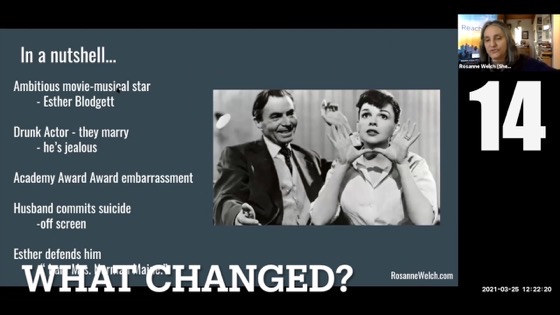
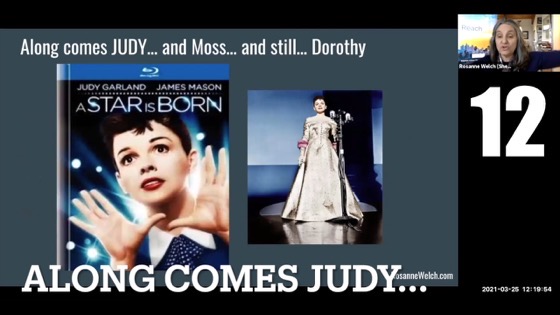
So let’s look at what changed. First, we’ve got to move her into it being a musical star because this is Judy Garland. She’s going to have to sing musical numbers in this particular remake. We’re still going to have our drunken actor and they’re going to marry and he’s going to be jealous. This is something that remains the same all the way until we get to Bradley Cooper and we’ll talk about why that changes. We’re going to have our Academy Award moment because musicals were things that earned Academy Awards back in the day of course. He’s going to commit suicide off-screen. He’s going to walk off into the ocean as the noble man that he is and she too will introduce herself as Mrs. Norman Maine. So these things remain exactly the same. When the Writer’s Guild arbitrates a script to decide who should get final credit, they look at all versions of a script. They have a blind group of writers who sign up to do this and they get the scripts –writer one, writer two, writer three. You don’t get any names and then you decide statistically how much of a percentage of this person’s original work made it to the end and that’s how they decide credit. So I am looking at this as if I’m arbitrating the various versions of this script to see how much credit Dorothy Parker still deserves. In this case, I think a lot right? They’re borrowing a lot of what she did.
Watch this entire presentation
Connections at conferences matter! Through the most recent SCMS, I met Vicki Callahan, whose film history focus right now is on Mabel Normand. When she learned I could put together a lecture on the importance of the female voice in the A Star is Born franchise she asked me to give that lecture to her master students.
It made for a great opportunity for me to hone the ideas I’m working on for a chapter on that franchise that I’m writing for a new book from Bloomsbury: The Bloomsbury Handbook Of International Screenplay Theory. It’s always nice when one piece of research can be purposed in other ways – and it’s always fun revisiting such a female-centric film franchise – one that drew the talents of such powerful performers as Janet Gaynor, Judy Garland, Barbara Streisand, and Lady Gaga.
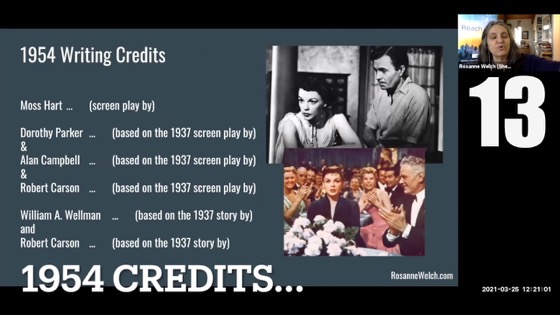
Where, first of all, let’s look at these credits. One of the things I want to make point of so here’s Moss Hart. He takes full credit for the screenplay but it is based on the one that Dorothy did with Alan and Robert right? So this is how our credits read properly. What’s interesting about this is he says when he’s asked during his rewrites about some things he did not change at all and he didn’t for this very reason. He felt they were perfect the way they were. They were perfect the way she wrote them. He could not top those lines. So the 1954 version is still an echo and a mimic of Dorothy Parker in my opinion based on Moss Hart’s confession. If you want to put it that way and Moss Hart if you’ve never read Act One, this is his autobiography of growing up poor in New York, working in some summer camps that are very much like dirty dancing summer camp, and eventually making it on Broadway. It’s quite a good book if you’re interested in that period. Of course, the joke is how much of it is true and how much did he elaborate on. We will never really know. There is then obviously a real biography of him if you are interested but here’s the man who’s rewriting this version of A Star Is Born, so I will say though it is written solely by a man, it is a man relying on and reusing the words of a woman’s. The female imprint is still highly there in this version.
Watch this entire presentation
Connections at conferences matter! Through the most recent SCMS, I met Vicki Callahan, whose film history focus right now is on Mabel Normand. When she learned I could put together a lecture on the importance of the female voice in the A Star is Born franchise she asked me to give that lecture to her master students.
It made for a great opportunity for me to hone the ideas I’m working on for a chapter on that franchise that I’m writing for a new book from Bloomsbury: The Bloomsbury Handbook Of International Screenplay Theory. It’s always nice when one piece of research can be purposed in other ways – and it’s always fun revisiting such a female-centric film franchise – one that drew the talents of such powerful performers as Janet Gaynor, Judy Garland, Barbara Streisand, and Lady Gaga.
Thanks to the gracious invitation from my Screenwriting Research Network colleague Paolo Russo – and a grant he was able to procure (and in the before-Covid time) I was able to spend a week at Oxford Brookes University working with the screenwriting masters students in Paolo’s course. At the culmination of the week, I gave this lecture on how writers rooms worked in the States.
Transcript:
For me, teachers make good writers. Right? Obviously Icatered this to where I have come and been happy to be. I actually — went too fast — this was my facebook post the other day. I don’t like a lot of words on the screen but I couldn’t resist this because I’ve never been to Oxford before.
So I found this little church just off Wharton Road where he was once a congregant and I had to find the picture and send it back to my husband and the cat just found me which I thought was cute but seriously I mean how long has the guy been dead and I’m still fascinated by the things he wrote? They still mean something to me and my family. Likewise, writers make good teachers.
Watch this entire presentation
Subscribe to Rosanne’s Channel and receive notice of each new video!
* A portion of each sale from Amazon.com directly supports our blogs ** Many of these books may be available from your local library. Check it out! † Available from the LA Public Library
1937. Huge Movie. It winds awards. It has everyone paying attention. Janet Gaynor is a very important actress. So, it’s a big deal. 1954 comes around. There is a movie we can remake and remember that in the era when they were remaking these films, there were no DVDs. There was no streaming. The film was done after it played in a theater for 2 weeks or 10 weeks — however successful it was. You would never see that film again. 1954. There’s no TV reruns of that film. That’s it. If your mother saw it in ’37, that’s it. Nobody has seen it since then. So remaking a movie made some sense. So, we’re going to come into this with a guy named Moss Hart. He’s a very famous Broadway playwright. He worked with George S. Kaufman, but he also worked on his own and he is invited to come and re-do this for Judy Garland as the star and it’s going to be a comeback film. She’s had trouble (Oh no) with drugs and alcohol AND it’s affected her career. So she needs a big vehicle and this is recognized as a showpiece for a female performer, but she’s Judy Garland, so we’ve got to change something.
Watch this entire presentation
Connections at conferences matter! Through the most recent SCMS, I met Vicki Callahan, whose film history focus right now is on Mabel Normand. When she learned I could put together a lecture on the importance of the female voice in the A Star is Born franchise she asked me to give that lecture to her master students.
It made for a great opportunity for me to hone the ideas I’m working on for a chapter on that franchise that I’m writing for a new book from Bloomsbury: The Bloomsbury Handbook Of International Screenplay Theory. It’s always nice when one piece of research can be purposed in other ways – and it’s always fun revisiting such a female-centric film franchise – one that drew the talents of such powerful performers as Janet Gaynor, Judy Garland, Barbara Streisand, and Lady Gaga.
Thanks to the gracious invitation from my Screenwriting Research Network colleague Paolo Russo – and a grant he was able to procure (and in the before-Covid time) I was able to spend a week at Oxford Brookes University working with the screenwriting masters students in Paolo’s course. At the culmination of the week, I gave this lecture on how writers rooms worked in the States.
Transcript:
What I hope you learned from me today is that a writer’s room requires collaboration. It’s always about sharing and talking with the other people to make the product better and participation. You can’t just sit in a corner. You have to be part of that conversation or your perspective will not be included and that’s bad for you and anybody else who looks like you. It’s your job to represent when you’re in the room. So you need to be able to do that. Plus I love this quote of Einstein’s — Imagination. You’re selling your imagination. Who gets to do that? What job do you get to do that in except writing? I think that is the coolest thing in the world.
Watch this entire presentation
Subscribe to Rosanne’s Channel and receive notice of each new video!
* A portion of each sale from Amazon.com directly supports our blogs ** Many of these books may be available from your local library. Check it out! † Available from the LA Public Library
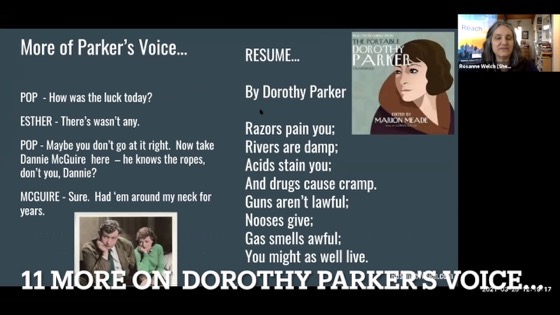
I think you’ll notice also in the lines here, this is a great bit —
“How’s your luck?
There wasn’t any.
Maybe you don’t do it right. No, take Danny McGuire here. He knows the ropes, don’t you, Danny?
Sure. Had ’em around my neck for years.”
She’s always thinking about suicide. Sadly. She’s always thinking about ways to kill yourself and this is best evidenced in this poem that she’s famous for. I don’t know if you’ve ever seen it before. You’re probably reading it to yourself right now, so I shall not read it out loud but it is quite brilliant, and look what she’s focusing on and that’s her “resume.” Think about the title and think about the words there and how they come across inside A Star Is Born.”
Watch this entire presentation
Connections at conferences matter! Through the most recent SCMS, I met Vicki Callahan, whose film history focus right now is on Mabel Normand. When she learned I could put together a lecture on the importance of the female voice in the A Star is Born franchise she asked me to give that lecture to her master students.
It made for a great opportunity for me to hone the ideas I’m working on for a chapter on that franchise that I’m writing for a new book from Bloomsbury: The Bloomsbury Handbook Of International Screenplay Theory. It’s always nice when one piece of research can be purposed in other ways – and it’s always fun revisiting such a female-centric film franchise – one that drew the talents of such powerful performers as Janet Gaynor, Judy Garland, Barbara Streisand, and Lady Gaga.
Thanks to the gracious invitation from my Screenwriting Research Network colleague Paolo Russo – and a grant he was able to procure (and in the before-Covid time) I was able to spend a week at Oxford Brookes University working with the screenwriting masters students in Paolo’s course. At the culmination of the week, I gave this lecture on how writers rooms worked in the States.
Transcript:
…and I really say that to the girls a lot because when I have my classes, often when I just open pitching up — anyone can start pitching their ideas — who’s first? We’ll go through a line of like four guys and then I have to stop and go “Does anyone notice anything odd right now?” and I promise you it will be a boy who says “None of the girls have pitched yet.” The girls haven’t even recognized that they are waiting their turn. No one will give you a turn. You have to take a turn or you won’t move as far as you like as fast as you like. So speaking of the big deal and I hate to say it but I learned how to cuss in a writer’s room because sometimes that was the only way to get attention. If I threw out a good four-letter word, all of a sudden everybody was looking at my section of the table which doesn’t make my mother very happy, but it was a silly thing right? So you have to think about managing yourself and managing the other people that you are around. That’s a big deal.
Watch this entire presentation
Subscribe to Rosanne’s Channel and receive notice of each new video!
* A portion of each sale from Amazon.com directly supports our blogs ** Many of these books may be available from your local library. Check it out! † Available from the LA Public Library

![52 Conclusion from There And Back Again: Writing and Developing for American TV [Video]](https://rosannewelch.com/wp-content/uploads/2021/12/rmw-oxford-brookes-52.jpg)
![51 Teacher Make Good Writers from There And Back Again: Writing and Developing for American TV [Video]](https://rosannewelch.com/wp-content/uploads/2021/11/rmw-oxford-brookes-51.jpg)
![50 Collaboration Is Required from There And Back Again: Writing and Developing for American TV [Video]](https://rosannewelch.com/wp-content/uploads/2021/11/rmw-oxford-brookes-50-1.jpg)
![49 Speaking Up In The Writer's Room There And Back Again: Writing and Developing for American TV [Video]](https://rosannewelch.com/wp-content/uploads/2021/11/rmw-oxford-brookes-49.jpg)