For this year’s SRN (Screenwriting Research Network) conference – which had to be online due to the continuing pandemic – I presented a short discussion of the chapter I wrote for a new book an old favorite show – Doctor Who.
I cover the ways in which I believe executive producer/showrunner Chris Chibnall used the tools of his writing trade to create the first female Doctor in the show’s over 50-year history. Those included casting and costuming, dialogue and diversity. In my opinion, Chibnall made a promise to diversify the show on all levels (not just by changing the gender of the lead character) and by hiring a diverse slate of writers who created stories under his direction I believe he kept that promise.
Thanks to the gracious invitation from my Screenwriting Research Network colleague Paolo Russo – and a grant he was able to procure (and in the before-Covid time) I was able to spend a week at Oxford Brookes University working with the screenwriting masters students in Paolo’s course. At the culmination of the week, I gave this lecture on how writers rooms worked in the States.
Transcript:
As I’m thinking about this idea, I didn’t pitch it for a while because I knew the answer would be to marry them and I didn’t want to do that and then one day Mrs. Doubtfire was on TV and I was watching. It reminded me of the article and I thought “Oh I will immediately pitch the story where the wife is already remarried” because the answer from angels can’t be get a second divorce in order to go right. So that was my reasoning around why they didn’t get back together and when I pitched it, it worked because I got the story I wanted and not the story that would have been molded from somebody else’s opinion. It’s hard when you’re in a writer’s room and you’re not the head of it because you are doing their show. It’s what they want done right but you have to keep some of yourself inside there too because that’s the theme. That’s the attitude. That’s the voice that you’re bringing to the story. So I couldn’t pitch it until I knew that I could protect the full story the way I wanted it to come out.
Watch this entire presentation
Subscribe to Rosanne’s Channel and receive notice of each new video!
* A portion of each sale from Amazon.com directly supports our blogs ** Many of these books may be available from your local library. Check it out! † Available from the LA Public Library
Thanks to the gracious invitation from my Screenwriting Research Network colleague Paolo Russo – and a grant he was able to procure (and in the before-Covid time) I was able to spend a week at Oxford Brookes University working with the screenwriting masters students in Paolo’s course. At the culmination of the week, I gave this lecture on how writers rooms worked in the States.
Transcript:
This particular episode was called “A House Divided.” It didn’t have Robin Williams in it. That’s from which movie? Mrs. Doubtfire, right, because I read an article about Mrs. Doubtfire. I wanted to do an episode about teaching parents not to teach their — make their child a weapon in their divorce right and because that’s the story of divorce. It’s like you love me more than you love him. My problem was i knew that my boss’s answer would be the parents — like The Parent Trap — should get married again at the end. That’s the answer that our show should give but i had read an interview with Robin Williams that had taken place several years earlier. When he agreed to do Mrs. Doubtfire, he put in his contract that the film could not end with he and Sally Field getting married again because he would not lie to his own children because he was divorced twice by then and he knew he was never getting back together with his first wife. So he would not do a movie that lied to his own children and that really struck me. So the way they fixed it was they made Sally Field already connected to Pierce Brosnan right?
Watch this entire presentation
Subscribe to Rosanne’s Channel and receive notice of each new video!
* A portion of each sale from Amazon.com directly supports our blogs ** Many of these books may be available from your local library. Check it out! † Available from the LA Public Library
Thanks to the gracious invitation from my Screenwriting Research Network colleague Paolo Russo – and a grant he was able to procure (and in the before-Covid time) I was able to spend a week at Oxford Brookes University working with the screenwriting masters students in Paolo’s course. At the culmination of the week, I gave this lecture on how writers rooms worked in the States.
Transcript:
…and to their credit, everybody in the room is kind of like “Oh duh yeah, why didn’t we think of that. Okay,” but a production problem. Della Reese was actually a minister in a church in Los Angeles and we filmed this in Utah. So she was given every Friday to fly back to LA to run her church for the weekend and then she’d come back Monday morning. So she didn’t work a day and a half of every week and so she couldn’t be in as many scenes as Roma Downey could. So immediately the supervising producer who’s in charge of scheduling shot that down and said “No we can’t do it,” and I thought damn, make me mad. I’m going to have to call my friend and say You’re going to hate this episode. Don’t watch it.” right and then I said “What if we asked Della if this particular week she would work a couple of extra days for the chance to play this character instead of that character” and they’re like “It can’t hurt to ask,” and you know to not play a maid she gave us another couple of extra days. So it was a move in the right direction right that had to be brought up. You have to think about it. Then you have to talk people into it. Persuasive speech is a good class to take if you want to be a writer in a writer’s room.
Watch this entire presentation
Subscribe to Rosanne’s Channel and receive notice of each new video!
* A portion of each sale from Amazon.com directly supports our blogs ** Many of these books may be available from your local library. Check it out! † Available from the LA Public Library
Thanks to the gracious invitation from my Screenwriting Research Network colleague Paolo Russo – and a grant he was able to procure (and in the before-Covid time) I was able to spend a week at Oxford Brookes University working with the screenwriting masters students in Paolo’s course. At the culmination of the week, I gave this lecture on how writers rooms worked in the States.
Transcript:
So, this other episode — it’s called Smokescreen — had to do with an African-American executive at a tobacco company who of course has to deal with the fact that he’s selling a product and kills people. There was going to be a lawsuit and originally — we have two angels — one was Roma Downey — who comes from Ireland — an Irish woman and one was Della Reese, a famous jazz singer who’s a woman of color. We always made the angels real people in people’s lives and that’s how they got to talk to you and try to — they never told you they were angels till the very end when everything would you know they could get you to change your mind — so the very first thing because people fall back on stereotypes all the time. It is far too easy to go to the stereotype and you have to learn to go beyond it. So they’re going to make Roma Downey the lawyer — the guest lawyer — and Della Reese the guest maid in this family and one of my best friends — this is a terrible phrase from Seinfeld happens to be African-American right. She’s not my only African-American friend but my best friend and I knew she would cringe if Della Reese played a maid. So I raised my little hand and I said wouldn’t it be cool if Della was the lawyer and Roma was the maid.
Watch this entire presentation
Subscribe to Rosanne’s Channel and receive notice of each new video!
* A portion of each sale from Amazon.com directly supports our blogs ** Many of these books may be available from your local library. Check it out! † Available from the LA Public Library
Thanks to the gracious invitation from my Screenwriting Research Network colleague Paolo Russo – and a grant he was able to procure (and in the before-Covid time) I was able to spend a week at Oxford Brookes University working with the screenwriting masters students in Paolo’s course. At the culmination of the week, I gave this lecture on how writers rooms worked in the States.
Transcript:
Where am I going to find a piece of wood on Christmas Eve that only an angel can deliver that I can’t throw in the trash?
Audience: Christmas tree?
Rosanne: Close. That was the first thought. Christmas tree. Christmas tree is not spiritual. It’s not connected to the Christmas story.
Audience: Cross.
Rosanne: Cross is close but that’s Easter — that’s Easter but you’re close. What involves wood and Jesus and Mary and Joseph?
Audience: The Manger?
Rosanne: Thank you! So I got the idea while I was sitting around the table with everybody but I knew this guy didn’t like to be one-upped and I didn’t want him on my bad side because he helped sign my contract later right, but I got to get this idea out there but I can’t pretend to be smarter than him because that will not make him happy. So I sit there at a table of like 10 people and I got the idea and I thought well luckily I’m a pretty loud person. I’m considered Italian where I come from but clearly not here because my grandparents are from Sicily. So all of a sudden I just went — Uh!
Not the whole table but the guy sitting next to me went what and that’s all I needed was someone to ask me what I was thinking right? I was like oh I just I’ve been thinking about this problem and I had this idea but I don’t know if you’ll like it… Oh, what’s your idea? Well, what if the wood came from the manger and like four people around the table went oh yes and the guy who wrote the story was about to say no. I could see his face but when his colleagues all went yes. he was like oh yeah that’s a great idea. We should — okay that’s what we’ll do. So I wasn’t one-upping him. I was just accidentally having a moment and it allowed me to get my idea out. Now that sounds ridiculous but I got what I wanted out of it right? So you have to learn to read the room. How is it operating? Who are your — who are your allies in the room?
Watch this entire presentation
Subscribe to Rosanne’s Channel and receive notice of each new video!
* A portion of each sale from Amazon.com directly supports our blogs ** Many of these books may be available from your local library. Check it out! † Available from the LA Public Library
During every Residency Workshop the Stephens College MFA in TV and Screenwriting Executive Director, Dr. Rosanne Welch, joins with the Writers Guild Foundation to moderate a panel on a topic of interest to female writers. This year we planned one on Writing Diverse Families – but in the last day before our panel 2 panelists had to drop out due to… family duties. So we pivoted, realizing the panelists who were able to appear all had shows that involved 3 generational families lead by matriarchs.
Hence the title: It’s All Relative: Writing Matriarchs.
This gave us a chance to explore how these female TV writers have expanded depictions of the relationships between grandmothers, mothers and daughter over the years and how they’ve developed storylines that reflect the complexity and universality of these inescapable bonds. Panelists include Sheryl J. Anderson – Creator and Executive Producer, Sweet Magnolias; Lang Fisher – Co-creator and Executive Producer, Never Have I Ever; and Valerie Woods – Co-executive Producer, Queen Sugar. Everyone shared memories of their own family matriarchs and the inspiration they continue to provide each woman’s writing.
Due to Covid we recorded this panel live at the Jim Henson Studios where we host our Workshop in front of the live audience of MFA candidates.
Thanks to the gracious invitation from my Screenwriting Research Network colleague Paolo Russo – and a grant he was able to procure (and in the before-Covid time) I was able to spend a week at Oxford Brookes University working with the screenwriting masters students in Paolo’s course. At the culmination of the week, I gave this lecture on how writers rooms worked in the States.
Transcript:
There was this violin and I kept sitting in the room thinking it took 26 years to make this violin and it’s really important. You give it to the kid soon. Throw it away and make a new one. Something’s wrong with the wood right? I said this is my problem is you know he said I’ll fix the problem. The angel will have given this guy the wood and therefore he can’t throw it away right? He’s like well 26 years and making his violin, the angel handed him a crap piece of wood okay? I need to start again. This is — I need a reason why you can’t throw this piece of wood away and it’s a Christmas episode. There’s only one piece of wood an angel can give me that I won’t throw away on Christmas eve. What is that?
Watch this entire presentation
Subscribe to Rosanne’s Channel and receive notice of each new video!
* A portion of each sale from Amazon.com directly supports our blogs ** Many of these books may be available from your local library. Check it out! † Available from the LA Public Library
Thanks to the gracious invitation from my Screenwriting Research Network colleague Paolo Russo – and a grant he was able to procure (and in the before-Covid time) I was able to spend a week at Oxford Brookes University working with the screenwriting masters students in Paolo’s course. At the culmination of the week, I gave this lecture on how writers rooms worked in the States.
Transcript:
Let me talk briefly about the kinds of things you learn in a room. One of the things you should take a class in is psychology because reading other people and managing how you deal with them — when you figure out their personalities either love you or don’t love you — but you have to work with them for the next three years because contracts are three years long. So you have to work around them. In this particular case. we were doing an episode about a gentleman, sadly, who was dying of AIDS and coming home for Christmas to tell his parents that he was both gay and dying of AIDS and what happened was the writer who was doing it was very fond of himself and didn’t like to be told anything was wrong with his stories, but your job in the room is to make all the stories as good as possible because if the show gets canceled you all lose your job. So I knew that he didn’t like criticism and he was higher on the hierarchy than I was right? He was a higher rank producer. I was still a co-editor or something like that at the time and I’m sitting in the room and his problem was — this is a story about angels who came into your life and told you how you were messing it up and please fix it — so the father was a violin maker and he’s going to give his son a violin he’d been working on since the boy was born. So that’s about 26 years and it was still not good and he really wanted to give the kid the violin because there was a metaphor that if you played violin again maybe he wouldn’t be gay. I’m not really sure I agree with that but anyway…
Watch this entire presentation
Subscribe to Rosanne’s Channel and receive notice of each new video!
* A portion of each sale from Amazon.com directly supports our blogs ** Many of these books may be available from your local library. Check it out! † Available from the LA Public Library
Subscribe to Rosanne’s Channel and receive notice of each new video!
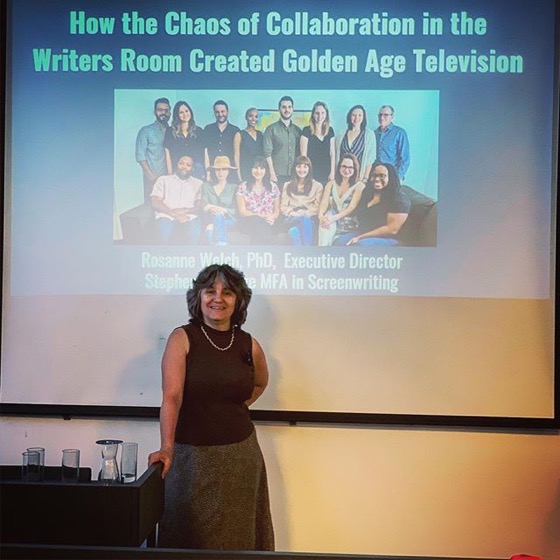
When the folks hosting the conference announced their theme as “Screen Narratives: Chaos and Order” the word ‘chaos’ immediately brought to mind writers rooms. I offered a quick history of writers rooms (the presentations are only 20 minutes long) and then quoted several current showrunners on how they compose their rooms and how they run them.
Transcript:
…and then there were many many stories in this one particularly, very quickly, there were people in the room who wanted to shoot down your ideas. Again reading the room and I had an idea about dealing with teenage young men who were fathers and lived in gangs and they had to make a commitment to their real family not their gang family. I knew that someone else in the room would not want me to have the extra script that year because that’s a nice chunk of money he would rather have. So my joke is I followed my executive producer into the bathroom because she was a woman and so was I and then I pitched her while we were washing our hands. So that when we walked back in the room, she already liked the idea and for someone else to shoot it down would be to say she had a bad idea and therefore I got whatever. So reading the room has always been a very important lesson. As well as remembering the doctors have power. Whenever you think about side characters, think about making them ethnic because that’s really important and then these are just the things that I learned from the room. You have to do research. You have to think about your nightmares. You have to speak up. I teach my female students this all the time. Please speak up. Don’t wait for the boys to give you a moment because they won’t and then I learned a lot and then I will briefly just say teachers make great writers because they do and collaboration doesn’t just happen in tv right because these guys collaborated on those films we have to recognize that so collaboration and chaos makes good quality presentations. Thank you.