17 Representation from How The Chaos Of Collaboration in the Writers Room Created Golden Age Television [Video]

With the full recording of “How The Chaos Of Collaboration in the Writers Room Created Golden Age Television”

17 Representation from How The Chaos Of Collaboration in the Writers Room Created Golden Age Television [Video]

Subscribe to Rosanne’s Channel and receive notice of each new video!


When the folks hosting the conference announced their theme as “Screen Narratives: Chaos and Order” the word ‘chaos’ immediately brought to mind writers rooms. I offered a quick history of writers rooms (the presentations are only 20 minutes long) and then quoted several current showrunners on how they compose their rooms and how they run them.

Transcript

I think inclusive writer’s rooms, obviously, create more inclusive stories. I happen to adore Torchwood. I’m a big Russell Davies fan and I love the stories he tells about how, when he came to create the show, he created a female police officer whose husband stayed at home and took care of the house and the baby and he hadn’t seen enough of that on television. So he provided that in the story and as they went through you got many more characters of color, characters from other backgrounds. it definitely shows, right? And He, I go to interview him, as I said, for Written By and he said it was a very difficult thing to watch people watch television seeing how badly so many were represented. So, his rooms have always been about representation.

For more information on the Screenwriting Research Network, visit

Screenwriting Research Network Conference, Porto, Portugal, All Sessions


Ready to present my talk yesterday at the Screenwriting Research Conference here in Porto, Portugal via Instagram

Follow me on Instagram


* A portion of each sale from Amazon.com directly supports our blogs
** Many of these books may be available from your local library. Check it out!

03 Inside The Writer’s Room Part 2 from Worry and Wonder | The Courier Thirteen Podcast | Episode # 29 [Video]

Watch the entire presentation – Worry and Wonder | The Courier Thirteen Podcast | Episode # 29 here

03 Inside The Writer's Room Part 2 from Worry and Wonder | The Courier Thirteen Podcast | Episode # 29 [Video]

Transcript:

The best thing I learned was that everybody has their own different way. You can’t try and copy somebody else or it’s just like a bad tv show that’s a rip-off of a ripoff of a ripoff. You know it and it’s very doesn’t have any emotion or passion to it. So it was really important to learn that you’ve got to do it your way and you’ve got to get better at it. You can’t be that shy person in the corner waiting for someone to offer you a turn that’s never going to happen because a room full of writers is a room full of performers and they’re all wanting to tell you their story. So they’re not going to turn around and say and what do you think about that? So you have to be comfortable doing that. So it was a really good lesson. I really say of course that is the jumping-off job for television writers. You need to get a job as an assistant because you need to study that little world before you dive into it because then you won’t know the people management part of it. You might be a really good writer — and that happens to a lot of people — but if you can’t manage the people aspect, you’re not going to be successful in the writer’s room.

Dr. Rosanne Welch is a television writer with credits that include Beverly Hills 90210, Picket Fences, ABCNEWS: Nightline and Touched by an Angel. She also teaches Television Writing and the Art of Film at San Jose State University.

Rosanne discusses what made shows like Beverly Hills 90210 compelling, what to do and not to do when attempting to pitch a show to broadcast or streaming, what most young writers neglect in their writing process, and much more!

The Courier Thirteen Podcast is available on YouTube, Spotify, Apple Podcasts, SoundCloud, and Audible.

29 Write What (Emotions) You Know from There And Back Again: Writing and Developing for American TV [Video]

29 Write What (Emotions) You Know from There And Back Again: Writing and Developing for American TV [Video]

Thanks to the gracious invitation from my Screenwriting Research Network colleague Paolo Russo – and a grant he was able to procure (and in the before-Covid time) I was able to spend a week at Oxford Brookes University working with the screenwriting masters students in Paolo’s course. At the culmination of the week, I gave this lecture on how writers rooms worked in the States.

Transcript:

And I think that writing what you know emotionally is an important thing to think about because you have to be comfortable doing that to be a writer. Tennessee Williams, who is a famous American playwright, once said that writers write from the first — the emotions of the first six years of their lives. Which I kind of thought was like, how do you make that up and then I look back at a bunch of scripts I’ve written in my life and I have this recurrent theme which is telling men that they should be good fathers — that raising — that having a child doesn’t make you a man — raising a child makes you a man. I’ve used that line several times accidentally in different scripts. My dad left when I was six. So either Tennessee Williams was right or that’s a nice coincidence. I don’t know but that’s an important thing to remember. You don’t just have to write the history of the life you’ve led. It’s the history of the emotions you’ve lived. That can bring you anywhere right because JK Rowling didn’t go to Hogwarts. She doesn’t do magic but she understood being lonely as a child right.

Watch this entire presentation

Subscribe to Rosanne’s Channel and receive notice of each new video!


* A portion of each sale from Amazon.com directly supports our blogs
** Many of these books may be available from your local library. Check it out!
† Available from the LA Public Library

16 Vida from How The Chaos Of Collaboration in the Writers Room Created Golden Age Television [Video]

With the full recording of “How The Chaos Of Collaboration in the Writers Room Created Golden Age Television”

16 Vida  from How The Chaos Of Collaboration in the Writers Room Created Golden Age Television [Video]


Subscribe to Rosanne’s Channel and receive notice of each new video!


When the folks hosting the conference announced their theme as “Screen Narratives: Chaos and Order” the word ‘chaos’ immediately brought to mind writers rooms. I offered a quick history of writers rooms (the presentations are only 20 minutes long) and then quoted several current showrunners on how they compose their rooms and how they run them.

Transcript

In the case of this show on Starz, Vida, it’s the story of three LatinX women in Los Angeles who had moved away but come home when their mother dies and they discover that they’ve inherited a bar and the bigger discovery is that they’ve co-inherited it with their mother’s lesbian lover. So, now they’ve learned their mother’s a lesbian and they own a bar and they’re living in a part of LA that is going under gentrification. The entire show is staffed by female LatinX writers and so having a room that is entirely inclusive of the people on the show has been very special to them. Whether or not they are missing other perspectives, I can’t say, but that’s an experience that’s making it an open place for them to tell their stories, which is very important. Queen Sugar is a director-led writer’s room. Ava Devernay, who’s done several films, she now ran the show, she created it and she brought in a team of writers who are in charge. So now she’s — everything comes from the visual with her and you have to start with the visual when you tell a story. She has hired someone else to run the room, but they’re thinking of her desire as they do it. So that’s important.

For more information on the Screenwriting Research Network, visit
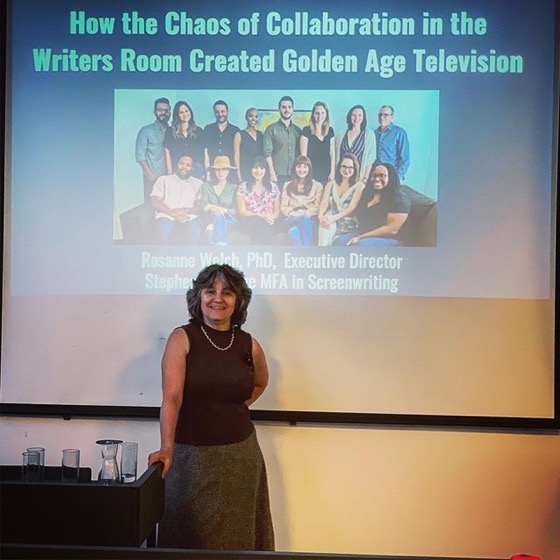
Screenwriting Research Network Conference, Porto, Portugal, All Sessions


Ready to present my talk yesterday at the Screenwriting Research Conference here in Porto, Portugal via Instagram

Follow me on Instagram


* A portion of each sale from Amazon.com directly supports our blogs
** Many of these books may be available from your local library. Check it out!

02 Inside The Writer’s Room from Worry and Wonder | The Courier Thirteen Podcast | Episode # 29 [Video]

Watch the entire presentation – Worry and Wonder | The Courier Thirteen Podcast | Episode # 29 here

02 Inside The Writer's Room from Worry and Wonder | The Courier Thirteen Podcast | Episode # 29 [Video]

Transcript:

I did. I did live in several writer’s rooms both as an assistant before I was a full-time writer and then as a writer, so i saw it in both ways through both perspectives. How are those perspectives different? When you’re an assistant, of course, you’re very wrapped up in I’ve got to get down everything they’re saying and make sure we know who told the funny joke or whose idea was the one we went forward with and you’re very focused but you’re also listening to how they banter ideas about and who gets paid attention to and how you learn how to run a room and it doesn’t just mean when you become the show running you’re going to run the room but when you’re pitching an idea, you are truly performing and making sure the other people in the room are focusing in on you. So I got to watch different people do that in their own different way.

Dr. Rosanne Welch is a television writer with credits that include Beverly Hills 90210, Picket Fences, ABCNEWS: Nightline and Touched by an Angel. She also teaches Television Writing and the Art of Film at San Jose State University.

Rosanne discusses what made shows like Beverly Hills 90210 compelling, what to do and not to do when attempting to pitch a show to broadcast or streaming, what most young writers neglect in their writing process, and much more!

The Courier Thirteen Podcast is available on YouTube, Spotify, Apple Podcasts, SoundCloud, and Audible.

Mentoris Project Podcast: Building Heaven’s Ceiling: A Novel Based on the Life of Filippo Brunelleschi with Author, Joe Cline [Audio]

Mentoris Project Podcast: Building Heaven's Ceiling: A Novel Based on the Life of Filippo Brunelleschi with Author, Joe Cline [Audio]

Listen Now

Subscribe Via iTunes | Google Play | TuneIn | RSS


His greatest accomplishment came after his greatest disappointment.

One of the founding fathers of the Renaissance, Filippo Brunelleschi was more than an Italian designer. Brunelleschi made his mark in architecture and construction.

In his early years, sculpting was Brunelleschi’s passion. But after being passed over for a major commission, he set his sights on architecture, and changed the landscape of Italy as it is known today.

Brunelleschi’s most prominent contribution, the dome of Cathedral of Santa Maria del Fiore, was the first of its kind, paving the way for bigger and more elaborate domes to come. His invention of machines to facilitate the construction of the dome allowed future structures to not only be imagined, but to be erected as well.

With his imagination, understanding of linear perspective, focus on geometric principles, and intellect for mathematics, Brunelleschi influenced the rise of modern science and architecture worldwide.


Follow @mentorisproject on Instagram

Visit the Mentoris Project for more!


Also from the Mentoris Project

Want to use these books in your classroom? Contact the Mentoris Project!`

28 Bruce Miller from There And Back Again: Writing and Developing for American TV [Video]

28 Bruce Miller from There And Back Again: Writing and Developing for American TV [Video]

Thanks to the gracious invitation from my Screenwriting Research Network colleague Paolo Russo – and a grant he was able to procure (and in the before-Covid time) I was able to spend a week at Oxford Brookes University working with the screenwriting masters students in Paolo’s course. At the culmination of the week, I gave this lecture on how writers rooms worked in the States.

Transcript:

Bruce Miller. He’s running The Handmaid’s Tale and there’s a whole lot of questions about that. He’s a guy and he’s running the handmaid’s tale, but he had the best take on the story. One of the things people will tell you in writing is to write what you know and you think that means write the experiences you’ve had but you can’t just write that or you’d be done right? So that’s where research comes in. So what do you actually know? What you know are the emotions you’ve had in your life. That’s what you know and anyone can recognize emotions of abandonment and fear and loneliness and all those things and bruce miller happened to come up with the best version of a pilot based on this novel of all the other people that they brought in.

Watch this entire presentation

Subscribe to Rosanne’s Channel and receive notice of each new video!


* A portion of each sale from Amazon.com directly supports our blogs
** Many of these books may be available from your local library. Check it out!
† Available from the LA Public Library

15 The Operation of a Writer’s Room Part 2 from How The Chaos Of Collaboration in the Writers Room Created Golden Age Television [Video]

With the full recording of “How The Chaos Of Collaboration in the Writers Room Created Golden Age Television”

15 The Operation of a Writer's Room Part 2 from How The Chaos Of Collaboration in the Writers Room Created Golden Age Television [Video]

Subscribe to Rosanne’s Channel and receive notice of each new video!


When the folks hosting the conference announced their theme as “Screen Narratives: Chaos and Order” the word ‘chaos’ immediately brought to mind writers rooms. I offered a quick history of writers rooms (the presentations are only 20 minutes long) and then quoted several current showrunners on how they compose their rooms and how they run them.

Transcript

…and she tells a lovely story about one scene in which she had two — this is, of course, about the pre— the days of the Czar — and so you have lovely rich people fencing. Two lovely young men having a fencing match — a practice — and at the end of it they take off their attire and they put on their nice shirts with the lace and they walk away. And the men in her writing room — the Russian men — said “well, the scene is over when we know who won the match,” and she said “No, this is a soap opera. The scene is over when the women see their chests.” So, she was teaching them what you need inside a soap opera. So they wanted a teaching writer’s room and that’s what she was able to provide.

For more information on the Screenwriting Research Network, visit

Screenwriting Research Network Conference, Porto, Portugal, All Sessions


Ready to present my talk yesterday at the Screenwriting Research Conference here in Porto, Portugal via Instagram

Follow me on Instagram


* A portion of each sale from Amazon.com directly supports our blogs
** Many of these books may be available from your local library. Check it out!

01 On Giving Notes from Worry and Wonder | The Courier Thirteen Podcast | Episode # 29 [Video]

Watch the entire presentation – Worry and Wonder | The Courier Thirteen Podcast | Episode # 29 here

01 On Giving Notes from Worry and Wonder | The Courier Thirteen Podcast | Episode # 29 [Video]

Transcript:

I always tell people you get hired to write on a television show. Look at them. They have eight episodes now or 12 maybe. You’re gonna write one and you’re going to have to give good notes on the other 10 or 11 for people who want you to stick around. It’s your job to make their work better so the show doesn’t get canceled and you don’t keep your job. So notes are one of the most important things to understand how to do.

Dr. Rosanne Welch is a television writer with credits that include Beverly Hills 90210, Picket Fences, ABCNEWS: Nightline and Touched by an Angel. She also teaches Television Writing and the Art of Film at San Jose State University.

Rosanne discusses what made shows like Beverly Hills 90210 compelling, what to do and not to do when attempting to pitch a show to broadcast or streaming, what most young writers neglect in their writing process, and much more!

The Courier Thirteen Podcast is available on YouTube, Spotify, Apple Podcasts, SoundCloud, and Audible.

Dr. Rosanne Welch Talks Worry and Wonder in Screenwriting on the Courier 13 Podcast [Audio] [Video]

It’s always fun to sit down with students and share stories about entering the television industry and how things work at all stages and I had that opportunity the other day. 

Daniela Torres, a just-graduated (Congratulations!) student of the Columbia College Semester in LA program asked me to guest on a podcast she had recently begun hosting with another college student she met during her internship (good example of networking in action!). 

We could have talked all morning (the benefit of a 3 hour class session) but we held it to about an hour and fifteen minutes or so.  Hopefully, along the way I answered some questions you might have about how the business works.  So often it amounts to working hard at being a better writer and gathering a group of other talented, hard-working people around you so you can all rise together.

Dr. Rosanne Welch


Dr. Rosanne Welch Talks Worry and Wonder in Screenwriting on the Courier 13 Podcast [Audio] [Video]

Courier 13 podcast

Listen to the audio version of this podcast

Dr. Rosanne Welch is a television writer with credits that include Beverly Hills 90210, Picket Fences, ABCNEWS: Nightline and Touched by an Angel. She also teaches Television Writing and the Art of Film at San Jose State University.

Rosanne discusses what made shows like Beverly Hills 90210 compelling, what to do and not to do when attempting to pitch a show to broadcast or streaming, what most young writers neglect in their writing process, and much more!

The Courier Thirteen Podcast is available on YouTube, Spotify, Apple Podcasts, SoundCloud, and Audible.